Vineyards on a lake shore, three hours from the Jungfrau
Lavaux sits on the far side of the country from Interlaken, on the northern shore of Lake Geneva between Lausanne and Montreux. It is not a natural add-on to a Bernese Oberland itinerary the way Gruyères or Bern can be, and the journey needs a full day on its own rather than a squeeze between mountain trips.
What is there is a genuinely different landscape from the peaks and lakes around Interlaken: roughly 800 hectares of vines built into stone terraces on slopes so steep that most of the work is still done by hand, with the water of Lake Geneva reflecting the light back up into the rows. UNESCO listed the terraces as a World Heritage Site in 2007, for the combination of scenery and a farming method that has barely changed in centuries.
Getting here from Interlaken Ost takes about three hours whichever route is used. One option runs via Bern and Lausanne on ordinary InterCity trains, changing once or twice depending on the connection. The more scenic option is the GoldenPass Line, which runs from Zweisimmen down to Montreux through the Simmental and gives good views of the Vaud Alps before dropping to the lake.
From Montreux, local trains reach Vevey in under ten minutes, and the Lavaux villages are a further ten to twenty minutes beyond that. A Swiss Travel Pass covers all of it; without one, the return fare from Interlaken adds up to a meaningful part of the day’s budget, so it is worth checking pass options before booking anything else.
Given the distance, most visitors treat Lavaux and Vevey as a single long day: an early train out, several hours split between the vineyard path and Vevey’s museums, and a return train that gets back to Interlaken in the evening. An overnight in Vevey or one of the wine villages turns it into something calmer, with time for an evening cellar visit and a slow walk the next morning before the trains back start filling with commuters.
The UNESCO terraces: how they got here
The terracing was not decorative. Monks from the Cistercian abbey of Montheron and later the Benedictines began walling the slopes above the lake in the eleventh century, cutting flat strips into ground too steep to plant otherwise and building drystone retaining walls that in places rise several metres. The lake below acts as a heat reservoir, reflecting sunlight back onto the vines and moderating frost, which is why grapes ripen here at a latitude where they would otherwise struggle. The dominant grape is Chasselas, a white variety that produces light, mineral wines that rarely leave Switzerland — production is small and mostly drunk within the country, which is part of why Swiss wine is unfamiliar outside it.
The terraces run in an almost unbroken band for about 30 kilometres, through a string of villages that keep their own character: Lutry, Cully, Riex, Épesses, Rivaz, Saint-Saphorin and Chexbres, roughly west to east. None of them is large — most have a few hundred to a couple of thousand residents — and none has grown into a resort town, which keeps the vineyards working land rather than a backdrop. The lakeside railway line between Lausanne and Montreux runs along the upper edge of the terraces with stops at several of these villages, which is what makes the area practical to visit without a car: walk one stretch, catch a train back or onward, repeat.
Walking the vineyard path: Chexbres to Lutry
The waymarked Sentier du Lavaux (Lavaux vineyard path) runs the full length of the terraces from Lutry to Chexbres, a distance of around 11 kilometres that takes three to four hours at an unhurried pace with stops. It follows small lanes and gravel tracks between the vine rows, close enough to reach out and touch the plants, with the lake almost always visible below and the outline of the French Alps often visible across the water on a clear day. The path has no significant climbing in any one section — a few short, steep connections between terrace levels — but it is not flat either; expect a couple of hundred metres of ascent and descent spread across the whole route.
Few visitors walk the entire distance. The most rewarding central section runs from Rivaz to Cully, about 5 kilometres and 90 minutes to two hours, passing through Saint-Saphorin, one of the best-preserved of the wine villages, with a cluster of stone houses and cellar doors right on the lane. Because the railway stops at nearly every village along the route, it is straightforward to walk one stretch and take a train back to the start, or to walk in one direction and catch a boat back from Cully or Lutry rather than retracing the path. There is very little shade on most of the terraces, so a hot midsummer afternoon is not the best time to do it; late morning or early evening light is more comfortable and better for photographs.
| Section | Distance | Time | Notes |
|---|---|---|---|
| Chexbres to Rivaz | ~2.5 km | 45-60 min | Steepest terraces, best views down to the lake |
| Rivaz to Saint-Saphorin | ~1.5 km | 30 min | Passes several open cellar doors |
| Saint-Saphorin to Cully | ~2 km | 45 min | Flattest stretch, good for a short visit |
| Cully to Lutry | ~4 km | 1-1.5 hours | Closer to Lausanne, busier near Lutry |
Tasting in the caves: how open cellars work
Along the path, small hand-painted signs marked “Caves Ouvertes” or simply a bunch of grapes indicate cellar doors where a grower will pour a taste of that year’s wine, usually for a small fee or the expectation of a purchase. This is informal and depends on who happens to be around; it is not a system of scheduled tastings with fixed hours.
The formal version is the Caves Ouvertes Lavaux weekend, held over one weekend at the end of May each year, when growers across all the wine villages open their cellars together, sell tasting glasses at a central point, and the trains and paths get considerably busier than on an ordinary day. Outside that weekend, several producers in Rivaz, Saint-Saphorin and Cully keep more regular tasting rooms open through the summer and early autumn, generally in the afternoon.
A guided option removes the guesswork of finding an open door and adds context on the grape varieties and the terracing itself. A guided wine tour through the Lavaux vineyards typically includes stops at two or three cellars with a local guide explaining the terracing and the Chasselas grape, which is a reasonable way to taste properly without needing to speak French or knock on unfamiliar doors.
Vevey: a working lakeside town, not a resort
Vevey sits at the eastern end of the Lavaux terraces, on the lake shore, and functions as a proper town rather than a tourist stop — it is the headquarters of Nestlé, and the working economy shows in a way it does not in more overtly touristic lakeside towns. The old town is compact: a market square (Grande Place) that hosts a market on Tuesday and Saturday mornings, a scatter of restored merchant houses, and a promenade along the lake shore with views across to the French shore and, on clear days, Mont Blanc in the distance.
The main sight for most visitors is the Alimentarium, a museum devoted to food, run with Nestlé backing but broader than a corporate showcase — it covers cooking, digestion, farming and food culture through hands-on exhibits, and works well for families since much of it is interactive rather than glass-case displays. Outside, a giant fork sculpture stands in the lake just off the promenade, a well-known local landmark and a popular photo spot regardless of whether the museum itself is on the agenda.
Vevey is also the base for the Fête des Vignerons, the Winegrowers’ Festival, a UNESCO-recognised event held only every few decades — the last was in 2019 — that turns the whole town into a stage for parades and performances celebrating the winegrowing year. It is not something to plan around unless the dates happen to align; between festivals, Vevey is a quieter, everyday sort of town.
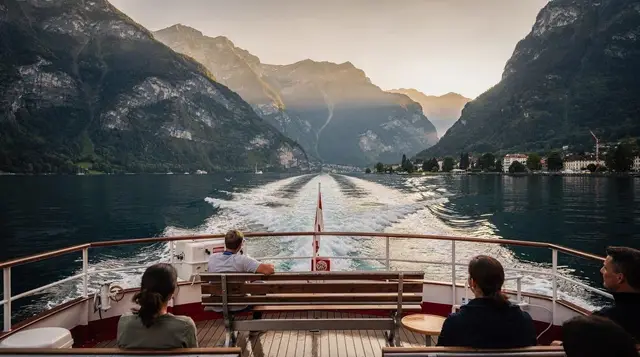
Boat trips on Lake Geneva depart from Vevey’s harbour, run by the CGN paddle steamer company, and are a relaxed way to see the shoreline and the vineyards from the water rather than on foot. A two-hour cruise along the Riviera shoreline from Vevey covers Montreux and the vineyards without needing to plan a walking route, and a longer option, a three-hour cruise from Lausanne through the Riviera and Lavaux region, extends further along the shore for those based nearer Lausanne.
Chaplin’s World
Just above Vevey, in the suburb of Corsier-sur-Vevey, stands the Manoir de Ban, the house where Charlie Chaplin lived with his family from 1953 until his death in 1977, having left the United States during the McCarthy era. The property opened to the public in 2016 as Chaplin’s World, combining a tour of the restored house and gardens with a separate studio building recreating film sets and props from his career. It is a thorough, well-produced museum rather than a quick photo stop, and a full visit takes two to three hours.
It is also one of the more expensive single attractions in the region: adult admission runs upwards of CHF 29, with family tickets available, and it is worth checking current prices before visiting since they have risen steadily since opening. For anyone travelling from further afield, a packaged day trip removes the need to work out local buses from Vevey station up to Corsier — a day trip from Zürich combining Chillon Castle, Glacier 3000 and the Lavaux vineyards covers a lot of ground for visitors based in German-speaking Switzerland, though it does not include Chaplin’s World itself and moves at a fast pace given how much it packs in.
Getting around once you are there
The lakeside railway line (Lausanne–Vevey–Montreux) is the backbone of a Lavaux visit, with trains roughly every 15 to 30 minutes and short hops between villages taking only a few minutes each. A regional day pass or the Swiss Travel Pass covers unlimited travel on this line for the day, which matters if the plan involves walking one section and training between others. CGN lake boats connect Vevey, Lausanne, Montreux and Lutry on a slower but scenic schedule, useful for turning a linear walk into a loop.
For those combining Lavaux with the wider Lake Geneva shore, a day trip from Montreux up to Glacier 3000 pairs the vineyards below with a very different, high-altitude landscape above Les Diablerets, though it adds a long day given the transfer times involved. Travellers coming specifically from the Bernese Oberland side sometimes combine the trip with Bern itself: a day trip from Bern taking in Lavaux, Sion and an underground lake in the gorges strings together several very different stops in one long day, which suits visitors trying to cover distance efficiently rather than linger in any one place.
For orientation once in Vevey itself, a guided walking tour of Vevey covering its lesser-known corners and local stories is a good way to get context on the town beyond the Alimentarium and the giant fork, with a local guide pointing out details a self-guided wander would miss.
What a day actually costs
Public transport from Interlaken and back is the largest fixed cost if travelling without a Swiss Travel Pass; food and one attraction typically make up the rest. A rough budget for a day focused on the vineyard path and a coffee or light lunch in a village runs towards the lower end; adding Chaplin’s World or a boat cruise pushes it up.
| Item | Approximate cost (CHF) |
|---|---|
| Return train, Interlaken to Vevey area | 90-130 without a pass |
| Light lunch or bakery stop in a wine village | 15-25 |
| Cellar door tasting (informal) | 5-15 per glass |
| Alimentarium entry | 15-20 |
| Chaplin’s World entry | 29 and up |
| Lake Geneva boat cruise (2 hours) | 30-45 |
Common mistakes
The most frequent one is underestimating the travel time and trying to fit Lavaux into the same day as a mountain excursion from Interlaken — the three-hour journey each way makes that impractical, and it is better treated as its own day, ideally with an overnight if time allows. The second is arriving without checking which cellars are actually open; outside the Caves Ouvertes weekend at the end of May, many doors along the path are closed on weekdays, and turning up expecting a tasting at every stop leads to disappointment. The third is booking Chaplin’s World without checking current opening days, since the site closes for maintenance periods that are not always obvious from a quick search.
Frequently asked questions about Lavaux and Vevey
How far is Lavaux from Interlaken?
Around three hours by train, either via Bern and Lausanne on regular InterCity services or via Zweisimmen and Montreux on the GoldenPass Line, which adds scenery but not much time saving.
Is the Lavaux vineyard path difficult?
No technical difficulty, but it is not flat — expect short, steep connections between terrace levels and little shade. The full Lutry to Chexbres route takes three to four hours; shorter sections between villages take under an hour each.
When are the Lavaux cellars open for tasting?
Some producers keep afternoon tasting rooms open through summer and early autumn, but the reliable option is the Caves Ouvertes Lavaux weekend at the end of May, when growers across all the villages open together.
Is Chaplin’s World worth the entry price?
It is a well-produced museum with two to three hours of content, but adult admission is upwards of CHF 29, among the pricier single attractions in the region, so it suits visitors genuinely interested in Chaplin’s life and films rather than a casual stop.
Can Lavaux be combined with Montreux or Gruyères in one day from Interlaken?
Combining it with Montreux is straightforward since the two are ten minutes apart by train. Adding Gruyères as well makes for a very long day given the total travel time from Interlaken; most visitors choose one or the other rather than both.
Do I need a car to visit Lavaux?
No — the lakeside railway line stops at nearly every wine village, and CGN boats provide an alternative route along the shore, which is why most visitors leave the car behind entirely.
What is the best time of year to see the Lavaux terraces?
April to October generally, with the vines green through summer and turning red and gold in late September and October during harvest, which many consider the most photogenic period.