A city stacked on three hills above the lake
Most Swiss towns sit either on flat ground or climb a single slope. Lausanne does neither: the old town occupies a ridge between two river valleys that have long since been built over and paved, so the streets rise and fall in a way that catches out anyone expecting the lakeside flatness of nearby Montreux. Walk from the cathedral to the port of Ouchy and you drop just over 100 metres in about 2 kilometres, which is why the city built one of the steepest metro lines in Europe rather than expect people to do it twice a day on foot.
Lausanne is the capital of the canton of Vaud and, at around 140,000 residents in the city itself and close to 420,000 in the wider agglomeration, the fourth-largest city in Switzerland after Zurich, Geneva and Basel. It is also the seat of the International Olympic Committee, which is the reason a small lakeside city carries a museum with the scale and budget of a national institution. None of this is on the way to anywhere in the Bernese Oberland: getting here from Interlaken means a deliberate day trip, not a stopover.
Getting from Interlaken to Lausanne
The direct route runs west through Bern rather than around the lake through Montreux. From Interlaken Ost, trains to Bern take about 52 minutes; from Bern, InterCity services to Lausanne take roughly 1 h 10, running via Fribourg. Connections at Bern are frequent enough on the hourly IC pattern that total journey time comes out around 2 h 10 each way, so 4 h 20 on trains for the round trip before any sightseeing.
A Swiss Travel Pass covers the whole route, as does a Half Fare Card combined with point-to-point tickets; check current fares before travelling, since full-price second-class one-way tickets from Interlaken to Lausanne run to around CHF 65-70 without a discount card. Seat reservations are not required on domestic IC trains. For the practicalities of passes and which one suits a Bernese Oberland base, see the Swiss Travel Pass guide; for the wider question of how to combine trains, buses and boats around the region, the transport overview is the place to start.
Lausanne’s main station, Lausanne CFF, sits below the old town; the cathedral and Flon are an uphill walk or a short metro ride away, and Ouchy is a further stop down.
Notre-Dame Cathedral and the last night watch in Switzerland
Lausanne Cathedral is the largest Gothic building in Switzerland, consecrated in 1275 in the presence of Pope Gregory X and Holy Roman Emperor Rudolf of Habsburg. The west front’s rose window, painted glass from the 13th century, and the carved Painted Portal on the south side survived the Reformation’s iconoclasm largely intact, which is unusual for a Swiss church converted to Protestant use in 1536 — most others were stripped bare.
The building’s other distinction is less architectural than civic: since 1405, a night watchman (the guet) has climbed the tower every night to call the hours between 10pm and 2am, announcing that the hour has struck and all is well. It survived the introduction of mechanical clocks, two world wars and the near-total disappearance of the profession elsewhere in Europe, and it is still done by a rostered watchman today rather than a recording. Climbing the 224 steps of the tower during the day (small entry fee, roughly CHF 5) gives a view across the lake to the French Alps on a clear day, and over the old town’s roofline the rest of the time.
The square in front of the cathedral, the Esplanade de la Cathédrale, is reached by the covered wooden staircase known as the Escaliers du Marché, one of the few surviving pieces of the city’s medieval street furniture.
Down to Ouchy: from cargo port to lakefront promenade
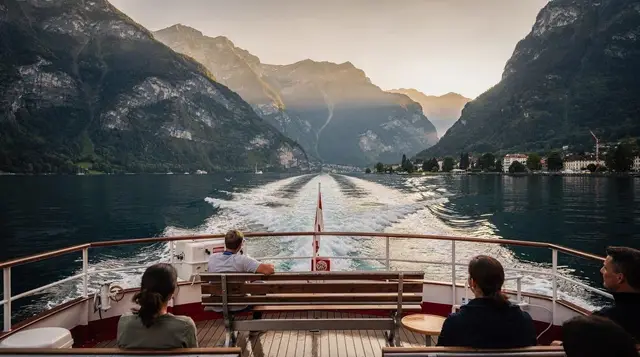
Ouchy was a working harbour into the 20th century, handling freight and passengers on Lake Geneva before the railway and then the motorway took over most of that traffic. What is left is a long lakefront promenade, a rebuilt medieval-style château (now a hotel, not open to casual visitors beyond its restaurant and bar), and the CGN paddle-steamer and boat network that still runs scheduled services along the lake to Montreux, Vevey and across to Évian and Thonon on the French shore. For the older Lake Geneva boats specifically, see the Lavaux and Oberland wine guide, which covers the vineyard terraces visible from the water between Lausanne and Montreux.
Ouchy is also where the Olympic Museum sits, in gardens running along the water, a five-minute walk from the metro terminus. The building was extended and reopened in 2013 after a major renovation, and now covers the modern history of the Games across three floors: the torch relay collection, medals from every edition since 1896, and an Olympic Studies Centre for anyone doing serious research. Standard adult admission is CHF 24, with reduced rates for students, over-65s and children aged 10 and up (under-10s free); the Swiss Travel Pass and Lausanne’s own visitor card both cover entry. Two hours is a reasonable minimum if the exhibits interest you at all; committed sports history readers can lose half a day here.
Between the museum and the château, the lakefront gardens are a genuinely pleasant place to sit with a takeaway coffee and watch the CGN boats come in, something Interlaken’s own two lakes don’t offer in quite the same urban-park form — for a comparison of the two, see the Lake Thun versus Lake Brienz pages, or simply note that Lake Geneva is roughly ten times the surface area of either.
The steepest metro in Europe
Lausanne’s m2 line opened in 2008, replacing an older funicular, and its rubber-tyred, driverless trains climb a maximum gradient of around 12% — the steepest full metro line in Europe, and one of the steepest anywhere. It runs from Ouchy on the lake up through the old town and Flon to the eastern suburb of Épalinges, a vertical rise of roughly 340 metres over the full line, with the touristically relevant Ouchy-to-Flon-to-cathedral stretch covering about 100 metres of that in under ten minutes.
It is a genuinely useful piece of transport rather than a novelty: locals use it to commute up and down the hill, and it runs frequently enough (every few minutes at peak times) that visitors rarely wait more than five minutes. A single ticket from the local transport authority (TL) costs around CHF 3.40 for a short zone hop; day passes are better value if you are moving between the cathedral, Flon and Ouchy more than twice. A Swiss Travel Pass does not automatically cover city transport in Lausanne, so check before assuming it is included.
Flon: from freight yard to the city’s evening quarter
Flon sits at the bottom of the old town’s slope, in the valley the m2 now tunnels and bridges through. Into the 1980s it was Lausanne’s warehouse and rail-freight district, a working zone of brick storage buildings that most residents had no reason to visit. A long redevelopment converted the same buildings into cinemas, bars, independent boutiques and offices without demolishing the original industrial shells, so the district still reads as a warehouse quarter rather than a shopping mall built to look like one.
It is the natural place to eat in the evening if staying over, and the only part of central Lausanne that stays lively much past 10pm; the old town above empties out considerably once the shops close. Flon connects to the upper town by the metro, by a network of outdoor escalators and lifts, and by stepped streets for anyone who wants the exercise.
What a day in Lausanne actually costs
| Item | Typical cost (CHF) |
|---|---|
| Return train, Interlaken–Lausanne (no discount) | 130-140 |
| Olympic Museum, adult entry | 24 |
| Cathedral tower climb | 5 |
| Coffee and pastry, Ouchy lakefront café | 9-12 |
| Sit-down lunch, main course | 28-38 |
| Metro day pass (TL) | 9.60 |
| CGN short lake cruise, Ouchy | 20-35 |
A day covering the cathedral, the Olympic Museum and a coffee on the Ouchy front, without a boat trip, comes to roughly CHF 120-150 including the train, before any shopping in Flon. That is broadly in line with a day in Bern’s old town or Lucerne, and cheaper than most days built around a Jungfrau region mountain excursion.
Is Lausanne better paired with Montreux or Gruyères?
Lausanne, Montreux and Gruyères sit within roughly an hour of each other by train, which tempts people into trying to see two or three in a single day from Interlaken. The arithmetic rarely works in the visitor’s favour: Interlaken to Lausanne alone is 2 h 10 each way, so adding Montreux (about 20 minutes further from Lausanne) or a branch line up to Gruyères pushes total travel time past 6 hours before any sightseeing.
If the appeal is specifically the Olympic Museum, the cathedral and the m2, do Lausanne on its own. If the appeal is broader Lake Geneva scenery — vineyard terraces, the Château de Chillon, cheese and chocolate — Montreux or Gruyères individually make a more relaxed day, covered in the Montreux and Chillon day trip guide and the Gruyères and Broc day trip guide.
A small number of guided day tours run from the Lake Geneva side combining Lausanne with Gruyères in one itinerary; for anyone based in Lausanne rather than Interlaken, a day tour from Lausanne to Gruyères with chocolate and cheese tasting covers both towns without the logistics of working out branch-line connections independently.
Travellers building a longer loop that already includes the Lake Geneva shore, such as the seven-day Grand Tour of Switzerland from Interlaken, get more value out of Lausanne than someone doing a single dedicated day trip, since the train time is then absorbed into a travel day rather than added on top of a return journey.
Beyond the obvious three sights
Lausanne has more than the cathedral, the museum and the metro, though most day-trippers from Interlaken will not have time for it. The Palais de Rumine on Place de la Riponne houses several of the city’s museums (fine arts, geology, zoology) under one Florentine-revival roof, free or low-cost depending on the collection. The Sauvabelin forest and tower, a 20-minute uphill walk or a bus ride from the centre, gives a 35-metre wooden lookout tower with views back over the city and lake, and is one of the few green, quiet spots within city limits.
For anyone with an extra hour and an interest in the lake rather than the city, a short CGN cruise from Ouchy is the easiest way to see the Lavaux vineyard terraces (a UNESCO World Heritage site) from the water without committing to a full Vevey or Montreux day. Vevey itself, a 20-minute train ride along the shore, has its own lakefront and a walking tour worth a look if extending the day: a two-hour Riviera cruise from Vevey covers a stretch of shoreline that the Lausanne-Ouchy boats don’t reach on their shorter routes.
Common mistakes
Underestimating the round-trip travel time is the biggest one: 4 h 20 on trains from Interlaken leaves less daylight for Lausanne itself than people expect, especially outside midsummer. Trying to add Montreux, Gruyères or Fribourg to the same day usually means seeing all of them too briefly to justify the effort — pick one add-on at most, or none.
The second mistake is assuming the old town and the lakefront are close together in the way they look on a simple city map. They are close in distance but not in effort: the climb back up from Ouchy to the cathedral after a lakeside lunch is a genuine uphill walk, and taking the m2 one way is not a failure of fitness, it’s how the city itself is designed to be used.
Finally, arriving without checking Olympic Museum opening hours costs people the whole point of the trip: it closes on Mondays outside the main summer season, so a Monday day trip built around it needs a different anchor, such as the cathedral tower and Flon, or the CGN lake cruise instead.
Lausanne questions, answered
How do you get from Interlaken to Lausanne?
The direct route runs via Bern: roughly 52 minutes Interlaken Ost to Bern, then about 1 h 10 to Lausanne, with a same-platform or short connection most hours. Total journey time is around 2 h 10, so budget 4 h 20 for the round trip alone.
Is Lausanne walkable, or do you need the metro?
The old town, cathedral and Flon are walkable from each other in 10-15 minutes, but the drop to Ouchy is around 100 metres of elevation. Most visitors take the m2 metro one way and walk the other.
What is the Lausanne night watch?
A guet has called the hours from Lausanne Cathedral’s tower every night since 1405, currently between 10pm and 2am, shouting that the hour has struck and all is well. It is one of the last surviving traditions of its kind in Europe and can be heard from the square below.
How much does the Olympic Museum cost?
Standard adult admission is CHF 24, with reductions for students, seniors and children; the Swiss Travel Pass and Lausanne city pass both cover it. Budget at least two hours inside.
Is the Lausanne metro really the steepest in Europe?
The m2 line’s rubber-tyred trains climb a maximum gradient of around 12%, the steepest of any full metro system in Europe, covering roughly 100 metres of vertical rise between Ouchy and the upper town in under 15 minutes.
Can you see Lausanne and Montreux in one day from Interlaken?
It is possible but tight: the two towns are only around 20 minutes apart by train, but combining both from Interlaken means over 4 hours on trains in a single day, leaving only a few hours for sightseeing. Most people pick one.
What is the Flon district in Lausanne?
Flon was the city’s warehouse and rail-freight quarter until the 1980s; the brick buildings now hold cinemas, bars, independent shops and restaurants, and it sits directly below the old town, linked by the metro and by steps and lifts.
Is there a good hot-air balloon or fondue experience near Lausanne?
For something outside the standard sightseeing route, a hot-air balloon flight over the region with a fondue included departs from around Lausanne on suitable-weather mornings; it depends on wind and visibility, so treat it as a bonus rather than the anchor of a tightly timed day trip from Interlaken.