Trains, buses and boats around Interlaken
Should I use Interlaken Ost or Interlaken West station?
Use Interlaken Ost for Jungfrau region trains to Lauterbrunnen, Grindelwald, Wengen and Mürren, and for Lake Brienz boats. Use Interlaken West, closer to the Hoheweg and central hotels, for Lake Thun boats and the PostAuto stop outside the station. Mixing the two up is the most common way to miss a connection.
The two stations, and why they matter
Interlaken has two mainline stations roughly 2 km apart, and getting them mixed up is the single easiest way to miss a train in this town. Interlaken Ost, at the eastern end near the Brienz lakeshore, is the departure point for almost everything heading into the mountains: trains to Lauterbrunnen and on to Wengen and Mürren, trains to Grindelwald and the Eiger Express terminal, the Brünig line towards Lucerne, and the boats on Lake Brienz. Interlaken West, closer to the Hoheweg and the big lakeside hotels, is the stop for Lake Thun boats and for most regional PostAuto routes heading around the Bodeli towards Beatenberg and the Lake Thun villages.
The two stations are linked by a four-minute train ride (part of the same S-Bahn line) or a flat 15 to 20-minute walk along Bahnhofstrasse and the Höheweg, passing the Hohematte meadow. If your hotel confirmation or a tour voucher just says “Interlaken station” without specifying which one, check the departure board rather than guessing — this catches more visitors out than any hill or altitude.
| Station | What leaves from here | Nearest to |
|---|---|---|
| Interlaken Ost | Lauterbrunnen, Wengen, Mürren, Grindelwald, Jungfraujoch trains; Brünig line to Lucerne; Lake Brienz boats | Ostbahnhof area, budget hostels, Lake Brienz shore |
| Interlaken West | Lake Thun boats; PostAuto routes to Beatenberg, Sigriswil, Merligen; regional trains to Spiez and Bern | Hoheweg, Hohematte, central hotels, casino |
PostAuto: the bus network that fills the gaps
Where the railways stop, Switzerland’s yellow PostAuto buses take over, and they run to the same clockface logic: departures at a fixed number of minutes past the hour, timed to meet the trains and boats they connect with rather than running on their own schedule. From Interlaken, PostAuto routes reach villages that have no station at all, including Beatenberg above Lake Thun, Sigriswil and Merligen on the same shore, and the smaller side valleys around Adelboden and Kandersteg further afield.
You board through any door. If you already hold a valid ticket, pass, or the local guest card, that’s it — no separate validation is needed on most routes. If not, tell the driver your destination and pay by contactless card (now standard on the newer fleet) or cash. Buses can fill up on the school run and at peak commuter times in the early morning and late afternoon, but tourist-heavy routes to viewpoints rarely do outside July and August.
Note the seasonal caveat that applies to almost every route into the hills: when mountain railways open and close for spring and autumn maintenance, some PostAuto routes serving those same lifts are cut back or suspended too, since there’s less reason to run a bus to a closed cable car station.
Boats: the slow, scenic alternative
Interlaken sits directly between two lakes, and both are genuinely part of the transport network, not just a scenic extra. The Lake Thun boat trips run from Interlaken West to Spiez, Thun, and the villages of Oberhofen and Hilterfingen along the northern shore; the Lake Brienz boat trips run from Interlaken Ost to Iseltwald, Giessbach and the town of Brienz at the far end. Both operate on the same integrated ticketing as the trains and buses, so a Swiss Travel Pass or a point-to-point rail ticket that includes the relevant lake segment covers you without a separate fare.
Boats are slower than the parallel bus or train — Interlaken to Thun by boat takes around two hours against 25 minutes by train — so they work best as the scenic option for a half-day rather than a fast way to get somewhere. The two lakes cruise guide covers combining both lakes in one day if you want the boats as the main activity rather than incidental transport. For a slower, self-directed way to cover the same shoreline, an e-bike route out to Iseltwald and the Giessbach falls follows much of the same Lake Brienz shore the boats do, at your own pace and with stops the timetable doesn’t allow.
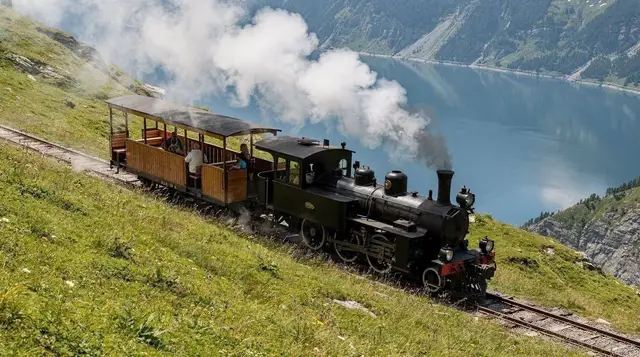
Some paddle steamers on both lakes are historic vessels rather than modern catamarans; timings can run a little longer and departures are less frequent outside the May to September season. Check the current timetable before planning a tight connection around one, especially in shoulder season.
How the timed connections actually work
Switzerland runs on an integrated clockface timetable (Taktfahrplan): trains, buses and boats are scheduled to arrive at hub stations a few minutes before their connections leave, and to depart at the same minute past the hour on every repeated cycle. In practice this means a train from Interlaken Ost to Lauterbrunnen leaving at, say, :06 and :36 past most hours, met at Lauterbrunnen by a connecting train up to Wengen or the Kleine Scheidegg line within a handful of minutes, not by luck but by design.
This system is genuinely reliable, which is why Swiss punctuality is not a myth as a piece of received wisdom — delays of more than a few minutes are unusual enough to be noteworthy. It does mean the reverse is also true: if you’re five minutes late for a connecting train, the next one may be 30 or 60 minutes away rather than a short walk down the platform. Build in slack on the day you’re catching an early train to the Jungfraujoch or the Schilthorn, where a missed first connection can cost you a chunk of an expensive ticket’s usable daylight.
| Route from Interlaken Ost | Approx. journey time | Typical frequency |
|---|---|---|
| Lauterbrunnen | 20 minutes | Every 30 minutes |
| Grindelwald | 35 minutes | Every 30 minutes |
| Wengen (via Lauterbrunnen) | 45 minutes | Every 30 minutes |
| Mürren (via Lauterbrunnen, cable car + train) | About 1 hour | Every 30 to 60 minutes |
| Thun | 25 minutes | Every 15 to 30 minutes |
| Bern | 52 minutes | Every 30 minutes |
| Lucerne (via Brünig line) | 1 hour 50 | Hourly |
| Zurich | 2 hours 5 | Hourly |
Tickets, passes and the SBB app
For a single point-to-point journey, buy a ticket at the station machine, over the SBB Mobile app, or (with a small on-board surcharge) from the conductor. The app is worth installing before you arrive: it shows live departures from both Interlaken stations, plots the platform you need, and lets you buy and store tickets and passes without a data connection once downloaded.
For a multi-day trip, weigh up the options rather than defaulting to the best-known one. The Swiss Travel Pass gives unlimited travel on trains, buses and boats nationwide, including both Interlaken lakes, but only a 25 to 50 percent discount on most mountain lifts — the Jungfraujoch, Schilthorn and Grindelwald First are not included at full value.
The Berner Oberland Pass and Jungfrau Travel Pass are regional alternatives scaled to this area specifically, and can work out cheaper if your trip is built around two or three big mountain days rather than long-distance travel to Zurich, Geneva or Lucerne. If you’re arriving from further afield, an organised transfer from Geneva or an arranged day trip from Lucerne can be simpler than piecing together the rail legs yourself, especially with luggage.
Interlaken’s own guest card, issued by most hotels and some campsites on arrival, covers local transport within the Bodeli area — buses and trains between Interlaken, Unterseen, Matten, Bönigen and Wilderswil — at no extra cost for the length of your stay. It doesn’t extend to Lauterbrunnen, Grindelwald or the lake boats, so don’t rely on it for a full mountain day.
| Pass | Covers | Best for |
|---|---|---|
| Swiss Travel Pass | Nationwide trains, buses, boats; partial discount on mountain lifts | Trips combining Interlaken with Zurich, Lucerne, Geneva or Bern |
| Berner Oberland Pass | Regional network plus better mountain lift rates | Trips focused on two or more big mountain excursions |
| Interlaken guest card | Local Bodeli buses and trains only | Short stays not leaving the immediate Interlaken area |
| Half Fare Card | 50% off standard fares nationwide, no free travel | Independent travellers buying tickets as they go |
Luggage, lockers and moving between stations
If you’re doing a day trip and don’t want to carry bags up a mountain, both Interlaken Ost and Interlaken West have coin-and-card lockers in a few sizes; Ost also has a staffed baggage counter that can hold larger items for longer. Since most mountain-bound trains start at Ost, that’s the more useful station for storage if your day involves the Jungfraujoch, Grindelwald First or the Lauterbrunnen valley. Full sizes, prices and opening hours are in the dedicated luggage and lockers guide.
Switzerland’s SBB CFF FFS also runs a station-to-station luggage forwarding service in some cases, useful if you’re moving on to a different Swiss town rather than returning to Interlaken the same evening. It needs to be arranged the day before, so it suits a planned itinerary rather than a spontaneous one.
Getting here in the first place, and getting around once you’ve arrived
Most visitors arrive by train rather than by air, since there’s no airport in Interlaken itself. If you’re flying in, the guide to reaching Interlaken from Zurich Airport and the route from Geneva Airport cover the direct rail options, both of which land you at Interlaken Ost.
Once you’re based here, the town itself is genuinely walkable — the Hoheweg, the Hohematte and both stations are within a 20-minute walk of most central hotels — so day-to-day movement rarely needs transport at all. It’s the excursions that require plotting: a hike, cable car and return train to somewhere like Kandersteg and Oeschinensee or a loop through Thun and back along the lake shore.
For getting between the sights close to the water at your own pace rather than to a bus timetable, an e-bike rental for the day covers roughly the same ground as the Lake Thun and Lake Brienz shore roads without waiting on a schedule at all. For the fuller picture of what a longer stay looks like logistically, see how many days in Interlaken and the day trips from Interlaken roundup, which notes which excursions genuinely need a car-free plan and which don’t.
Frequently asked questions about getting around Interlaken
What is the difference between Interlaken Ost and Interlaken West?
Interlaken Ost, at the eastern edge of town, is the hub for Jungfrau region trains (Lauterbrunnen, Wengen, Grindelwald, Mürren via Lauterbrunnen), the Brünig line to Lucerne, and Lake Brienz boats. Interlaken West sits closer to the Hoheweg and the main hotel strip, and is the stop for Lake Thun boats and most PostAuto routes into the surrounding villages. The two stations are about 2 km apart, roughly 15 minutes on foot or four minutes by train.
Do I need to book train tickets in advance in the Jungfrau region?
No. Swiss trains and the Jungfrau railways sell tickets right up to departure at station machines, over the SBB Mobile app, or on board (with a small surcharge). Booking ahead only matters for the panoramic GoldenPass Express and Glacier Express, which have limited seats and reserved seating.
Is the Swiss Travel Pass worth it for a trip based in Interlaken?
It depends on how many mountain excursions you plan. The pass covers trains, buses and boats fully, including the two lakes, but only gives 25 to 50 percent off the Jungfraujoch, Schilthorn, Grindelwald First and most other mountain lifts, which are excluded from full coverage. Add up your planned journeys against the pass price before buying; for a trip built mostly around one or two big mountain days, the regional Berner Oberland Pass is often cheaper.
How do PostAuto buses work, and do I need cash?
PostAuto is Switzerland’s yellow-liveried regional bus network, run to the same clockface schedule as the trains and covered by the same passes. You board through any door, and if you don’t already hold a valid ticket or pass, tell the driver your stop and pay by card or cash; contactless card payment is now standard on most vehicles.
Can I use the same ticket for trains, buses and boats?
Yes. Point-to-point tickets, the Swiss Travel Pass, the Berner Oberland Pass and Interlaken’s hotel guest card all cover the local rail, PostAuto bus and boat network as one system. You buy or validate once and transfer freely between the three, as long as your ticket covers the zones or route involved.
What happens if I miss a connection?
On the core network it is rare, because trains, buses and boats are built around the same clockface timetable and wait for each other at the main junctions. If you do miss one, the next departure on most Interlaken–Lauterbrunnen, Interlaken–Grindelwald and lake boat routes is usually within 30 to 60 minutes; check the SBB app for the next option rather than waiting at random.
Where can I store luggage if I’m doing a day trip from Interlaken?
Both Interlaken Ost and Interlaken West have coin-and-card lockers in various sizes, and Ost also has a staffed baggage counter. If you’re catching an early train to the Jungfraujoch or a village hike, lockers at Ost are the more useful set, since most mountain trains start there.
Scenic train tours on GetYourGuide
Verified deep-linked GetYourGuide tours. Book through these links and we earn a small commission at no cost to you.
GetYourGuide does not provide a product photo for this activity — the image shows the meeting point, photographed by us.