The town where the Aare leaves the lake
Thun sits at the exact point where the River Aare flows out of Lake Thun, roughly 20–25 minutes by train from Interlaken. It gets a fraction of the foot traffic of Interlaken or Bern, which is part of the appeal: a working Swiss town with a genuine medieval core, a castle that has stood on its hill since around 1190, and a river running fast enough through the middle of it that people swim in the current rather than fight it.
Most visitors treat it as a half-day add-on to a lake cruise or a stopover on the way to Bern; that undersells it slightly, but not by much — a morning is genuinely enough to see the things worth seeing.
The town divides cleanly into three parts: the castle hill (Schlossberg), the old town below it with the raised Obere Hauptgasse, and the modern lakeside district around the station and Schadau park. All three are within a 15-minute walk of each other, and the whole town is flat except for the climb up to the castle itself.
Schloss Thun: five rooms, one hill, 800-plus years
Thun’s castle was built by Berchtold V von Zähringen around 1190, the same dynasty responsible for founding Bern. It sits on the Schlossberg, the hill directly above the old town, and its four corner towers are visible from most of the lakefront. The climb up from Rathausplatz takes about five minutes on stone steps and cobbled lanes; there is no lift or accessible route to the top.
Inside, the museum occupies five rooms. The Knights’ Hall (Rittersaal) is the one worth the entry fee on its own — a barrel-vaulted space under the original 12th-century roof timbers, used for weapons and armour displays. The other rooms cover local history, costume and the Bernese governors who ran the town from the castle for roughly 500 years after the Zähringen line died out. A full visit takes 45 minutes to an hour; the castle opens daily in summer with reduced hours and closed days in winter, so check before making it the centrepiece of a short visit.
| Item | Detail |
|---|---|
| Founded | c. 1190, by the Zähringen dynasty |
| Rooms open to visitors | 5, including the Knights’ Hall |
| Visit length | 45–60 minutes |
| Access | On foot only, stone steps from the old town |
| Adjacent viewpoint | Terrace by the towers, over the old town and lake |
Obere Hauptgasse: shopping on the roofs
The street that makes Thun’s old town distinctive is the Obere Hauptgasse, which runs below the castle hill. Rather than pavements at street level, the road is built on top of a continuous row of vaulted shop cellars, so pedestrians walk along a raised terrace at roughly first-floor height, with the actual shop entrances one flight of stone steps below. Cars use the lower level; people use the upper one. It sounds like a gimmick until you’re standing on it — the effect is a shopping street with a permanent view over its own rooftops toward the lake.
The street holds a mix of independent shops, cafés and the odd chain outlet, plus the Rathausplatz at its southern end, where the Saturday market sets up. It’s worth walking the full length in both directions since the character changes — busier and more commercial near the station end, quieter and more residential toward the castle steps.
The Aare locks and the town’s swimming culture
Below the old town, the Aare leaves Lake Thun through a set of locks and weirs that regulate the lake’s level — a more technical, less romantic sight than Bern’s stretch of the same river, but one that matters practically: this is also where Thun’s summer river swimming happens. In warm weather, locals walk upstream along the bank, get in below the Schwäbis footbridge or near the Bälliz district, and let the current carry them down past the old town, climbing out at one of the marked exit points before the water speeds up further.
The Aare here runs cold — glacier meltwater even in August — and the current is stronger than the calm surface suggests, so this isn’t a casual paddle for anyone unsure of open-water swimming. For a gentler introduction, the guide on swimming in Lake Thun and Lake Brienz covers safer entry points.
The Bälliz, the island-like district between two arms of the river near the station, holds most of Thun’s newer shopping and is a reasonable spot to watch the current without getting in it.
Schadau park and the lake’s edge
East of the station, a 15-minute lakeside walk leads to the Schadau park, a landscaped green space right on the water with Schloss Schadau — a 19th-century neo-Gothic villa, now home to a Swiss gastronomy museum and a restaurant — at its centre. The park itself is free to walk through and makes a good spot to sit with a view back across the water toward the Bernese Oberland peaks, weather permitting. Near the park’s edge stands a small Chinese-style pavilion, an unexpected leftover from a 19th-century garden fashion for “exotic” follies, now more a curiosity than an attraction in its own right.
This is also where the passenger boats from Interlaken and along the lake dock, so the park doubles as the natural end point if you’ve arrived by water rather than rail. For the different routes and timetables, see the Lake Thun boat trips guide and the note on the region’s older paddle steamers, several of which call at Thun.
The Saturday market
Thun’s weekly market runs on Saturday mornings, roughly April to October, spread across Rathausplatz and the lower stretch of Burgstrasse. Stalls sell local produce, cheese, bread, flowers and a scattering of household goods and clothing — a genuine local market rather than a tourist-oriented one, though visitors are obviously welcome. It thins out by early afternoon, so a morning arrival is worth timing around it if this is part of the draw. Outside the April–October window, a smaller market still runs but with far fewer stalls.
Getting to Thun and getting around
Trains from both Interlaken Ost and Interlaken West reach Thun in 20–25 minutes, running every 15–30 minutes through the day — this is a main line toward Bern, not a branch service, so connections are frequent and reliable. The Swiss Travel Pass and Berner Oberland regional passes both cover the route; a standard single costs a modest fare given the short distance, and the Half Fare Card cuts it further.
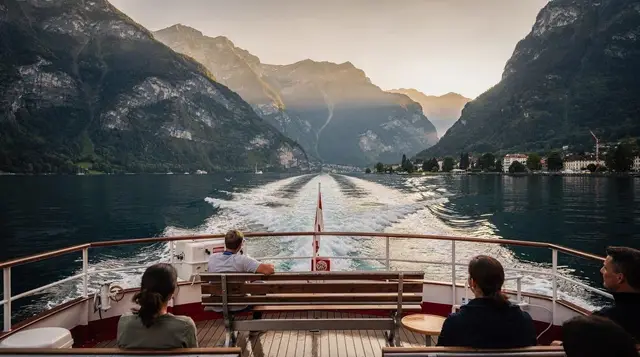
The boat option is slower but part of the point: sailings from Interlaken West’s harbour take around 2 hours 15 minutes end to end, stopping at villages including Spiez, Oberhofen and Hilterfingen along the way. It suits a day with no fixed schedule more than a quick castle visit.
Once in Thun, everything described here — station, old town, castle, Bälliz and Schadau park — sits within a 20-minute walk of the next, and the town is flat except for the castle steps. A car is unnecessary and parking in the old town is limited in any case.
| From Interlaken | Time | Cost guide (CHF) |
|---|---|---|
| Train, Interlaken Ost/West to Thun | 20–25 min | ~9–14 one-way, less with Half Fare Card |
| Boat, Interlaken West to Thun | ~2 h 15 | ~30–40 one-way |
| Return, same day, either mode | — | Day pass often better value if combining stops |
Combining Thun with the rest of the day
Thun’s proximity to Bern makes it a natural stop on the way to or from the capital rather than a destination requiring its own dedicated day. A common pattern: train to Thun in the morning for the castle and old town, lunch in the Bälliz, then onward to Bern for the afternoon, or back to Interlaken via Spiez if the plan is a lake-focused day instead.
Families or anyone building a longer stay might slot Thun into a two lakes and villages itinerary alongside Sigriswil and Merligen on the lake’s north shore, or Kandersteg and Oeschinensee further along the valley.
For visitors who prefer a guided version of this route, an organised Lake Thun cruise combined with a visit to the St Beatus Caves covers both the boat leg and a stop most independent itineraries skip. Those routing through from further afield sometimes take it the other direction, on a day trip from Basel that takes in Thun, the caves and a lake cruise, or a private day trip pairing Bern and Thun from Basel for a tighter schedule.
Travellers based in Lucerne can reach Thun on a panoramic train day trip from Lucerne that continues on to Thun, and anyone wanting to add a hike above the lake before heading back down might book the guided summit hike to the Rothorn above Sigriswil on the same trip.
A sensible order for a half day
The easiest way to use Thun well is to let the geography set the order. Arrive by train, walk into the old town and head straight for the castle steps while you are still fresh; the climb is short but it is the only effort the town asks of you. Take the terrace by the towers for the view over the rooftops and the lake, then come back down and walk the raised Obere Hauptgasse in one direction before returning along the lower level. Lunch fits naturally in the Bälliz or on the Rathausplatz, and the afternoon can go to the riverbank or a slow walk out to Schadau park.
If rain is forecast, the castle and the shops under the Obere Hauptgasse make Thun a better wet-weather choice than most lakeside towns; the ideas in things to do in Interlaken when it rains and the page on Interlaken in bad weather show how it fits alongside the indoor options back in the Jungfrau region. For a slower, more detailed walk through the same streets, the dedicated Thun old town and castle guide goes room by room and lane by lane.
Who Thun suits, and who might skip it
Thun rewards people who like towns more than summits. If your list is built around cable cars and glaciers, one of the mountain excursions will feel more like what you came for, and Thun is better kept as a quieter second day. If you are travelling with children, the flat streets, the castle’s towers and the river give an easy outing; the wider Interlaken with kids guide has more ideas for filling the rest of the trip.
Anyone comparing the two big lakes will also find Thun a useful anchor: it is the working town at the end of one of them, which is a different experience from the villages around Lake Brienz. That comparison page helps decide which shore deserves your limited time.
Thun in context
Compared with the villages further up the Jungfrau valleys, Thun offers something none of them do: an actual old town with civic history rather than a tourism-built base for mountain access. It won’t compete with Jungfraujoch or Grindelwald for scenery, and it isn’t trying to.
What it offers is a well-preserved medieval streetscape, a castle you can walk around in under an hour, and a river culture — the Aare swimming — that’s more associated with Bern but works just as well here, with far smaller crowds. For the city sightseeing category of a Bernese Oberland trip, or for a lakes and cruises day that needs a landing point, Thun earns its half day without needing to be oversold.
Frequently asked questions about visiting Thun
How do I get from Interlaken to Thun?
Direct trains leave from both Interlaken Ost and Interlaken West roughly every 15–30 minutes, taking 20–25 minutes to Thun. The scenic alternative is the boat, which runs the length of Lake Thun in about 2 h 15 with several stops along the way.
Is Thun castle worth visiting?
Yes. Schloss Thun dates to around 1190 and holds five rooms open to the public, including the Knights’ Hall with its original roof timbers. Entry is a few francs cheaper than most mountain excursions and takes about an hour to see properly.
What is the Obere Hauptgasse known for?
It is Thun’s main shopping street, built with the road running along the top of a row of vaulted shop roofs, so pedestrians walk at first-floor level above the actual shopfronts. Stone steps drop down to the shops at intervals.
Can you swim in the Aare at Thun?
Yes, in summer many locals float down the stretch of river below the locks, the same current-assisted swimming Bern is better known for. The water is glacier-fed and cold even in August, and the current is stronger than it looks.
When is the Thun market?
The main market runs on Saturday mornings along the Rathausplatz and Burgstrasse, roughly April to October, with stalls for produce, cheese, flowers and household goods. It winds down by early afternoon.
Is Thun a good base instead of Interlaken?
It works for travellers focused on Bern, Lake Thun villages and the western Bernese Oberland, since Bern is closer from Thun than from Interlaken. For the Jungfrau region trains and cable cars, Interlaken stays the more practical base.
How much time do I need in Thun?
Two to three hours covers the castle, old town and riverside; a half day allows time for the market or a lakeside walk to Schadau park. A full day works if paired with a boat trip to Spiez or Oberhofen.