Spiez sits on a hooked promontory that pushes out into Lake Thun, and the result is the single most photographed bay on the lake: a medieval castle on the spur, a Romanesque church right beside it, terraced vines climbing the slope behind, and a working harbour and railway station a few minutes’ walk away. It is not a place to build a whole holiday around, but as a stop of two or three hours it earns its place on a day trip from Interlaken, and as a junction it matters more than its size suggests.
The bay everyone photographs
The view that appears on postcards and calendars is taken from the water or from the little park by the harbour: the square tower of Schloss Spiez rising directly above the lake, the church’s stone apse next to it, and the Niesen’s pyramid shape across the water. It works because Spiez is one of the few points on Lake Thun where a castle, a church and a working vineyard sit together on the same short stretch of shoreline, rather than scattered around the lake as they are elsewhere.
The bay itself, the Spiezerbucht, curves round from the castle promontory to the boat pier and the beginning of the beach. It is a genuinely pleasant walk of ten to fifteen minutes, flat the whole way, and it is the easiest way to see the castle from several angles before deciding whether the entrance fee is worth it for your visit.
Schloss Spiez, the castle on the spur
Schloss Spiez occupies a rocky spur that has been fortified in some form since Roman times; the present tower dates largely from the 12th and 13th centuries, with later wings added by the noble families who owned it, including the von Bubenberg and, from the 17th century until 1875, the von Erlach family. It then passed into public ownership and now operates as a museum run by a foundation.
Inside, the rooms are furnished across several centuries rather than frozen at one date, which makes the visit more of a walk through Bernese domestic history than a single-period reconstruction. The Knights’ Hall (Rittersaal) and the castle’s own chapel, built directly into the rock, are the two rooms worth the most time. The tower can be climbed for a view back over the bay towards Interlaken and the Niesen.
The castle runs on a seasonal calendar, open roughly from April to October and closed over winter; it is often shut on Mondays even in season. Entry is a modest fee, typically in the region of CHF 8 for adults with reductions for children and pass holders, and the grounds around the tower can usually be viewed for free even outside opening hours.
The Church of Spiez, older than the castle
Right next to the castle, and easy to see as part of the same stop, stands the Church of Spiez (Schlosskirche), one of the oldest church buildings in the Bernese Oberland. Its foundations are thought to go back to the early medieval period, with the current Romanesque nave dating from around the 10th and 11th centuries. Fragments of older wall paintings survive inside, and the churchyard’s position on the spur gives one of the quieter lake views in Spiez, away from the crowds photographing the castle tower itself. Entry is usually free, and it is worth five minutes even for visitors who skip the castle museum.
The Spiezberg vineyards, the canton’s highest
Behind the castle and the old village, the ground rises steeply into the Spiezberg, planted with vines up to around 600–700 metres, which makes it the highest vineyard area in canton Bern. The main grape is Chasselas, made into a light, dry white in the same style as much of Swiss lake-country wine, alongside smaller plantings of Pinot Noir and Riesling-Sylvaner.
A signed vineyard path climbs from the old town through the terraces, giving views back down over the castle roof to the lake that are arguably better than anything at lake level. The local growers’ cooperative and a handful of independent producers open cellar doors for tastings, mostly on specific afternoons or by appointment rather than as a walk-in tourist attraction, so it is worth checking current hours locally rather than assuming a cellar will be open when you arrive. Even without a tasting, the walk up through the vines and back down is a good hour of gentle exercise that most visitors to Spiez never bother with.
The beach and the lido
Strandbad Spiez, the public lido, sits on the lakeshore a short walk from the castle and harbour, with grass for sunbathing, a diving platform, changing rooms and a kiosk. It is a paid facility rather than an open beach, and like every lido on Lake Thun and Lake Brienz, the water is glacier-fed and stays cold even in a hot July. It gets genuinely busy on fine summer weekends, mostly with local families rather than tourists, which is part of its appeal if you want an afternoon that feels less staged than the castle courtyard.
Spiez as a railway junction
For anyone travelling further into Switzerland, Spiez matters as much for its station as for its castle. Three lines meet here: the direct route back towards Thun and Bern; the Simmental line south towards Lenk and Gstaad, which continues as the GoldenPass Line towards Montreux and Lake Geneva; and the Lötschberg line via Frutigen, which tunnels under the Bernese Alps towards Brig, Valais and on to Zermatt.
A change at Spiez is often unavoidable if you are heading from Interlaken towards Kandersteg, Adelboden or the Matterhorn, so it is worth knowing the platform layout rather than treating it as just a name on the departure board.
Trains run frequently and, as everywhere in Switzerland, punctually; connections at Spiez are usually built with only a few minutes’ change time, which is normal here but can feel tight to visitors used to looser schedules elsewhere.
Boat trips from the Spiez pier
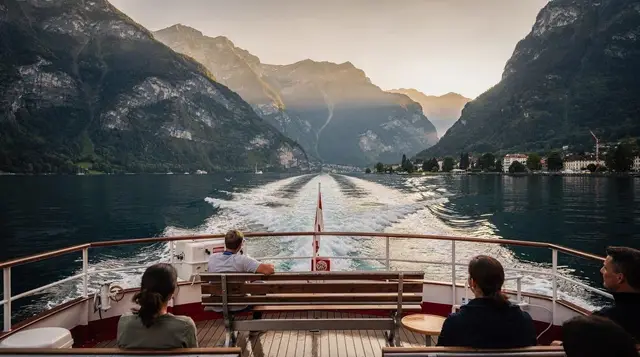
The Spiez pier is a stop on the BLS boat network for Lake Thun, with services running to Thun in one direction and towards Interlaken West, Oberhofen, Sigriswil and the Beatenbucht landing for the St Beatus Caves in the other. Arriving or leaving by boat rather than train is the better choice if the point of your visit to Spiez is the view of the castle from the water, since the approach by boat gives a slow, front-on look at the promontory that the train and road do not.
For a fuller loop of the lake with a stop for the caves, the Interlaken cruise on Lake Thun with a stop at St Beatus Caves and a picnic covers Spiez’s bay as part of a longer circuit, which suits visitors who want the boat experience without planning individual timetable connections themselves. See the full guide to Lake Thun boat trips for the wider network and current fares.
The Niesen and Rothorn above the bay
Spiez is also a natural base for two summits on either side of the lake. The Niesen, the pyramid-shaped peak visible from almost everywhere in Spiez, is reached by funicular from Mülenen, a short train ride from Spiez station, and gives one of the best panoramic views over Lake Thun and the peaks beyond. Across the water, above Sigriswil, the Rothorn offers a comparable high-altitude view from the opposite shore.
For visitors who want to combine the ascent with some structured hiking guidance, two options run from this area: a guided summit hike up the Niesen with a Swiss triathlete and, on the far side of the bay, a similar guided route to the summit of the Rothorn above Sigriswil.
Both are demanding hikes rather than casual walks, and both depend on clear weather and open lift schedules, so check conditions before committing a day to either.
Getting further afield from Spiez
Because of its junction position, Spiez also works as a starting point for day trips that would otherwise require a change in Interlaken or Thun first. The Simmental line reaches Gstaad and Saanenland directly, and the Lötschberg route via Frutigen is the fastest way from this side of the lake towards Kandersteg and its Oeschinensee lake, or onward through the Lötschberg base tunnel towards Valais.
Visitors without their own transport who want to see several of these places in one day, rather than piecing together train changes, sometimes prefer a fixed itinerary. The private full-day driver covering Interlaken, Thun and the Spiez lakeshore removes the timetable planning at the cost of a considerably higher price than public transport, which is worth weighing honestly against a Swiss Travel Pass covering the same ground.
Eating and practicalities
Spiez’s old town, clustered around the harbour and the approach to the castle, has a modest choice of lakeside restaurants and cafés, generally priced in line with the rest of the Bernese Oberland rather than at Interlaken’s more tourist-driven rates. A simple lunch with a drink typically runs to CHF 25–35 per person; a proper sit-down meal with lake fish, a Spiez speciality on several menus, runs higher. There are public toilets near the harbour and the castle entrance, and lockers are not generally available, so plan luggage accordingly if Spiez is a stop en route elsewhere rather than a dedicated day out.
The village itself, Spiez proper, sits apart from the more built-up strip along the main road, and it is easy to see the castle, church and harbour without ever needing a car; parking near the castle is limited and best avoided in high season.
Planning a stop at Spiez
Most visitors treat Spiez as a half-day add-on to a longer Lake Thun itinerary rather than a destination on its own, and that is the right instinct. A reasonable plan is: train from Interlaken Ost to Spiez, thirty to forty minutes at the castle and church, a walk up into the Spiezberg vines if the weather is clear, lunch by the harbour, and either a boat back towards Interlaken or a change at the station to continue south towards the Simmental or Valais.
Combining the visit with Thun’s old town and castle on the same day, or fitting it into a two lakes and villages itinerary, makes fuller use of the train and boat tickets than treating Spiez as an isolated trip.
For travellers arriving from further away, a combined route such as the
day tour from Basel taking in Thun, the Beatus Caves and a lake cruise
passes close enough to Spiez’s bay to give a sense of the castle from the water, though it does not include a stop in the village itself, so check the itinerary carefully if seeing the castle up close matters to you.
Spiez questions answered
How do I get from Interlaken to Spiez?
The train from Interlaken Ost takes around 20 minutes on the line towards Bern and Thun, with several departures an hour. The lake boat is slower, around an hour, but it is the more scenic option and lets you see the bay from the water before you arrive.
Is Spiez Castle open every day?
No. Schloss Spiez runs on a seasonal schedule, typically open from April to October and closed over winter. Check the current opening days before visiting, since it is often shut on Mondays outside peak summer.
Can you taste wine in Spiez?
Yes. The Spiezberg vineyards above the bay produce mostly Chasselas, along with some Pinot Noir and Riesling-Sylvaner, and several small producers and the local wine cooperative offer tastings, though hours are limited outside the summer season and it is worth confirming before you walk up.
Is Spiez a good base instead of Interlaken?
It works for travellers who want a quieter lakeside town with direct rail access south towards the Simmental, Gstaad and the Lötschberg line, but Interlaken has far more transport options towards the Jungfrau region and a wider choice of accommodation.
Is the Spiez lido open to non-residents?
Yes, Strandbad Spiez is a public lido on the lake shore with an entrance fee, changing rooms, grass for sunbathing and a diving platform. It gets busy on hot weekends in July and August.
Why does the railway matter so much in Spiez?
Spiez station sits at the point where the line from Interlaken and Thun splits: one route continues towards Bern, another climbs the Simmental towards Zweisimmen, Gstaad and on to Montreux on the GoldenPass Line, and a third heads via Frutigen and the Lötschberg tunnel towards Brig and Valais, including trains to Zermatt.