A tower in the lake, ten minutes apart
Oberhofen and Hilterfingen sit on the northern shore of Lake Thun, between Thun and Sigriswil, close enough together that most visitors treat them as one outing rather than two destinations. Oberhofen is the smaller and better known of the pair, built around a castle whose round tower rises straight out of the water on wooden piles. Hilterfingen, immediately next door towards Thun, has its own castle, Schloss Hünegg, set back in a private-feeling garden of sequoias and cedars.
Neither village has much beyond its castle: a scattering of guesthouses, a church, a handful of cafés, and gardens that run down to jetties used by the lake boats. That is the appeal. Compared with the crowds funnelling through the Jungfraujoch or queuing for the Harder Kulm funicular, an afternoon here is unhurried: two furnished houses, two gardens, and a lakeshore path connecting them to Thun’s old town.
Both places are germanophone, in the canton of Bern like Interlaken, and both castles are run as museums rather than private residences, which is why they close for the winter rather than staying open year-round like a commercial attraction would.
Getting there from Interlaken
There is no single best way to reach Oberhofen and Hilterfingen; it depends whether you want the scenery of the boat or the speed of the train and bus.
| Method | Time from Interlaken | Approx. cost (one way) | Notes |
|---|---|---|---|
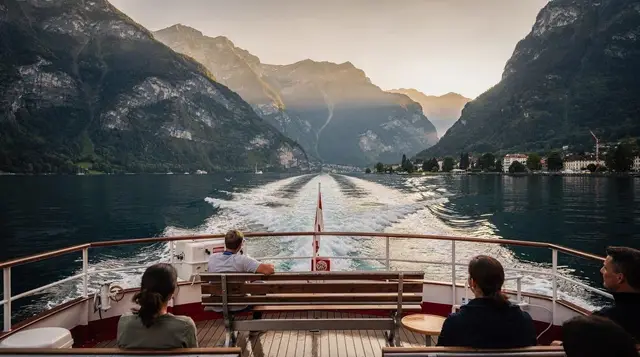
| Lake boat from Interlaken West | 45–55 min to Oberhofen | CHF 24–30 | Direct, scenic, but the slowest option; several sailings a day in season only |
| Train to Thun, then bus 21 | 20 min train + 10 min bus | CHF 12–15 combined | Fastest and runs year-round; buses roughly every 15–30 minutes |
| Train to Thun, then walk | 20 min train + 45–60 min on foot | CHF 8–9 (train only) | Only for those who want to walk the Thunerseeweg lakeshore path anyway |
| Car | 20–25 min | Parking CHF 5–10/day | Small car parks at both castles fill up on summer weekends |
Swiss Travel Pass and Half Fare Card holders get the usual discounts on the train and bus legs; the lake boats are covered by the Swiss Travel Pass but only discounted, not free, on some routes. A Swiss Travel Pass is worth doing the maths on if you are also planning boat trips on Lake Brienz or a two-lakes cruise during the same stay.
If a boat day is what you are after rather than a fixed timetable, a guided Lake Thun cruise that stops at the St Beatus Caves with a picnic included covers the water and a second attraction in one booking, though it does not call at Oberhofen itself — check the stop list before assuming it does.
Schloss Oberhofen: the castle that stands in the water
The core of Schloss Oberhofen dates to the 12th or 13th century, when the Bubenberg family, one of Bern’s ruling dynasties, built a fortified tower on the shore to control lake traffic and collect tolls. Ownership passed through several Bernese patrician families over the following six centuries, each adding wings, until Count Albert de Pourtalès bought it in 1844 and gave the building most of its current look: the round corner tower extended out over the water on piles, crenellations added for picturesque effect, and an English landscape garden laid out around it in place of the old formal terraces.
The castle opened as a museum in 1952 and is now run as a branch of the Bernisches Historisches Museum. Inside, furnished rooms trace daily life across roughly three centuries rather than presenting a single frozen moment: a medieval kitchen and knights’ hall on the lower floors, then Baroque and Rococo reception rooms, up to 19th-century apartments furnished in the style the Pourtalès family actually lived in. The best-known single room is a Turkish smoking room added in the 1850s, tiled and furnished in an Ottoman style that was fashionable among wealthy Europeans at the time — an oddity rather than anything authentically local, but a memorable one after several rooms of Bernese oak furniture.
That said, this is as much a museum of Bernese domestic culture as it is a display of aristocratic wealth: cupboards, stoves, textiles and everyday objects sit alongside the grander pieces, giving a more rounded picture of how the Bernese upper and middle classes actually furnished their homes than a purely “stately home” museum would.
| Oberhofen | |
|---|---|
| Open | Mid-May to mid-October, Tue–Sun (closed Mondays except public holidays) |
| Adult ticket | Around CHF 9 for the castle interior |
| Garden | Free to enter during museum hours; a pleasant stop even for visitors who skip the interior |
| Typical visit length | 45–60 minutes for the castle, longer with the garden |
The garden itself, with its lakeside pavilion, mature trees and a small pier, is worth the stop even outside the castle’s opening months, since the grounds and the exterior view of the tower rising from the water are visible from the public lakeshore path regardless of the museum’s calendar.
Schloss Hünegg: Hilterfingen’s Belle Époque time capsule
Schloss Hünegg is a different kind of building entirely: a neo-Gothic villa built in 1861–63 for a Prussian general, Albert von Parpart, then bought in 1897 by the Gaudin family, wealthy industrialists who remodelled the interior in the Art Nouveau style fashionable at the time. What makes Hünegg unusual is what happened next — nothing. The Gaudin family kept the house largely unchanged until the last family member died in 1970, so the wallpaper, curved wooden furniture, stained glass and light fittings on show today are original to around 1900, not a later reconstruction.
Walking through Hünegg feels closer to visiting a wealthy family’s actual home than a curated museum display: parquet floors, an oval dining room, a curved main staircase, and bedrooms with their original fabrics still in place. It is a smaller, more intimate visit than Oberhofen and appeals particularly to anyone interested in Jugendstil (the German-speaking world’s Art Nouveau) or in domestic interiors rather than grand state rooms.
The garden slopes down to the lake and includes sequoias, cedars and other exotic species planted by 19th-century owners keen to show off what money could import — a contrast with Oberhofen’s more classically English layout.
| Hilterfingen (Schloss Hünegg) | |
|---|---|
| Open | Mid-May to mid-October, Tue–Sun (hours can shift slightly by season — check before travelling) |
| Adult ticket | Around CHF 10 for the castle interior |
| Garden | Free with a castle ticket; partially visible from outside the fence when closed |
| Typical visit length | 30–45 minutes for the castle, plus the garden |
The lakeshore path linking Hilterfingen, Oberhofen and Thun
A signed lakeshore path, the Thunerseeweg, runs along this whole stretch of shore and is flat enough for anyone comfortable with a long, gentle walk. From Hilterfingen to Thun’s old town is around 5 km and takes about 1 hour 15 minutes; extending back out to Oberhofen adds roughly another 30–40 minutes each way. The path alternates between lakeside gardens, small public beaches, and quiet residential streets, with almost no gradient throughout, which puts it in a similar category to the easy flat walks around Interlaken rather than anything approaching a mountain trail.
It also works well as a one-way walk paired with the boat or bus: walk from Oberhofen to Thun and take the train back to Interlaken, or reverse the direction depending on which way the afternoon light falls on the lake. Cyclists use the same corridor, and the route connects into the wider network covered in the region’s cycling guide if you would rather cover the ground faster.
Swimmers should note that both villages have small public lidos (Strandbad) with grass areas and jetties into the lake, similar in style to the public bathing spots described for swimming in Lake Thun and Lake Brienz — a reasonable way to cool off between the two castles on a hot day, water temperature permitting.
Eating and other practicalities
Neither village has much of a restaurant scene, so plan around a small number of fixed options rather than expecting a wide choice.
- Oberhofen: a lakeside restaurant and a café sit close to the boat pier and the castle entrance, with mains typically CHF 25–38; both get busy at lunch in July and August.
- Hilterfingen: a couple of village restaurants along the main road, generally quieter than Oberhofen’s cluster, with similar pricing.
- Picnic option: both castle gardens have benches and lake-view spots, and a bakery or Migros/Coop in Thun or Interlaken before setting out is the cheaper route if the CHF 25–38 mains feel steep for a casual lunch.
For a fuller sense of what a meal costs across the region, the Interlaken restaurant guide gives comparable price ranges; nothing in Oberhofen or Hilterfingen undercuts those figures.
Toilets are available at both castles during opening hours and at the public lidos; outside the May–October season, facilities along this stretch are more limited, another reason a winter visit here is really just a walk past closed buildings rather than a full day out.
Combining Oberhofen and Hilterfingen with the rest of Lake Thun
Because both castles are small and close together, most itineraries pair them with something else rather than filling a whole day around them alone. Reasonable combinations:
- Thun’s old town and castle, reached by the lakeshore walk or a short bus ride — see the Thun old town and castle guide for its own opening hours and layout.
- A wider Lake Thun boat loop, using the Lake Thun boat trips guide to work out which sailings actually call at Oberhofen versus which skip it.
- Spiez, further round the lake, if travelling by boat and willing to make a full circuit rather than an out-and-back.
- A structured multi-day plan such as the two lakes and villages itinerary, which slots a lake-shore afternoon like this one in among the region’s bigger mountain excursions.
Anyone still deciding which of the region’s two lakes deserves the time can compare them directly in Lake Thun versus Lake Brienz; Oberhofen and Hilterfingen are two of the stronger arguments for giving Thun’s shore at least half a day.
Travellers approaching from further afield, rather than based in Interlaken, sometimes reach this stretch of shore as part of a longer coach itinerary — a day tour from Basel that combines Thun’s old town, the St Beatus Caves and a Lake Thun cruise is one such option, useful for comparison if you are weighing a packaged day against organising the boat and bus yourself.
Those who prefer to earn the view rather than sail past it can also look uphill from Oberhofen: the ridge above Sigriswil is the starting point for a guided hike up the Sigriswil Rothorn led by a Swiss triathlete, a full step up in effort from the flat lakeshore path but a way to see both castles and the whole lake from above afterwards.
Visiting Oberhofen and Hilterfingen: common questions
Can you visit Schloss Oberhofen and Schloss Hünegg in one day?
Yes. They are about 2 km apart along the lakeshore, roughly 25 minutes on foot or 5 minutes by bus. Most visitors manage both interiors plus the gardens in three to four hours, leaving time for lunch.
How do you get to Oberhofen from Interlaken without a car?
The lake boat from Interlaken West is the direct option, taking around 50 minutes and stopping at Oberhofen’s own pier. Faster is the train to Thun (about 20 minutes) then local bus 21 towards Sigriswil, which reaches Oberhofen in another 10 minutes.
Is Schloss Oberhofen open in winter?
No. Both Oberhofen and Hünegg are seasonal museums, typically open from mid-May to mid-October and closed the rest of the year. The lakeshore path and the exterior of both castles can still be seen year-round from the public shore.
What is inside Schloss Oberhofen?
Furnished period rooms spanning the 17th to 19th centuries, run as a branch of the Bernisches Historisches Museum, including a Turkish smoking room added by a 19th-century owner and displays on everyday Bernese domestic life rather than just aristocratic staterooms.
Why is Schloss Hünegg described as a time capsule?
The Gaudin family who bought it in the 1890s left its Art Nouveau furniture, wallpaper and fittings almost untouched when the last family member died in the 1970s, so the interior still looks like a well-off Swiss household from around 1900.
Is the walk between Hilterfingen and Thun flat and suitable for families?
Yes. The lakeshore path (Thunerseeweg) between Hilterfingen and Thun is flat, paved or fine gravel, and takes about 1 hour 15 minutes at a gentle pace, with benches and lake views for most of the way.
Do you need to book tickets for the castles in advance?
Not usually. Both museums sell tickets on site and rarely sell out outside of a handful of summer weekends. Groups of ten or more should call ahead, but individual visitors can just turn up during opening hours.
Which castle is better for children?
Schloss Oberhofen edges it, with its garden pavilion by the water, a small tower to climb, and grounds that stretch right down to the lake for paddling. Hünegg’s garden is quieter and its interior, full of fragile original furniture, suits older children and adults more than toddlers.