Lake Thun boat trips: stops, the paddle steamer and day tickets
How do the Lake Thun boats work?
BLS runs scheduled boats around Lake Thun between Thun and Interlaken West, calling at villages such as Spiez, Oberhofen and Beatenbucht. A day pass covers unlimited stops and costs less than two or three separate single fares; the historic paddle steamer Blümlisalp runs a limited summer schedule, and winter service drops to a handful of daily crossings on the core route only.
Lake Thun looks like a single obvious boat trip until you actually try to plan one: there are two lakeside stations to keep straight, a dozen possible stops, a historic steamer that only runs some days, and a fare system where the “cheap” ticket is not always the day pass. This is what the timetable actually gives you, not the brochure version.
Which boats run and who operates them
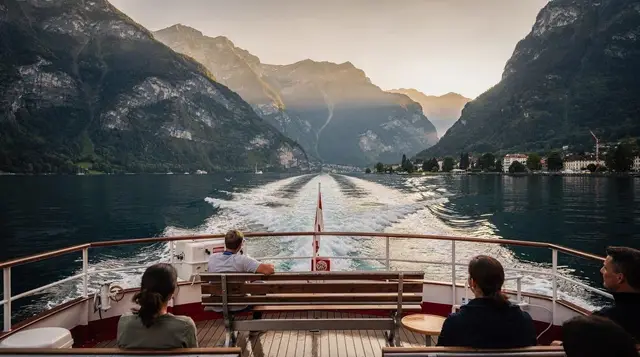
The fleet on Lake Thun is run by BLS, the same regional operator behind the Bern–Interlaken railway and the boats on Lake Brienz. Most vessels are modern diesel-electric catamarans and motor ships seating 200 to 800 passengers, with open upper decks, a small onboard buffet, and space for bikes on most sailings. Boats depart from Interlaken West, the station closer to the Hoheweg and the town centre, not from Interlaken Ost — a distinction that catches people out because Ost is where the Jungfrau trains and the Lake Brienz boats leave from. Confusing the two stations on a tight connection means walking 15 to 20 minutes across town or paying for a taxi.
The standard route runs the full length of the lake between Thun and Interlaken West, roughly 18 kilometres, taking about two hours end to end if you stay on board the whole way. Most departures call at a selection of the intermediate stops rather than all of them, so the same “Thun to Interlaken” journey can take anywhere from 55 minutes on a direct express-style sailing to over two hours on a boat working its way along both shores.
The stops and what people actually get off to see
| Stop | Side of lake | What’s there |
|---|---|---|
| Interlaken West | East end | Town centre, Hoheweg, rail connections |
| Neuhaus | East end | Small landing, close to Unterseen |
| Beatenbucht | North shore | Beatus Caves, funicular up to Beatenberg |
| Merligen | North shore | Quiet lakeside village, Sigriswil hillside above |
| Gunten | North shore | Small resort village, palm trees on the promenade |
| Oberhofen | North shore | Moated lakeside castle, Oberhofen village |
| Hilterfingen | North shore | Villa Rose, quieter than Oberhofen |
| Thun | West end | Old town, Thun Castle, river Aare outflow |
| Spiez | South shore | Spiez Castle and vineyard terraces, Spiez village |
| Faulensee | South shore | Small village, lakeside swimming spot |
| Leissigen | South shore | Vineyard slopes, quiet stop |
| Därligen | South shore | Small halt near Interlaken, limited sailings |
Oberhofen is the stop most people build a trip around: the moated castle sits right on the water and is walkable from the landing stage in under five minutes. Spiez does the same job on the south shore, with its own castle and a wine-growing terrace that most boat-trip visitors never bother reaching on foot from the station. Beatenbucht matters for a different reason — it is the jumping-off point for the funicular up to Beatenberg, covered below.
The Blümlisalp: the last paddle steamer on Lake Thun
The Blümlisalp is a coal-fired paddle steamer built in 1906, one of the last working examples of its kind on Swiss lakes. It was restored over several years and returned to service with its original triple-expansion steam engine still doing the work, visible through a glass panel on deck for anyone curious about the mechanics. It is slower and noisier than the modern catamarans, which is exactly the point for the people who seek it out.
The catch is scheduling: the Blümlisalp does not run daily. It typically sails a reduced programme of weekends and public holidays between May and October, sometimes with a themed evening cruise or brunch sailing added in high season. It is withdrawn for winter entirely. If riding the steamer specifically is the goal rather than just getting from A to B, check BLS’s current-season timetable for the exact dates before building a day around it — turning up on a random Tuesday expecting the paddle wheels will mean a standard catamaran instead.
Tickets: single fares versus the day pass
Lake Thun tickets work on point-to-point fares by default, priced by distance in the usual Swiss CHF-per-zone way. A short hop, such as Interlaken West to Beatenbucht, costs a few francs; the full run from Interlaken to Thun in second class runs to roughly CHF 40 for an adult one-way, more in first class.
a Lake Thun day pass covering unlimited boat stops for the day tends to make sense once you plan to get on and off more than twice — Oberhofen for the castle, back on to Thun for the old town, then a return sailing, for example. Below that, a single or return ticket for the specific stop is usually cheaper than the day pass. For travellers also planning a Lake Brienz crossing on the same trip, a combined day pass for both Lake Thun and Lake Brienz boats avoids buying two separate passes.
A Swiss Travel Pass covers Lake Thun boats in the class booked, as does a regional Berner Oberland Pass or Jungfrau Travel Pass on the days it’s valid — see the Swiss Travel Pass guide for how the passes compare. A Half Fare Card gives 50% off point-to-point tickets and the day pass, but doesn’t make travel free, and it needs to be bought and validated before boarding.
For a slower, guided alternative to the scheduled timetable, a private three-hour boat tour on Lake Thun with refreshments included replaces the fixed stops with a route set to the group, useful for a family or small group who want the castles and villages without working around a public timetable.
Combining the boat with the Beatenberg funicular
The boat-plus-funicular combination that actually gets used is: boat from Interlaken West to Beatenbucht, then the funicular up to Beatenberg village on the ridge above the lake, from where a cable car continues to Niederhorn at 1,950 metres for the panoramic view over both lakes. The funicular does not run continuously — departures are typically every 15 to 30 minutes depending on season — so a boat arriving just after a funicular has left means a real wait at Beatenbucht rather than a seamless connection. Building in a 20-minute buffer avoids standing around at the landing stage.
This combination works as a half-day trip on its own, or as one leg of a longer loop that returns via Sigriswil and Merligen by road or a different boat back to Interlaken. It’s also one of the more efficient ways to add a genuine viewpoint to a boat day without doubling back on the same route.
Winter timetable: what actually runs
This is the detail that catches out anyone visiting between November and March expecting the summer brochure to apply. Winter service on Lake Thun drops to a small number of daily departures — often as few as two or three round trips — running the core Thun–Interlaken route with only the main stops served. Smaller landing stages such as Faulensee, Leissigen and Därligen typically close for the season, and the Blümlisalp does not sail at all in winter. Some years see the service suspended entirely for a few weeks around the turn of the year for maintenance.
If a Lake Thun boat trip is part of a winter itinerary, check BLS’s published winter timetable for exact dates and departure times rather than assuming a modified version of the summer schedule — the reduction is substantial, not a case of running every other sailing. For a broader look at what does and doesn’t operate off-season, see Interlaken in bad weather, which covers indoor options for the days a lake crossing isn’t practical anyway.
Practical tips
Book online or buy on arrival. BLS boat tickets don’t need to be booked in advance for individual travellers; buy them at the landing stage ticket office or from the machine, or online in advance if travelling in a larger group. Bikes are usually allowed on the open lower deck for a small supplement, space permitting.
Sit on the north side heading west. For photos of Oberhofen’s castle and the Sigriswil hillside, the north-shore side of the boat gets the better light on a typical afternoon sailing from Interlaken toward Thun.
Don’t confuse the two Interlaken stations. Every Lake Thun boat leaves from Interlaken West. If arriving by train from Grindelwald or Lauterbrunnen via Interlaken Ost, factor in the walk or a short local train hop to West before the boat’s scheduled departure.
Pair it with the old town. Thun’s old town, with its raised walkway over the shopfronts and the castle on the hill above, is a 5-minute walk from the boat landing — see the Thun old town and castle guide for what to prioritise if the return sailing is only an hour or two away.
Doing both lakes in one trip. Anyone trying to fit Lake Thun and Lake Brienz into the same day should read the two lakes cruise guide first — the logistics of switching from Interlaken West to Interlaken Ost mid-day are the main constraint, not the sailing times themselves. For a slower version spread over several days, the two lakes and villages itinerary builds in a full day per lake.
Swimming from the shore. Several stops, notably Spiez and Faulensee, sit next to public lake access good for a swim in summer; see swimming in Lake Thun and Lake Brienz for water temperatures and the better public spots.
For travellers deciding between the two lakes rather than doing both, Lake Thun versus Lake Brienz sets out the real differences — Thun has more castles and villages to stop at, Brienz has the more striking turquoise colour and the steam train up the Rothorn. Those wanting the historic-boat experience specifically, on either lake, should also check paddle steamers of the Bernese Oberland, which covers the Blümlisalp alongside its counterpart on Lake Brienz.
Travellers weighing up whether to do the lake by public boat or with a driver who also covers Spiez and the wider area might prefer a private day trip from Interlaken to Thun and Spiez, which skips the timetable altogether in exchange for a fixed daily rate.
Frequently asked questions about Lake Thun boat trips
Who operates the Lake Thun boats?
BLS Schifffahrt, the same company that runs the trains between Bern and Interlaken, operates the Lake Thun fleet under the Schifffahrtsgesellschaft des Thunersees. Boats depart from Interlaken West, not Interlaken Ost, which catches out visitors expecting a single station for everything.
What is the Blümlisalp and when does it run?
The Blümlisalp is a coal-fired paddle steamer built in 1906, restored to working order and now the last of its kind on Lake Thun. It sails a reduced schedule, mostly weekends and public holidays from May to October, and does not run at all in winter, so check the day’s timetable before planning a trip around it specifically.
Is a Lake Thun day pass worth it?
If you plan to get on and off more than twice, or combine the boat with the Beatenberg funicular, a day pass usually costs less than buying single tickets separately. For a single one-way crossing, such as Interlaken to Thun with no stops, a standard point-to-point ticket is cheaper.
Do boats run all year on Lake Thun?
No. Full timetable, with all stops and the paddle steamer, runs roughly from April to October. From November to March, service shrinks to a limited number of daily departures on the Thun–Interlaken core route, several intermediate landing stages close for winter, and the Blümlisalp does not sail.
Can I combine the boat with the Niederhorn cable car?
Yes. The standard combination is boat to Beatenbucht, the funicular up to Beatenberg village, and then the Niederhorn cable car from there. Check connection times before setting out, since the funicular does not run continuously and a missed connection can mean a 30 to 60 minute wait.
Does the Swiss Travel Pass cover the Lake Thun boats?
Yes, a Swiss Travel Pass covers Lake Thun boat travel in the class booked, as does a Berner Oberland Pass. A Half Fare Card gives 50% off tickets and the day pass but does not make them free.
Where do the boats actually stop?
The main stops are Interlaken West, Neuhaus, Beatenbucht, Merligen, Gunten, Sigriswil (Gunten side), Oberhofen, Hilterfingen, Thun, and on the south shore Spiez, Faulensee, Leissigen, and Därligen. Not every sailing calls at every stop, so check the specific departure’s route before boarding.
Lake cruises & boat tours on GetYourGuide
Verified deep-linked GetYourGuide tours. Book through these links and we earn a small commission at no cost to you.
GetYourGuide does not provide a product photo for this activity — the image shows the meeting point, photographed by us.