Lake Brienz boat trips: Interlaken to Giessbach and Iseltwald
How do you do a Lake Brienz boat trip from Interlaken?
Boats run from Interlaken Ost to Brienz year-round, calling at Iseltwald and Giessbach Ost, where a funicular climbs to the Giessbach Falls. The full crossing takes about 1 hour 10 minutes, and the Brünig railway runs back along the shore to Interlaken Ost in around 20 minutes, so a there-by-boat, back-by-train loop fits into an afternoon.
The Interlaken Ost to Brienz crossing
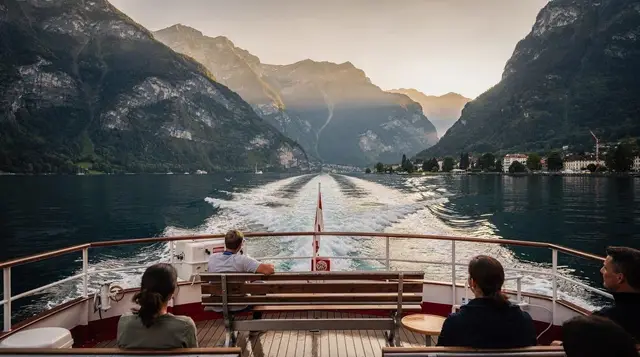
Lake Brienz is the quieter, more dramatically coloured of the two lakes flanking Interlaken, and the public boats that cross it are one of the better value ways to spend a half day here. The main line runs from the jetty next to Interlaken Ost station, along the south shore past Ringgenberg, Niederried and Oberried, calling at Iseltwald and Giessbach Ost, before finishing at the town of Brienz. The full run takes about 1 hour 10 minutes on the direct service, or up to 1 hour 25 minutes on boats that stop everywhere.
Boats are operated by BLS Schifffahrt, the same company running the Lake Thun boats, and the fleet mixes modern diesel-electric vessels with the historic paddle steamer Lötschberg, built in 1914 and still in regular summer service. If you have a choice of departures, the Lötschberg is worth timing around: it is slower, noisier in a pleasant mechanical way, and has an open sun deck that the newer boats lack.
Frequency drops off sharply outside the main season. From roughly early April to late October there are sailings every one to two hours through the day; in winter, service is thin and some of the smaller stops are skipped altogether. Always check the current timetable rather than assuming a boat will be waiting, particularly if you are trying to connect with the Brünig railway on the way back.
Fares and passes
| Route | Duration | 2nd class single | With Half Fare Card |
|---|---|---|---|
| Interlaken Ost – Iseltwald | ~25 min | CHF 18 | CHF 9 |
| Interlaken Ost – Giessbach Ost | ~40 min | CHF 24 | CHF 12 |
| Interlaken Ost – Brienz | ~1h10 | CHF 30 | CHF 15 |
Fares above are approximate 2026 figures and change year to year, so treat them as a guide rather than a quote. The Swiss Travel Pass, the Saver Day Pass and the Berner Oberland Pass all cover Lake Brienz boats at no extra charge, which makes the boat one of the better uses of a pass day if you already own one. The Interlaken hotel guest card does not cover the lake boats, only Bodeli buses and a couple of local funiculars, which catches out a fair number of visitors who assume it covers everything.
If you only have time for one lake, this is the one to pick over Lake Thun for scenery: the water is more vividly coloured, the shoreline is steeper and less built up, and the Giessbach stop gives you a genuine reason to get off partway rather than just admiring the view from a deck chair.
Giessbach: the funicular and the falls
The stop at Giessbach Ost is the best reason to break the crossing. A small, steep funicular, opened in 1879 and one of the oldest still working in Switzerland, climbs directly from the boat landing up through the trees to the Grandhotel Giessbach, a restored nineteenth-century hotel that once hosted European royalty and now takes day visitors for coffee on its terrace. The ride takes about four minutes and a return ticket costs a few francs more than the fare posted at the jetty kiosk; it is not included in the Swiss Travel Pass, though pass holders get a percentage off.
From the top, a network of short paths leads to the Giessbach Falls themselves, a series of cascades dropping roughly 300 metres down the hillside in stages, lit up at night in summer on selected evenings. Unlike the Trümmelbach Falls near Lauterbrunnen, which are enclosed inside the mountain, Giessbach is entirely in the open, and the paths along the falls are free once you have paid for the funicular, or you can walk down for nothing and only pay to go up. Allow 45 minutes to an hour if you want to see the falls properly and have a drink at the hotel terrace, longer if you plan to walk the full shore path rather than take the boat straight back.
Giessbach gets busy in July and August, mostly with coach groups doing a fast turnaround, so if you want the terrace and paths to yourself, aim for the first or last sailings of the day.
Iseltwald and the Bergfried pier
A few minutes further along, the boat calls at Iseltwald, a small village that would otherwise be a footnote were it not for a wooden boathouse and pier known as the Bergfried, which appeared in the Korean television drama Crash Landing on You. Since the show aired, Iseltwald has become a fixture on Korean and Chinese tour itineraries, and the pier can have a genuine queue of visitors waiting for their turn at the same photo angle.
The blog piece on the Iseltwald effect covers how a village of a few hundred people ended up dealing with tour buses on a daily basis, and how the parish council responded by introducing a modest access charge to the pier to fund its upkeep and manage the crowd.
Away from the pier, Iseltwald is a genuinely pleasant lakeside village with a small harbour, a church set slightly above the water, and walking paths in both directions along the shore. If your interest is the view rather than the specific photo spot, the public shoreline either side of the pier gives much the same panorama without the queue. Boats stop here in both directions, so it is easy to break the journey for half an hour without losing your onward connection, as sailings are frequent enough in season to pick up a later one.
Why the water is that colour
Lake Brienz’s colour is the first thing most visitors comment on, and it is a genuine phenomenon rather than a filtered photograph. Meltwater from glaciers at the head of the Aare valley, well beyond Meiringen, carries extremely fine rock particles known as glacial flour into the rivers that feed the lake. These particles are too small to settle and instead stay suspended in the water column, where they scatter incoming light in a way that produces the saturated turquoise and jade greens visible from the boat deck.
The effect is strongest on sunny days from midsummer into early autumn, when glacial melt is at its highest and the particle load in the water peaks; it is noticeably duller on overcast days or after periods without much melt. The blog article on why Lake Brienz is that colour goes into the mechanism in more detail, including why Lake Brienz tends to look more intensely coloured than Lake Thun even though both lakes sit in the same glacial system.
Swimming is possible at several points around the lake, though the water stays cold even in August since it is glacier-fed; see the guide to swimming in both lakes for the better access points, most of which are around Bönigen and the eastern shore near Brienz.
Getting back: boat, train, or both
The most common mistake is treating the boat as a there-and-back journey when the Brünig railway, run by Zentralbahn, tracks the south shore of the lake almost the whole way and gives a genuinely scenic return option. From Brienz station, a few minutes’ walk from the boat landing, trains to Interlaken Ost run roughly twice an hour and take about 20 minutes, considerably faster than sailing back. A sensible plan for a half day is to take the boat out as far as Giessbach or Brienz, walk or explore, then catch the train back, rather than doubling the time spent on the water.
The reverse works too: some visitors prefer the train out to Brienz, since the views from the right-hand side of the carriage are close to as good as from the boat, and then a slower boat back with stops at Iseltwald and Giessbach on the way. Either way, buying single tickets for each leg rather than a return by boat gives more flexibility if your plans change partway through the day.
A typical half day on the lake
| Time | Stop | What to do |
|---|---|---|
| Morning | Interlaken Ost | Board the boat, front deck for the best views |
| +40 min | Giessbach Ost | Funicular up, see the falls, coffee at the Grandhotel terrace |
| +1h20 | Iseltwald | Optional stop for the Bergfried pier and village |
| +1h40 | Brienz | Lunch by the harbour, browse the wood-carving shops |
| Afternoon | Brienz station | Train back to Interlaken Ost, about 20 minutes |
This loop works comfortably between about 9am and 3pm, leaving the rest of the afternoon free, and it fits within a single day trip alongside a morning at Harder Kulm or a later dinner back in town.
Beyond the public boat
The scheduled BLS service covers the lake at a gentle pace and suits most visitors, but a handful of smaller operators run faster or more active alternatives if the timetable does not suit or you want to get closer to the water. A guided scenic jetboat ride on Lake Brienz covers a good stretch of shoreline at speed in under an hour, which suits visitors short on time or travelling with teenagers who find the public boat too slow.
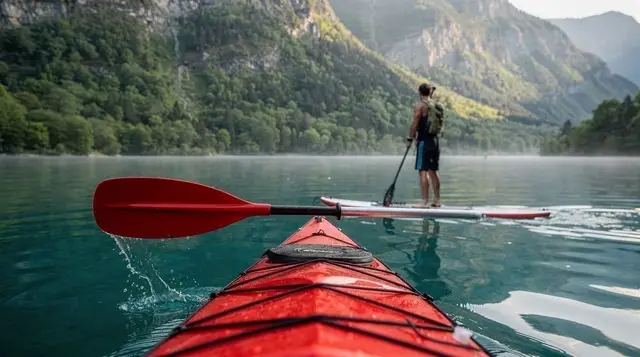
For a quieter pace at water level, a half-day kayak trip on Lake Brienz gets you close to the shoreline cliffs and coves that the boat only passes at a distance; see also the kayaking and paddleboarding guide for where to launch independently.
If you would rather combine Giessbach and Iseltwald with some exercise and skip the boat schedule entirely, a guided e-bike tour to Iseltwald and Giessbach follows the lakeside road and gives more control over how long you spend at each stop. There is also a quad tour to Iseltwald and Lake Brienz for a different, noisier way of covering the same ground, aimed more at the novelty of the vehicle than the scenery itself.
None of these replace the public boat as the standard way to see the lake, and they cost considerably more per person, but they are worth knowing about if the sailing times do not line up with your day or you want a more active version of the same route.
Choosing your sailing
The best departure depends on what you want from the day. Early sailings suit anyone who dislikes crowds: the light on the water is softer, the decks are quieter, and the stops at Giessbach and Iseltwald are not yet full of coach groups. Later departures work better if you would rather have a slow breakfast in town and treat the lake as an afternoon outing, though in that case it pays to work out your return connection before you set off, so you are not hurrying back to the landing stage.
If the weather looks uncertain, remember that the boat is one of the more forgiving activities in the region. Cloud sitting on the peaks above the shore takes some drama out of the view, but the lake colour, the wooded slopes and the waterfalls still carry the trip, and the covered lower decks keep you dry in a shower. Our guide to Interlaken in bad weather has other ideas for a day that refuses to clear, and the trains, buses and boats guide explains how the lake services fit with the rest of the local network.
Combining the lake with other plans
Because the boat can be taken one way and the train the other, the lake slots easily into a longer itinerary. Visitors planning a few days in the area will find it works well as a gentler day between more demanding mountain outings, and it appears in several of our suggested plans, such as the three-day two lakes and villages itinerary and the two-day Interlaken itinerary. Families with younger children usually enjoy the funicular as much as the sailing itself, and the Interlaken with kids guide has more on keeping a day like this relaxed.
For anyone who likes to walk, Brienz is also the gateway to a wooded hillside route to the wildlife park, which makes an easy half day once you have crossed the lake. The village’s wood-carving tradition is another reason to linger after you step off the boat; the Brienz woodcarving and violin-making guide tells the story behind the workshops you will pass near the harbour.
Practical notes
Sun protection matters more on the water than it feels like it should, since there is little shade on deck and the glare off the lake surface is strong on clear days. A jacket is worth carrying even in summer, as the boat generates its own wind once moving and the lake stays noticeably cooler than the town. Toilets are on board the larger vessels but not the smaller ones, so check before boarding if that matters for your group.
Bicycles can be taken on the boats for an extra fee, which makes it possible to cycle out along the lakeside road one way and sail back, or vice versa; see the cycling and e-bike routes guide for suggested routes along this shore. Buggies and wheelchairs can generally be wheeled straight onto the main deck, though the Giessbach funicular and some of the smaller jetties have steps, so check ahead if mobility is a concern.
Finally, if you are trying to decide between doing Lake Brienz or Lake Thun with limited time, or want to see both in one outing, the two-lakes cruise guide covers the combined route via the connecting canal through Interlaken, and the paddle steamers guide has more on the historic vessels working both lakes, including sailing dates for the Lötschberg.
Lake cruises & boat tours on GetYourGuide
Verified deep-linked GetYourGuide tours. Book through these links and we earn a small commission at no cost to you.
GetYourGuide does not provide a product photo for this activity — the image shows the meeting point, photographed by us.