Why Lake Brienz is that colour
I’ve stood on the Iseltwald jetty often enough now to have a rough system: check the sky, check the time, then decide whether it’s worth the walk down to the shore or whether the lake is going to look like any other alpine lake today. On a bright afternoon it doesn’t. Lake Brienz turns an opaque, milky turquoise that looks retouched even when you’re looking straight at it, and every time a visitor asks me the same question — is that real, or is there something in the water?
Something is in the water, yes. It’s rock, ground down to a powder so fine it never settles.
Where the colour actually comes from
The glaciers above the Bernese Oberland are constantly grinding the bedrock beneath them as they move, the way a millstone grinds grain. That process produces glacial flour, sometimes called rock flour: mineral particles a few micrometres across, far smaller than ordinary silt or sand. When the ice melts, that flour doesn’t dissolve and it doesn’t sink quickly. It stays suspended in the meltwater and travels downstream.
For Lake Brienz, the main carrier is the Aare, which rises in the glaciers near the Grimsel and Susten passes and feeds into the eastern end of the lake near Meiringen, along with smaller glacial tributaries like the Lütschine further along the valley. By the time that water reaches the lake, it’s carrying a genuine suspension of rock particles, not just dissolved minerals. That suspension is what scatters light. Particles of roughly that size scatter blue and green wavelengths far more efficiently than red, which is the same basic physics behind a blue sky, just happening in water instead of air. The result reads to the eye as turquoise, sometimes closer to jade depending on the concentration.
Depth does the rest of the work. Lake Brienz has a maximum depth of 261 metres and averages around 176 metres, which is deep enough that sunlight penetrating the water doesn’t simply reflect back off a shallow, visible lakebed the way it might in a shallow pond. Instead it travels down into water that’s already scattering light from the suspended flour, and that scattered light is what comes back to your eye as colour rather than as a reflection of the sky. A shallow lake with the same amount of glacial flour would look duller, because there isn’t enough depth of water for the scattering effect to build up.
Compare that with Lake Thun, a 25-minute train ride away on the other side of Interlaken. The Aare flows into Lake Thun too, but only after it has already passed through Lake Brienz and dropped most of its sediment load along the way. Lake Thun’s water is genuinely clearer and less flour-laden, so it settles into a steadier blue-green without the same milky cast. Stand on the Harder Kulm above Interlaken on a good day and you can see both lakes at once, and the difference in colour is not subtle.
When the colour is strongest
Three things need to line up: bright, ideally overhead sun; a reasonable amount of glacial flour already in the water; and calm conditions so wind isn’t churning up sediment unevenly near the shore or clouding the surface with ripples.
Seasonally, that means summer. Glacial melt is a slow-building process through spring and early summer, so the flour load in the lake climbs from May onward and peaks through July and August, when daytime temperatures upstream are highest and melt rates are at their fastest. By late October, melt has slowed right down again and the colour fades toward a plainer dark blue or grey-green, which is one reason autumn photos of the lake from Interlaken rarely match the postcards. In winter, with glaciers largely frozen and feeder streams reduced to a trickle, the flour that’s already suspended in the lake has time to settle and the water clears — colder, more transparent, and considerably less turquoise.
Within a summer day, late morning through mid-afternoon is the reliable window, roughly 11am to 4pm. Low-angle morning or evening sun reflects more off the surface and shows you the sky rather than the water beneath it; overhead sun does the opposite, penetrating further and letting the scattering effect dominate what you see. I’ve had genuinely disappointing 8am starts at Iseltwald that turned into a completely different lake by lunchtime, same weather, same spot, just a different sun angle.
Wind matters too, and not always in the direction you’d expect. A calm day lets the colour show cleanly across open water. A very windy day can actually intensify the effect close to the mouths of glacial streams, where fresh flour gets stirred into the shallows, while roughing up the surface everywhere else so it scatters light in every direction and looks duller from a distance. That’s part of why the colour near Giessbach and the Lütschine mouth at Bönigen can look more concentrated than the middle of the lake even on an average day.
Where to actually see it
You don’t need a boat trip to see the colour, though it helps for the open-water version rather than the shoreline shallows. The shore path around Iseltwald is the easiest access, a short walk from the village that gets you right down to water level where the turquoise is often at its most saturated, close to where meltwater streams enter. Giessbach, reached by the historic funicular or on foot along the shore path, gives a similar close-up view with a waterfall thrown in.
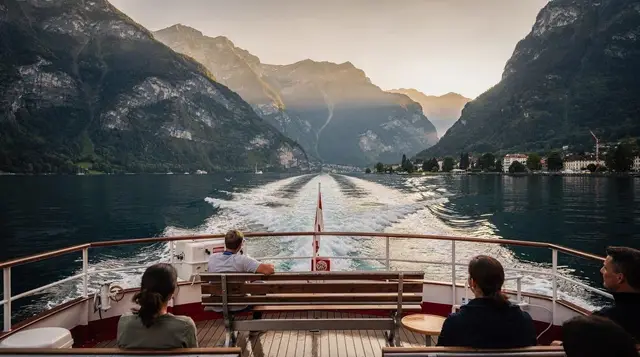
For the wider view, a scenic boat crossing between Interlaken and Brienz puts you out in open water where the colour spreads uninterrupted, and it’s a genuinely relaxed way to cover ground you’d otherwise spend an hour driving around. I’d also recommend getting some height if you can: from the Harder Kulm above Interlaken, or from the Rothorn above Brienz, you see the full extent of the colour against the darker water further out, which a shoreline photo never quite captures.
An e-bike route around the lake covers both angles in one outing, since you get shoreline access at several points plus the elevated stretches of road above Bönigen and Iseltwald where you can pull over and look down. If you’d rather stay on the water and cover the whole lake quickly, a scenic jetboat ride out of Interlaken does that in under an hour and gets you out into the middle of the lake, which is where the colour is least broken up by shore shadow.
None of this requires a filter, a polarising lens, or particular luck. It requires reasonably clear weather, a time of day with the sun overhead, and ideally a summer month when the glaciers upstream are doing the work that makes the water look the way it does.
Why Lake Brienz’s colour, answered
Why is Lake Brienz that turquoise colour?
Glacial meltwater carries extremely fine rock particles, known as glacial flour, into Lake Brienz, mostly via the Aare river. Suspended in the water, these particles scatter blue and green light more than other wavelengths, and the lake’s 261 m maximum depth lets that scattered light show rather than getting lost against a dark bottom. The effect is strongest on sunny afternoons in July and August, when glacial melt upstream is at its peak.
Is Lake Thun the same colour as Lake Brienz?
No. Lake Thun’s main inflow is the Aare after it has already passed through Lake Brienz and dropped most of its sediment, so Lake Thun runs a deeper, steadier blue-green with much less turquoise haze. Side by side from a plane or the Harder Kulm, the difference is obvious.
What time of day is Lake Brienz most turquoise?
Late morning to mid-afternoon on a clear day, roughly 11am to 4pm between June and September. Overhead sun penetrates the water instead of reflecting off the surface, and glacial melt upstream peaks in the afternoon warmth, feeding more flour into the lake by evening.
Does the colour change with the seasons?
Yes, considerably. Meltwater is minimal in winter and early spring, so the lake often looks a plainer grey-green or dark blue from November to April. The turquoise builds through May and June and is at its most saturated in July and August, then fades again through October as glaciers refreeze.
Is the colour ever fake or enhanced in photos?
Some Instagram shots are pushed with saturation sliders, but the base colour is real and not a filter trick. What editing usually exaggerates is the contrast between the turquoise shallows near shore and the darker blue of open water, which the eye does not separate as sharply as a boosted photo does.
Where is the best place to see the colour up close?
The shoreline path at Iseltwald and Giessbach is reliable, as is the view from a boat between Interlaken and Brienz. From height, the Harder Kulm and the Rothorn viewpoint above Brienz show the full sweep of colour rather than a close-up patch of it.
Can you swim in water that colour?
Yes, and the colour has nothing to do with cleanliness. Lake Brienz is oligotrophic, meaning very low in nutrients and algae, so the water is clear as well as cold, typically 14-18°C in summer even when the air is warm. Our guide to swimming in both lakes covers the best spots.
Making the most of a lake-colour day
If you’re planning a trip around catching the colour at its best, build the day around late morning to mid-afternoon rather than an early start. Check a forecast for a calm, sunny window rather than chasing a specific date, since the colour genuinely depends on light and wind more than on the calendar.
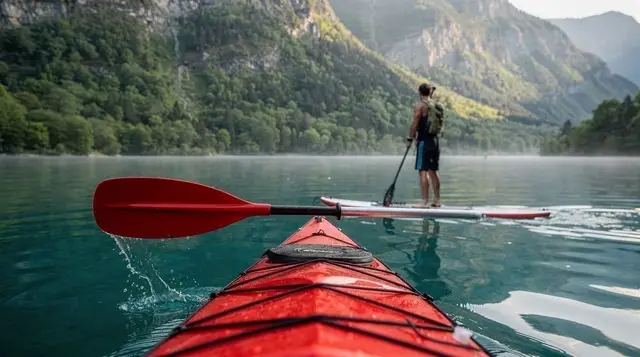
For a full circuit, our Lake Brienz boat trips guide lays out the timetables and routes, and the two-lakes cruise guide covers combining both Lake Thun and Lake Brienz in one day if you want the direct comparison for yourself. Paddlers can get closer to the water’s surface with our kayaking and SUP guide, and if you’d rather walk the shore than take a boat, the Giessbach falls and shore path guide covers the best access points on foot.
For getting out onto the water yourself, a scenic jetboat ride across Lake Brienz is the fastest way to see the colour change as you cross from shore to open water. An e-bike tour around Interlaken and the lakeshore lets you stop wherever the colour looks best and keep going.
For the Iseltwald and Giessbach stretch specifically, there’s an e-bike route out to Iseltwald and Giessbach, and a broader e-bike tour taking in both lakes and the ruins above them if you want to see the contrast between Lake Thun and Lake Brienz in a single ride.
Whichever way you see it, go on a day the forecast actually supports. I’ve sent people down to Iseltwald on a grey, drizzling afternoon expecting the postcard and watched them come back a little confused about what the fuss was — the lake was still there, just doing its ordinary grey-green impression rather than the turquoise one. The colour is real, but it’s a fair-weather performance, not a permanent feature.
For more on when conditions generally favour this kind of thing, see our best time to visit Interlaken guide and Interlaken in summer, and for the practicalities of a longer stay around both lakes, where to stay in Interlaken and day trips from Interlaken are good next stops.
If you want the fuller comparison between the two lakes beyond just colour, Lake Thun vs Lake Brienz covers swimming, boat routes and scenery side by side, and villages like Bönigen and Brienz town itself are worth an hour if you’re already on that side of the water.
Lake cruises & boat tours on GetYourGuide
Verified deep-linked GetYourGuide tours. Book through these links and we earn a small commission at no cost to you.
GetYourGuide does not provide a product photo for this activity — the image shows the meeting point, photographed by us.