The pier that changed a fishing village
Iseltwald was, until a few years ago, a place people drove past on the way to somewhere else: a cluster of stone and timber houses on a small headland jutting into Lake Brienz, a working harbour for a handful of fishing boats, a church tower, and a car park that rarely filled. That changed after the 2019 Korean television series Crash Landing on You used a plain wooden jetty at the eastern tip of the village for one of its best-known scenes. Stills and clips from that episode have been shared for years since, mostly on Instagram and among South Korean and Southeast Asian tourists, and the pier itself, not the village behind it, became the destination.
The numbers involved are modest by the standards of a city sight but large for a village of around 400 residents. On a clear summer Saturday, coach groups and self-drive visitors can outnumber locals several times over, almost all of them converging on the same 30 metres of jetty for the same photograph. The commune’s response has been practical rather than dramatic: a paid car park where parking used to be informal and free, and a marshal at the pier itself during the busiest hours, there to keep visitors moving through rather than to charge for access. There is currently no ticket or turnstile for the pier. Whether that stays true is worth checking close to your visit, since the pressure on the site has not eased.
None of this makes Iseltwald a bad stop. Away from the pier, the village is what it always was: narrow lanes between old houses, a small Reformed church with a lakeside cemetery, and views across the water to the Faulhorn ridge that are genuinely good, not just good in one specific frame. The Lake Brienz region generally has this problem in miniature, one photographed spot pulling disproportionate traffic while the quieter parts of the shoreline see almost nobody.
Getting there and the parking question
Iseltwald sits on the southern shore of Lake Brienz, roughly 20 to 25 minutes from Interlaken by car or by the regional Postbus, and about 40 minutes by passenger boat from Interlaken Ost. Each option has a different trade-off.
| Method | Time from Interlaken | Cost | Notes |
|---|---|---|---|
| Postbus | ~25 min | Covered by Swiss Travel Pass or regional pass | Stops in the village, no parking to worry about |
| Car | ~20 min | Free to drive, paid parking on arrival | Car park fills by late morning in summer |
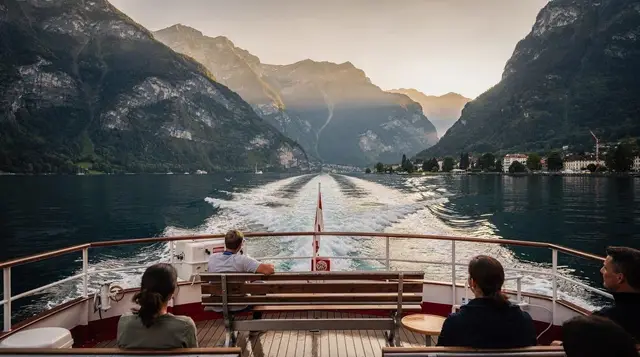
| Lake Brienz boat | ~40 min from Interlaken Ost | Covered by Swiss Travel Pass, otherwise a standard boat fare | Slowest option but scenic, stops at Giessbach en route |
Driving is the least reliable option in July and August. The single road along the southern shore has few places to turn around, and once the Iseltwald car park is full, the next available parking is a walk away in Bönigen or Interlaken. Visitors who want certainty should take the bus or the boat. For a wider comparison of how the region’s transport passes stack up, see Swiss Travel Pass and, for the boats specifically, Lake Brienz boat trips.
Those who want to see Iseltwald as one stop among several rather than a dedicated trip can join a guided run: the quad tour to Iseltwald and Lake Brienz covers the shoreline and a few viewpoints that are awkward to reach without your own transport, and an e-bike covers similar ground at a gentler pace with the e-bike tour taking in Iseltwald and Giessbach in a single loop.
The shore path to Bönigen
Fewer visitors realise that a genuinely pleasant, mostly flat walking path runs the length of the lake’s southern shore between Iseltwald and Bönigen, the small town just east of Interlaken. It covers around 8 km and takes two to two and a half hours at an unhurried pace, staying close to the water for most of its length with occasional short climbs around private gardens and rock outcrops.
The path passes through or near Golderen, Ringgenberg, and Goldswil before reaching Bönigen, from where it is a short additional walk or a local bus ride back into Interlaken. None of it requires hiking boots in dry conditions, though after rain the unpaved sections near Iseltwald itself turn muddy. It is one of the better options in the region for anyone who wants a half-day walk without altitude gain, and it sits alongside the routes covered in easy flat walks around Interlaken.
Doing the walk in the Iseltwald-to-Bönigen direction has one practical advantage: it ends close to Interlaken rather than requiring a return journey from a village with limited onward transport. Combined with an early boat out to Iseltwald, it makes a full but unrushed day. For a broader look at what a day trip from Interlaken can look like on foot rather than by tour bus, see best day trips from Interlaken.
Giessbach Falls and its 1879 funicular
A 15-minute boat ride further along the lake from Iseltwald, on the northern shore, is a very different kind of sight: Giessbach Falls, a cascading series of waterfalls dropping roughly 300 metres down a wooded hillside in fourteen distinct stages. Unlike the Trümmelbach Falls near Lauterbrunnen, which are enclosed inside the mountain, Giessbach is entirely open, illuminated at night in summer, and reachable directly from a lake steamer landing, which makes it one of the more convenient waterfalls in the Lake Brienz area to combine with other stops.
The funicular that climbs from the boat landing to the Grandhotel terrace opened in 1879, built specifically to carry hotel guests and their luggage up from the steamers without the climb. It is among the oldest funiculars in Switzerland still operating on its original route, though the cars and cable machinery have been renewed multiple times since. The ride takes about five minutes and runs only in the warmer months, typically from around late April to mid-October, closing entirely over winter. A footpath alongside the line makes the same climb in 15 to 20 minutes for anyone who would rather not pay the fare, and it is signed clearly from the landing stage.
| Option | Time | Cost | Best for |
|---|---|---|---|
| Funicular | ~5 min | Paid one-way or return fare | Limited time between boats, or reduced mobility |
| Footpath | 15-20 min | Free | Anyone comfortable with a moderate uphill walk |
For visitors who want to see the falls as one stage of a longer lake experience rather than a quick stop, the two-lakes cruise on Thun and Brienz in one day covers how Giessbach fits into a combined Lake Brienz and Lake Thun day, and the boat trip to Giessbach Falls with a hike on to Iseltwald packages the two sights into a single guided outing, which removes the timetable-juggling that independent travel between them otherwise requires.
The Grandhotel Giessbach
At the top of the funicular sits the Grandhotel Giessbach, a white 19th-century hotel built in 1875 to house the wealthy travellers who came specifically to see the falls, part of a wave of grand hotel construction across the Bernese Oberland during the same decades documented in When the Alps invented tourism. It fell into decline through the mid-20th century and was close to demolition before a restoration in the 1980s brought it back into use.
The hotel still operates as a working property with rooms, a restaurant, and a terrace that runs the full width of the building, looking directly down Lake Brienz towards Interlaken and the peaks beyond. Day visitors do not need a room reservation to eat there or take a coffee on the terrace; only the guest corridors and private event spaces are off-limits. It is not cheap by the standards of a lakeside café, but it is one of the few places in the region where the view and the building itself are both part of what you are paying for, rather than one justifying the other.
What a day here actually costs
Iseltwald alone can be done cheaply: a Postbus ticket each way, no entrance fees, and the pier costs nothing to see beyond the queue. Add Giessbach and the numbers move, mostly because of the boat and the funicular.
| Item | Approximate cost (CHF) |
|---|---|
| Postbus Interlaken-Iseltwald return | 10-16, less with a travel pass |
| Lake Brienz boat, Interlaken-Iseltwald-Giessbach-Interlaken | 30-45, covered by Swiss Travel Pass |
| Giessbach funicular, return | 10-12 |
| Iseltwald car park, half day | 8-15 |
| Lunch or coffee at the Grandhotel terrace | 15-30 per person |
| Full day, boat, funicular, and a modest lunch | 60-90 per person |
Anyone holding a Swiss Travel Pass or a Berner Oberland Pass will find both the boat and, in some cases, the funicular already covered, which changes the calculation considerably; check current pass inclusions before assuming either is free, since funicular coverage varies by pass tier. The wider question of what a day out from Interlaken tends to cost, and where the real expenses sit, is covered in the real cost of a stay in Interlaken and Interlaken on a budget.
On the water itself
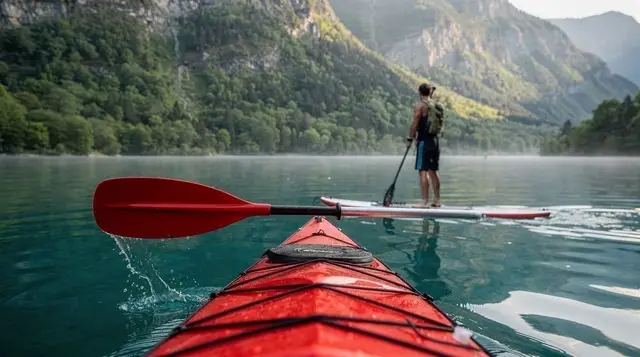
Lake Brienz’s colour, an intense turquoise fed by glacial meltwater carrying fine rock flour, is best appreciated from the water rather than the shore, and both Iseltwald and Giessbach sit directly on the boat route that shows it off. Beyond the scheduled steamers, a few operators run smaller guided trips that get closer to the shoreline than the timetabled boats can.
A full-day option for anyone who wants to be on the water rather than just crossing it is the full-day kayaking experience on Lake Brienz, which passes both Iseltwald and the mouth of the Giessbach with time to stop. Why the water looks the way it does, and why it varies through the season, is explained in more detail in Why Lake Brienz is that colour, and the broader phenomenon of Iseltwald’s sudden fame is the subject of The Iseltwald effect.
For those staying longer in the area and wanting to see how Giessbach connects to the rest of the eastern Lake Brienz shoreline, including the Brienzer Rothorn’s steam train departing from nearby Brienz itself, Brienz and the Rothorn railway and the Brienz Rothorn steam railway guide cover the connecting options, and the region overview at lake cruises lists the other boat-based days out from Interlaken.
When to go, and when to skip it
Both sights are seasonal in a way that catches visitors out. The Giessbach funicular and the passenger boats run a reduced or suspended timetable outside roughly late April to mid-October, and in winter Iseltwald in particular has very little to offer beyond the view itself: no boats, a quiet car park, and a village with almost nothing open. If a trip to either place is the main reason for visiting Interlaken in the shoulder or winter months, check the current boat and funicular schedules directly before travelling, since the exact dates shift year to year with weather and maintenance.
In peak season, the opposite problem applies: arrive at Iseltwald before 10am or after 5pm to have any realistic chance at the pier without a queue, and treat the middle of the day as a period to spend at Giessbach or on the shore path instead, returning to the pier later. Neither sight needs more than two to three hours on its own, which is what makes combining them, by boat, on foot, or on a guided tour, the more efficient way to spend a day here rather than treating either as a destination in itself.