Brienz Rothorn steam railway: steam vs diesel, season and tickets
What makes the Brienz Rothorn Bahn different from other mountain railways near Interlaken?
It is the last rack railway in Switzerland still hauled by steam locomotives on a regular timetable, some dating from 1892. Diesel-hauled trains run the same route more often and more cheaply; steam trains cost more, run less frequently and are worth booking ahead, especially at weekends.
The last steam rack railway in Switzerland
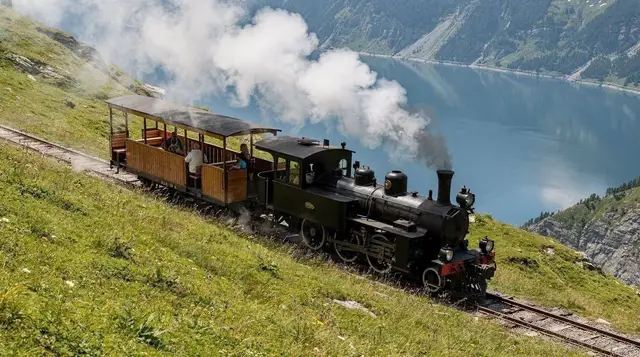
Switzerland has several heritage railways that bring out a steam locomotive for special anniversaries or a summer weekend. The Brienz Rothorn Bahn is different: it is the only rack railway in the country that still puts steam locomotives on its ordinary, printed timetable, day after day, for most of the season. Diesel locomotives share the same line and the same track, so on any given morning you might see a 1930s oil-fired steam engine pull out ten minutes before a modern diesel-hauled train follows the same route up the mountain.
The line opened in 1892, built to take visitors from the lakeside village of Brienz up to the Brienzer Rothorn at 2,350 metres, a viewpoint over Lake Brienz, Lake Thun and the wall of peaks around the Jungfrau. It has run every summer since, aside from wartime interruptions, using the Abt rack system to climb gradients that a normal adhesion railway could not manage. For a broader comparison of what else runs on rails around the region, see the guide to Bernese Oberland Railways explained.
Steam locomotives: 1892 originals and later rebuilds
The oldest working locomotives on the line, numbered in the H 2/3 class, date from the railway’s opening year of 1892. They were originally coal-fired and have been rebuilt more than once over more than a century of service, most significantly converted to burn heating oil rather than coal, which is cleaner to handle and easier to control on a mountain line with no space for coal stores at the summit. A handful of these locomotives, plus similar machines added in the 1930s and again as late as the 1990s to a near-identical design, form the steam fleet still in daily use.
Each steam locomotive pushes a single carriage from behind rather than pulling it, standard practice on rack railways so that the locomotive’s weight and power stay on the downhill side of the train, the safer configuration if anything in the rack mechanism were to fail. The carriage seats around 30 to 40 passengers, which is why steam departures sell out quickly: it is a genuinely small train, not a marketing description.
Diesel trains: faster, more frequent, less atmosphere
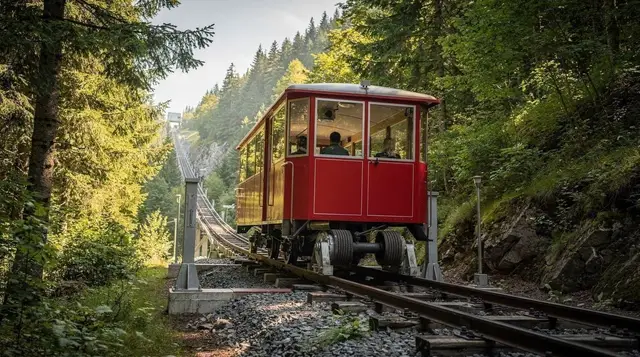
From the 1990s onward the railway added diesel locomotives to cope with rising visitor numbers without needing more steam engines and the crews and maintenance they require. Diesel trains use the same track, the same rack system and broadly the same journey time, but they run more often through the day, carry a bit more capacity, and are less likely to be delayed or cancelled by wind, since a diesel engine is mechanically simpler to run in marginal conditions than a steam boiler.
What you lose is the experience: no hiss of steam, no smell of hot oil, no sense of riding something closer to industrial heritage than public transport. Most visitors who make a special trip for the railway choose steam; most who are simply including it as one stop on a busier day take whichever departure fits their schedule, which in practice is often diesel.
Ticket prices and what the steam supplement buys
| Diesel-hauled | Steam-hauled | |
|---|---|---|
| Base return fare (adult) | around CHF 100 | around CHF 100 |
| Supplement | none | around CHF 30–40 |
| Departures per day | several, spread through the day | usually one or two |
| Seat reservation | not required | required, book ahead |
| Journey time | about 1 hour each way | about 1 hour each way, occasionally slower |
Prices move from one season to the next, so treat these as a guide rather than a quote, and check the current fare when you book. The Swiss Travel Pass and Half Fare Card both give a discount on the base fare but do not cover the steam supplement, which is charged separately when you reserve a specific steam departure. If you are travelling on a wider regional pass, it is worth reading the Jungfrau and Berner Oberland Pass guide and the Swiss Travel Pass guide before assuming the whole ride is included.
Season, weather and why the summit closes in shoulder months
The Brienz Rothorn Bahn typically operates from early June to late October, though exact opening and closing dates shift by a week or two each year depending on snowfall. Steam services generally run for a shorter core window, roughly mid-June to mid-September, with the shoulder weeks at each end of the season covered only by diesel trains, partly because the summit section can still hold snow or ice into June and again from October, and partly because staffing a steam locomotive for a handful of daily passengers in a quiet month is not worthwhile for the operator.
Wind is the main operational risk in summer. Like most exposed mountain lines around Interlaken, services can be suspended or reduced in strong wind near the summit, and the railway’s own website and webcam are more reliable than a general weather forecast for the day you are travelling. The general pattern of mountain closures for maintenance and weather is covered in when mountain railways open and close.
Booking, and why weekends need advance planning
Because each steam train is a single small carriage, and because there are only one or two steam departures on a typical day, seats sell out well before the platform fills up, particularly on Saturdays and Sundays in July and August when both Swiss and international visitors are travelling. Tickets can be reserved online in advance for a specific steam departure; turning up on the day and hoping for a steam seat on a weekend in high season is a reasonable way to end up on the diesel train instead.
Diesel trains have more departures and more seats, so same-day tickets are usually available even in peak season, though queues at the Brienz ticket office can still build up around midday. If your priority is simply reaching the summit rather than riding behind steam, travelling early or late in the day, or on a weekday, avoids most of the crowding either way.
The journey and the view from the top
The line climbs 7.6 kilometres from Brienz station, on the shore of Lake Brienz, to Rothorn Kulm at 2,244 metres just below the summit, gaining almost 1,700 metres in around an hour. Gradients reach 25 per cent in places, among the steepest anywhere on the Swiss rack network, and the train’s pace on the steeper sections is slow enough to take in the view rather than a blur.
At the top, Rothorn Kulm has a restaurant and a short walk to the actual summit cairn at 2,350 metres. On a clear day the view takes in the length of Lake Brienz below, Lake Thun beyond it, and the snow line of the Bernese Alps around the Jungfrau, Mönch and Eiger to the south. It is one of the wider panoramas accessible from Interlaken without a long hike; for how it compares with the region’s other high points, see best mountain excursions from Interlaken and, for a direct comparison with a lower, closer option, Harder Kulm guide.
Getting to Brienz and combining the trip
Brienz is about 20 minutes from Interlaken Ost by train on the line towards Lucerne, or a longer, more scenic option by boat across Lake Brienz, covered in the Lake Brienz boat trips guide. Many visitors pair the railway with Brienz’s other attractions: the woodcarving workshops in the village, a walk along the lakeshore towards Iseltwald and Giessbach, or the waterfall and funicular at Giessbach Falls a short boat hop away.
a combined Lake Brienz cruise and Rothorn steam train day from Interlaken covers the boat crossing and the mountain railway in one booking, which is a practical way to fix a steam seat in advance rather than queuing at the Brienz ticket office. For a more active option on the same mountain, a guided summit hike up the Brienzer Rothorn with a local mountain athlete reaches the same viewpoint on foot rather than by rail, returning by train.
If the Rothorn is booked out or the weather forecast for the summit looks poor, Beatenberg and the Niederhorn is a lower alternative on the other side of the lake, reached by funicular and cable car rather than rack railway; see the Niederhorn guide for how the two compare. the Brienz aerial tram return trip to the Rothorn is a faster, non-rail way up the same mountain when the steam train timetable does not fit your day.
Other ways to spend a day around Brienz
Not every visitor wants a full day built around a single railway. a tour combining Brienz, Iseltwald and Giessbach Falls takes in several of the lake’s better-known spots in one outing, useful if the Rothorn is a secondary stop rather than the main plan. a hike from Hofstetten to the Brienz wildlife park stays at lower altitude entirely and suits a day when the summit is under cloud.
For a wider view of how a day at Brienz fits into an Interlaken itinerary, the day trips from Interlaken guide and the three-day two lakes and villages itinerary both place the Brienz Rothorn Bahn alongside the rest of the Bodeli’s lakes and viewpoints, including Interlaken’s own vantage points for days when the higher summits are closed.
Brienz Rothorn Bahn: steam trains and their season
Is the Brienz Rothorn Bahn really the last steam rack railway in Switzerland?
Yes, for scheduled service. Other Swiss lines run heritage steam trains occasionally as special events, but the Brienz Rothorn Bahn is the only rack railway with steam locomotives in its regular published timetable, usually a handful of departures a day alongside diesel-hauled trains.
What is the difference between the steam and diesel trains?
The steam trains use oil-fired locomotives, several rebuilt from the original 1892 machines, that push a single carriage up the rack from the rear. They are slower, noisier and produce a strong smell of hot oil and steam. Diesel locomotives, introduced from the 1990s, pull or push modern carriages, run more frequently and keep closer to the printed timetable in strong wind or light rain.
How much does a steam-hauled ticket cost compared with a diesel one?
Both use the same base fare for the return journey, currently around CHF 100 for an adult from Brienz to Rothorn Kulm. Steam-hauled departures carry a supplement of roughly CHF 30 to CHF 40 per person on top of that, payable when you reserve a seat on a specific steam service.
When does the Brienz Rothorn Bahn run each year?
The season typically runs from early June to late October, weather and snow cover permitting. Steam trains are usually limited to the core of the season, roughly mid-June to mid-September, with diesel trains covering the shoulder weeks in June and October when snow can still close the summit section overnight.
Do I need to book in advance, especially at weekends?
For steam trains, yes. There are only one or two steam departures most days, each with a single small carriage, and seats are frequently sold out on Saturdays and Sundays in July and August. Diesel trains have more capacity and more departures, so same-day tickets are usually available, but arriving early is still safer in high season.
How long does the journey take and how steep is the line?
The one-way trip covers about 7.6 kilometres and takes roughly an hour, climbing from Brienz at 566 metres to Rothorn Kulm at 2,244 metres. The Abt rack system handles gradients of up to 25 per cent, among the steepest rack lines in Switzerland.
Is the Brienzer Rothorn worth it in bad weather?
Not really. The appeal is almost entirely the view over Lake Brienz, the Bernese Alps and, on a clear day, as far as the Jungfrau group and Lake Thun. In cloud you get a steep train ride and a restaurant at the top with nothing to look at, so check the webcam and forecast before buying steam tickets, which are non-refundable for weather.
Can I combine the railway with a Lake Brienz boat trip?
Yes, and most visitors do. The Brienz Rothorn Bahn station is a short walk from the Brienz boat pier, so a common day combines a paddle steamer or boat crossing of Lake Brienz from Interlaken Ost with the train up to Rothorn Kulm and back.
Scenic train tours on GetYourGuide
Verified deep-linked GetYourGuide tours. Book through these links and we earn a small commission at no cost to you.
GetYourGuide does not provide a product photo for this activity — the image shows the meeting point, photographed by us.