Two lakes and villages: a 3-day itinerary at water level
Interlaken’s brochures are built around altitude: the Jungfraujoch, the Schilthorn, Grindelwald First. All three are real and, on a clear day, worth the price. But they also mean queueing at a mid-station, checking a webcam before you leave the hotel, and paying between CHF 90 and CHF 220 for a return ticket. This itinerary skips all of that. It stays under 600 m the entire time, uses boats and a rack railway instead of cable cars, and costs a fraction of a single high-altitude ticket per day. It suits anyone who gets nothing from a view through cloud, anyone travelling with knees or a stroller that don’t do steep trails, and anyone visiting in the shoulder season when the summit lines close for scheduled maintenance.
Why skip the summits for three days at water level
Lake Thun and Lake Brienz sit on either side of Interlaken, joined by the Aare river that gives the town its name (Interlaken: “between the lakes”). BLS runs scheduled boats on both, most with a small on-board restaurant, and both lakes are ringed by villages that get a fraction of the Jungfraujoch’s visitor numbers. Lake Brienz in particular is often described as turquoise, and the colour is real rather than a filter: fine rock flour ground by the glaciers upstream stays suspended in the water and scatters light the same way it does in glacial lakes worldwide.
The two lakes are different enough to justify three separate days rather than a rushed loop. Thun’s side is about a castle, an old town built on a covered arcade, and a scattering of smaller châteaux along the shore. Brienz’s side is about a working village, a mountain railway that still runs on steam, and one very photogenic waterfall. Cutting it to a single day means picking one and skipping the other; this itinerary gives each its due.
Day 1: Thun, its castle and the lake’s north shore
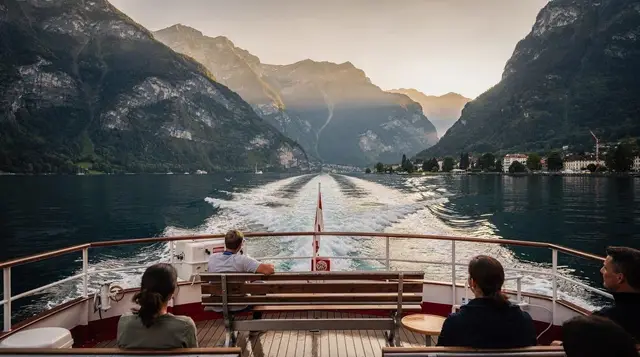
Start at Interlaken West, the station closer to the Hoheweg and the Lake Thun boat pier. The BLS boat to Thun takes around two hours and fifteen minutes end to end, considerably longer than the 25-minute train, and that is the point: the slow route stops at Spiez, Oberhofen, Hilterfingen and several smaller jetties, and the view of the Bernese Alps from the water is one the train never gives you.
If two hours each way feels like too much boat for one day, take the train to Thun (around 25 minutes from Interlaken West) and save the boat for the return leg, or for a shorter hop to just one château.
Thun’s old town is built over the Aare, with shops set into arcades below street level and the river running fast enough through the centre that swimmers use it as a natural lazy river in summer (locals do this constantly; visitors mostly don’t, and the current is stronger than it looks). Above the old town, Thun Castle (Schloss Thun) dates to the 12th century and now houses a local history museum; the climb up from the marketplace takes about ten minutes and the museum itself takes an hour, less if you’re short on time. Entry runs around CHF 10 for adults.
Along the lake’s northern shore, reachable by the same boat line, Oberhofen and Hilterfingen both have their own waterside castles, smaller and less visited than Thun’s. Oberhofen Castle has a garden that’s free to walk even if you skip the interior, and it’s a pleasant stop to break up the boat journey rather than a full destination in its own right.
For a guided version of this day that also takes in the Beatus Caves partway along the lake’s south shore, a day tour bundles the castle visits with the boat cruise and cave entry in one booking: a Thun, Beatus Caves and lake cruise day trip, useful if you’d rather not piece together boat timetables yourself.
Return to Interlaken by boat if you took the train out, or vice versa, so you see both banks of the lake across the day. Dinner back in Unterseen, the quieter old town across the river from central Interlaken, avoids the higher prices on the Hoheweg itself.
Full boat and train timetables, plus how the two compare on time and price, are in the Lake Thun boat trips guide and the Thun old town and castle guide.
Day 2: Brienz, the Rothorn steam train and the shore path
Take the train from Interlaken Ost to Brienz, a 20-minute ride along the lake’s edge. Brienz is Switzerland’s woodcarving centre, with a carving school that’s operated since 1884 and workshop windows along the main street where you can watch the process rather than just buy the result. It’s also, less usefully for tourists, a violin-making town, with one of the country’s few schools for the craft based here.
The main event is the Brienz Rothorn Bahn, the last steam-hauled rack railway still running in Switzerland on its original timetable (a handful of departures each day run on diesel instead; the timetable marks which). It climbs from Brienz station to the Rothorn summit at 2,350 m in about an hour, through hay meadows in the lower section and open alpine terrain higher up, at a pace slow enough to see marmots from the carriage window if you’re lucky.
A return ticket costs roughly CHF 82, more on steam departures than diesel ones, and the railway operates only from around late May to late October — check the current season before planning a shoulder-month visit, since it’s one of the routes most affected by scheduled spring and autumn closures across the region.
For a version of this day built around reaching the summit with some structure and company rather than working out the timetable solo: a guided ascent of the Brienzer Rothorn pairs well with an afternoon back at lake level.
If you’d rather stay low, the shore path between Brienz and Iseltwald is a flat, well-marked walk of a few hours with the lake on one side the entire way — a reasonable alternative on a day when wind has grounded the Rothorn’s upper cars, which does happen more often than the brochures suggest.
Back in Brienz, the wood-carving museum and shop windows fill an hour if the train timetable leaves a gap, and there’s a small lakeside beach near the station for anyone travelling in summer who wants to swim in genuinely cold, genuinely clear water. Details on both the railway and the walking alternative are in the Brienz Rothorn steam railway guide; swimming spots and water temperature by month are covered in the swimming guide to both lakes.
Day 3: Iseltwald, Giessbach Falls and the crossing back
The last day covers Lake Brienz’s south shore, best done entirely by boat. From Interlaken Ost, the boat to Iseltwald takes about 25 minutes. The village has become disproportionately busy for its size after its harbour and lone tree on the pier appeared in a popular South Korean television drama; coach groups now stop specifically for photos at that one spot. Arriving on an early boat, before the tour groups, is the difference between an empty pier and a queue for the same three metres of railing.
From Iseltwald, the boat continues to Giessbach, where a waterfall drops in several tiers directly above the shore and a funicular — Switzerland’s oldest still in operation, dating to 1879 — carries you up to the Grandhotel Giessbach, a 19th-century hotel built specifically to give guests a view of the falls from their rooms. The funicular ride takes about five minutes and costs a few francs each way; walking up alongside the falls instead takes 20–30 minutes on a clear path.
A boat-and-hike combination covering both stops in one booking is available as a boat trip to Giessbach Falls with a hike to Iseltwald, which works well if you’d rather walk the shore path between the two than wait for a second boat.
For something less sedate on the same stretch of shore, a quad-bike route running inland from Iseltwald covers similar ground from a different angle: a quad tour to Iseltwald and Lake Brienz.
Take the boat back to Interlaken Ost for the last leg, timing it for late afternoon light on the water if the weather’s cooperating — Lake Brienz’s colour is at its most striking a couple of hours before sunset. Full boat schedules and the difference between the north and south shore routes are in the Lake Brienz boat trips guide and the Giessbach Falls and shore path guide.
What it costs and how the two lakes compare
| Item | Approx. cost (CHF) | Notes |
|---|---|---|
| Interlaken–Thun boat, one way | 34 | Train alternative: ~13, 25 min |
| Thun Castle museum entry | 10 | Adult, ~1 hour visit |
| Interlaken–Brienz train, one way | 8 | 20 minutes |
| Brienzer Rothorn Bahn, return | 82 | More on steam departures |
| Giessbach funicular, return | 10 | 5-minute ride |
| Interlaken–Iseltwald boat, one way | 18 | ~25 minutes |
| Lake lunch (boat restaurant or lakeside café) | 25–35 | Per person |
The Swiss Travel Pass covers every boat listed here in full and gives a 50% discount on the Rothorn railway and the Giessbach funicular, which makes it worth pricing out if this three-day itinerary is part of a longer Swiss trip — details in the general Swiss Travel Pass guide. Without a pass, three days runs to roughly CHF 150–190 per person on transport and the Rothorn ticket alone, before food and any museum entries.
For how the two lakes actually differ — colour, crowd levels, which villages are worth a stop — the side-by-side comparison in Lake Thun vs Lake Brienz is a useful companion to this itinerary if you’re deciding how to split your time unevenly rather than three even days.
This works as a standalone long weekend, or as the low-altitude half of a longer stay; see the 3-day Interlaken itinerary for a version mixing in one mountain excursion, or the full 7-day Interlaken itinerary with day trips if you have more time. General costs for the region are broken down in the Interlaken travel costs guide, and where to base yourself for a lake-focused stay is covered in where to stay in Interlaken.
Two lakes in three days: your questions answered
Do I need a car for this itinerary?
No. Every stop sits on a BLS boat route or the Bern–Lucerne railway line, and Interlaken’s two stations connect to both lakes in under ten minutes on foot or by local bus.
Does the Swiss Travel Pass cover the boats and the Rothorn train?
The Swiss Travel Pass covers the BLS boats on Lake Thun and Lake Brienz in full. The Brienzer Rothorn Bahn is only discounted, not free, even with the pass, and the steam-hauled departures cost more than the diesel ones.
Is the Brienzer Rothorn Bahn worth it if I have already done a big mountain like the Jungfraujoch?
It is a different experience rather than a smaller version of it. You are on an open rack railway climbing through hay meadows and forest at walking-pace speeds, not inside a tunnel, and the top station at 2,350 m has none of the Jungfraujoch’s crowds or infrastructure.
Why is Iseltwald so busy for such a small village?
A single pier and boathouse became a well-known filming location in a South Korean television drama, and coach groups now stop specifically for photographs at that spot. Arriving on the first or last boat of the day avoids the queue for the same view.
Can this itinerary be done in two days instead of three?
Yes, by combining Thun with Oberhofen and Spiez on one long day and keeping Brienz, the Rothorn and Giessbach for a second, but the boat and train timetables leave little slack, and a missed connection costs an hour rather than the ten minutes it would on the first day.
What happens if it rains for all three days?
Boats run in light rain, and Thun’s old town and castle museum, Brienz’s woodcarving workshops and the covered sections of Ballenberg all work as wet-weather stops. Only the Rothorn’s open-air summit views suffer, and the railway itself keeps running unless winds are strong.
Lake cruises & boat tours on GetYourGuide
Verified deep-linked GetYourGuide tours. Book through these links and we earn a small commission at no cost to you.
GetYourGuide does not provide a product photo for this activity — the image shows the meeting point, photographed by us.