Why most visitors walk past it
Every train to the Jungfrau region, every lake boat, every rack railway leaflet points toward Interlaken’s Höheweg, the Hohematte meadow and the two stations. Almost nobody points across the river to Unterseen, even though it is older than Interlaken and has the only genuine old town on the Bödeli, the flat strip of land between Lake Thun and Lake Brienz.
Interlaken itself was never a town in the medieval sense — it grew from an Augustinian priory and later from hotels built for 19th-century tourists. Unterseen was chartered as a fortified town in 1279 by Berchtold von Weissenburg, with its own walls, its own church and its own council, and it kept that structure while Interlaken next door filled up with grand hotels and travel agents.
The result is a strange bit of local geography: the “real” old town sits about 400 metres from the Höheweg’s five-star hotels, across a river most visitors cross only to reach a supermarket or a cheaper guesthouse. This guide covers what is actually there — the Untere Gasse, the 1471 church, Stadthausplatz and the tourism museum — and why the price difference between sleeping here and sleeping on the lakefront strip is as real as the sights themselves.
Untere Gasse: the street Interlaken doesn’t have
The Untere Gasse is Unterseen’s spine, a single straight street lined with tall, dark-timbered houses from the 17th and 18th centuries, their ground floors stone, their upper storeys wood-shingled or clad in weathered boards. Nothing about it has been rebuilt for tourism the way parts of the Höheweg have; it still functions as an ordinary street, with a bakery, a couple of restaurants and private homes behind the shutters. Wooden houses of this age and density are unusual for the region — most Bernese Oberland villages lost their old cores to fires — and Unterseen’s survival is largely down to it having been a proper walled town rather than a scattered settlement.
Walking the full length takes about ten minutes without stopping, but the details reward slowing down: carved door lintels with dates in the 1600s, small oriel windows, and the occasional passage leading through to the riverbank. It photographs best in the morning, before the afternoon crowds heading to the Harder Kulm funicular or the lake boats pass through, and it is one of the few genuinely quiet streets on the entire Bödeli in high season.
Stadthausplatz and the town hall
At the western end of the old town, the Untere Gasse opens into Stadthausplatz, a modest square built around the Stadthaus — Unterseen’s town hall, still used for municipal business rather than preserved as a museum piece. The square is small by the standards of larger Swiss towns like Thun or Bern, but it has the same basic ingredients: a fountain, a row of façades from different centuries standing next to each other without much attempt at uniformity, and enough space for a weekly market and occasional local events.
This is the clearest sign that Unterseen was, and remains, a self-governing community rather than a resort extension. Interlaken has no equivalent civic square; its public space is the Hohematte meadow, which was never meant for markets or council meetings, only for grazing and, more recently, paragliding landings. Stadthausplatz is a five-minute stop for most visitors, but it is the single clearest piece of evidence that Unterseen’s history runs on a different track from Interlaken’s.
The church of 1471
Next to the square stands Unterseen’s reformed parish church, built in 1471 on the site of an earlier chapel connected to the Augustinian foundation across the river. It is plain rather than grand — whitewashed walls, a functional Gothic structure, no elaborate façade — but it is one of the oldest buildings still in continuous everyday use anywhere on the Bödeli, predating every hotel on the Höheweg by roughly four centuries. The tower is visible from several points along the Untere Gasse and from the riverbank, and it gives Unterseen’s skyline a completely different silhouette from Interlaken’s hotel roofs and church spire on the south side of the river.
The interior is usually open outside of services and costs nothing to visit. It is not a major sight in the way Bern’s minster or the abbey church in Interlaken are; it is worth the five minutes mainly because it anchors the argument that this side of the river had its own settled life long before tourism arrived.
The tourism museum in the old priory building
Immediately beside the church, in a building that shares its 15th-century origins, is the Touristikmuseum der Jungfrau-Region — the museum that explains how a farming valley became one of the first tourist destinations in the Alps. Exhibits cover the early 19th-century arrival of British and other foreign travellers, the building of the first hotels, the construction of the Jungfrau railway up to 1912, and the equipment — alpenstocks, early climbing gear, guidebooks, hotel registers — that documents how deliberately the region marketed itself from very early on.
It is a small museum, realistically 45 minutes to an hour, and it is far more informative about why Interlaken looks the way it does than anything you will pick up walking the Höheweg itself. Pair it with the church and the Untere Gasse and the old town becomes a genuinely worthwhile half-day rather than a shortcut between a guesthouse and the station. For context on how the wider valley’s identity was built, the region’s museums are covered in more depth in the Interlaken history and museums guide.
Matten: the quiet half of the Bödeli
South and east of Unterseen, bordering Interlaken itself, sits Matten — a residential municipality with no old town of its own but a real role in where people actually sleep. Matten has fewer grand hotels than Interlaken and none of Unterseen’s medieval core; instead it has streets of guesthouses, chalet-style B&Bs, a couple of campsites, and easy walking access to the Lütschine river and the flat paths that head toward Wilderswil and the base of the Jungfrau railway network. It is not a sightseeing destination, but for anyone counting Swiss francs it matters as much as Unterseen does, because a large share of the Bödeli’s budget beds sit within its boundaries.
Why beds are cheaper here than on the Höheweg
The price gap between the Höheweg and Unterseen or Matten is not marketing — it comes down to what guests are actually paying for. Höheweg hotels sit directly on the Hohematte meadow with unobstructed views toward the Eiger, Mönch and Jungfrau, in buildings built specifically for that view starting in the 19th century. Unterseen and Matten sit a few hundred metres back, across the river or along ordinary residential streets, with no comparable sightline and generally older, smaller, family-run properties rather than grand hotels with lake-facing terraces.
| Höheweg hotels | Unterseen / Matten guesthouses | |
|---|---|---|
| Distance to Interlaken West | 2-8 min walk | 10-15 min walk |
| Typical double room | CHF 220-450+ | CHF 90-160 |
| View | Jungfrau massif, Hohematte | Old town street or residential |
| Building age/style | 19th-century grand hotel | 17th-19th-century townhouse or modern guesthouse |
| Breakfast included | Often, at extra cost on some | Usually included |
Prices swing with the season — expect the top end in July, August and the Christmas weeks, and noticeably softer rates in November or March — but the gap between the two sides of the river holds fairly consistently. For a full breakdown of where different budgets land across the Bödeli, see the where to stay in Interlaken guide and the wider Interlaken travel costs guide.
Getting there and getting around
Unterseen and Matten are close enough to both stations that a car or taxi is rarely worth it. From Interlaken West, it is roughly a 10-minute walk across the river to the Untere Gasse; from Interlaken Ost it is closer to 15-20 minutes, or a short bus ride. Local buses 102 and 21 connect both stations to Unterseen and Matten every 10-20 minutes and are covered by Interlaken’s guest card for anyone staying overnight in the area, which makes the extra distance from the Höheweg a non-issue in practice.
| From | To Stadthausplatz | Mode |
|---|---|---|
| Interlaken West | ~10 min | On foot |
| Interlaken Ost | ~15-20 min | On foot |
| Interlaken West | ~5 min | Bus 102/21 |
| Höheweg (centre) | ~10-12 min | On foot |
Once there, everything worth seeing is within a five-minute radius of the Untere Gasse, so the town itself needs no transport at all. For a longer loop that takes in the river and the approach to Lake Brienz by bike, an e-bike route through Unterseen and along the water is a pleasant way to cover more ground than the old town alone allows.
an e-bike ride through Unterseen with a stop for local cheese tastingEating, drinking and stopping for the day
The old town has a handful of straightforward restaurants and cafés along the Untere Gasse and around Stadthausplatz — nothing aimed specifically at coach groups, which is part of the appeal. Prices tend to run slightly lower than equivalent spots on the Höheweg, in keeping with the general cost pattern of this side of the river. For a fuller picture of where to eat well without overpaying, the Interlaken restaurant guide and the dedicated eating cheaply in Interlaken guide both cover options within easy walking distance of Unterseen.
If the goal for the day is simply to see the old town and stretch your legs without spending anything beyond a coffee, the walk described here pairs naturally with the riverside paths covered in the easy flat walks around Interlaken guide — a genuinely free afternoon that most visitors never realise is available a few minutes from their hotel. It also fits neatly alongside the broader list in the free things to do in Interlaken guide.
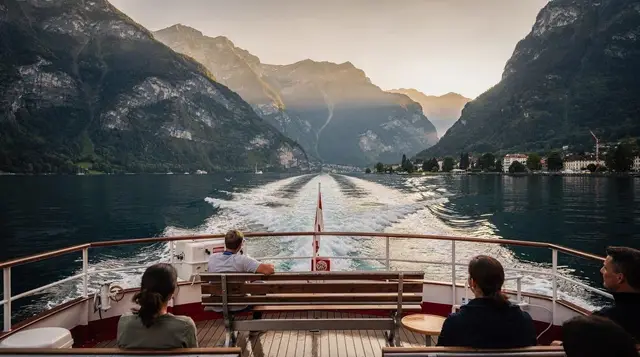
For visitors who want to see more of the water rather than more streets, a short cruise from nearby Interlaken extends the day onto Lake Thun itself.
a private three-hour boat trip on Lake Thun with refreshments includedFitting Unterseen and Matten into a longer stay
For a first visit built around the mountain trains, Unterseen and Matten work best as a half-day add-on — the kind of thing that fills a morning before an afternoon on the Harder Kulm or a rest day between bigger excursions. A typical two-day itinerary can absorb it easily; see the Interlaken 2-day itinerary for how it slots alongside the bigger-ticket mountain trips.
For anyone travelling on a tighter budget, though, it is worth considering as a base rather than a stop. Sleeping in Unterseen or Matten and walking or busing into Interlaken for trains and boats costs nothing extra in time and meaningfully less in money over a stay of several nights — the calculation covered in more detail in the Interlaken on a budget guide. Either way, it is worth building in a proper look at the sights covered here rather than treating the crossing as pure transit, since most of what makes Unterseen distinct — the street, the square, the church, the museum — sits within the same five-minute radius that everyone walks through without stopping.
Those with more time can extend the same riverside direction toward Lake Brienz, where the scenery and the old-town contrast continue in a different register.
an e-bike route from Interlaken out toward Iseltwald and the Giessbach fallsFor a broader look at how Unterseen compares with sightseeing options elsewhere on the Bödeli, the city sightseeing category and the general day trips from Interlaken guide both give useful context on where this modest old town sits relative to the region’s bigger draws — and why it is worth the ten-minute walk regardless.
Practical questions about Unterseen and Matten
Is Unterseen the same place as Interlaken?
No. Unterseen is its own municipality, older than Interlaken, on the north bank of the River Aare. Interlaken grew up around the Augustinian monastery on the south bank; Unterseen was founded as a fortified town in 1279 and kept its own street plan, church and town hall. They now run together with Matten to form the built-up area locals call the Bödeli, but Unterseen has always governed itself separately.
What is there to see in Unterseen’s old town?
The core is small: the Untere Gasse with its row of dark-timbered 17th and 18th-century houses, the Stadthausplatz square with the town hall, the reformed church built in 1471, and the Touristikmuseum der Jungfrau-Region housed in the former priory building next to the church. All of it is walkable in under an hour, though the museum and church interiors add more time.
How old is the church in Unterseen?
The current church building dates to 1471, replacing an earlier chapel tied to the Augustinian foundation across the river. It is one of the oldest intact buildings in the Interlaken area still in everyday use, and its plain Gothic form is a useful contrast to the ornate hotel façades on the Höheweg.
Why is accommodation cheaper in Unterseen and Matten than on the Höheweg?
The Höheweg hotels sit directly on the Hohematte meadow with lake and mountain sightlines, which is what guests pay the premium for. Unterseen and Matten are a few hundred metres back from that strip, with no lake view and older, smaller buildings, so guesthouses and B&Bs there run noticeably lower rates for essentially the same walking distance to the stations and the mountain trains.
How do I get from Interlaken to Unterseen?
On foot it is 10-15 minutes from Interlaken West station or the Höheweg, crossing the Aare on one of the footbridges. Bus routes 102 and 21 also run through Unterseen and Matten from both Interlaken stations every 10-20 minutes, which matters more in poor weather or with luggage than for the walk itself.
Is Matten worth a separate visit from Unterseen?
Matten does not have Unterseen’s old town, but it has the quieter residential streets, several of the area’s guesthouses and campsites, and closer access to the lower Lütschine and the paths toward Wilderswil. Most visitors see it in passing rather than as a destination in its own right, unless they are staying there.
How much time do I need for Unterseen and Matten?
Two to three hours covers the Untere Gasse, Stadthausplatz, the church and the museum at an unhurried pace. Add an hour for a riverside coffee or a walk along the Aare toward Lake Brienz. Many budget-minded visitors simply sleep here for two or three nights and commute into Interlaken proper for the mountain trains.