Free things to do in Interlaken
What can you do for free in Interlaken?
Watch paragliders land on the Hohematte, walk the Aare river path between the two lakes, swim for free at Lake Thun or Lake Brienz, wander Unterseen's 700-year-old old town, and climb the path to the Heimwehfluh viewpoint. All of it costs nothing beyond the train fare to get to Interlaken.
Most visitors to Interlaken budget for the Jungfraujoch, the Schilthorn or at least one cable car, and that budget is often the right call — the mountains are the reason the town exists as a resort. But a full day here can be spent without a single railway ticket, and it isn’t a consolation prize. The Hohematte, the river between the two lakes, the free lake access points and the old town across the water in Unterseen are worth doing on their own terms, mountain weather or not.
This guide sticks to genuinely free activities: no entry fee, no lift ticket, no minimum spend. Where a paid alternative exists alongside a free one — a funicular next to a walking path, a lido next to open lake access — both are noted so you know what you are giving up.
The Hohematte: parkland with paragliders overhead
The Hohematte is 14 hectares of protected meadow sitting in the middle of Interlaken, bordered by the Hoheweg and its row of grand 19th-century hotels. It has no fence, no ticket booth and no closing time. Locals cut through it on the way to work; tourists lie on it between train connections.
Its second function is as the official landing zone for paragliders coming down from Beatenberg, the Niederhorn and other launch points above Lake Thun. On a clear afternoon between roughly April and October, expect a steady stream of canopies coming in low over the meadow every few minutes. Landings cluster in the afternoon, when thermal conditions are best, and thin out or stop entirely in poor weather or strong wind — the same wind that also closes some of the region’s cable cars.
Watching from the grass costs nothing. If you’d rather be under the canopy than watching it, tandem paragliding is one of the region’s signature paid activities and launches from several points above town; that’s a separate trip, not part of this list.
Walking the Aare from lake to lake
Interlaken’s name literally means “between the lakes,” and the Aare river channel that connects Lake Thun and Lake Brienz runs straight through the middle of town. A footpath follows it for most of its length, past the Hohematte, under the town’s bridges, and out toward the canal mouths at each end.
It’s flat, entirely free, and takes about 30 to 45 minutes end to end at an easy pace — longer if you stop. The water itself is glacier-fed and startlingly clear with a pale turquoise tint, the same colour that shows up in both lakes and that surprises people who assume it’s a filter effect in photographs. Interlaken Ost sits near the Lake Brienz end of the channel and Interlaken West near the Lake Thun end, so the walk conveniently connects the town’s two railway stations if you have time to kill between trains.
Two lakes, two places to swim for nothing
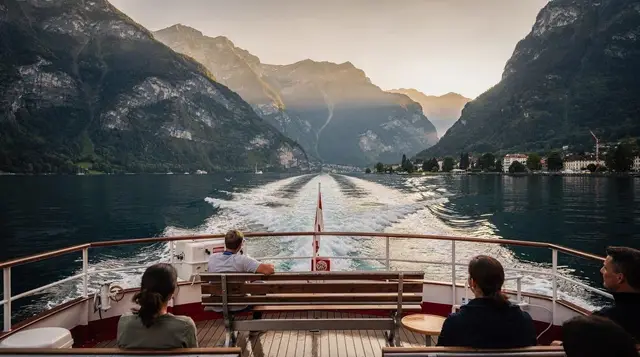
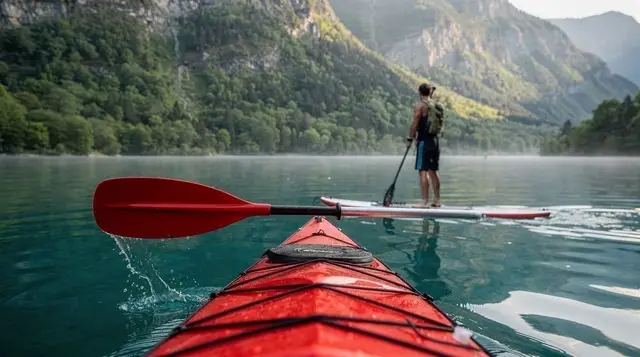
Interlaken sits between two lakes and both have free public access points, separate from the paid lidos that offer lifeguards, changing rooms and grass to lie on for an entrance fee.
| Lake | Free access point | Getting there | What you get |
|---|---|---|---|
| Lake Thun | Lakeside lawns near Neuhaus, on the edge of Unterseen | 15–20 min walk from Interlaken West, or bus | Open shoreline, no facilities, water quality is monitored and reliably good in summer |
| Lake Brienz | Shoreline at Bönigen | 20 min walk from Interlaken Ost, or a few minutes by train/bus | Quieter than the Thun side, colder water (Brienz is fed more directly by glacial meltwater), views toward the Faulhorn ridge |
Both lakes are glacial and cold even in August, warming to swimmable temperatures mainly from July through early September. Neither free spot has a lifeguard, so the usual open-water caution applies, particularly for children. If you want facilities — changing cabins, diving platforms, a snack kiosk — that’s what the paid lidos on both lakes are for, and they’re covered in the swimming guide for Lake Thun and Lake Brienz.
Unterseen: the old town across the river
Most visitors never cross the Aare into Unterseen, a separate municipality that predates Interlaken’s hotel district by centuries. Where the Hoheweg is 19th-century tourism architecture, Unterseen’s Marktgasse is a proper Bernese old town: wooden shutters, arcaded ground floors, a town hall, and a market square that still functions as one on Tuesday mornings.
It costs nothing to walk it. The Touristik-Museum der Jungfrau-Region, which covers the history of tourism in the region, does charge admission if you want to go inside; the streets around it don’t. Unterseen also has its own church, distinct from Interlaken’s, and its tower is the oldest built structure in the immediate area — see below.
Unterseen’s 1471 church tower
The tower of Unterseen’s parish church dates to 1471. The body of the church has been rebuilt and altered since, as is normal for a building of this age, but the tower itself is the genuine article: a 15th-century structure still standing in a town that otherwise reads as 18th- and 19th-century. It’s a two-minute stop, not a destination in itself, but it’s the oldest thing you’ll see in Interlaken or Unterseen without a car and a trip further afield to somewhere like Thun or Bern, both of which have considerably more medieval fabric intact.
Up to the Heimwehfluh — on foot, not the funicular
The Heimwehfluh is a low hill directly above Interlaken with a viewing platform looking out over both the town and the Hohematte toward the peaks beyond. A funicular runs to the top and is paid; a signed walking path climbs the same hill in roughly 20 to 30 minutes and is not.
The path starts from streets on the south side of town and isn’t difficult, but it is uphill the whole way, so it’s not the place to go in flip-flops or with a stroller — the funicular guide covers that paid ropeway alternative if you’d rather not walk up. What you get at the top for free is essentially the same view as paying visitors: a panorama over the rooftops of Interlaken, the green rectangle of the Hohematte, and the mountains framing the valley. There’s also a small summer toboggan run and model railway at the summit, both of which do charge — walking up doesn’t get you those, only the view.
For a longer version of the same idea, the town’s viewpoints are ranked and compared in the Interlaken viewpoints guide, which also covers paid options like the Harder Kulm funicular for comparison.
Putting a free day together
A realistic itinerary, assuming you’re staying in or near Interlaken and not adding train travel to another town:
| Time | Activity | Cost |
|---|---|---|
| Morning | Walk the Aare path from Interlaken Ost to Interlaken West | Free |
| Late morning | Cross into Unterseen, walk the Marktgasse, see the 1471 church tower | Free |
| Midday | Lunch in town (not free, but unavoidable) | Variable |
| Early afternoon | Walk up to the Heimwehfluh viewpoint | Free |
| Late afternoon | Back down to the Hohematte to watch paragliders land | Free |
| Evening | Swim at Neuhaus (Lake Thun) or Bönigen (Lake Brienz) if the weather and season allow | Free |
That’s a full day without a single lift ticket. It pairs naturally with the one-day Interlaken guide if you want to see how a paid mountain excursion would slot in instead, and with the Interlaken on a budget guide for the wider picture on keeping costs down across a longer stay — including the real cost of a day in Interlaken, which breaks down where the money actually goes when it isn’t going to free activities.
If the weather turns, most of this list stops working — the Hohematte and the Heimwehfluh path are outdoor propositions, and swimming obviously depends on the season. The rainy-day guide covers the indoor fallback, and the flat walks guide has more low-effort outdoor options if the Aare path leaves you wanting another hour of walking.
Where free still costs something
None of this is really a zero-cost day. You’ll pay to get to Interlaken in the first place, whether that’s a Swiss Travel Pass, a point-to-point ticket, or driving and parking. You’ll pay for food, at Swiss prices, whether or not you spent anything on sightseeing that day. If you’re arriving with luggage between trains, lockers at both stations aren’t free either.
What you save is the CHF 100+ that a Jungfraujoch ticket or a Schilthorn round trip represents. That’s real money, and it’s worth spending on at least one of the region’s signature excursions during a longer stay — but it doesn’t have to be spent every day, and this list is what fills the gaps around it.
If you’d rather see the town with some structure and local commentary than work it out from a map, a guided option covers the same ground with context added:
a private walking tour of Interlaken takes in the Hohematte, the old town and the river in a couple of guided hours, which is one way to see all of the above without cross-referencing a map on your phone.
For a version that covers more distance — useful if you also want to see Unterseen, the lakeshores and a bit of the surrounding countryside in one outing — an e-bike tour taking in Interlaken’s lakes, ruins and viewpoints reaches spots the walking itinerary above doesn’t, in less time.
And if half a day on two wheels appeals more broadly, a panoramic e-bike tour through the villages around both lakes extends the same free-sightseeing logic — mountains and lakes as scenery rather than as ticketed attractions — further out from the town centre.
None of these tours are free, and none of them are necessary to do everything described above; they’re for anyone who’d rather have a guide and a bike than a map and their own two feet.
Free things to do in Interlaken: your questions answered
Is the Hohematte free to visit?
Yes. It is public parkland with no entry fee, no gate and no opening hours. You can walk across it at any time, and in summer you will usually find paragliders landing there through the afternoon.
Can you swim in Interlaken for free?
Yes, at public lake access points on both Lake Thun and Lake Brienz. There is no entry charge, though staffed lidos with changing rooms and lifeguards elsewhere on the lakes do charge admission.
Is Unterseen the same town as Interlaken?
No. Unterseen is a separate municipality just across the Aare from Interlaken, though the two are joined and share the Bodeli agglomeration with Matten. Unterseen has the older townscape; Interlaken grew up around the hotels on the Hoheweg.
Do you have to pay for the funicular to reach the Heimwehfluh?
No. The funicular is paid, but a signed walking path climbs the same hill from Interlaken in about 20 to 30 minutes and costs nothing. You give up the funicular ride, not the view from the top.
What is the oldest building in Interlaken or Unterseen?
The tower of Unterseen’s parish church dates to 1471, making it the oldest standing structure in the immediate area. The rest of the church was rebuilt later, but the tower survives from the 15th century.
How much does a day of free activities in Interlaken actually cost?
The activities themselves cost nothing, but you will still pay for the train or bus to reach Interlaken, any food you buy, and possibly a locker for luggage. Budget for transport and meals as normal; only the sightseeing itself is free.
Is Interlaken expensive if you stick to free things?
It is cheaper than a day involving the Jungfraujoch or Schilthorn, but Switzerland’s general price level for food and drink still applies. A coffee or a sandwich costs the same whether or not you paid for a mountain railway that day.
Lake cruises & boat tours on GetYourGuide
Verified deep-linked GetYourGuide tours. Book through these links and we earn a small commission at no cost to you.
GetYourGuide does not provide a product photo for this activity — the image shows the meeting point, photographed by us.