Things to do in Interlaken when it rains
What should you actually do in Interlaken when it rains?
Go to St Beatus Caves and the Trummelbach Falls, both largely indoors or already drenched by design, spend an afternoon at a thermal bath, and use the Touristik-Museum or a Bern museum day trip to fill the rest. Skip the Jungfraujoch, Schilthorn and Harder Kulm until the forecast clears, since the view is the entire product and cloud takes it away.
When three grey days land on your Interlaken trip
The Bernese Oberland gets weather systems that stall against the mountains, and it isn’t unusual to have three or four days of low, unbroken cloud sitting over Interlaken while the rest of Switzerland is dry. That’s a problem specifically for this region, because most of what people come here for is a view: the Eiger, Monch and Jungfrau from a summit platform, the turquoise water from a boat deck, the valley floor from a cable car. Take the view away and a lot of the standard itinerary stops making sense.
This isn’t a list of consolation-prize indoor activities to kill time. Some of what follows is genuinely better in poor weather, because the product doesn’t depend on visibility. The rest is a guide to what still functions properly when it’s tipping down, and what to leave for a day when the forecast improves.
St Beatus Caves: the one attraction rain cannot touch
The Beatushohlen, on the north shore of Lake Thun near Sundlauenen, are a genuinely good half-day out regardless of what’s happening outside. You walk about 1 km of lit, paved passage through limestone caverns with underground waterfalls, on a route that takes roughly 50 minutes. Entry runs around CHF 20 for adults, CHF 10 for children, and the caves stay a constant 8 to 10 degrees Celsius year-round, so bring a layer even in August.
The only outdoor part is the approach path from the car park or from the boat landing, a walk of 10 to 15 minutes with some steps. Buses run from Interlaken West via Beatenbucht, and the site sits below Beatenberg, reachable by the same road that climbs to the Niederhorn cable car base. The caves close for winter, typically from early November to Palm Sunday, so this is a fair-weather-independent option only in season.
The Trummelbach Falls are already wet
At Stechelberg, deep in the Lauterbrunnen valley, the Trummelbach Falls carry glacial meltwater from the Jungfrau massif down through a series of ten waterfalls inside the mountain, reached by a funicular that climbs about 100 m through the rock. Entry is around CHF 16 for adults, CHF 6 for children, and the visit takes 45 minutes to an hour on a walkway that’s already soaked with spray at several points regardless of what the sky is doing.
This is arguably the single best rainy-day pick in the region: the weather outside genuinely doesn’t change the experience, since you’re inside the mountain looking at water that’s been falling there since the glaciers retreated. It closes in winter, usually late October to early April, same seasonal window as most of the valley’s paid attractions.
Indoor museums worth the entrance fee
Interlaken’s own museum scene is modest. The Touristik-Museum covers how a farming village on the Bodeli became a 19th-century tourist resort, with old mountaineering equipment, hotel memorabilia and the story of the Jungfrau Railway’s construction; it’s small, a genuine 30 to 45 minute visit, and entry is a few francs. It’s fine for a rain-delayed morning but won’t fill a whole day on its own.
For that, take the train to Bern (52 minutes from Interlaken Ost) and spend the day on museums. The Zentrum Paul Klee, Renzo Piano’s wave-shaped building on the eastern edge of the city, holds the largest Klee collection anywhere, and Bern’s compact old town has a cluster of other museums within walking distance, alongside the arcaded streets themselves, which are covered enough by the arcades to stay dry-ish even in real rain. A walking guide to the old town covers the route between the Zytglogge, the cathedral and the Bear Park.
Ballenberg open-air museum, the collection of relocated historic Swiss farmhouses near Brienz, is a genuinely good day out but it’s mostly outdoors between buildings, so a full day of steady rain makes it hard work even with decent waterproofs; a morning of drizzle with the interiors of the houses themselves as shelter is more manageable than an all-day downpour. Nearby, Brienz’s woodcarving and violin-making workshops are entirely indoors and make a shorter, weather-proof stop if you’re already on that side of the lake.
Thermal baths and a slow afternoon
When the cloud has been down for two days and everyone’s patience is thinning, a thermal bath is the honest answer, not a downgrade. The region’s thermal baths run CHF 25 to CHF 35 for a half-day session depending on the venue, with indoor and outdoor pools, saunas and, in most cases, mountain views from the water that look better shrouded in mist than they have any right to. If you want to make an afternoon of it properly, several spa hotels in the Jungfrau region sell day access to non-guests, which is worth checking if your own accommodation doesn’t have a pool.
A walking tour that adapts to the weather
A guided walk through the town centre, along the Hoheweg past the Hohematte and down to the Aare channel between the two lakes, works in genuine drizzle in a way that a cable car simply doesn’t; if it turns to proper rain you cut it short. A private guided walk through Interlaken gives you a local’s read on where to shelter, what’s actually worth queuing for, and which of the two lakes is which, at a pace you control rather than a fixed departure time you’d be stuck with in a downpour.
What not to pay for when the cloud is down
This is the part that saves money. The Jungfraujoch, Schilthorn and Harder Kulm are all selling a view, and cloud at valley level often means cloud at summit level too, though not always: the Jungfraujoch guide and the Schilthorn guide both cover the trick of checking the summit webcam on jungfrau.ch or schilthorn.ch before you buy, since the mountain can occasionally be in sunshine above a valley cloud layer.
If the summit cam shows white-out, a round trip to the Jungfraujoch at over CHF 220 buys a viewing platform with fog pressed against the glass, and the funicular up Harder Kulm above Interlaken Ost has the same problem at a smaller price. Our rundown of overpriced things in the region treats a summit ticket bought on a bad forecast as the single biggest way to waste money here.
Paragliding, skydiving and canyon activities are a different kind of no. They don’t get rained on so much as grounded: low cloud and poor visibility over the Bodeli mean tandem paragliding and skydiving flights simply don’t operate, and operators reschedule or refund rather than fly blind. If you’ve booked a skydiving jump over the Alps for a day that turns out grey, expect a same-day rebooking rather than a refund fight, since this is routine for operators here.
Rafting and canyoning are more weather-tolerant since you’re wet anyway, but heavy rain raises river levels and can suspend trips on safety grounds; a booking like a rafting trip with raclette afterwards is worth checking the operator’s own weather policy for rather than assuming it will simply go ahead.
The comparison, side by side
| Activity | Weather-proof? | Approx. cost | Time needed |
|---|---|---|---|
| St Beatus Caves | Yes, mostly indoors | CHF 20 adult | 1–1.5 hours |
| Trummelbach Falls | Yes, inside the mountain | CHF 16 adult | 45–60 min |
| Thermal baths | Yes | CHF 25–35 | 2–4 hours |
| Touristik-Museum | Yes | CHF 6–8 | 30–45 min |
| Bern museum day trip | Yes | Train + entries | Full day |
| Ballenberg | Partly, mostly outdoors | CHF 32 adult | Half to full day |
| Jungfraujoch | No, view-dependent | CHF 220-plus | Full day |
| Schilthorn | No, view-dependent | CHF 110-plus | Half to full day |
| Harder Kulm | No, view-dependent | CHF 40 return | 2–3 hours |
| Paragliding / skydiving | No, grounded in low cloud | CHF 180-plus | Weather permitting |
A day trip instead of waiting it out
If the forecast shows rain settling in for the whole Bodeli but clearing further north or west, the fastest fix is to leave. A Bern day trip or a run to Lucerne, about 1 hour 50 by the scenic Brunig line, both put you somewhere with a genuine museum and old-town alternative rather than a scaled-down version of what you’d have done in sunshine.
A guided day trip between Lucerne and Interlaken works in either direction and is a reasonable way to reroute a bad-weather day without organising the connections yourself. Thun’s old town and castle, just 25 minutes away, is a shorter option if you don’t want to commit to a full day elsewhere, with covered arcades along the main street that keep shoppers dry the way Bern’s do.
Checking before you commit
The mountain railways here close for scheduled maintenance in spring and autumn on top of any weather closures, so a rainy-day plan should also confirm the line you’re relying on is actually running that week; our guide to when the mountain railways open and close lists the typical maintenance windows by route. None of the indoor options above have that problem, which is part of why they’re worth building a wet stretch of your trip around rather than treating as filler.
FAQ: rainy days in Interlaken
Is it worth going up the Jungfraujoch if it’s raining in Interlaken?
Only if the summit forecast is separate and clear, which happens more often than you’d think since Interlaken sits at 568 m and the Jungfraujoch at 3454 m can be in sunshine above the cloud layer. Check the live webcam on jungfrau.ch before buying. If the summit webcam shows white-out, the CHF 220-plus round trip buys you a viewing platform with no view.
Are St Beatus Caves open in the rain?
Yes. The show cave itself is entirely underground and unaffected by weather, and only the short approach walk from the car park or the boat landing at Beatenbucht is outdoors. It’s one of the few attractions in the region that a wet forecast doesn’t touch.
Is the Trummelbach Falls worth it if it’s already raining?
Yes, arguably more so. You’re seeing meltwater cascading through tunnels inside the mountain, reached by a funicular, so you’re already going to get some spray regardless of the weather outside. A grey day outside doesn’t change what’s happening inside the rock.
What should you avoid booking in Interlaken on a rainy day?
Paragliding, skydiving and the summit railways to the Jungfraujoch, Schilthorn and Harder Kulm. Paragliding and skydiving simply don’t fly in low cloud or heavy rain and get rebooked or refunded, while the summit trips run on schedule but sell you a ticket to stand inside a cloud.
Are museums in Interlaken itself any good, or do you need to go to Bern?
Interlaken’s own museum offer is thin, essentially the Touristik-Museum covering tourism and mountaineering history. For a proper wet-day museum circuit you need Bern, about 52 minutes away by train, which has the Zentrum Paul Klee and the old town’s museum quarter.
Do the lake boats still run in the rain?
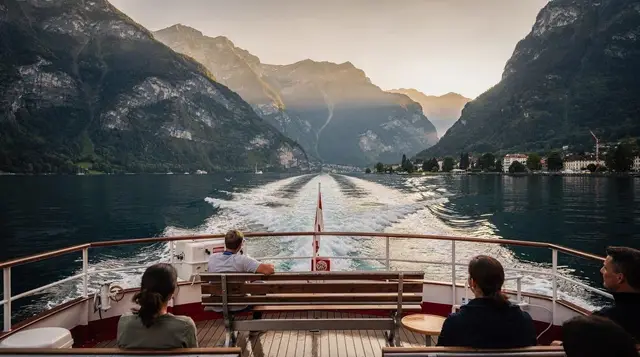
Yes, the BLS boats on Lake Thun and Lake Brienz run on their published timetable in rain, with covered seating on every vessel. Wind is the more common reason for cancellation than rain alone, and that’s announced at the pier, not in advance.
Is Ballenberg open-air museum worth it on a rainy day?
It’s mostly outdoors between historic farmhouses, so a full day of steady rain makes it hard going even with an umbrella. A morning of drizzle with clearer spells is manageable since many of the houses themselves are open for shelter, but book it for a better forecast if you have the choice.
Lake cruises & boat tours on GetYourGuide
Verified deep-linked GetYourGuide tours. Book through these links and we earn a small commission at no cost to you.
GetYourGuide does not provide a product photo for this activity — the image shows the meeting point, photographed by us.