Schilthorn: cable car, revolving restaurant and the Thrill Walk
How do you get to the Schilthorn and is it worth it?
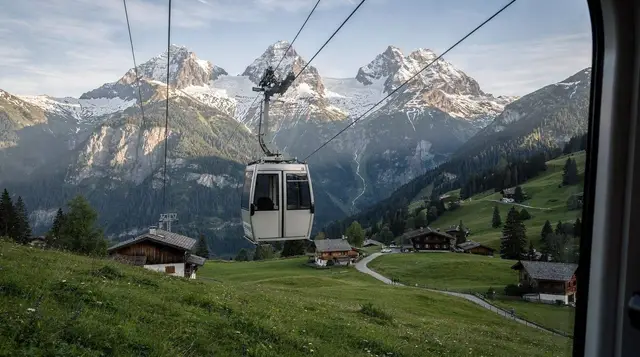
The Schilthorn is reached by a four-stage cable car from Stechelberg via Gimmelwald, Mürren and Birg, taking around 30-32 minutes each way. The summit panorama at 2,970 m takes in the Eiger, Mönch and Jungfrau, and a return ticket costs roughly CHF 108-138 depending on season and starting station.
Four cable cars from Stechelberg to the summit
The Schilthorn, at 2,970 m, sits on the ridge above the Lauterbrunnen valley, and the classic way up is the Schilthornbahn from Stechelberg, at the head of the valley. It is not one cable car but four linked sections, each with its own cabin change: Stechelberg to Gimmelwald, Gimmelwald to Mürren, Mürren to Birg, and Birg to the Schilthorn summit. The whole ride takes around 30-32 minutes each way including the changes, and cabins run every 15-30 minutes depending on season and time of day.
Gimmelwald and Mürren are both car-free villages, reached only by this cable car, by the funicular up from Lauterbrunnen via Grütschalp, or on foot. If you are staying in Mürren rather than down in Stechelberg, you join the cable car partway up at the Mürren station, cutting the ride to the summit down to about 16 minutes through Birg. Either way, keep in mind that a car left in Lauterbrunnen or Stechelberg stays exactly where you parked it — none of these villages take vehicles beyond a handful of resident permits.
| Stage | From | To | Approx. time |
|---|---|---|---|
| 1 | Stechelberg (922 m) | Gimmelwald (1,363 m) | 5 min |
| 2 | Gimmelwald | Mürren (1,638 m) | 5 min |
| 3 | Mürren | Birg (2,677 m) | 7 min |
| 4 | Birg | Schilthorn (2,970 m) | 5 min |
Return fares from Stechelberg run roughly CHF 108-138 depending on season, with Half Fare Card and Swiss Travel Pass holders getting 25% off. Starting from Mürren instead is noticeably cheaper, since you skip the first two sections. For a first visit, a guided option such as this small-group day trip to the Schilthorn from Interlaken is worth comparing against — actually, book it directly through a small-group day trip to the Schilthorn from Interlaken, which bundles transport from Interlaken with the lift ticket and takes the guesswork out of timings and connections.
Birg and the Thrill Walk
Birg, the second-to-last station at 2,677 m, is easy to treat as a mere changeover point, but it is worth 20-30 minutes on its own. This is where the Thrill Walk sits: a roughly 200-metre steel walkway fixed to the outside of the cliff, including sections of glass flooring and a net bridge strung over the drop toward the Lauterbrunnen valley. It is free once you are at Birg — no separate ticket — but it is entirely weather-dependent. In wind, rain or ice the platform is roped off, and staff will not open it for the view alone.
Birg also has its own outdoor viewing platform and a small restaurant, both usually far quieter than the summit above. If the queue for the last cabin up to the Schilthorn is long, or if the top is in cloud while Birg is clear, it can be the better stop of the two. Anyone uneasy with heights should be aware that the glass sections and the net crossing are the whole point of the Thrill Walk, not an incidental feature — there is a solid walkway alternative alongside for those who want the view without the exposure.
Piz Gloria: the revolving restaurant and Bond World
The Schilthorn’s summit building is called Piz Gloria, built in the late 1960s and used as a filming location for the 1969 Bond film On Her Majesty’s Secret Service — the reason the restaurant markets itself around the connection to this day. The 360° restaurant rotates a full circle roughly every 45 minutes, so a sit-down meal or even a coffee gives you the entire panorama without moving from your seat. It is not a cheap option — a main course runs from around CHF 25 upward and a full breakfast buffet is closer to CHF 30 — but paying for the view once, rather than shuffling around an open deck in the wind, is a reasonable trade at this altitude.
The Sunrise Breakfast package, run on specific mornings depending on season, gets you up to the summit before the first regular cabins, ahead of the day’s crowds, for breakfast as the sun comes over the Jungfrau massif. It costs more than a standard ticket and requires an early departure from Stechelberg or Mürren, but it is the version of Piz Gloria that best matches the marketing photos — the ordinary late-morning visit, by contrast, often means a busy restaurant and a viewing platform shared with several coach groups.
Bond World 007, included in the standard lift ticket, is a compact exhibition on the making of the film, with props, stills and a short themed cinema experience. It takes 20-30 minutes and is a reasonable way to fill time before a restaurant table is ready, though it is not, on its own, worth the trip.
Schilthorn versus Jungfraujoch: an honest comparison
Both summits are heavily marketed from Interlaken, and both are genuinely worth doing if the weather allows only one. They are not the same experience, though, and the choice usually comes down to budget, crowds and what kind of view matters more to you.
| Schilthorn (2,970 m) | Jungfraujoch (3,454 m) | |
|---|---|---|
| Return from Interlaken area | Roughly CHF 108-138 from Stechelberg | Roughly CHF 200-230 from Interlaken |
| Journey time (one way) | Approx. 45-60 min from Interlaken | Approx. 2 hours from Interlaken |
| View | Wide panorama of the Eiger-Mönch-Jungfrau wall from across the valley | Standing among the peaks, plus the Aletsch Glacier |
| Typical crowds | Moderate | Heavy, especially midday |
| Extras | Thrill Walk, Bond World, revolving restaurant | Ice Palace, Sphinx observatory, glacier plateau |
The Jungfraujoch sits higher and delivers the novelty of Europe’s highest railway station, with the Aletsch Glacier stretching out below, but the journey is longer, the ticket costs roughly double, and the platforms can feel crowded by mid-morning. The Schilthorn’s advantage is the angle: rather than standing in among the three great peaks, you look across at the whole Eiger-Mönch-Jungfrau wall from a separate ridge, which for photography is arguably the better vantage point.
For a longer read on the trade-offs, see this Jungfraujoch versus Schilthorn comparison, and for the Jungfraujoch itself in detail, the Jungfrau railway guide covers the route through Kleine Scheidegg and Männlichen.
If time and budget allow both, they pair reasonably well over a longer stay, but doing both on the same trip in bad weather is a waste of money — check forecasts and webcams before committing to either, and see when the mountain railways open and close for the seasonal maintenance windows that catch out a surprising number of visitors.
Prices, passes and how to save
Ticket prices for the Schilthornbahn change by season, and discounts stack differently depending which pass you hold, so treat the figures below as a starting point rather than the final word — always check the current tariff table before buying.
- Half Fare Card / Swiss Travel Pass: 25% off standard return fares.
- Berner Oberland Pass: covers or heavily discounts the Schilthorn depending on the pass tier and season — see the Jungfrau and Berner Oberland Pass guide for the current tiers.
- Starting from Mürren instead of Stechelberg: cuts out two of the four cable car sections and reduces the fare accordingly.
- Morning versus Sunrise Breakfast tickets: the Sunrise option costs more but avoids the midday crowds entirely.
For a wider look at how the Schilthorn compares cost-wise with the region’s other passes, the Swiss Travel Pass guide and the general cable cars and funiculars explained page both cover how discounts apply across the Jungfrau region’s various lifts.
Weather, wind and when to go
The Schilthorn’s summit platform and the Thrill Walk at Birg are both routinely closed by wind, not just by cloud, and this is what ruins more visits than anything else. Check the live webcam and forecast on the Schilthornbahn site before setting out from Interlaken — a clear morning down in the valley says nothing about conditions at 2,970 m. As with most high lifts in the region, the Schilthornbahn also shuts for a scheduled maintenance window in spring and again in late autumn, typically a couple of weeks each in April and November, so a trip planned for those months needs a check against the published closure dates first.
Late spring through early autumn gives the most reliable weather and the longest opening hours. Winter opens up a different use of the same lift: Mürren and the Schilthorn form one of the region’s ski areas, with the descent from the summit rated among the more demanding runs in the Bernese Oberland, while Wengen sits across the valley with its own, gentler slopes. For a non-skiing winter alternative that still gets you into the snow, a guided snowshoe tour from Interlaken covers similar terrain at a gentler pace.
Combining the Schilthorn with a wider day out
Because the Schilthornbahn starts at Stechelberg, it sits naturally alongside a walk through the Lauterbrunnen valley or a stop at Trümmelbach Falls on the way there or back. Adventurous visitors sometimes pair the trip with the via ferrata routes above Mürren and Gimmelwald, which use fixed cables on the cliffs below Birg. For those who prefer a guided, all-in version of the day that also takes in Bern, a private day trip combining Bern with Lauterbrunnen, Mürren and the Schilthorn covers considerably more ground than a self-planned itinerary would in a single day.
If a full day feels like too much, a shorter option exists: an afternoon tour up to the Schilthorn from Interlaken compresses the cable car ride, summit time and return into half a day, which suits anyone splitting a stay between the Schilthorn and another excursion such as Grindelwald First or Harder Kulm closer to town. For a longer stay that fits the Schilthorn into a broader look at the region, the Jungfrau region highlights, three days itinerary sets out a workable order for the area’s main excursions without doubling back on transport.
What to bring and how long to allow
Even in summer, the summit temperature at 2,970 m typically runs 15-20°C cooler than Interlaken, and wind at the top makes it feel colder still — bring a proper layer even on a warm valley morning. Sunglasses and sunscreen matter more than they seem to at this altitude, given the exposure on the open viewing platforms.
Allow a minimum of three hours door to door for a straightforward visit: the return cable car journey, 45-60 minutes at the summit for the view, restaurant and Bond World, plus transport time from Interlaken to Stechelberg. A half-day is comfortable; a full day gives room to add Birg’s Thrill Walk properly, a sit-down meal at Piz Gloria, and a stop in Mürren on the way down rather than treating it purely as a changeover station.
Schilthorn and Piz Gloria: frequently asked questions
How long does it take to get from Interlaken to the Schilthorn?
Allow around 1 hour 15 minutes door to door: roughly 20 minutes by train or postbus from Interlaken to Stechelberg, then about 32 minutes on the four-stage cable car to the summit. Starting from Mürren instead cuts the cable car time to around 16 minutes.
Is the Schilthorn cable car included in the Swiss Travel Pass?
No. Swiss Travel Pass holders get 25% off the Schilthornbahn, the same discount as the Half Fare Card. The Berner Oberland Pass and Jungfrau Travel Pass include or further discount the ride depending on the season and pass tier, so check the current terms before buying a separate ticket.
What is the Thrill Walk and is it included in the ticket?
The Thrill Walk is a roughly 200-metre steel walkway bolted to the cliff face at Birg, with glass floor sections and a net crossing over a sheer drop. It is free to walk once you are at Birg station, which any standard Schilthorn ticket passes through, but it only opens in fine weather and closes in wind or ice.
Do I need to book the revolving restaurant separately?
No booking is required to enter Piz Gloria’s Bond World 007 exhibition or the 360° revolving restaurant, since both are covered by the lift ticket. A table by the window is not guaranteed at busy lunch sittings, so arrive close to opening or plan for a later, quieter seating.
Is the Schilthorn or the Jungfraujoch better?
The Jungfraujoch is higher, has the Aletsch Glacier and the novelty of Europe’s highest railway station, but is often crowded and can be in cloud. The Schilthorn is roughly half the price, usually quieter, and gives a wider, uninterrupted view of the Eiger-Mönch-Jungfrau wall from across the valley rather than standing underneath it.
When does the Schilthorn close for maintenance?
The Schilthornbahn typically closes for around two to three weeks each in spring and late autumn for annual servicing, usually in November and again in April, with exact dates published on the operator’s site each year. Outside those windows, the lift itself rarely closes, though the summit platform and Thrill Walk shut in high wind.
Can I do the Schilthorn without a car?
Yes, and most visitors do. Trains and postbuses run from Interlaken to Stechelberg via Lauterbrunnen roughly twice an hour, and Mürren and Gimmelwald are themselves car-free villages reached only by cable car or on foot.
Is Bond World worth the extra time?
Bond World 007 is a compact, free exhibition on the making of On Her Majesty’s Secret Service, filmed partly at Piz Gloria, with props, behind-the-scenes photos and a short 4D-style bobsled film. It takes 20-30 minutes and is worth a look if you have time before or after breakfast, but it is not a reason on its own to make the trip.
Mountain excursions on GetYourGuide
Verified deep-linked GetYourGuide tours. Book through these links and we earn a small commission at no cost to you.
GetYourGuide does not provide a product photo for this activity — the image shows the meeting point, photographed by us.