The Jungfrau railway: the tunnel, the timetable and the ticket
What is the Jungfrau railway and do I need a timed ticket?
It is the cogwheel line that runs from Kleine Scheidegg through a tunnel bored into the Eiger and the Mönch to the Jungfraujoch station at 3,454 m, opened in 1912 after sixteen years of construction. Since 2019 every seat needs a fixed-time reservation booked in advance, and the first and last trains of the day are worth checking separately from the ticket, since missing the last connection down from Kleine Scheidegg means a long, expensive taxi from Grindelwald or Lauterbrunnen.
Sixteen years to reach the top of Europe
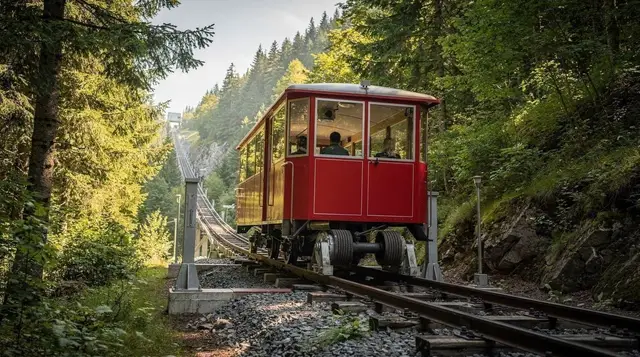
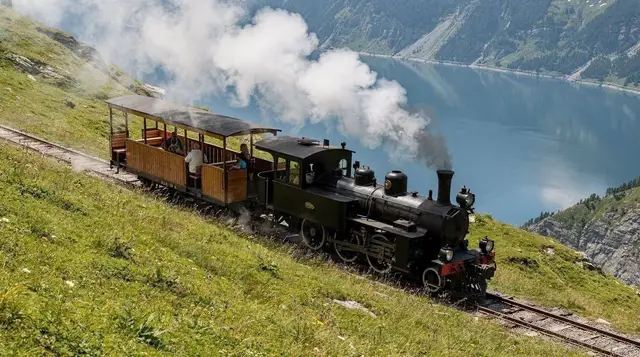
The Jungfrau railway is the reason the Jungfraujoch, a saddle of rock and ice at 3,454 m between the Mönch and the Jungfrau, is one of the most visited high-altitude sites in the Alps rather than a destination for mountaineers alone. It is a metre-gauge cogwheel line, and almost half of it runs inside the mountain.
The idea belonged to Adolf Guyer-Zeller, a Zurich industrialist who is said to have sketched the route on a napkin in 1893 while looking up at the Eiger from Mürren. His plan was audacious even by the standards of an era that had just finished wiring Switzerland’s lower slopes with rack railways: start at Kleine Scheidegg, at 2,061 m, and tunnel straight through the Eiger and the Mönch to reach a station just below the summit of the Jungfrau itself.
Construction began in 1896 and was meant to take about seven years. It took sixteen. Workers, many of them Italian, blasted and drilled through granite and gneiss in conditions that made progress slow and dangerous; several died in construction accidents over the project’s life. Costs ran well past the original budget, and the company returned to shareholders more than once for further capital. Guyer-Zeller himself did not live to see any of it finished — he died in 1899, three years into a project that would not open even partially for another seven.
Faced with the money running out, the company scaled the plan back. The original target, a station at the summit of the Jungfrau reached by lift, was dropped. The line would stop instead at the Jungfraujoch, the saddle between the two peaks, a few hundred metres below and to the side of the summit. The first section, as far as the Eigerwand viewing gallery, opened in 1903; the Eismeer stop followed in 1905; the line finally reached the Jungfraujoch on 1 August 1912, National Day, sixteen years after the first blast. It remains, at 3,454 m, the highest railway station in Europe, and the achievement is still marked at the Jungfraujoch with a small museum area recounting the construction — worth ten minutes if you have not seen it before.
The route: from open track to solid rock
The journey to the Jungfraujoch happens in stages, and understanding them helps explain both the ticket structure and where the views actually are.
From Interlaken, trains run to Grindelwald or to Lauterbrunnen, the two valleys that meet at Kleine Scheidegg from opposite sides. From Grindelwald, most visitors now take the Eiger Express gondola from the Grindelwald Terminal up to Eigergletscher, cutting out the older, slower train journey via Grindelwald Grund and Kleine Scheidegg. From Lauterbrunnen, the route runs up through Wengen on the Wengernalp railway to Kleine Scheidegg, a scenic, unhurried climb with the north face of the Eiger filling the window for much of the way.
At Kleine Scheidegg, or at Eigergletscher if arriving via the Eiger Express, everyone joins the same Jungfrau railway for the final ascent. The lower stretch out of Kleine Scheidegg still runs in the open, climbing across the base of the Eiger’s north face — the same wall that has drawn and killed mountaineers for a century. At Eigergletscher station, at 2,320 m, the line turns into the mountain and the tunnel begins.
From here to the Jungfraujoch is entirely underground, roughly 7 km of tunnel bored through the Eiger and then the Mönch. The gradient is steep enough that the cogwheel mechanism does all the work; on the open sections above, and on some of the connecting lines, adhesion and cogwheel sections alternate. The tunnel is unlit rock face for most of its length, but two intermediate stops break the ascent.
Eismeer: the stop most people time wrong
The first of those stops, and the one worth planning around, is Eismeer, at 3,160 m. The train halts here for a few minutes on both the ascent and the descent, and doors open onto a gallery cut directly into the cliff, with large windows looking straight down onto the Eismeer glacier and across to the peaks on the far side of the valley. It was the line’s terminus for two years before construction resumed toward the Jungfraujoch, and it has been kept as a scheduled stop ever since rather than bypassed once the tunnel was finished.
The mistake people make is not getting off — the stop is announced and the doors do open — but treating the halt as long enough to wander. It is not. You have a few minutes to reach the windows, look, and get back on; conductors do keep an eye on the doors, and being left at Eismeer while your ticketed group continues is a genuine inconvenience given how much of the rest of the journey and the return descent depends on catching the same connecting service. If photography matters to you, decide before the doors open which window you are heading for.
An older intermediate stop, Eigerwand, at 2,865 m, was used for viewing purposes for over a century but was discontinued for passenger stops once the Eiger Express changed how most visitors approach the mountain; trains pass through without opening doors there today.
The Jungfraujoch itself
The train terminates in a station complex built into the rock, from which lifts and tunnels lead out to the Sphinx observation terrace, the Aletsch Glacier viewing point, an ice palace carved into the glacier itself, and a network of indoor corridors connecting restaurants, a Lindt chocolate shop, and the Alpine Sensation walkway. Almost none of the complex is outdoors in the conventional sense; even the Sphinx terrace is reached by a high-speed lift from inside the mountain. This matters for what to bring — see what to pack for the altitude before you go, since temperatures at 3,454 m are consistently well below Interlaken’s even in August, and the terrace is exposed to wind.
For a full walkthrough of what there is to do once you arrive, the pricing tiers, and how much time to allow, see the dedicated Jungfraujoch guide. This page focuses specifically on the railway that gets you there.
First and last ascent: the timetable that actually matters
Jungfrau Railways publishes a same-day timetable that changes with the season, and the two numbers worth checking before you leave Interlaken are the first ascent and the last descent, not the headline journey time.
The first train from Kleine Scheidegg typically leaves in the early morning, commonly in the 7:00–8:00 window depending on season, with the very first departures of the day reserved for early risers chasing clear morning light before cloud builds over the peaks — a real consideration, since the Jungfraujoch clouds over on plenty of days when Interlaken itself is sunny. The last train down from the Jungfraujoch generally leaves in the mid-to-late afternoon, with a connecting service down from Kleine Scheidegg to Lauterbrunnen or Grindelwald following shortly after. Missing that last connection is expensive: there is no late train, and a taxi down from Kleine Scheidegg is not a short or cheap fix.
The safest approach is to check the current-day timetable posted at Kleine Scheidegg or Grindelwald Terminal on the morning you travel, rather than relying on a schedule from a previous visit or a general guide. Times shift by 20–40 minutes between summer and shoulder-season timetables, and maintenance closures — which happen most often in spring and autumn, as with most Bernese Oberland cable cars and railways — can compress the day further. See when the mountain railways open and close for how these seasonal windows work across the region.
Timed tickets and why they exist
Since the operator introduced online booking with fixed departure slots, tickets for the Jungfrau railway are sold for a specific time window rather than as an open same-day pass. You choose an ascent time when booking — typically in half-hour or hourly bands — and are expected to board within that window at Kleine Scheidegg or Eigergletscher. The system exists because the tunnel section is single-track for most of its length, with the timetable built around a fixed number of trains per hour that the tunnel can physically hold; unlimited walk-up demand on peak summer days used to produce queues of several hours at Kleine Scheidegg.
In practice this means booking your Jungfraujoch day in advance, not deciding over breakfast in Interlaken. July and August, and the period around Christmas and New Year, are the times slots disappear first, sometimes days ahead for the popular late-morning departures. Shoulder season and midweek departures in spring and autumn are far easier to get on short notice.
a self-guided day ticket to the Jungfraujoch that bundles the fixed-time reservation with the return journey is the straightforward option for a single day trip from Interlaken, and it removes the separate step of booking the timed slot yourself on the operator’s site.
Booking through a pass instead of a single ticket
Regional passes complicate the picture rather than simplifying it, and it is worth knowing which ones actually cover the Jungfrau railway before assuming a pass in your pocket gets you up for free. The Swiss Travel Pass covers the approach trains to Grindelwald or Lauterbrunnen and gives a discount, usually 25%, on the Jungfraujoch sector itself rather than free travel — see the Swiss Travel Pass guide for what is and is not included across the network.
The regional Jungfrau Travel Pass and Berner Oberland Pass, covered in the Jungfrau and Bernese Oberland pass guide, can include a set number of days on the line itself depending on the tier purchased, which is usually the better option if you are combining the Jungfraujoch with several other cable cars and railways across a multi-day stay.
For a broader look at how the region’s rack railways, cable cars and gondolas relate to each other — useful context if the Jungfrau line is one stop on a wider itinerary — see Bernese Oberland railways explained.
a customisable Swiss travel pass itinerary with a private guide suits visitors who want the pass logistics handled rather than worked out sector by sector.
Coming from further afield
Not everyone starts the day in Interlaken. Day-trip operators run the whole loop from Zurich or Basel, which is a long day — realistically 12 hours door to door — but workable if the Jungfraujoch is the one Alpine excursion on a short Switzerland itinerary built around a base in Zurich rather than the Bernese Oberland.
a small-group day trip to the Jungfraujoch from Zurich covers the return rail journey and the timed ticket in one booking, which removes the need to coordinate the reservation system yourself from outside Switzerland. A similar option, a Zurich day trip into the Jungfrau region combining train travel with an additional stop, adds a second point of interest to the same long day.
If an overnight at altitude appeals more than a same-day round trip, an overnight package at 3,600 m on the Jungfraujoch allows an early and a late viewing of the Sphinx terrace without the pressure of the last train down, since the following day’s descent replaces it — worth considering if clear-sky odds matter more to you than sleeping at a normal altitude.
Comparing it with the region’s other cogwheel lines
The Jungfrau railway is the highest and the most tunnel-heavy of the region’s rack railways, but it is not the only one worth a half-day. The Wengernalp railway, which forms part of the Lauterbrunnen approach to Kleine Scheidegg, is entirely open-air and considerably cheaper, running through Wengen with the Eiger, Mönch and Jungfrau in view for most of the climb. The Schynige Platte guide covers a similar 1893-built cogwheel line on the other side of the valley, with views back over Lake Thun and Lake Brienz rather than up at the peaks.
Beyond the Bernese Oberland, the Gornergrat railway near Zermatt is the closest comparison in scale and ambition, climbing to a similar altitude with a view of the Matterhorn rather than the Eiger’s north face — a useful reference if you are deciding between the two on a longer Switzerland trip, or wondering whether the Jungfraujoch is worth doing alongside a Zermatt stop. a Gornergrat cogwheel railway ticket from Zermatt is the equivalent booking on that line, for anyone weighing the two.
For a direct comparison of the Jungfraujoch against the other big-ticket excursion from Interlaken, the Jungfraujoch vs Schilthorn guide sets out cost, weather risk and crowding side by side, and best mountain excursions from Interlaken places both within the wider set of options including Harder Kulm, Grindelwald First and Niederhorn.
Practical notes before you book
A few things are easy to overlook when a single fixed-time ticket is doing most of the planning for you. Weather at 3,454 m is not weather in Interlaken or even Grindelwald: check a Jungfraujoch-specific forecast, since cloud cover at the summit is common on days that look clear from the valley floor, and a non-refundable timed ticket booked on a cloudy-forecast day is money spent on an indoor visit and a white-out view from the Sphinx terrace. Dress for winter conditions regardless of season — see Interlaken in bad weather and the altitude packing guide linked above.
Build in slack at Kleine Scheidegg or Eigergletscher for the connecting trains either side of the Jungfrau railway itself; a delay on the approach from Lauterbrunnen or Grindelwald can mean missing your booked ascent slot, and the ticket does not automatically rebook you onto the next available departure. Finally, decide in advance whether you are approaching via Lauterbrunnen and Wengen or via Grindelwald and the Eiger Express — they are genuinely different days out, not two routes to the same experience, and which one suits you better is worth five minutes’ thought before you book the timed slot.
Frequently asked questions about the Jungfrau railway
How long did it take to build the Jungfrau railway?
Construction ran from 1896 to 1912, sixteen years, against an original plan of about seven. Money ran out repeatedly, the route was shortened to stop at the Jungfraujoch instead of the summit of the Jungfrau itself, and the project’s driving force, Adolf Guyer-Zeller, died in 1899, thirteen years before the first train reached the top.
Is the whole railway inside a tunnel?
No. The lower section from Kleine Scheidegg to the Eigergletscher station runs in the open, climbing the flank below the Eiger’s north face. From Eigergletscher the line disappears into rock and stays underground for the remaining ascent through the Eiger and the Mönch to the Jungfraujoch, roughly 7 km of tunnel.
What is the Eismeer stop?
It is an intermediate underground station at 3,160 m where the train pauses for a few minutes and doors open onto a gallery cut into the rock face, with picture windows looking straight down onto the Eismeer glacier. It was the line’s temporary terminus for several years before the tunnel was extended, and it is still a scheduled stop on every ascent and descent.
Do I need to book a specific time for the Jungfrau railway?
Yes. Since the introduction of the reservation system, tickets are sold for a specific departure slot from Kleine Scheidegg (or from Grindelwald Terminal if arriving via the Eiger Express), and you cannot simply turn up and board the next train the way you can on most Swiss regional lines. Book ahead in July, August and over the Christmas and New Year period, when slots for midday departures sell out.
What time does the last train down from the Jungfraujoch leave?
It varies by season and is published on the official Jungfrau Railways timetable rather than fixed year-round, but as a rule of thumb the last descent from the Jungfraujoch leaves mid-to-late afternoon, and the last connecting train down from Kleine Scheidegg to Grindelwald or Lauterbrunnen follows within the hour. Check the same-day timetable at Kleine Scheidegg station when you go up, not a printed schedule from a previous trip.
Which route is faster, via Grindelwald or via Lauterbrunnen?
Via Grindelwald Terminal and the Eiger Express gondola to Eigergletscher is the newer, faster option, cutting the journey by roughly 30–45 minutes compared with the older route through Grindelwald village and Kleine Scheidegg. Via Lauterbrunnen and Wengen to Kleine Scheidegg is slower but keeps you on trains the whole way and passes through the car-free village of Wengen.
Is the Jungfraujoch worth it if the weather is bad?
Cloud at the Jungfraujoch is common even on a clear day in Interlaken, because the summit sits well above the valley’s weather. Check a dedicated mountain forecast for the Jungfraujoch itself, not the forecast for Interlaken or Grindelwald, before committing to a fixed-time ticket that cannot easily be refunded.
Scenic train tours on GetYourGuide
Verified deep-linked GetYourGuide tours. Book through these links and we earn a small commission at no cost to you.
GetYourGuide does not provide a product photo for this activity — the image shows the meeting point, photographed by us.