Jungfraujoch vs Schilthorn: which summit is worth it?
Should I go to Jungfraujoch or Schilthorn?
Jungfraujoch is higher, more famous and roughly twice the price, with the biggest single risk being cloud cover that hides everything at 3,454 m. Schilthorn is cheaper, faster to reach, clears more often and has the better all-round panorama. First-timers with one day and money to spend usually pick Jungfraujoch; everyone else, and anyone travelling on a tighter budget, tends to be happier at Schilthorn.
Two summits, one Bernese Oberland decision
Ask ten people in Interlaken which mountain to visit and most will say Jungfraujoch without hesitation. It is the name on every poster in the Hoheweg shop windows, the “Top of Europe” branding is everywhere, and it is genuinely the highest railway station in Europe. What fewer visitors realise is that Schilthorn is the other serious option, sitting above Mürren with a 360-degree panorama that regularly beats Jungfraujoch’s view on a clear day, at roughly half the price and half the travel time.
Both are legitimate full-day excursions from Interlaken. Neither is a mistake. But they are different days out, with different costs, different failure modes, and different audiences, and conflating them because they are both “the mountain trip” is how people end up disappointed. This guide sets the two side by side on the things that actually matter: altitude, price, journey time, what you see, how crowded it gets, and how each one behaves in bad weather.
Altitude, access and journey time at a glance
| Jungfraujoch | Schilthorn | |
|---|---|---|
| Altitude | 3,454 m | 2,970 m |
| Opened | 1912 (railway) | 1967 (cable car) |
| Base town | Grindelwald or Lauterbrunnen | Stechelberg or Mürren |
| Typical one-way journey from Interlaken | 2–2.5 hours, including changes | 1.5–2 hours, including changes |
| Route | Train to Grindelwald Terminal, Eiger Express cable car to Eigergletscher, cog railway through the Eiger tunnel; or via Lauterbrunnen and Kleine Scheidegg on the Wengernalp railway | Bus or train to Stechelberg, cable car via Gimmelwald and Mürren, then Birg to the summit |
| Return price from Interlaken (adult, full fare) | Around CHF 220 | Around CHF 110 from Stechelberg, less from Mürren |
| Weather risk | Higher — cloud base often sits below 3,454 m even on fine valley days | Lower — 2,970 m clears more often, though not always |
| Restaurant | Cafeteria-style dining, plus a sit-down restaurant | Piz Gloria, the revolving restaurant made famous by the 1969 James Bond film |
Prices move every December when the Swiss railways revise their tariffs, so treat the figures above as a guide, not a quote, and check the current fare before you commit.
Jungfraujoch: the Top of Europe, at Top of Europe prices
Jungfraujoch earns its reputation. The railway was cut through solid rock inside the Eiger between 1896 and 1912, an engineering project that took sixteen years and cost the lives of several workers, and the station it delivers you to is still the highest in Europe at 3,454 m. Inside, there’s an ice palace carved into the glacier, an observation deck with views toward the Aletsch Glacier on a clear day, and enough tunnels and lifts to keep you occupied for two to three hours before the cold and the queues push you back toward the train.
Since December 2020, the fastest way up is the Eiger Express, a tri-cable gondola that runs from the purpose-built Grindelwald Terminal to Eigergletscher, cutting out a chunk of the old journey time. The alternative route goes via Lauterbrunnen and Kleine Scheidegg on the historic Wengernalp railway, which is slower but a more scenic ride in its own right, with Wengen and the north faces of the Eiger, Mönch and Jungfrau passing the window.
The catch is the price. A standard return from Interlaken runs to roughly CHF 220, and even with a Half Fare Card the discount only applies to part of the fare, since a summit supplement is charged separately. Booking an early “Good Morning” ticket before around 8:10am shaves off some of that cost and, more usefully, gets you there before the tour groups arrive in force from Zurich and Lucerne. Without a reserved slot in July and August, you may not get on the train you want at all — Jungfraujoch effectively runs at a fixed capacity and sells out on peak summer days.
The bigger risk isn’t cost, it’s cloud. At 3,454 m, the Jungfraujoch sits in cloud a meaningful share of days each year, even when Interlaken itself is bathed in sunshine. Visitors regularly pay full price to stand on the observation deck and see white in every direction. There’s no refund for weather, so check the live webcam and forecast before you leave, not after you’ve bought the ticket.
Schilthorn: the 360-degree panorama with a Bond film attached
the Jungfraujoch day trip with an overnight at 3,600 m is the way to see the Top of Europe without the sunrise scramble, but for most visitors the Schilthorn is the more sensible mountain to add to an itinerary alongside it, or instead of it.
At 2,970 m, Schilthorn is nearly 500 m lower than Jungfraujoch, and that difference matters more than it sounds. The summit sits below the cloud base often enough that the odds of a clear view are noticeably better, and the panorama itself is arguably the more complete one: rather than the close-up glacier and rock walls of Jungfraujoch, Schilthorn gives you an open 360-degree sweep that takes in the Eiger, Mönch and Jungfrau on one side and, on an exceptionally clear day, a horizon that stretches toward the Black Forest and the Vosges.
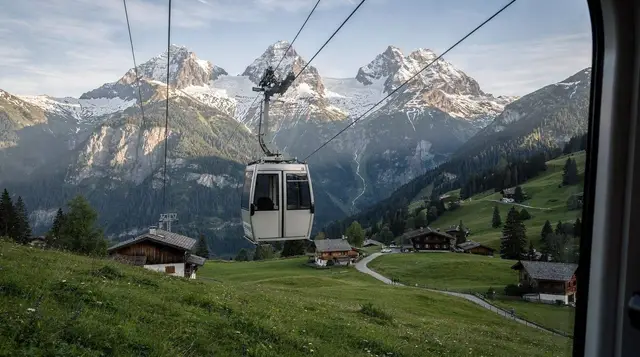
The approach is also part of the appeal. From Stechelberg, the cable car climbs via Gimmelwald and Mürren, two of the car-free villages that make the Lauterbrunnen valley worth lingering in on their own account, then continues via the Birg mid-station to the summit. Birg has its own attraction, a steel skywalk cantilevered out over a sheer drop, and is worth ten minutes even if you’re not stopping for the whole visit. At the top, Piz Gloria — the revolving restaurant used as the villain’s lair in the 1969 James Bond film “On Her Majesty’s Secret Service” — still runs a small Bond-themed exhibition alongside the dining room, which draws a specific kind of fan as much as it does hikers.
Price-wise, a return from Stechelberg runs to roughly CHF 110, and less again if you start from Mürren rather than the valley floor, since you skip the lowest section of cable car. That’s about half of what Jungfraujoch costs, and the regional Berner Oberland Pass and Jungfrau Travel Pass both cover a larger share of the Schilthorn fare than they do the Jungfraujoch supplement.
Crowds: two very different atmospheres
Jungfraujoch is a mass-tourism operation, and it feels like one. Coach groups arrive from Zurich, Lucerne and Basel on tight schedules, the train carriages fill up, and the summit facilities — while extensive — can feel congested by mid-morning, particularly in the ice palace and around the main viewing platforms. An early departure, ideally on the first train of the day, is the single best way to avoid the worst of it.
Schilthorn draws a smaller, more mixed crowd: day hikers heading down from Birg or up from Mürren, a scattering of Bond enthusiasts, and considerably fewer coach groups, since the road access to Stechelberg is narrower and slower than the route to Grindelwald. The cable cabins are smaller and the queues shorter, and the summit itself rarely feels overwhelmed even in August.
Accessibility and who finds each trip hardest
Both summits are wheelchair and pushchair accessible as far as the cable cars and trains are concerned, but the practical experience differs. Jungfraujoch involves more walking through tunnels and between viewing points once you arrive, plus a longer overall journey that adds up to a demanding day for anyone with limited mobility or for very young children. The altitude itself, at 3,454 m, is also more likely to bring on a mild headache in people unused to it.
Schilthorn’s shorter journey and lower altitude make it the gentler option for families and older travellers, and Mürren and Wengen both make pleasant places to break the day with lunch rather than pushing straight through to the summit and back.
When the weather turns
Both lines suspend service in strong wind, and both can close the top section while keeping the lower stations running — check the specific segment status, not just whether “the mountain is open.” Jungfraujoch has the additional quirk that the summit can be in dense fog while Grindelwald and Interlaken are in full sun, since the station sits inside the mountain and the observation areas are exposed at 3,454 m. There is no reliable way to predict this more than a day or two out, which is why flexible dates matter more here than almost anywhere else in the region.
If either mountain is closed or clouded in on the day you’d planned, Kleine Scheidegg and Männlichen or Grindelwald First are useful lower-altitude fallbacks that clear more reliably, and both sit well below the worst of the cloud base.
The verdict, by traveller profile
First-timer with one day and a fixed budget for “the big mountain trip”: Jungfraujoch, booked early, on a clear-forecast day, ideally with the early “Good Morning” ticket. It’s the name people ask about and the one they’ll remember booking, but only go if the forecast is genuinely favourable.
Anyone on a tighter budget, or doing more than one mountain excursion: Schilthorn. Half the price of Jungfraujoch, a shorter day, and a view that’s arguably more satisfying, leaves money and energy for a second excursion elsewhere in the region.
Families with young children: Schilthorn, for the shorter journey and lower altitude, with a stop in Mürren or Gimmelwald to break up the cable car changes.
Hikers: Schilthorn wins on flexibility, since Birg and Mürren connect into a genuine network of trails, while Jungfraujoch’s summit access is largely confined to the indoor facilities and a short outdoor platform. For a longer hiking day nearby, a guided hike between Lauterbrunnen and Mürren covers similar ground at a walking pace.
James Bond fans and photographers chasing the widest panorama: Schilthorn, without much competition — Piz Gloria’s exhibition and the 360-degree summit view are specific to the Schilthorn experience.
Visitors who want to do both: split them across separate days rather than one long combined trip. If time is genuinely tight, consider a private Jungfraujoch tour with door-to-door transfers to compress the travel time on the Jungfraujoch side, then a separate, unhurried day for Schilthorn.
Practical notes before you book
Check the Jungfraujoch guide and the Schilthorn and Piz Gloria guide for step-by-step route planning, ticket types and current opening hours before you travel, since both change with the seasons — see when the mountain railways open and close for the spring and autumn maintenance windows that catch out a surprising number of visitors.
If you’re weighing up a broader set of viewpoints rather than just these two, Mountain excursions from Interlaken compared and the more specific First vs Männlichen vs Kleine Scheidegg comparison cover the mid-altitude alternatives that clear more often than either summit here.
Anyone travelling on a multi-day rail pass should read the fine print before assuming either mountain is included — see the Swiss Travel Pass guide for what it actually discounts versus what it covers outright, since the gap between the two catches a lot of first-time visitors at the ticket counter.
Frequently asked questions about Jungfraujoch vs Schilthorn
Is Jungfraujoch or Schilthorn better for a first visit to Interlaken?
Jungfraujoch is the one most first-time visitors ask for by name, and the Top of Europe branding, the ice palace and the highest railway station in Europe justify the trip once. Schilthorn is the better first choice if you’d rather have reliable views and more of your day left over for Mürren or a hike.
Which is cheaper, Jungfraujoch or Schilthorn?
Schilthorn is roughly half the price. A return trip to Jungfraujoch from Interlaken costs around CHF 220, while a return to the Schilthorn from Stechelberg is around CHF 110, less again from Mürren.
Can I visit both Jungfraujoch and Schilthorn in one day?
Physically yes, but it makes for a long, expensive and rushed day with two separate valley approaches. Most people who want both split them across two days or two separate trips from Interlaken.
Which summit has more reliable weather?
Schilthorn, at 2,970 m, sits below the cloud base more often than Jungfraujoch at 3,454 m. Neither is guaranteed, but Jungfraujoch has the higher chance of a whiteout on an otherwise fine-looking day in the valley.
Is the Schilthorn cable car included in the Swiss Travel Pass?
The Swiss Travel Pass gives a discount on the Schilthorn, not free travel, and the same applies to Jungfraujoch. Regional passes such as the Berner Oberland Pass or the Jungfrau Travel Pass cover more of the approach lines but still charge a supplement for the final stretch to both summits.
What happens if the mountain railway closes for wind or fog?
Both the Jungfraujoch line and the Schilthornbahn can suspend the top section in high wind, and Jungfraujoch closes without warning in fog even when the cable cars below keep running. Check the live status before you leave Interlaken, and build in a backup day if the forecast looks marginal.
Which is better for families with small children?
Schilthorn is the easier day: the journey is shorter, Mürren and Gimmelwald are relaxed, car-free villages to break up the trip, and the altitude gain is less likely to cause headaches. Jungfraujoch has an ice palace that children enjoy, but the long journey and thin air at 3,454 m are harder on toddlers.
Do I need to book Jungfraujoch or Schilthorn tickets in advance?
Jungfraujoch effectively requires a reserved time slot in July and August, since capacity on the trains is limited and sells out. Schilthorn rarely sells out, but booking ahead still avoids queuing at the ticket counter in Stechelberg or Mürren.
Mountain excursions on GetYourGuide
Verified deep-linked GetYourGuide tours. Book through these links and we earn a small commission at no cost to you.
GetYourGuide does not provide a product photo for this activity — the image shows the meeting point, photographed by us.