At 3,454m, the Jungfraujoch station is the highest point on Europe’s rail network, reached by a line that took sixteen years to build and runs for its final stretch through a tunnel blasted straight through the rock of the Eiger. It opened in 1912. Everything up here — the Sphinx observatory, the ice palace, the viewing terraces over the Aletsch Glacier — sits at the saddle between the Jungfrau and the Mönch, and everything about getting there costs real money and depends on weather you cannot control from home. This is the single most expensive excursion most visitors will make from Interlaken, and also the one most likely to disappoint if you book it on the wrong day.
Two ways up, and which one to pick
There are two routes to the Jungfraujoch, and they meet at Kleine Scheidegg before the final push to the summit.
The newer option goes via Grindelwald and the Grindelwald Terminal, where the Eiger Express gondola opened in December 2020. The cable car covers the climb to the Eigergletscher station in around 15 minutes, replacing a cog-railway leg that used to take closer to 45. From Eigergletscher, a connecting train covers the last stretch through the Eiger Tunnel to the summit. This route is faster overall and the gondola cabins are large and comfortable, but you miss the slower, more scenic climb through Kleine Scheidegg and the Männlichen area.
The classic option runs via Lauterbrunnen, changing at Kleine Scheidegg. This is the older, slower way, and it takes you past Wengen, a car-free village clinging to the valley side, with proper views down into the Lauterbrunnen valley on a clear day. It is the route most guidebooks still describe, and the Wengernalp Railway that covers the Lauterbrunnen–Kleine Scheidegg leg is a rack railway in its own right, worth a look for anyone interested in how the whole system was built.
Neither route is objectively “better” — the Grindelwald side is quicker and more modern, the Lauterbrunnen side is scenic and traditional. Many visitors go up one way and down the other, which the standard tickets allow for. The full mechanics of both approaches, including which trains connect where, are covered in the Jungfrau Railway guide and the dedicated piece on the Eiger Express and Grindelwald Terminal.
| Route | Via | Approx. one-way time from Interlaken Ost | Character |
|---|---|---|---|
| Grindelwald Terminal / Eiger Express | Grindelwald | ~1 hour 40 | Faster, modern gondola, less scenery en route |
| Lauterbrunnen / Kleine Scheidegg | Lauterbrunnen, Wengen | ~2 hours 10 | Slower, classic rack railways, valley views |
What’s actually at the top
The Jungfraujoch complex is bigger than a single viewing platform. The Sphinx Observatory, reached by a fast internal lift, has an outdoor terrace at just over 3,570m with panoramic views that, on a genuinely clear day, extend toward the Black Forest and the Vosges. Below it, the Ice Palace is a series of tunnels carved into the glacier itself, lit and decorated with ice sculptures — it is touristy, but it is also the only place most visitors will ever walk inside a glacier.
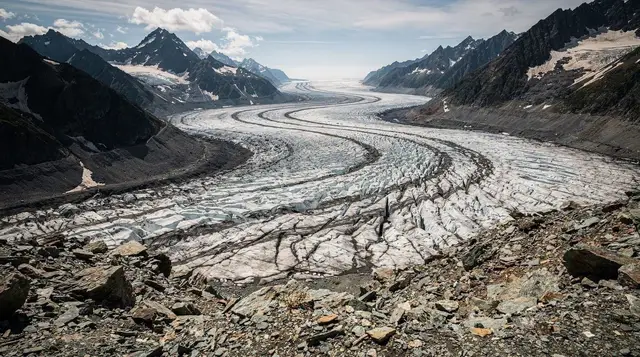
Outside, the Plateau is a snowfield you can walk out onto (weather permitting), with the Aletsch Glacier — the longest ice stream in the Alps — visible flowing away toward the Rhône valley. A day-trip visit to the glacier itself, rather than just the view of it, is covered separately in the Aletsch Glacier day trip guide. There is also a Lindt chocolate shop, a Swiss watch outlet, and several restaurants, all priced for a captive audience at 3,454m — expect a simple lunch to run CHF 25–35.
Everything at the summit is indoors-accessible via lifts and tunnels, which matters in poor weather or wind, but it also means the complex gets crowded in the middle of the day, particularly in July and August when tour groups from Zurich and Lucerne arrive on set schedules. Early trains genuinely mean thinner crowds, not just cheaper tickets.
The real cost, and how to cut it
This is the expense that catches people out. A standard second-class return ticket from Interlaken Ost is typically priced in the CHF 220–235 range at full fare — prices are revised each season, so treat this as a working figure rather than an exact quote. First class runs meaningfully higher. That is before food, and before any add-on for the Ice Palace or Sphinx (both are included in the base ticket, but the on-mountain restaurants are not).
There are three ways to bring the cost down, and they can be combined:
- Good Morning Ticket: valid for travel on the first one or two trains of the day, this typically saves CHF 30–40 off the standard fare. The trade-off is an early departure from Interlaken, usually before 8am.
- Half Fare Card: cuts the price of most Swiss rail travel, including the Jungfraujoch line, by 50%. Worth buying if you are spending more than a few days in the country.
- Swiss Travel Pass: gives a 25% discount on the Jungfraujoch excursion specifically (the summit line itself is not covered in full by any pass, unlike most other Swiss trains). Full mechanics are in the Swiss Travel Pass guide.
Combine the Good Morning Ticket with a Half Fare Card and the round trip from Interlaken can come down to somewhere in the CHF 140–160 range per person — still not cheap, but a genuine reduction from the walk-up fare. Group and organised-tour pricing works differently again, since it usually bundles transport, guiding and sometimes lunch into a single figure.
| Ticket type | Approx. price from Interlaken (2nd class return) | Notes |
|---|---|---|
| Standard fare | CHF 220–235 | Valid any train, any time |
| Good Morning Ticket | CHF 180–195 | First 1–2 departures only |
| With Half Fare Card | Roughly 50% of the above | Card itself has its own upfront cost |
| Swiss Travel Pass discount | 25% off standard fare | Pass does not cover the line in full |
Booking: tickets, tours and timing
Independent travellers can buy point-to-point rail tickets directly and manage their own schedule, which suits anyone comfortable reading Swiss timetables and changing trains at Kleine Scheidegg or the Grindelwald Terminal unassisted. For a fixed departure with a guide and no logistics to plan, the Top of Europe day trip with an overnight option at 3,600m handles the return journey and, for anyone wanting a genuinely rare experience, a night near the summit above the cloud line.
Visitors basing themselves further afield, including day-trippers from the city, tend to book the small-group day trip from Zurich, which folds the transfer to and from the Bernese Oberland into one long but manageable day. For a smaller group wanting flexibility on timing and stops along the way, a private tour with a luxury van avoids fixed group schedules entirely, at a higher price point.
Whichever way you book, arrive at Interlaken Ost with time to spare — both routes start from the same station, and missing the connecting train at Kleine Scheidegg or the Grindelwald Terminal can add well over an hour to the day.
Fog, wind and the day that gets ruined
This is the part most tour operators understate. The Jungfraujoch sits at 3,454m in a range where cloud forms and clears on its own schedule, largely independent of what the weather is doing down in Interlaken at 568m. It is entirely possible to leave Interlaken under blue sky and arrive at the summit inside a white-out, with visibility down to a few metres and the outdoor terraces closed to wind.
There is no refund for weather once you have travelled and used the ticket. The only real defence is checking the Jungfrau Railways webcams and official weather page the morning of travel — not the night before, and certainly not when you book, since alpine conditions change fast. If the forecast for the summit specifically (not the valley) shows cloud, it is worth postponing by a day if your schedule allows it. On persistent bad-weather days, the Interlaken in bad weather guide and the rainy day activities piece cover lower-altitude alternatives that are not weather-dependent in the same way.
Wind is the other factor: the lifts and outdoor terraces at the summit can close in high wind even when visibility is fine, which happens more often in shoulder seasons (April, November) than in mid-summer. Spring and autumn also bring scheduled maintenance closures on some of the connecting lines — always confirm the full route is running before booking, particularly outside June to September.
Getting there and combining it with the rest of the region
From Interlaken Ost, allow 2 to 2.5 hours each way including the change at Kleine Scheidegg or the Grindelwald Terminal, and budget a full day rather than trying to combine the Jungfraujoch with much else. Travellers wanting to see more of the high country without repeating the same train journey sometimes split their trip: up via Grindelwald, lunch and a look around Kleine Scheidegg and Männlichen, then down via Lauterbrunnen and a stop in Wengen.
For a structured multi-day plan that fits the Jungfraujoch alongside the region’s other high points without overloading a single day, see the Jungfrau region highlights, 3 days itinerary. Anyone weighing this excursion against the region’s other big-ticket outing should read Jungfraujoch vs Schilthorn before booking either — they solve different problems and rarely both belong in the same trip.
Two smaller add-ons are worth knowing about before you go. An e-bike tour to Lauterbrunnen and Isenfluh is a good way to fill a half day at valley level either before or after a Jungfraujoch trip, and a private walking tour in Wengen makes sense for anyone taking the Lauterbrunnen route who wants a proper look at the village rather than just a change of train.
Visiting the Jungfraujoch: frequently asked questions
Is the Jungfraujoch worth the price?
It is a genuine engineering achievement and the highest railway station in Europe at 3,454m, but a standard return ticket from Interlaken runs well over CHF 200 and the summit is inside cloud on many days. It is worth it on a clear forecast with a discount ticket; it is a poor use of money on a grey one.
How much does the Jungfraujoch actually cost?
A standard second-class return from Interlaken Ost is typically in the CHF 220–235 range at full fare. The Good Morning Ticket, valid on the first trains of the day, brings that down to roughly CHF 180–195. A Half Fare Card cuts the rail portion by 50%, and the Swiss Travel Pass gives a 25% discount on top of whatever base fare applies.
Which route is better: Grindelwald Terminal or Lauterbrunnen?
The Grindelwald Terminal route uses the Eiger Express gondola and is faster and more comfortable, cutting close to 30 minutes off the old cog-railway journey. The Lauterbrunnen–Kleine Scheidegg route is slower but keeps you on trains the whole way, with better views of the valley and the option to stop at Wengen.
What if it’s foggy at the Jungfraujoch?
The summit is in cloud on a meaningful share of days, even in summer, and there is no refund once you have travelled up and found white-out conditions. Check the Jungfrau Railways webcam and weather page the morning of travel, not the day you book, and be ready to postpone.
How long do you need at the Jungfraujoch?
Budget two to three hours at the summit itself once you include queuing for lifts inside the mountain, plus 4 to 5 hours of travel time round trip from Interlaken. Most visitors treat it as a full day out.
Can you see the Aletsch Glacier from the Jungfraujoch?
Yes. The Sphinx observation terrace and the Plateau look directly onto the Aletsch Glacier, the longest ice stream in the Alps, which flows away from the Jungfraujoch saddle toward the Rhône valley.
Is the Jungfraujoch suitable for people with breathing or heart conditions?
At 3,454m, altitude effects are possible even on a short visit, especially for people with existing heart or lung conditions. Jungfrau Railways publishes an altitude advisory, and anyone with a relevant condition should check with a doctor before booking.
Do children need a full-price ticket?
Children under 6 travel free, and children up to 15 travel free with a paying parent holding a Swiss Family Card, which is issued automatically with most rail passes. Check current terms when booking, as child policies are revised from time to time.