The Swiss Travel Pass: what it actually covers in the Interlaken region
Is the Swiss Travel Pass worth it for a trip based in Interlaken?
Only if you plan to ride the regular rail, bus and boat network on most days and tackle at least one of the big peaks, such as the Jungfraujoch or Schilthorn. The pass gives free unlimited travel on the core network but only a 25 to 50 percent discount on the mountain railways, so a short, low-mileage stay is usually cheaper on point-to-point tickets or a Half Fare Card.
What the Swiss Travel Pass is sold as, and what it actually is
The marketing line is “free travel across Switzerland.” The reality, once you’re based in Interlaken planning trips to the Jungfrau region, is more mixed: the pass gives genuinely unlimited free travel on the regular rail, PostBus and boat network, plus free entry to hundreds of museums, but on the mountain railways that most visitors actually come for — the Jungfraujoch, the Schilthorn, Mount Pilatus, Mount Titlis — it only ever gives a discount, usually 50 percent, sometimes as little as 25 percent. Nobody tells you that at the point of sale, and it’s the single biggest reason travellers either overpay or underbuy.
This guide breaks the pass down into what’s free, what’s half-price, and what still costs full fare, with a worked example for a typical Interlaken stay so you can see where the break-even point actually falls.
What’s fully included
Everything below costs nothing extra once you’re holding a valid Swiss Travel Pass, for any consecutive-day or Flex pass:
- All SBB, BLS and regional rail lines, including the Bernese Oberland line from Interlaken to Lauterbrunnen and Grindelwald, and the branch up to Kleine Scheidegg.
- PostBus and local bus routes, including services around Unterseen and Matten and the wider Bodeli.
- The BLS boats on Lake Thun and Lake Brienz, including the routes to Oberhofen, Spiez, Iseltwald and Giessbach.
- City transport (trams and buses) in around 90 towns, including Bern, Zurich, Lucerne, Basel and Geneva — useful on a Bern day trip or a Lucerne day trip.
- Free entry to more than 500 museums nationwide.
- The Brünig line to Lucerne, and the Harder Kulm funicular from Interlaken Ost, both included at no extra charge.
That last one is a genuine freebie many visitors miss: the eight-minute ride up to Harder Kulm for the view over both lakes is fully covered by the pass, no discount arithmetic required.
What’s only discounted, not free
This is the part the brochures gloss over. Most of the big-ticket mountain excursions around Interlaken are run by separate concessionaires — Jungfraubahnen, Schilthornbahn, and others — and the Swiss Travel System only negotiates a discount on their fares, not free travel.
| Excursion | Swiss Travel Pass discount | What you still pay for |
|---|---|---|
| Jungfraujoch | 25% off | The Kleine Scheidegg/Eigergletscher–Jungfraujoch section |
| Schilthorn | 50% off | The Schilthornbahn cable car from Stechelberg or Mürren |
| Grindelwald First | 50% off | The gondola from Grindelwald Grund |
| Schynige Platte | 50% off | The 1893 rack railway from Wilderswil |
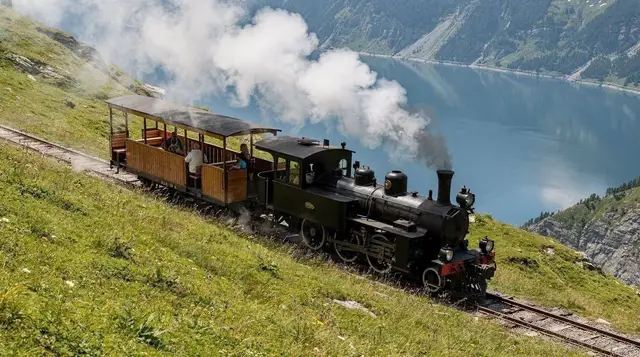
| Brienzer Rothorn | 50% off | The steam rack railway from Brienz |
| Niederhorn | 50% off | The cable car from Beatenbucht (boat approach is free) |
| Mount Pilatus, Mount Titlis, Mount Rigi | 50% off | The summit cable car or cogwheel section |
The Jungfraujoch is the case that trips people up most, because it’s the excursion everyone plans around. The train ride from Interlaken up to Kleine Scheidegg is ordinary Bernese Oberland Railway track, fully covered by the pass. It’s only the final stretch — the Jungfraubahn tunnel through the Eiger and Mönch to Europe’s highest railway station at 3,454 m — that carries its own tariff, discounted by a quarter. Budget roughly CHF 75-90 for that top section alone even with the pass, on top of a pass you’ve already paid for.
Consecutive-day prices (indicative, 2026)
Swiss Travel Pass fares are reviewed every December, so treat the figures below as planning numbers rather than a quote — check the official calculator before paying. Prices are per adult, consecutive days, and roughly halved for travellers aged 6-16 (under 6 travel free with a parent).
| Duration | 2nd class | 1st class |
|---|---|---|
| 3 days | CHF 244 | CHF 389 |
| 4 days | CHF 279 | CHF 445 |
| 6 days | CHF 363 | CHF 579 |
| 8 days | CHF 393 | CHF 627 |
| 15 days | CHF 429 | CHF 686 |
A Swiss Travel Pass Flex version exists too, letting you pick non-consecutive days within a month rather than a run of consecutive ones — useful if your Interlaken stay is broken up by a few slower days elsewhere. It typically costs 10-15 percent more than the consecutive pass for the same number of days, so it only earns its keep if you genuinely need the gap.
a bundled Swiss Travel Pass package covering rail, bus and boat travel across the country is one way to lock in the network coverage before you land, rather than queuing at Interlaken Ost on arrival.
The break-even calculation for a four-day Interlaken stay
Take a fairly typical itinerary: a day in Bern, a lake boat loop, and one day each at the Jungfraujoch and the Schilthorn. Here’s what it costs paid piecemeal versus with a 4-day pass.
| Item | Full fare (no pass) | Cost with 4-day pass |
|---|---|---|
| Interlaken–Bern return | CHF 76 | Included |
| Lake Brienz boat loop (Interlaken–Giessbach–Iseltwald) | CHF 48 | Included |
| Local Bodeli buses (4 days) | CHF 20 | Included |
| Jungfraujoch full return from Interlaken Ost | CHF 220 | CHF 75 (25% off top section only) |
| Schilthorn full return via Lauterbrunnen | CHF 160 | CHF 60 (50% off cable car only) |
| Pass itself | — | CHF 279 |
| Total | CHF 524 | CHF 414 |
On this itinerary the pass saves about CHF 110 over four days, and that’s before counting free museum entries if you also stop in Bern’s old town. The saving comes almost entirely from folding the “free” categories — regional trains, the boat, local buses — into one price, since the two mountain excursions are only ever discounted, not free, under either scenario.
Change the itinerary and the maths flips. A visitor doing only the Harder Kulm (already free), one lake boat trip and a Bern day out, with no Jungfraujoch or Schilthorn, would spend perhaps CHF 150 in point-to-point fares — well under the CHF 279 pass price. For that kind of light, low-mileage stay, buying individual tickets or a one-month Half Fare Card (around CHF 120, which halves nearly everything including the mountain railways) comes out cheaper.
Who should skip the pass entirely
- Anyone spending three days or fewer entirely within Interlaken and the Bodeli, walking most places and taking one or two short bus or boat rides.
- Drivers who plan to keep a hire car for the whole stay and only use trains for the car-free villages where vehicles aren’t allowed anyway.
- Visitors doing a single big excursion and nothing else — a one-off Jungfraujoch or Schilthorn day is often cheaper with a Half Fare Card and a point-to-point ticket than with a full pass bought just for that.
Regional alternatives worth comparing
The Berner Oberland Pass and the Jungfrau Travel Pass cover a smaller area — broadly the Interlaken, Grindelwald, Lauterbrunnen and Wengen network — at a lower price than the nationwide Swiss Travel Pass, and they include some of the same mountain discounts. They make more sense if you’re not leaving the Jungfrau region at all; see the full comparison in Jungfrau and Berner Oberland pass options. If your trip also runs through Zurich, Lucerne or Geneva, the nationwide pass usually wins on flexibility alone — see getting to Interlaken from Zurich Airport for how that first leg fits in.
a Swiss Travel Pass covering unlimited train, bus and boat travel across the network covers the base transport described above; pair it with a discounted excursion ticket bought locally for the Jungfraujoch or Schilthorn rather than assuming the pass gets you there for free.
Buying it and using it day to day
Buy the pass online before arrival or at any Swiss station counter; it activates on first use, so buying a few days early to have it ready doesn’t waste validity. Reservations are still required separately for some scenic trains such as the GoldenPass or Glacier Express, and for the seated sections of the Jungfraubahn during peak season — the pass covers the fare, not the seat. Keep the physical or mobile pass and photo ID together, since Swiss conductors do check.
If your Interlaken stay includes a private guide rather than self-navigating the network, a customisable Swiss Travel Pass tour with a private guide bundles the transport allowance with someone who already knows which trains connect at Spiez or Zweisimmen. For a one-off big excursion beyond the Jungfrau region itself, a Glacier 3000 cable car roundtrip ticket is a useful example of the kind of separate, discounted-not-free ticket the pass applies to — budget for it the same way as the Jungfraujoch or Schilthorn.
Practical planning links
Working out how many days to buy is easier once you know how long you’re actually staying — see how many days in Interlaken — and what the rest of the trip costs beyond transport in Interlaken travel costs and Interlaken on a budget.
For the day-by-day logic of which excursions to combine, day trips from Interlaken lays out routings that make the most of whichever pass you choose, and trains, buses and boats around Interlaken covers the practical side of interchanges at Interlaken Ost and West. A Zurich stop at either end of the trip is covered in Zurich in one day from Interlaken.
Swiss Travel Pass questions for an Interlaken trip
Does the Swiss Travel Pass include the Jungfraujoch for free?
No. The rail journey from Interlaken up to Kleine Scheidegg or Eigergletscher is fully included, but the final Jungfraubahn section from there to the Jungfraujoch is a separate concession and the pass only gives 25 percent off it. You still pay for the top part of the trip.
Is the Schilthorn cable car free with the Swiss Travel Pass?
The rail connection to Lauterbrunnen or Stechelberg is included, but the Schilthornbahn cable car up to Piz Gloria is discounted by 50 percent, not free. Budget for that segment separately.
How many days of the Swiss Travel Pass do I need for Interlaken?
Four consecutive days covers a typical stay well: one day for Bern or Lucerne, one for a lake boat trip, and two for mountain excursions. Add days only if you are also travelling on to Zurich, Geneva or further afield.
Is the Swiss Travel Pass Flex better than the consecutive version for Interlaken?
Flex lets you pick, say, three days within a month rather than three in a row, which suits visitors mixing an Interlaken base with a slower few days elsewhere. It costs slightly more than the consecutive pass for the same number of days, so it only pays off if you genuinely need the gaps.
Are Interlaken’s local buses and the Bodeli area included?
Yes. PostBus and BLS local services around Interlaken, Unterseen, Matten, Wilderswil and Bönigen sit inside the Swiss Travel System network, as do the Lake Thun and Lake Brienz boats operated by BLS.
Does the Swiss Travel Pass cover museum entry in Interlaken?
It gives free entry to more than 500 Swiss museums nationwide, including several in Bern, Lucerne and Zurich, but Interlaken itself has few large museums, so this benefit matters more on day trips than in town.
Is the Half Fare Card a better option than the Swiss Travel Pass?
For a short stay with only local transport and one mountain excursion, the Half Fare Card (around CHF 120 for a month) plus point-to-point tickets is often cheaper than the full Travel Pass, since it applies the same 50 percent mountain discount without paying for unlimited base travel you may not use.
Scenic train tours on GetYourGuide
Verified deep-linked GetYourGuide tours. Book through these links and we earn a small commission at no cost to you.
GetYourGuide does not provide a product photo for this activity — the image shows the meeting point, photographed by us.