Lucerne day trip from Interlaken: Chapel Bridge, Musegg Wall and the Lion Monument
Is Lucerne a good day trip from Interlaken?
Yes. The direct train takes about 1 hour 50 minutes each way via the Brünig line, leaving a full working day in Lucerne. The old town, Chapel Bridge, the Musegg Wall and the Lion Monument fit comfortably into half a day, which leaves the other half for either the Museum of Transport or a mountain trip such as Pilatus or Rigi, but not both.
Getting from Interlaken to Lucerne
There is one direct train worth knowing about: the Luzern-Interlaken Express. It runs roughly hourly from Interlaken Ost over the Brünig Pass and takes about 1 hour 50 minutes to reach Lucerne, without a change. That is longer than a straight-line distance would suggest, because the line climbs over the pass rather than skirting it, but the climb is most of the point: this is one of the better scenic routes in the country, not a detour to be endured. Full details of the line, including the panoramic carriage and where to sit, are in the separate Luzern-Interlaken Express guide.
Second-class fares run to roughly CHF 38 one way at full price, less with a Half Fare Card, and the trip is fully covered by a Swiss Travel Pass if you already hold one for other legs of a longer trip. No seat reservation is compulsory. In July and August the train does add an optional panoramic carriage with reserved seating for a small surcharge, worth it for the Brünig summit stretch if you book ahead, skippable otherwise since every carriage on this route has decent windows.
Practically, that 1h50 each way means roughly 3h40 of your day spent in transit if you go by public transport and come straight back. Add the walk from Lucerne station to the old town (five minutes) and you are left with a genuine working day of six to seven hours in Lucerne if you catch an early train out and a reasonably late one back. That is enough for the old town plus one of the two big add-ons below, not both.
If you would rather not manage timetables, a fixed-departure option exists: a private day trip from Interlaken to Lucerne with a driver covers the return journey and adds flexibility on timing, at a price well above the train fare. For most visitors comfortable with Swiss public transport, the train is the better value; the private option earns its keep mainly for groups or anyone travelling with heavy luggage or mobility constraints.
| Option | Time each way | Typical cost (one way, 2nd class) | Change of train |
|---|---|---|---|
| Luzern-Interlaken Express | ~1h50 | ~CHF 38 full fare | None |
| Private driver transfer | ~1h30–1h45 by road | Priced per group, not per seat | None |
Chapel Bridge and the old town
Chapel Bridge (Kapellbrücke) is the image most people already have of Lucerne before they arrive: a covered wooden footbridge crossing the Reuss diagonally, with the octagonal Water Tower (Wasserturm) standing beside it. It dates to the 14th century, which made it the oldest wooden bridge in Europe until a fire in August 1993 destroyed roughly two-thirds of the structure, including most of the painted panels inside the roof trusses that told scenes from Lucerne’s history and the lives of the city’s patron saints. It was rebuilt within a year using the surviving timber where possible; some of the original 17th-century panels survived and are back in place, others are modern replacements, and the bridge photographs just as well either way.
Crossing it costs nothing and takes about three minutes if you walk straight through, longer if you stop to look at the panels, which is worth doing at least once each way. On the south side, the old town proper begins: narrow lanes, painted façades on buildings like the Rathaus (town hall), and enough small squares to wander for an hour without a plan. The Jesuit Church (Jesuitenkirche), a little further along the river, is the other building worth putting your head into if churches interest you at all — an early Baroque interior that is more ornate inside than its plain twin-tower façade suggests.
This part of the day costs nothing beyond a coffee and takes two to three hours at an unhurried pace, including photographs at the bridge from both banks (the view from the Rathaus-Steg, one bridge downstream, is the one used on most postcards).
The Musegg Wall
Above the old town, the Musegg Wall is the surviving stretch of Lucerne’s medieval fortifications, with nine towers along roughly 870 metres of wall. Several of the towers are open to climb, and part of the wall walk itself is open to the public, free of charge, typically from spring to autumn — it closes over winter, so check the season before planning around it. The climb up from the old town takes fifteen to twenty minutes on foot, more if you are stopping for the view back down over the rooftops, the lake, and Lake Lucerne stretching away towards the mountains.
It is easy to skip because it involves a climb and is not directly on the postcard route, which is exactly why it is worth the detour: far fewer visitors make it up here than to the bridge below, and the view is better. Budget an hour for the walk and one or two towers.
The Lion Monument
The Lion Monument (Löwendenkmal) is a ten-minute walk north of the old town and costs nothing to see. It is a large relief carved directly into a sandstone cliff face, showing a dying lion pierced by a broken spear, commemorating the Swiss Guards killed defending the Tuileries Palace in Paris in 1792. It was carved in the 1820s to a design by the Danish sculptor Bertel Thorvaldsen, executed by the stonemason Lukas Ahorn. Mark Twain, visiting in the 1880s, called it “the most mournful and moving piece of stone in the world,” and the description has stuck to every guidebook since, this one included, because it happens to be accurate rather than because it is quotable.
The site itself is small — a pool in front of the carving, a shaded park around it — and ten minutes is enough unless you want to read the full inscription. The Glacier Garden (Gletschergarten), a small museum of glacial potholes and a hall of mirrors, sits directly opposite and is worth the entry fee only if you have time in hand; it is not essential on a single-day visit.
Museum of Transport or a mountain: the real trade-off
This is the decision that shapes the rest of your day, and it is worth making before you leave Interlaken rather than on the platform in Lucerne.
The Swiss Museum of Transport (Verkehrshaus) is on the lakeshore, a short bus or boat ride from the old town. It is large — aircraft, trains, boats, a planetarium and an IMAX cinema as separate paid add-ons — and genuinely needs three to four hours to do properly. Entry runs to roughly CHF 35 for the core museum. It is entirely indoors and weatherproof, which makes it the obvious choice on a wet or low-cloud day when a mountain trip would be wasted money.
The alternative is a mountain, and Lucerne sits close to three good ones, each different in character:
- Pilatus, reached via the world’s steepest cogwheel railway from Alpnachstad or the cable car from Kriens, with the option to go up one way and down the other on the “Golden Round Trip.” Full details are in the Pilatus guide. Return fares from Lucerne including the connecting transport run to roughly CHF 100–120 depending on the route chosen.
- Rigi, the “Queen of the Mountains,” reached by cogwheel train from Vitznau or cable car from Weggis, usually combined with a boat crossing on Lake Lucerne. The Rigi guide covers the combined boat-and-train tickets, which run to roughly CHF 110–120 return from Lucerne.
- Stanserhorn, reached from Stans by the open-top double-decker Cabrio cable car, is smaller and less crowded than either. A half-day option covering the cable car is available as a half-day Cabrio cable car trip to Stanserhorn from Lucerne, useful if you want a mountain view without committing a full day to it.
All three are weather-dependent in the way that matters most: on a cloudy day above roughly 2,000 metres, you pay full fare to stand in fog. Check the summit webcam before buying a ticket, not after. All three also close for scheduled maintenance in spring and again in late autumn, so confirm the lift is actually running on your date rather than assuming a mountain railway operates year-round.
For a group or anyone wanting the whole Rigi day handled without juggling boat and train timings separately, a Mount Rigi day trip from Lucerne with cruise and cable car included bundles the lake crossing and the ascent into one ticket.
| Option | Time needed | Approx. return cost from Lucerne | Weather-dependent |
|---|---|---|---|
| Museum of Transport | 3–4 hours | ~CHF 35 entry | No |
| Pilatus (cogwheel + cable car) | 4–5 hours | ~CHF 100–120 | Yes |
| Rigi (boat + cogwheel/cable car) | 4–6 hours | ~CHF 110–120 | Yes |
| Stanserhorn (Cabrio cable car) | 3–4 hours | ~CHF 80–100 | Yes |
Given the train time already spent getting to and from Interlaken, only one of these fits alongside the old town in a single day without turning it into a route march. If the forecast is doubtful, the museum is the safer bet; if the sky is clear, a mountain is the better use of a rare good day, and Rigi or Pilatus are the two most complete experiences.
Mount Titlis: usually a different day, not an add-on
Mount Titlis, above the resort of Engelberg, is often marketed alongside Lucerne, and it is a striking excursion — a revolving cable car, a glacier plateau, and Europe’s highest suspension bridge, the Titlis Cliff Walk. It is also further away than the three peaks above: Engelberg is over an hour beyond Lucerne by train, so a Titlis trip from Interlaken means adding that leg on top of the 1h50 already spent reaching Lucerne. The full detail is in the Titlis guide and the Engelberg destination page.
It is not impossible as a single very long day, and a guided option exists that removes the logistics: a private scenic day trip from Lucerne to the Titlis summit. But most visitors get more out of treating Titlis and Lucerne as two separate day trips from Interlaken rather than cramming both into one, particularly given how much of the day is already consumed just getting to and from Lucerne itself.
Lake Lucerne as an alternative to a mountain
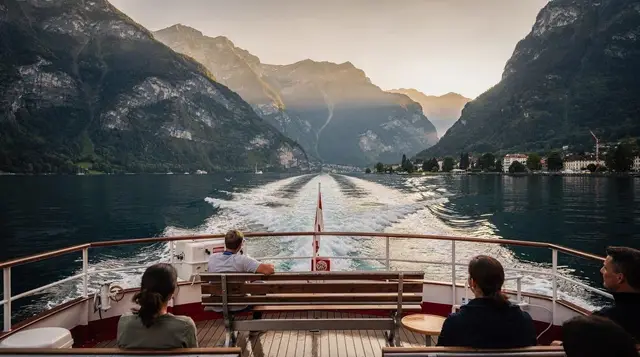
There is a third option that gets less attention than the mountains: staying at lake level and taking a boat. Lake Lucerne (Vierwaldstättersee) is one of the more attractive lakes in Switzerland precisely because of the mountains around it rather than despite the extra travel time — the shoreline bends through several arms, each with a different backdrop, and the historic paddle steamers that still work the lake are worth riding for their own sake.
The Lake Lucerne boat trips guide covers routes, timetables and which steamer to pick for the best views. This is the gentler option compared with a mountain ascent: no altitude, no weather risk beyond rain, and it slots in well after a morning in the old town if the peaks are under cloud.
Practical logistics: timing your day
A workable structure, assuming an early train from Interlaken:
- Depart Interlaken Ost around 07:00–08:00 on the Luzern-Interlaken Express.
- Arrive Lucerne around 09:00–10:00; walk to Chapel Bridge and the old town (allow 2–3 hours, including the Musegg Wall).
- Walk to the Lion Monument (30 minutes including the visit).
- Lunch in the old town — expect roughly CHF 25–35 for a simple sit-down meal, more near the bridge itself, less a few streets back.
- Afternoon: either the Museum of Transport, or a mountain (Pilatus, Rigi or Stanserhorn), chosen the night before based on the forecast.
- Return train from Lucerne, last direct departure typically a little after 20:00; confirm the exact time on the SBB app for your date, since it shifts between the summer and winter timetables.
This is a full day rather than a relaxed one. Anyone wanting a slower pace, or planning to add Titlis or a full boat cruise on top, should look at spreading Lucerne and its surrounding excursions across two days rather than one, using where to stay in Interlaken as a base for cost comparisons if an overnight in Lucerne itself is being weighed against commuting from Interlaken both days.
Where this trip goes wrong
The single most common mistake is trying to fit the old town, the Museum of Transport and a mountain into one day. It does not fit, not without cutting each element down to something rushed and unsatisfying. Pick one add-on and do it properly.
The second mistake is buying a mountain ticket before checking the summit webcam. Cloud sitting on Pilatus or Rigi is common even on a day that looks clear from lake level in Lucerne, and there is no refund for weather once the ticket is used.
The third is underestimating the Brünig line’s schedule rigidity: it runs hourly, not more often, so missing a connection by five minutes costs a full hour, not a short wait. Build in slack around the outbound departure from Interlaken rather than a knife-edge connection.
More ways to do this day trip
Cyclists and anyone wanting a slower look at the lakeshore rather than the old town’s crowds can also consider a private guided trip along Lucerne’s cliff path, which takes in views over the city and lake from above rather than from the bridge at water level — a reasonable substitute for a mountain excursion on a day when the higher peaks are in cloud but the lake basin itself is clear.
For a wider view of how Lucerne fits against other options from Interlaken — Bern, Zurich or the Bernese Oberland’s own peaks — the day trips from Interlaken overview compares travel times and costs across all of them side by side, which is useful before committing a full day and a full-price train ticket to any single destination.
Frequently asked questions about a Lucerne day trip from Interlaken
Is Lucerne worth a day trip from Interlaken?
Yes, for the old town alone: Chapel Bridge, the Musegg Wall towers and the Lion Monument are all within a 20-minute walk of the station and free to see. Add a mountain or the Museum of Transport and it becomes a full, well-used day rather than a rushed one.
How long is the train from Interlaken to Lucerne?
About 1 hour 50 minutes from Interlaken Ost on the Luzern-Interlaken Express, which runs hourly via the Brünig Pass with no change of train. It is one of the more scenic direct routes in Switzerland, not just a way of getting somewhere.
Do I need to reserve a seat on the Luzern-Interlaken Express?
No reservation is required for a normal second-class seat with a valid ticket or pass. Seat reservations exist only for the panoramic carriage in peak summer months, and they carry a small surcharge on top of the fare.
Should I visit the Museum of Transport or go up a mountain?
Pick one, not both, if this is a single day trip. The Museum of Transport needs a genuine half day and is weatherproof; a mountain like Pilatus or Rigi needs most of a day once travel time and queues are counted, and depends on clear weather to be worth the money.
Is the Lion Monument worth seeing?
Yes, and it costs nothing. It is a five-minute walk from the old town and takes ten minutes to see properly, so there is no real reason to skip it even on a tight schedule.
What is the last train back to Interlaken from Lucerne?
The Luzern-Interlaken Express runs until early evening, with the last direct departure typically leaving Lucerne a little after 8pm; check the exact time on the SBB app for your travel date, since timetables shift slightly between summer and winter.
Is the Swiss Travel Pass worth it for this day trip?
On its own, a single Lucerne day trip rarely justifies a multi-day Swiss Travel Pass. It becomes worthwhile once you add a boat trip on Lake Lucerne or a mountain excursion on the same pass, since both are included or heavily discounted.
Can I combine Lucerne with Mount Titlis in one day?
It is possible but tight from Interlaken. Titlis is above Engelberg, itself over an hour beyond Lucerne, so combining the old town, a mountain and Titlis in a single day from Interlaken means a very early start and almost no slack if any connection runs late.
Lake cruises & boat tours on GetYourGuide
Verified deep-linked GetYourGuide tours. Book through these links and we earn a small commission at no cost to you.
GetYourGuide does not provide a product photo for this activity — the image shows the meeting point, photographed by us.