Luzern-Interlaken Express: the Brünig route explained
How long does the Luzern-Interlaken Express take and do I need to book ahead?
The direct train between Lucerne and Interlaken Ost takes close to two hours, climbing the Brünig Pass on a partly cogwheel-assisted line. No reservation is compulsory in the standard carriages, but the panoramic carriage carries a small seat-reservation supplement that is worth paying between May and September.
A two-hour crossing of the Alps’ watershed
The Luzern-Interlaken Express is not a special train with its own rolling stock, its own marketing budget or a fee to board it, and that is exactly why it is worth understanding properly rather than skipping past. It is the ordinary direct service that Zentralbahn runs roughly every hour between Lucerne and Interlaken Ost, and for most of the journey it looks like any other regional Swiss train: overhead luggage racks, unreserved seating, a trolley that may or may not appear.
Then, for about twenty minutes around the village of Brünig-Hasliberg, a cogwheel engages under the carriage, the gradient steepens to over 100 per mil, and the train hauls itself over the watershed between the Reuss and Aare river systems at just over 1,000 metres. That single stretch, plus the lakes on either side of it, is the entire case for choosing this route deliberately instead of treating it as a connection to endure.
This guide covers the practical side: how long it actually takes, which side of the carriage to sit on, what the panoramic-carriage supplement buys you, how fares and passes work, and how to structure it as a same-day round trip from Interlaken rather than a one-way transfer.
The route: Lucerne, the Brünig Pass and three lakes
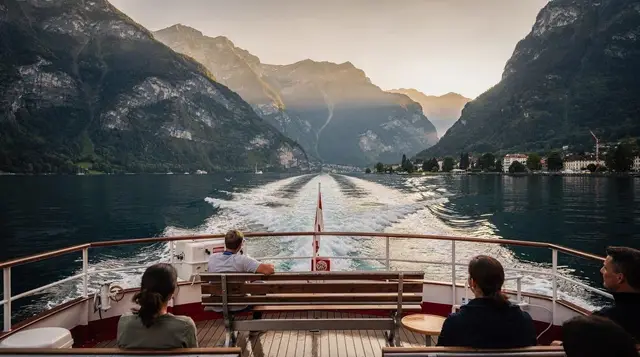
Eastbound from Lucerne, the train runs first along the shore of Lake Lucerne as far as Alpnachstad, the base station for the Mount Pilatus cogwheel railway, then turns inland and climbs gently past Sarnen and Giswil, skirting Lake Sarnen and Lake Lungern. The cogwheel section proper starts a little before Brünig-Hasliberg station, at 1,008 metres the summit of the line, and continues down the far side to Meiringen. From Meiringen the train follows the Aare valley and then the shore of Lake Brienz through Brienz village before reaching Interlaken Ost, where connections wait for the Jungfrau region’s mountain railways.
| Station | Approx. time from Lucerne | Notes |
|---|---|---|
| Lucerne | 0 min | Departure; connections from Zurich, Basel, Zug |
| Alpnachstad | 20 min | Pilatus cogwheel railway base station |
| Giswil | 35 min | Lake Lungern visible shortly after |
| Brünig-Hasliberg | 55–60 min | Summit of the line, 1,008 m, cogwheel section |
| Meiringen | 1 h 10 min | Connection for Grindelwald via the Grosse Scheidegg road bus; Aare Gorge nearby |
| Brienz | 1 h 30 min | Lake Brienz boats, wood-carving workshops |
| Interlaken Ost | Close to 2 h | Connections for Jungfraujoch, Grindelwald, Lauterbrunnen |
Times vary a little by departure and by how many intermediate stops a given train makes, so treat the table as a guide rather than a fixed timetable — always check the current departure board before committing to a connection at either end.
Which side of the carriage to choose
Travelling from Lucerne to Interlaken, the right-hand side is the one to book or drift towards once the train fills up. It faces Lake Sarnen and Lake Lungern on the climb, and on the descent it stays closer to the Aare valley floor and then the shore of Lake Brienz on the run into Interlaken Ost. The left-hand side spends more of the journey looking at the hillside and the Brünig road running parallel to the tracks. Travelling the other direction, from Interlaken to Lucerne, the logic simply flips: take the left-hand side for the same lake views, and you get the bonus of the approach along Lake Lucerne into the city, with Pilatus filling the window on the final stretch.
Neither side gets much from staring at a phone during the cogwheel section — this is one of the few places in the region where the view genuinely changes character within a few minutes, from open lake to dense forest to the pass itself, and it is worth being at the window rather than in the aisle seat.
The panoramic carriage and its supplement
Zentralbahn runs one panoramic carriage on most Luzern-Interlaken Express departures, recognisable by its larger windows and slightly raised seating that lifts sightlines above the standard stock. Unlike the ordinary carriages, a seat here has to be reserved in advance and carries a flat supplement — typically in the CHF 5 to 15 range depending on class, rather than a percentage of the ticket price. It does not get you there any faster and it is not a separate premium train; it is the same service, with better glass.
Whether it is worth booking depends on when you are travelling. In good weather between May and September, especially around midday departures used by day-trippers doing exactly the round trip described below, the panoramic seats sell out, sometimes days ahead in peak August weeks. In November fog or a grey January afternoon, the standard carriages are perfectly adequate and the supplement buys very little. If the crossing is the whole point of your day, book the panoramic seat ahead through SBB or Zentralbahn’s own booking channels; if it is one leg of a busier itinerary, do not worry about it.
Fares, passes and how to book
The regular one-way second-class fare on this route sits in the CHF 30s bracket at full price, with first class roughly 60 per cent higher; a Half Fare Card cuts the second-class figure to somewhere in the high teens. These figures move with SBB’s annual fare updates each December, so treat them as an order of magnitude rather than a quote — check the current price when booking.
| Pass or ticket | Covers the base fare | Covers the panoramic reservation |
|---|---|---|
| Standard point-to-point ticket | Yes, full price | No, booked separately |
| Half Fare Card | Yes, at half price | No |
| Swiss Travel Pass | Yes, included | No |
| Berner Oberland / Jungfrau regional passes | Only within their zone; Lucerne sits outside it | No |
That last row matters: the regional passes sold around Interlaken and the Jungfrau region stop at their own boundary and do not extend to Lucerne, so travellers relying on one of those for the rest of their stay still need a separate ticket, Half Fare discount or Swiss Travel Pass validity for this specific leg. Tickets can be bought at any SBB machine or counter, through the SBB app, or via Zentralbahn directly; the panoramic reservation is a distinct add-on booked at the same time or afterwards against an existing ticket.
Using it as a same-day round trip from Interlaken
Because the journey is close to two hours each way, a same-day round trip from Interlaken to Lucerne uses most of a day but is genuinely workable if you take an early train out. A departure from Interlaken Ost around 7:30 to 8:00am arrives in Lucerne by mid-morning, leaving five to six hours in the city before a return departure in the late afternoon gets you back to Interlaken by early evening — enough time for the old town and lakefront, a short cruise on Lake Lucerne, or a side trip up Mount Pilatus or Mount Rigi if you are prepared to skip most of the town itself.
Travellers who fit a night or a long afternoon in Lucerne around the train often add the boat-and-cogwheel day trip up Mount Rigi before or after the Brünig crossing, since the boat departs from the same lakefront the train arrives at. Others go for the round-trip cable car to the summit of Mount Pilatus, which starts from Kriens on the edge of Lucerne and needs a local bus or taxi to reach from the station.
If timetables and connections feel like too much to manage on an already long day, a guided option that folds the crossing itself into a planned itinerary is the guided transfer along the so-called Swiss Blue Heart route between Lucerne and Interlaken, which removes the need to plan connections at all.
For a private alternative that turns the whole day into a chauffeured outing rather than a scheduled train ride, some visitors instead book the private cogwheel-train day trip from Lucerne to the Jungfraujoch, which uses a different, longer route via the Jungfrau railways rather than the Brünig line covered here.
The round trip also works reversed, based in Lucerne with Interlaken as the day out — useful for anyone splitting a Switzerland trip between the two towns who wants a preview of the Jungfrau region’s mountain railways before committing to a longer stay there. See the wider Lucerne day trip from Interlaken guide for the itinerary in that direction, with timings for slotting in Pilatus or Rigi on the same day.
How it compares with the GoldenPass Line and the Glacier Express
Switzerland markets several routes as headline scenic trains, and it is worth being clear that the Luzern-Interlaken Express is not one of them, in the sense of ticketing and presentation. The GoldenPass Line between Lucerne, Interlaken, Zweisimmen and Montreux and the Glacier Express between Zermatt and St. Moritz both use dedicated panoramic stock throughout, carry compulsory seat reservations, and charge accordingly — the Glacier Express reservation alone typically costs more than this entire Brünig crossing.
The Luzern-Interlaken Express is, underneath the scenery, a workaday regional connection that Zentralbahn runs for commuters and skiers as much as for tourists, with an optional upgrade bolted on rather than a premium experience built in from the start.
That has one clear upside: flexibility. There is no need to book a specific departure weeks ahead the way the Glacier Express often requires in summer. You can turn up, buy a ticket, and take whichever hourly service suits, reserving the panoramic seat only if you decide it is worth it once you see the weather. The trade-off is that the standard carriages are exactly that — standard, sometimes crowded with commuters and skiers on winter weekends, and not designed around the view the way purpose-built panoramic stock is.
Practical notes: luggage, frequency and connections
Services run roughly hourly in each direction across most of the day, with a slightly reduced timetable on some Sunday mornings — check the current schedule rather than assuming an exact hourly clock. Luggage space is standard Swiss regional-train racking rather than the oversized racks fitted to some tourist-oriented services, which is rarely a problem for a day bag but worth planning around if travelling with full suitcases; storing bags at lockers in Interlaken before a day trip is the simpler option for most visitors.
At Interlaken Ost, the Luzern-Interlaken Express connects reasonably well with services up to Grindelwald, Lauterbrunnen and the Jungfraujoch, though it is worth allowing a genuine buffer rather than the shortest theoretical connection, particularly with luggage or in winter when mountain railways occasionally run reduced schedules. At the Lucerne end, connections run onward to Zurich, Basel and Zug, making the Luzern-Interlaken Express a reasonable middle leg for anyone threading a route from northern Switzerland into the Jungfrau region without doubling back through Bern.
For a broader view of how this line sits alongside boats, buses and the region’s other railways, see the guide to trains, buses and boats around Interlaken and the wider explainer on how cable cars and funiculars fit into the same network. As with most Swiss rail travel, departures tend to run close to published times — a habit covered in more general terms in why Swiss punctuality is not a myth — which makes the tight connections at both ends more forgiving in practice than they look on paper.
Luzern-Interlaken Express: frequently asked questions
How long is the Luzern-Interlaken Express journey?
Around 1 hour 50 minutes to just under 2 hours end to end, depending on the specific departure and how many stops it makes at Giswil, Brünig-Hasliberg, Meiringen and Brienz.
Do I need to reserve a seat on this train?
Not in the standard second- or first-class carriages, which run on unreserved seating like most Swiss domestic trains. The panoramic carriage is the exception: it takes a paid reservation, and in July and August it sells out on the midday departures.
Which side of the train has the best views?
Heading from Lucerne to Interlaken, the right-hand side keeps you closest to Lake Sarnen, Lake Lungern and the descent along Lake Brienz. Heading the other way, from Interlaken to Lucerne, swap to the left-hand side for the same lakes and for the approach into Lake Lucerne at Alpnachstad.
What does the panoramic carriage supplement cost?
It is a flat reservation fee rather than a percentage of the fare, typically in the region of CHF 5 to 15 depending on class and how close to departure you book. It buys a fixed, numbered seat in the carriage with the largest windows, not a faster journey.
Is the whole line a rack railway?
No. Only the steepest stretch, roughly between Giswil and Meiringen over the summit at Brünig-Hasliberg, uses a cogwheel to grip the track. The rest of the route runs on ordinary adhesion track, including the flatter sections beside Lake Lucerne and Lake Brienz.
Can I do this as a day trip from Interlaken and come back the same day?
Yes, and it is one of the more relaxed rail day trips from the Bernese Oberland. An early train out and a late-afternoon or early-evening train back leaves five to six hours in Lucerne, enough for the old town, a lake cruise or the trip up Mount Pilatus or Mount Rigi.
Is the Luzern-Interlaken Express covered by the Swiss Travel Pass?
Yes, the Swiss Travel Pass covers the standard fare on this route, as does a Half Fare Card at half price. Neither covers the panoramic-carriage reservation supplement, which is always paid separately regardless of which pass you hold.
How does it compare with the GoldenPass Line or the Glacier Express?
It is shorter, cheaper and far less hyped than either. The GoldenPass Line and Glacier Express are marketed as headline scenic trains with compulsory reservations and premium panoramic stock throughout; the Luzern-Interlaken Express is a regular Zentralbahn service that happens to cross a genuinely scenic pass, with an optional upgrade rather than a built-in one.
Lake cruises & boat tours on GetYourGuide
Verified deep-linked GetYourGuide tours. Book through these links and we earn a small commission at no cost to you.
GetYourGuide does not provide a product photo for this activity — the image shows the meeting point, photographed by us.