Mount Pilatus: the dragon mountain above Lucerne
Is Mount Pilatus worth the day trip from Interlaken?
Yes, if you build in the roughly 3 hours of travel each way via Lucerne. The steepest cogwheel railway in the world and the Golden Round Trip are genuinely distinctive; the summit view is weather-dependent, so check the webcam before committing to the fare.
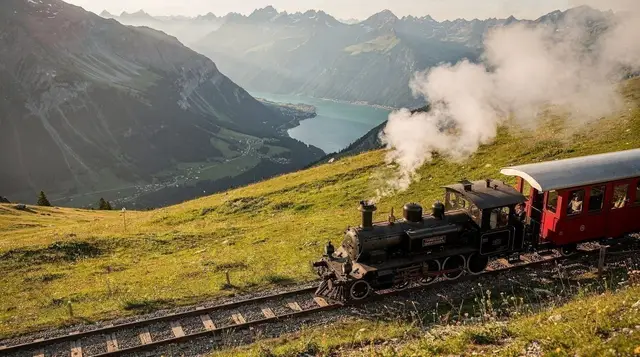
Mount Pilatus is not, strictly, an Interlaken mountain. It rises over Lucerne, roughly two hours from Interlaken by train, and it competes for your day-trip budget against nearer options like Mount Rigi and the Jungfraujoch. What gets it onto most itineraries anyway is a single piece of engineering: the world’s steepest cogwheel railway, still doing what it did in 1889, hauling carriages up a slope that looks, from the valley floor, like it should be a cable car and nothing else.
A railway that shouldn’t work
The Pilatus Bahn climbs from Alpnachstad, on the shore of Lake Lucerne, to Pilatus Kulm at 2,132 metres. The distance is short, 4.6 kilometres, but the gradient reaches 48 percent on its steepest section, which the operator has marketed since opening day as the steepest rack railway on earth. Nobody has seriously challenged the claim.
The trick is in the rack itself. Ordinary cogwheel railways, like the one to the Schynige Platte above Interlaken, use a single toothed rail between the running rails. Eduard Locher, the engineer behind Pilatus, knew a standard rack would simply pop out of its cogs on a 48 percent slope, so he designed a horizontal rack with teeth on both sides, gripped from the side rather than pushed from below.
The carriages are stepped, each row of seats sitting higher than the one in front, so that on the steepest stretch you are looking almost straight down the aisle at the person four rows ahead. The whole ascent takes about 30 minutes and covers roughly 1,600 metres of height gain, at a pace of around 9 km/h on the steep sections, slow enough that people do occasionally read on the way up.
It only operates from around early or mid-May to mid-November. Snow and ice on that gradient are not something the operator attempts to manage; the line simply closes for winter, and the closure dates shift a little year to year depending on conditions, so check the current calendar before building a trip around it. See when mountain railways open and close for the general pattern across the region.
The Golden Round Trip: how it actually works
Most visitors do not go up and down the same way. The standard route, sold as the Golden Round Trip, links four modes of transport into a loop that starts and ends in Lucerne:
| Leg | Transport | Approx. duration |
|---|---|---|
| Lucerne to Alpnachstad | Train or lake boat | 20-45 min |
| Alpnachstad to Pilatus Kulm | Cogwheel railway | 30 min |
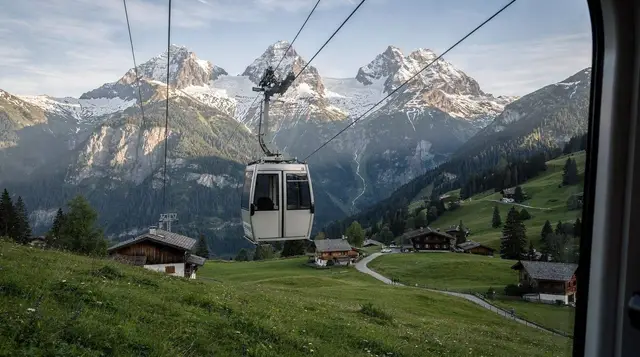
| Pilatus Kulm to Fräkmüntegg | Aerial cableway | 5 min |
| Fräkmüntegg to Kriens | Gondola (Panorama Gondelbahn) | 20 min |
| Kriens to Lucerne | Bus or 20-minute walk to the station | 10-20 min |
You can run it in either direction, and most people go up by cogwheel railway and down by cable car, since the descent side gives you a longer, gentler view over Lucerne and the lake rather than a steep look at the rack rails. A full-price adult ticket for the whole loop from Lucerne runs to roughly CHF 110 to 120; Half Fare Card and Swiss Travel Pass holders pay around half that. If you already have transport as far as Alpnachstad, the cogwheel railway alone, return, is noticeably cheaper.
For the self-guided version of exactly this loop, including the boat option from Lucerne, see this self-guided round trip by train to Mount Pilatus, or, if you would rather start from the railway end without arranging the boat yourself, the Alpnachstad round-trip cogwheel railway ticket covers just that leg.
Both the Swiss Travel Pass and regional passes give a discount rather than free travel on Pilatus, since the mountain sits outside the Berner Oberland Pass network entirely. Factor that in when comparing the cost of a Pilatus day against a Jungfraujoch or Schilthorn day closer to Interlaken, where those passes go further.
The dragon of Pilatus
The name invites two competing stories, and Lucerne has never fully settled which one is true. The tourist-friendlier version says the mountain is named for Pontius Pilate, whose body, according to medieval legend, was thrown into the small lake near the summit after his suicide, cursed to rise from the water once a year and bring storms down on the city if anyone disturbed it. Lucerne authorities took the story seriously enough that, for a period in the 16th century, climbing the mountain without official permission was against local law.
The more likely origin is duller: “pileatus,” Latin for cloud-capped, describing the summit’s habit of gathering cloud even on otherwise clear days. Both explanations coexist in local telling, and Pilatus tourism has never had much interest in picking a winner.
Dragons are the older and stranger thread. Between the 14th and 17th centuries, several chroniclers in Lucerne recorded supposed dragon sightings on and around the mountain, including one account of a dragon flying overhead so low a man was said to have been scorched by its breath before it dropped a fist-sized stone at his feet. That stone, the Drachenstein, still exists and is kept in the Natural History Museum in Lucerne. Whatever prompted the sightings, the dragon has stayed as the mountain’s mascot ever since, on everything from the railway’s branding to the summit hotel’s décor.
What the summit actually gives you
At 2,132 metres, Pilatus Kulm sits well below the giants around Jungfraujoch or Gornergrat, but its position directly over Lucerne and its lake gives a different kind of view: the city laid out below, Lake Lucerne’s fingers reaching into the valleys, and on a clear day a long line of Alpine peaks to the south. Two hotels sit at the top, along with a handful of short marked paths around the ridge, the longest running out to the Tomlishorn at 2,128 metres in about 45 minutes each way.
The honest caveat is that this view is not guaranteed, and the two failure modes are opposite. A Nebelmeer, a sea of cloud filling the valleys while the summit stands clear above it, shows up most reliably on still autumn and winter mornings after a spell of high pressure, and it is the postcard version of a Pilatus trip: the lake and city invisible under a flat white layer, mountain tops around you poking through like islands.
The other, more common outcome is that the cloud sits over the summit itself rather than below it, and you arrive at Pilatus Kulm to a grey wall a few metres past the railway platform. There is no way to predict this from Interlaken; check the live summit webcam on the morning you plan to travel, not the general forecast, since Lucerne town can be clear while the summit is capped, or the reverse.
Getting to Pilatus from Interlaken
There is no direct route. From Interlaken Ost, trains to Lucerne run roughly hourly and take about 1 hour 50 minutes via the Brünig line, with a change usually required. From Lucerne station, it is a short walk or tram to the boat pier or to the train for Alpnachstad. Door to door, allow a good 2.5 to 3 hours each way once you include the connection to the cogwheel railway, which makes Pilatus a full day, not a half-day add-on.
Some visitors prefer to skip the planning and let someone else handle the connections; the fully organised tour covering three mountain passes from Interlaken runs through this general region as part of a longer loop, useful if Pilatus is one stop among several rather than the whole point of the day. For a Pilatus day built around Lucerne itself, pair it with the Lucerne day trip guide, and see Interlaken versus Lucerne if you are still deciding whether to base yourself in one or the other.
Alternatives to the round trip
The cogwheel railway and cable car are not the only ways up, and they are not always the better choice.
Walking up. The classic ascent path from Alpnach or Hergiswil climbs around 1,600 metres over 5 to 7 hours, steep and largely shaded by forest for the lower half. It is only realistic from June to October and rewards you with a ticket down by rail or cable car rather than a second climb. A guided version exists for anyone who would rather not navigate the route alone, combined with food along the way: the guided Mount Pilatus hike with snacks and coffee or tea.
Mountain biking. Obwalden’s lower slopes have a growing network of marked mountain bike trails, and a guided mountain bike tour through the Obwalden region is a reasonable way to see the area around Pilatus without committing to the summit railway at all, particularly outside the cogwheel railway’s operating season.
Cable car only, no train. Driving or busing to Kriens and taking the Panorama Gondelbahn and aerial cableway up skips Alpnachstad and the rack railway entirely. It is the year-round option, since the cable cars keep running through winter when the cogwheel line is shut, but it also skips the single most distinctive part of the whole trip.
Pilatus against the other big day trips
| Mount Pilatus | Mount Rigi | Mount Titlis | |
|---|---|---|---|
| Summit height | 2,132 m | 1,798 m | 3,238 m |
| Signature feature | 48% cogwheel railway | Gentle summit, lake views | Rotating cable car, glacier |
| Travel time from Interlaken | ~2.5-3 h | ~2-2.5 h | ~2.5-3 h |
| Winter access | Cable car only, railway closed | Full access | Full access |
| Best paired with | Lucerne | Lake Lucerne boat trip | Engelberg |
None of the three is a wrong choice, and none needs defending against the others; see best mountain excursions from Interlaken for how they compare against the closer options around the Jungfrau region, and cable cars and funiculars explained if the mechanics of rack railways, gondolas and aerial cableways still need untangling before you book anything. If Pilatus is one stop in a longer loop rather than a standalone day, it slots naturally into a week that also covers day trips from Interlaken or a full 7-day itinerary built around day trips.
Mount Pilatus, the dragon mountain: frequently asked questions
How steep is the Pilatus cogwheel railway?
Its maximum gradient is 48 percent, which the operator still markets as the steepest rack railway in the world. It runs from Alpnachstad, on Lake Lucerne, up to Pilatus Kulm in about 30 minutes, using a design patented in 1889 that keeps the carriages level on the slope.
What is the Golden Round Trip?
It is the classic combination for reaching Pilatus: a boat or train from Lucerne to Alpnachstad, the cogwheel railway up to Pilatus Kulm, and the aerial cableway and gondola down to Kriens, or the same route reversed. It uses four different modes of transport in one day and avoids doubling back on yourself.
Why is Pilatus called the dragon mountain?
Medieval chronicles from Lucerne recorded sightings of dragons around the mountain for centuries, and a stone said to have fallen from one, the Drachenstein, is kept in the Natural History Museum in Lucerne. A separate legend claims the mountain holds the body of Pontius Pilate, which is the more likely source of the name.
Do you see a sea of clouds from Pilatus?
Sometimes. A Nebelmeer, a sea of cloud sitting in the valleys below a clear summit, is most common on autumn and winter mornings when high pressure traps mist over Lake Lucerne. On plenty of days it works the other way round and the summit itself sits in cloud, so check the live webcam before you buy a ticket.
When is the Pilatus cogwheel railway closed?
It typically runs from late spring to autumn only, roughly May to November, and closes completely outside that window because the track cannot be cleared of snow on a 48 percent gradient. The aerial cableway from Kriens runs year-round instead, weather permitting.
Can you walk up Mount Pilatus?
Yes. The main path from Alpnach or Hergiswil to Pilatus Kulm takes 5 to 7 hours of steady climbing with around 1,600 metres of ascent, and is only sensible from June to October. Most visitors ride up one way and walk a shorter stretch, or skip the walk entirely.
How much does a Mount Pilatus trip cost?
A full-price Golden Round Trip from Lucerne runs to roughly CHF 110 to 120 per adult, with about 50 percent off for Half Fare Card and Swiss Travel Pass holders. The Alpnachstad cogwheel railway alone, return, is cheaper again if you already have transport to Alpnachstad.
Is Mount Pilatus better than Mount Rigi?
They suit different days. Pilatus has the more dramatic railway and a closer view over Lucerne and its lake, while Rigi is easier to combine with a relaxed boat trip and has gentler summit walking. Neither is a wasted day; the choice usually comes down to which railway experience you want more.
Mountain excursions on GetYourGuide
Verified deep-linked GetYourGuide tours. Book through these links and we earn a small commission at no cost to you.
GetYourGuide does not provide a product photo for this activity — the image shows the meeting point, photographed by us.