Cable cars, funiculars and rack railways explained
What is the difference between a funicular, a cable car and a rack railway around Interlaken?
A rack railway and a funicular both run on fixed rails, so wind almost never stops them. A gondola or aerial tram hangs from a cable in open air, so it is suspended in strong wind or storms. Fares also scale with the system: rack railways to Jungfraujoch and Schynige Platte are the most expensive, small local funiculars the cheapest.
Every brochure around Interlaken shows a cabin swinging over a ridge, but “cable car” is doing a lot of work covering four genuinely different pieces of engineering. They do not cost the same, they do not react to wind the same way, and they do not run to the same clock. Getting this wrong is how people end up stuck at 2,000 metres with the last descent already gone, or paying rack-railway prices for what turns out to be a ten-minute funicular hop.
Four systems, one region
The Jungfrau region runs on a mix of four mountain transport types, and the German names on timetables and tickets are worth learning because they tell you what you are actually booking.
| System | German name | How it works | Wind sensitivity | Examples near Interlaken |
|---|---|---|---|---|
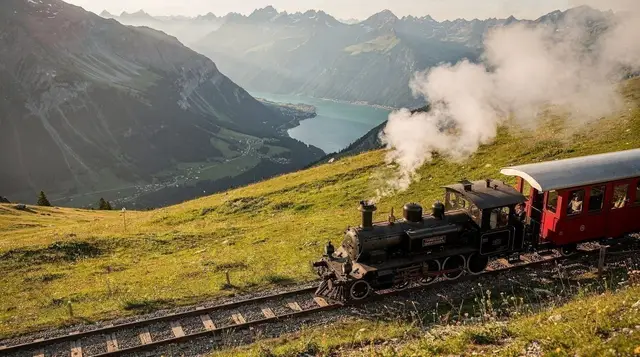
| Rack railway (cog railway) | Zahnradbahn | A toothed rail between the running rails engages a cogwheel under the train, giving grip on steep gradients | Low – runs on fixed rails | Jungfrau Railway, Schynige Platte railway, Brienz Rothorn steam railway |
| Funicular | Standseilbahn | Two cars on rails are linked by a single cable over a pulley at the top; one going up counterbalances the other coming down | Low | Harder Kulm funicular, Niesenbahn |
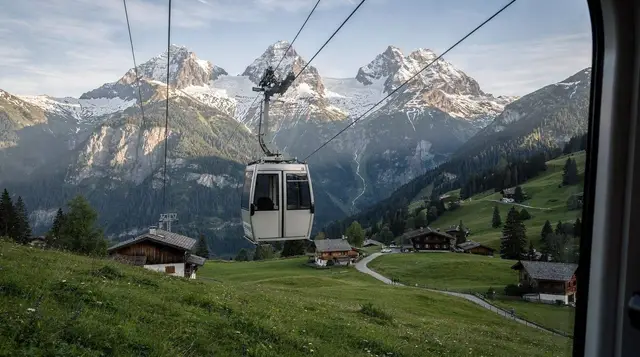
| Gondola (small cabin, continuous) | Gondelbahn / Umlaufbahn | Small cabins (four to ten seats) are clipped to a cable that keeps moving; you board and alight without the cabin stopping | Moderate | Grindelwald First gondola, Männlichen gondola |
| Aerial tramway (large cabin) | Luftseilbahn / Pendelbahn | One or two large cabins (30 to 125 people) shuttle back and forth, suspended from thick support cables | High | Schilthornbahn, Niederhornbahn |
| Tricable gondola | 3S-Bahn | Large cabins ride on three cables (two fixed carrying cables plus one hauling cable), giving more stability than a standard aerial tram | Lower than a comparable aerial tram | Eiger Express (Grindelwald Terminal to Eigergletscher) |
None of this is trivia. It is the difference between a trip that runs in a stiff breeze and one that gets suspended for the afternoon.
Rack railways: slow, steady, expensive
A rack railway is the closest thing to a normal train, just fitted with a cogwheel for grip. That is why it is the least wind-affected system on this list and also, generally, the most expensive: building and maintaining rails up a mountainside costs far more than stringing a cable.
The Jungfrau Railway is the flagship example, climbing to Jungfraujoch at 3,454 metres partly through a tunnel bored into the Eiger, opened in 1912 and still the highest railway station in Europe. A return trip from Interlaken takes the better part of a day and the fare reflects that: expect a full-price adult return in the low hundreds of Swiss francs, with meaningful discounts for Swiss Travel Pass holders, Half Fare Card holders and early morning departures.
At the other end of the scale, the Schynige Platte cog railway dates to 1893 and runs a shorter, cheaper route to 1,967 metres with panoramic views over both lakes. The Brienz Rothorn line still runs a steam locomotive on part of its schedule, alongside diesel trains, and is genuinely one of the last steam rack railways left in Switzerland – see the full steam railway guide for timetables, since steam departures are limited and sell out.
Funiculars: cheap, quick, and rarely cancelled
A funicular is mechanically simple: two cars, one cable, gravity and a counterweight doing most of the work. That simplicity is why funiculars are usually the cheapest mountain ride in the region and the least likely to be affected by weather.
The Harder Kulm funicular from Interlaken Ost is the obvious example: an eight-minute ride to 1,322 metres, running since 1908, with a return fare that is a fraction of what Jungfraujoch or Schilthorn cost. It is also one of the few mountain trips near Interlaken that keeps running in conditions that would ground a gondola, because it is bolted to rails the entire way.
Gondolas and small cabins: continuous but weather-limited
Gondolas with small, continuously moving cabins are a middle case. They are cheaper to build than rack railways, cheaper to run than a full rack line, and the small cabin size means less wind resistance than a big aerial tram cabin, but they still hang from a cable in open air and do get suspended in genuinely bad weather.
Grindelwald First runs this way, and its gondola is also the access point for the first-flyer zipline and the mountain cart descent. The gondola from Grindelwald to Männlichen, covered together with the cable car from Wengen in the Männlichen guide, is the same type: efficient in normal conditions, closed in storms.
Large aerial trams: the most weather-dependent
The big cabins that swing dramatically across a valley on thick cables are aerial tramways, and they are the system most likely to interrupt your day. Larger cabin surface area catches more wind, and most aerial trams are built with two or three sections rather than one continuous ride, multiplying the number of points where a gust can force a stop.
The Schilthornbahn to Piz Gloria at 2,970 metres is the best-known example, running from Stechelberg via Gimmelwald and Mürren in stages. It is also one of the more expensive single trips in the region: a return from Stechelberg typically runs close to CHF 100, and considerably less if you already hold a regional pass or start from Mürren rather than the valley floor. The full picture, including the revolving restaurant at the top, is in the Schilthorn and Piz Gloria guide.
Niederhornbahn, above Beatenberg, is a smaller-scale version of the same idea: a single large-cabin aerial tram, cheaper than Schilthorn because the vertical gain and journey length are shorter, but built the same way and just as exposed to wind advisories – see the Niederhorn guide.
Tricable gondolas: the newest, sturdiest option
The Eiger Express, opened in December 2020, is a 3S tricable gondola: its cabins ride on three cables instead of the single cable a standard aerial tram or gondola uses. That extra cable width is specifically what makes tricable systems more wind-tolerant than a comparable large-cabin tram, which is part of why it was chosen for the route from the Grindelwald Terminal to Eigergletscher, cutting a journey that used to take about 45 minutes down to roughly 15.
Full detail on how it fits into the wider route to Jungfraujoch is in the Eiger Express and Grindelwald Terminal guide; the alternative route via Lauterbrunnen and Kleine Scheidegg still runs on the older Wengernalp rack railway, detailed in its own guide.
What actually moves the price
Four things drive the fare more than anything else: vertical metres gained, total journey length, number of connecting sections, and how recently the infrastructure was built or renewed. As a rough guide to how the region’s main lines compare:
| Line | Type | Approx. summit altitude | Typical one-way time | Roughly where it sits on price |
|---|---|---|---|---|
| Harder Kulm funicular | Funicular | 1,322 m | 8 min | Lowest |
| Niederhornbahn | Aerial tram | 1,950 m | 20–25 min total | Low–mid |
| Schynige Platte railway | Rack railway | 1,967 m | 50 min | Mid |
| Grindelwald First gondola | Gondola | 2,168 m | 25 min | Mid |
| Schilthornbahn (from Stechelberg) | Aerial tram, multi-stage | 2,970 m | 30–35 min | High |
| Jungfrau Railway (from Interlaken) | Rack railway + gondola/tram sections | 3,454 m | 2h+ door to door | Highest |
Treat these as orders of magnitude rather than fixed francs and centimes: every operator revises its tariff at least once a year, so check the current fare on the day rather than a figure quoted in an old blog post – including this one.
Wind, storms and how the closures actually work
Operators do not close for wind at a whim; large cabins are rated to a specific wind speed, and once forecasts or live readings pass that threshold, the line either slows down, suspends the top section, or shuts entirely until conditions ease. This is why the exposed upper sections of the Schilthornbahn and Niederhornbahn are the first things to close on a blustery day, while a rack railway on fixed rails, such as the Jungfrau Railway or the Schynige Platte line, keeps running through all but genuinely dangerous storms.
Practically, that means: if your one fixed-date plan is Schilthorn or a large aerial tram and the forecast shows strong wind, build in a backup day, or pick a rack railway or funicular destination instead for that particular day. Operators post live status on their own websites, and the guide to when mountain railways open and close covers seasonal closures on top of day-to-day wind holds.
Last descent: the detail that ruins more days than the weather
Every mountain line publishes a last-descent time, and it moves with the season – often somewhere around 5pm to 6.30pm in high summer, considerably earlier once the clocks change in autumn and through winter. There is no universal rule across the region, so the only reliable approach is checking the specific line’s timetable for the specific date you are travelling, ideally the same morning, since schedules can also be trimmed for maintenance work or low demand outside peak months.
Missing the last car down is a genuine problem, not an inconvenience you can shrug off. On car-free terrain such as Mürren or above Wengen, there is no road access and no taxi alternative; you are relying on the next morning’s first departure, or a mountain hut or berghaus with a spare room if one exists nearby. Build a comfortable buffer, particularly if you are also trying to catch a specific train connection back to Interlaken from Interlaken Ost or Interlaken West afterwards.
Passes and what they actually cover
The Swiss Travel Pass, the Berner Oberland Pass and the Jungfrau Travel Pass each cover a different subset of these lines, and coverage is not consistent: some funiculars and lower-altitude gondolas are fully included, while premium routes such as the final Jungfraujoch section are typically discounted rather than free even with a pass in hand. Do not assume full coverage on a big-ticket line; check the specific line against your specific pass before you count on a free ride.
Combining several systems in one day
Because the region has this many mountain transport types clustered together, it is genuinely possible to ride a funicular, a gondola and a rack railway in a single outing without much backtracking. For a guided version of that idea rather than planning your own connections, an organised trip such as the day trip covering three Swiss peaks by cable car and funicular handles the timing and ticketing across systems for you.
For a shorter, lower-altitude outing that still uses a cable car and stays closer to Interlaken, the day trip to Lake Oeschinen with a cable car ride pairs an aerial tram section with the turquoise lake near Kandersteg, and it does not demand a full day at altitude the way Jungfraujoch does.
If you are staying longer in the region and want to see a cable car system further afield, the Glacier 3000 cable car roundtrip ticket reaches a different aerial tram system above Gstaad, useful context for comparing how one large-cabin system differs from another once you factor in altitude and route length.
Practical checklist before you go up
- Check the specific line’s live status page on the morning of travel, not the night before.
- Note the last descent time for that day and plan to be at the top station at least 30 to 45 minutes earlier.
- If wind is forecast above roughly 60 to 70 km/h, expect aerial trams and exposed gondola sections to be the first affected; rack railways and funiculars are more likely to keep running.
- Confirm what your pass covers on that specific line before assuming it is free.
- In April and November, check for scheduled maintenance closures before building a day around one line – see the seasonal opening and closing guide for typical windows.
- If you are travelling to a car-free village such as Gimmelwald or Wengen, know the last car down before you commit to a late lunch.
Cable cars and funicular questions people ask before travelling to Interlaken
What’s the difference between a gondola and a cable car?
In everyday English both terms get used loosely, but technically a gondola has small cabins on a continuously moving cable that you board without it stopping, while a cable car or aerial tramway uses one or two large cabins that shuttle back and forth and stop fully at each end. Grindelwald First is a gondola; the Schilthornbahn is an aerial tramway.
Is the Jungfraujoch trip a single cable car ride?
No. Depending on the route chosen, it combines a rack railway from Interlaken to Lauterbrunnen or Grindelwald, then either the Wengernalp rack railway to Kleine Scheidegg or the Eiger Express tricable gondola to Eigergletscher, then the final Jungfrau Railway rack section through the Eiger tunnel to the summit station. It is several connected systems, not one ride.
Which mountain lines run all year?
The Jungfrau Railway to Jungfraujoch, the Harder Kulm funicular and the main Schilthornbahn sections generally run year-round outside their scheduled maintenance windows. Some smaller seasonal lines, particularly certain hiking-access chairlifts, close for winter entirely; always check the specific line’s calendar rather than assuming.
Do I need to book cable car tickets in advance?
For the busiest single line, the Jungfraujoch trip, booking a timed slot in advance is strongly recommended in July and August to avoid being turned away at capacity. Smaller local lines such as Harder Kulm or Niederhorn rarely require advance booking outside exceptional peak weekends.
Can wheelchair users access these systems?
Accessibility varies significantly by line and by station; some funiculars and the main Jungfraujoch route have step-free access built in, while some older aerial tram stations do not. Confirm directly with the specific operator before travelling if accessibility is a requirement.
Why do some lines have three cables instead of one?
A tricable system, or 3S-Bahn, spreads the cabin’s weight and wind exposure across two fixed carrying cables plus a separate hauling cable, which increases stability in wind compared with a standard one-cable aerial tram of similar cabin size. The Eiger Express is the regional example.
Are older cable cars less safe than newer ones?
No. Swiss mountain railways, whatever their age, operate under strict federal inspection regimes, and lines dating from the 1890s to 1900s are still running today precisely because they are well maintained. Age is not a safety indicator here; wind rating and cabin design are what determine when a line suspends service.
Mountain excursions on GetYourGuide
Verified deep-linked GetYourGuide tours. Book through these links and we earn a small commission at no cost to you.
GetYourGuide does not provide a product photo for this activity — the image shows the meeting point, photographed by us.