Wilderswil is easy to overlook. It’s a five-minute train ride south of Interlaken, a village of a few thousand people with a handsome church and not much reason to linger — until you notice the little green-and-cream rack railway carriages waiting at the platform opposite the main line. That railway, running since 1893, is why Wilderswil earns a page of its own. It climbs 1,400m in 52 minutes to a ridge at 1,967m that faces the Eiger, Mönch and Jungfrau across the valley, and it is, for a fair number of people who’ve already spent a small fortune on the Jungfraujoch, the mountain trip they end up preferring.
A cog railway that hasn’t changed its job in 130 years
The Schynige Platte Bahn opened in 1893, a product of the same wave of Bernese Oberland railway-building that gave the region the Brienz Rothorn line and, two decades later, the Jungfrau Railway itself. It uses the Riggenbach rack-and-pinion system: a toothed rail between the running rails that the locomotive’s cog wheel engages, which is what lets a train climb gradients of up to 25 percent without simply sliding back down. The open-sided carriages, painted in the railway’s traditional green and cream, are original in spirit if not always in every carriage — restoration has kept the line running much as it always has, at a pace of roughly 14 km/h.
Fifty-two minutes sounds slow for 7.3km. It is slow, deliberately. The train stops briefly partway up, the gradient steepens and eases in stages, and the view widens gradually — first over the roofs of Wilderswil and Interlaken, then across the Bödeli to Lake Brienz, then, as the train rounds the final curves, to the wall of peaks on the far side of the valley. Sit on the right-hand side going up for the best sequence of views; on a clear day you’ll have the Eiger, Mönch and Jungfrau in sight well before the terminus.
the Wilderswil–Schynige Platte railway round trip is the straightforward way to book the ride, and it’s worth doing so a day or two ahead in July and August, when the first morning departures can fill.
Getting to Wilderswil and buying tickets
Wilderswil sits on the BLS line between Interlaken Ost and Grindelwald/Lauterbrunnen, and also on the branch that continues to Lauterbrunnen and Grindelwald. From Interlaken Ost it’s a five-minute hop; from Interlaken West, allow closer to ten minutes with the change. The Schynige Platte Bahn departs from its own platform directly across from the BLS station — you don’t need to leave the station building to make the connection.
| From | Journey | Approx. time |
|---|---|---|
| Interlaken Ost | Train to Wilderswil | ~5 min |
| Interlaken West | Train to Wilderswil | ~10 min |
| Wilderswil | Rack railway to Schynige Platte | 52 min |
| Interlaken Ost | Total door to summit | ~60-70 min |
Fares run somewhere in the region of CHF 60-70 for a second-class return from Wilderswil, with the standard 50 percent reduction for Swiss Travel Pass and Half Fare Card holders — check current pricing before you travel, since Swiss rail fares are revised annually. Trains typically run at half-hourly to hourly intervals through the day in season, more frequently at midsummer weekends. There’s no need to book the train itself in advance in most conditions, though the affiliate ticket above bundles the return fare with a guided element if you’d rather not manage timings yourself.
The alpine garden: 650 species above the tree line
At the top, a short walk from the station, is the Alpine Garden Schynige Platte — a genuine botanical garden rather than a scattering of labelled plants, with around 650 species of alpine and pre-alpine flora arranged along paths that loop through rockeries and meadow plots.
It was established in the early 20th century specifically to take advantage of the site’s exposure and altitude, and it remains one of the more serious alpine gardens in Switzerland, not a tourist add-on. Peak flowering is roughly June into July, when gentians, edelweiss and a long list of less famous alpines are out; by September the garden is past its best but still worth the modest entry fee if botany interests you at all. Allow 45 minutes to an hour to walk it properly.
The Panoramaweg and longer walks
The reason people linger at Schynige Platte rather than taking the next train down is the Panoramaweg, a ridge path that loops from the station with the Eiger, Mönch and Jungfrau in view for almost its entire length. The short loop takes about an hour, is largely flat with a little unevenness underfoot, and needs nothing more than sturdy shoes. It’s one of the easiest genuinely scenic walks in the region — easier than anything comparable from Kleine Scheidegg or Männlichen, and without Harder Kulm’s tree-filtered views.
For walkers with more time and better boots, Schynige Platte is also the start of the multi-hour route toward the Faulhorn and on to Grindelwald First or down to Bussalp — a full-day undertaking with real elevation change, well beyond the scope of a half-day trip. There’s a shorter, less demanding option down through Bort to Wilderswil for anyone who’d rather walk one direction and ride the other, though it’s a long descent on tired knees and most visitors simply take the train both ways.
When it’s open, and when it isn’t
The Schynige Platte Bahn runs a short season: typically early June to late October, and that window moves a little each year depending on how much snow lingers on the upper track and when the first autumn snow arrives. Outside those months the line simply doesn’t operate — there’s no winter service, unlike the year-round Jungfrau Railway via Kleine Scheidegg.
Within the season, the railway (like most mountain lines in the region) can still suspend service on days of high wind or heavy cloud that would make the trip pointless anyway. If Schynige Platte is the main reason for your day, check the operator’s live status or a webcam before setting off from Interlaken, and have a fallback in mind — Harder Kulm or a boat on Lake Thun both work as lower-altitude alternatives that shrug off marginal weather.
Schynige Platte versus the Jungfraujoch
The comparison comes up constantly, and it’s a fair one: both are cog railways built to put visitors somewhere they couldn’t otherwise easily go, and both are marketed heavily around the Jungfrau massif. They deliver very different things.
| Schynige Platte | Jungfraujoch | |
|---|---|---|
| Altitude | 1,967m | 3,454m |
| Journey from Interlaken | ~60-70 min door to door | ~2h 20min via Lauterbrunnen or Grindelwald |
| Return fare from Interlaken (approx.) | CHF 60-70 from Wilderswil | CHF 200+ |
| The view | Eiger, Mönch, Jungfrau seen from across the valley | Standing among the peaks, partly indoors/in tunnel |
| Crowds | Modest, even in August | Heavy, year-round |
| Season | June-October only | Year-round |
| Best for | An unhurried afternoon, photography, walking | A once-per-trip “highest point in Europe” experience |
Neither makes the other redundant. The Jungfraujoch puts you inside the mountains, with the Sphinx Observatory, the ice palace and the glacier plateau — worth doing once for that reason alone, and a full day trip to the Jungfraujoch from Interlaken is the standard way to see it properly.
Schynige Platte instead gives you the classic postcard angle of those same three peaks, uncluttered by tunnels or queues, at around a third of the cost and with room to actually sit down and look at it for a while. Visitors who’ve done both quite often say Schynige Platte was the view they remember more clearly — not because it’s more dramatic, but because they had time to look at it.
Wilderswil itself, and what else to combine it with
Wilderswil is small enough to see on foot in twenty minutes — a working village rather than a resort, with a 19th-century church and a scattering of guesthouses that are noticeably cheaper than equivalents on Interlaken’s Höheweg. Most visitors treat it purely as the railway’s starting point, which is reasonable, though it’s a pleasant, quiet base if you’d rather stay slightly outside the town centre.
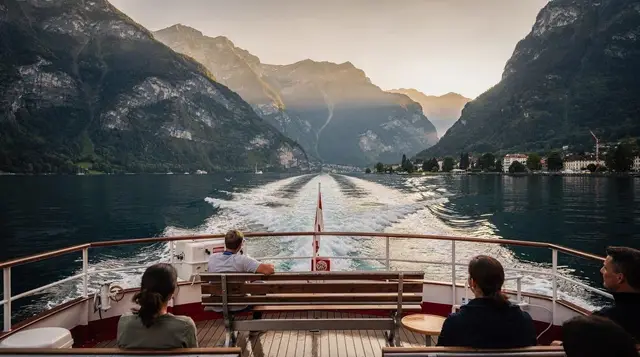
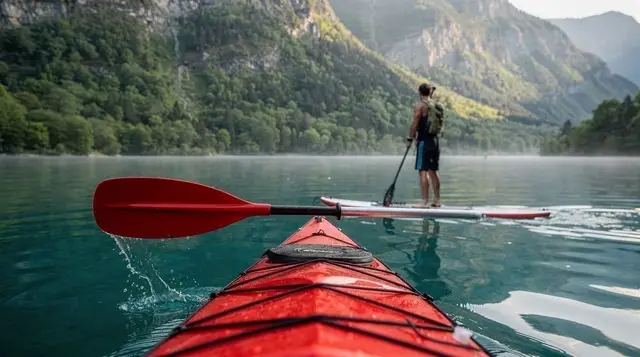
Because Schynige Platte is only a half-day commitment including travel, it pairs naturally with something else on the same day. An easy combination is a morning at the summit followed by an afternoon by the water: Lake Brienz and Lake Thun both border the Bödeli, and a short e-bike route or boat trip fills the rest of the day without feeling rushed.
an e-bike tour taking in Interlaken’s lakes, ruins and viewpoints works well as a lower-key afternoon after the morning’s climb, and for something more sedentary, an Interlaken raclette and rafting outing makes for a contrasting, food-and-adrenaline second half of the day. Walkers who want more altitude without more crowds should also look at Schynige Platte’s dedicated hiking write-up and the comparison against Harder Kulm for a fuller sense of which lower viewpoint suits a given day.
Practical tips
Bring more layers than the temperature in Interlaken suggests. At 1,967m, even a warm Bödeli morning can mean a stiff wind on the ridge, and the Panoramaweg has no shelter along most of its length. Sun protection matters for the same reason the wind does — you’re above a lot of the atmosphere’s filtering, and reflected light off any remaining snow patches in June is stronger than it looks.
Photographers should aim for a morning departure. Cloud tends to build over the peaks through the afternoon in summer, and the classic Eiger-Mönch-Jungfrau panorama is at its clearest before midday. The Berghotel Schynige Platte serves lunch and simple Swiss dishes if you want to stay past the morning light rather than turning around immediately, and its terrace is the obvious spot to sit with the view rather than just photograph it.
Anyone weighing this against Harder Kulm or the Schilthorn should read the dedicated comparisons before deciding — the trade-offs between altitude, cost, crowding and journey time aren’t the same for every visitor, and the Jungfraujoch-versus-Schilthorn breakdown and the wider round-up of mountain excursions from Interlaken both cover ground this page doesn’t.
If your trip includes Mürren or the Lauterbrunnen valley, note that Schynige Platte is a separate railhead entirely — Wilderswil, not Lauterbrunnen or Stechelberg — so it doesn’t slot into the same itinerary day as those car-free villages without a fair amount of backtracking. And because the whole operation is seasonal, it’s worth checking when the region’s mountain railways open and close before building a trip around it outside the June-to-October window, and cross-referencing against the best time of year to visit Interlaken more broadly if Schynige Platte is a trip priority rather than an optional extra.
Schynige Platte and Wilderswil: frequently asked questions
How long does the Schynige Platte railway take?
The rack railway from Wilderswil to Schynige Platte takes 52 minutes to cover 7.3km and climb about 1,400m. It runs at a steady, unhurried pace of around 14 km/h, which is part of the point: the view opens up gradually rather than arriving all at once.
When is Schynige Platte open in 2026?
The line typically operates from early June to late October, depending on snow on the upper section. It closes completely outside that window, unlike Harder Kulm or the Jungfrau railways via Kleine Scheidegg, which run for longer stretches of the year.
Is Schynige Platte worth it after visiting the Jungfraujoch?
Many visitors rate it higher, precisely because it isn’t the Jungfraujoch. At 1,967m you’re standing on an open ridge looking across the valley at the Eiger, Mönch and Jungfrau, rather than inside a tunnel station at 3,454m. It’s also a fraction of the price and far less crowded.
How much does the Schynige Platte railway cost?
Expect a return fare from Wilderswil of roughly CHF 60-70 in second class, with the usual half-price reduction for Swiss Travel Pass and Half Fare Card holders. That compares with upwards of CHF 200 return for the Jungfraujoch from Interlaken, even after discounts.
Is the Panoramaweg walk difficult?
No. The Panoramaweg is a gentle, mostly flat ridge path with no technical sections, suitable for anyone with basic fitness and proper shoes. The return loop takes about an hour; longer routes toward the Faulhorn require more time and better boots.
Can I visit Schynige Platte in bad weather?
You can ride the train, but there’s little reason to. The entire appeal is the panorama, and cloud at 1,967m is common even when Interlaken is clear. Check a live webcam or the operator’s site before travelling, and treat a forecast of high wind as a reason the line may not run at all.
Is there anywhere to eat at the top?
Yes. The Berghotel Schynige Platte, open for the same season as the railway, serves straightforward Swiss food and has rooms if you want to watch the sunrise from the ridge rather than day-trip it.