The colour everyone photographs and few can explain
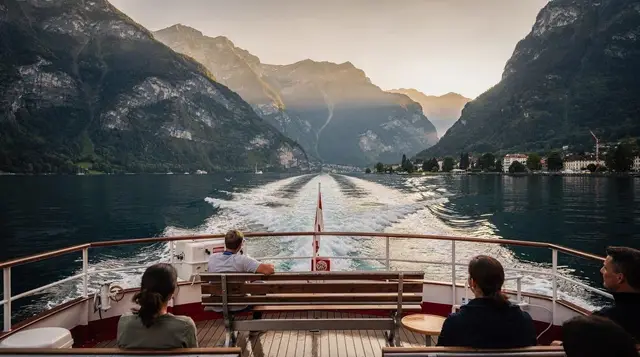
Lake Brienz sits at the eastern end of the Bödeli, the flat strip of land between the two lakes where Interlaken was built. From the shore at Bönigen or the deck of a boat on a clear day, the water reads as an almost implausible turquoise, closer to a Caribbean postcard than a lake fed by Alpine glaciers at 568 metres above sea level. It is not a filter and it is not algae. The colour is caused by glacial flour: rock ground to a fine powder by glaciers in the mountains around Grindelwald and the Hasli valley, carried down by the Lütschine and Aare rivers, and suspended in the water in particles too small to settle out quickly.
Those particles scatter blue and green wavelengths of light while absorbing the rest, which is the same physical process, at lake scale, that gives some glaciers themselves a blue tint. The explanation, and why the effect varies through the season, is set out properly in a dedicated piece on the lake’s colour; the short version is that the colour is strongest in mid-summer, when glacial melt upstream is at its peak, and duller in early spring and late autumn when the rivers run clearer.
Lake Brienz is 14 kilometres long, up to 2.5 kilometres wide, and drops to 261 metres at its deepest point, making it one of the deeper lakes in Switzerland relative to its size. The Aare River enters at the eastern end, near Brienz and Meiringen, having already collected meltwater from the Grimsel and Susten glacier region, and leaves at the western end at Interlaken, where it becomes the short canalised stretch that separates Interlaken Ost from Interlaken West before it reaches Lake Thun.
That sequence matters for the colour comparison people ask about most: Lake Thun receives the Aare after it has already passed through Lake Brienz and had a chance to shed some of its sediment, plus water from the Kander that was diverted into it in the 18th century specifically to reduce flooding. Lake Brienz gets the glacial water first. The full comparison, including which lake is warmer, which has more going on around its shores, and which is better for a lazy afternoon, is covered in Lake Brienz versus Lake Thun.
The boat line from Interlaken Ost
The lake is worked by BLS Schifffahrt, the same company that runs boats on Lake Thun, and the Lake Brienz fleet includes one genuine paddle steamer, the DS Lötschberg, built in 1914 and still in scheduled service alongside newer diesel-electric boats. Boats leave from a pier a short walk from Interlaken Ost station, which is also where the Jungfrau railway and the Brünig line to Lucerne depart, so it is easy to combine a lake crossing with a train connection on the same day.
The standard route calls at Bönigen, Iseltwald, Giessbach (a request stop, timed to meet the funicular), Brienz, and Ringgenberg, with the full one-way crossing to Brienz taking roughly an hour and ten minutes. A return ticket Interlaken Ost–Brienz costs around CHF 33 second class at full fare; the Swiss Travel Pass covers the boat free of charge, and the Half Fare Card and regional passes such as the Berner Oberland Pass and Jungfrau Travel Pass all apply a discount, so it is worth checking which pass you already hold before buying at the ticket window.
Boats run roughly hourly in the June-to-September high season and drop to a handful of daily departures, or none, outside it, so anyone travelling in April, May or late October should check the current timetable rather than assume a boat will be waiting. The full schedule, fares, and which sailings use the historic steamer rather than a modern boat, are in the Lake Brienz boat trips guide; background on the older paddle steamers still working Swiss lakes, including the Lötschberg, is in a separate piece on the region’s paddle steamers.
Taking a train to Brienz and the boat back to Interlaken, or the reverse, is a common way to see the lake without doubling back on the same route, since the Brünig line runs along the southern shore in about 20 minutes and the boat takes the scenic way along the whole lake.
Villages on the north shore
The north shore road is narrower and quieter than the road and railway on the south side, and it is where most of the lake’s small villages sit.
Bönigen is the first stop out of Interlaken and effectively a suburb of it, with a lakeside lido, a campsite, and one of the more reliable places to swim without travelling far.
Iseltwald is a working village of a few hundred people that became a global tourist stop after its small wooden pier featured in the 2019 Korean drama “Crash Landing on You”. Coach parties and day-trippers now queue for photos on a pier that was never built to take that kind of footfall, and the village itself has struggled with narrow lanes, parking, and the mismatch between a residential settlement and a sudden influx of visitors chasing one specific shot.
What that has done to Iseltwald, and how to visit without adding to the problem, is covered honestly in a longer piece on the Iseltwald effect. The village is still worth the stop for the walk along the shore and the view back across the lake, just without the expectation of having the pier to yourself.
Giessbach is reached by a funicular built in 1879, the oldest of its kind in Switzerland still running its original water-ballast technology, and it climbs directly from the boat landing to the Grandhotel Giessbach, a Belle Époque hotel that has hosted guests since 1875, and to the Giessbach Falls themselves, a 14-stage cascade that is illuminated on summer evenings. It is one of the better half-day stops on the lake precisely because most people on the boat do not get off here. Full detail on the falls, the funicular, and the shore path connecting Giessbach to Iseltwald on foot is in the Giessbach falls and shore path guide.
Brienz itself, at the eastern end, is the region’s woodcarving and violin-making town, home to a school of woodcarving founded in 1884 and workshops still producing carved bears, chalets and instruments by hand; the craft and where to see it worked is covered in a dedicated guide. Brienz is also the lower station for the Brienz Rothorn steam-hauled rack railway, the last of its kind still running regular steam service in Switzerland, detailed in the Brienz Rothorn steam railway guide.
From Brienz it is a short run by train to Meiringen and the Aare Gorge, and the Ballenberg open-air museum sits on the hillside between Brienz and the lake, reachable by a short bus ride; both make sense as an extension to a Lake Brienz day rather than a separate trip. See the Ballenberg guide for opening dates, since the museum closes for winter.
Swimming: clear, cold, and colder than Lake Thun
Lake Brienz has official lidos (Strandbad) at Bönigen, Interlaken and Brienz, all with grass for lying out, changing rooms, and usually a kiosk in summer, and free entry to the lakeside area even where the pool facilities charge.
The water itself is what puts some visitors off: because the lake is fed directly by glacial meltwater rather than by an upstream lake that has had time to warm, surface temperatures in August typically run a couple of degrees cooler than Lake Thun, often sitting in the 16–19°C range even at the height of summer, and noticeably colder than that away from the shallows. It is swimmable and popular with locals, but it is not warm-lake swimming, and going in without expecting the cold is the main way people cut a swim short.
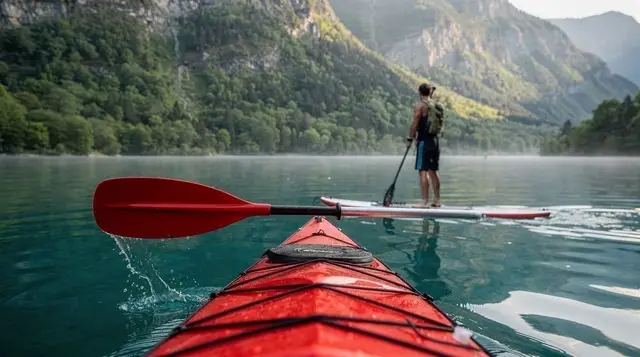
Full comparative water temperatures and the best spots on each lake are in swimming in Lake Thun and Lake Brienz. For a slower way to feel the colour and the cold from the water itself rather than the shore, guided kayak trips run from the Interlaken side; a full-day option covering much of the lake is bookable as the 15-hour kayak experience on Lake Brienz, and paddling options generally, including stand-up paddleboarding, are covered in kayaking and SUP on Lake Brienz.
Wilder than Lake Thun
Ask anyone who has done both lakes which they preferred and the answer usually comes down to development. Lake Thun is ringed by larger towns, vineyards on the Lavaux-style slopes near Spiez, a lakeside castle at Thun itself, and more or less continuous settlement along both shores. Lake Brienz has Brienz and Interlaken at its two ends and comparatively little in between beyond Bönigen, Iseltwald and Ringgenberg: the north shore road narrows to a single lane in places, the south shore is mostly given over to the railway and a busier road, and long stretches of both shorelines are forest and rock face running straight down to the water.
That is the practical meaning of “wilder” here — fewer hotels, fewer restaurants, a shorter list of things to do on any given stop, and a lake that looks the same today as it does in photographs from decades ago. It also means fewer options if you arrive without a plan: Lake Thun has more towns to fall back on for a meal or a bed, while a Lake Brienz day works best when it is built around the boat timetable rather than around picking somewhere and hoping it will be open.
Getting there and getting around
| From Interlaken Ost | By boat | By train |
|---|---|---|
| Bönigen | 5 min | not applicable, walk or bus |
| Iseltwald | approx. 35 min | approx. 20 min by bus (Postauto) |
| Giessbach | approx. 50 min | not directly served by rail |
| Brienz | approx. 1 h 10 | approx. 20 min |
| Item | Typical cost (CHF) | |
| Boat, Interlaken Ost–Brienz return, 2nd class | approx. 33 | |
| Lido entry (Bönigen or Brienz) | approx. 6–8, often free for lake access | |
| Giessbach funicular return | approx. 10 | |
| Lakeside lunch | 20–35 per person |
Swiss Travel Pass holders ride the boats free; Half Fare Card holders and regional pass holders get a discount at the ticket window rather than automatically online, so buy in person or check the pass conditions first. The full pass comparison for the whole region is in the Swiss Travel Pass guide.
Away from the lake, e-bike routes along the Bödeli and out towards Bönigen and Ringgenberg are a practical alternative to the boat timetable, especially outside the summer sailing season; guided options include the Discover Interlaken e-bike tour taking in both lakes and local ruins, the Interlaken valley e-bike tour through the rivers, lakes and forests around the Bödeli, and, for the colder months when the boat schedule thins out, the winter e-bike tour covering the same valley routes.
On the Brienz side, a half-day guided walk from Hofstetten up towards the local wildlife park is a way to see the lake from above rather than from the water, bookable as the Hofstetten to Brienz hike to the wildlife park. For a wider view over the whole area including the neighbouring lake, the vantage point on Harder Kulm above Interlaken shows both Lake Brienz and Lake Thun from the same spot, which is the easiest way to see the colour difference between them in a single glance. More combinations for a longer day out are listed in day trips from Interlaken.
Lake Brienz: your questions answered
Why is Lake Brienz turquoise?
The colour comes from glacial flour, extremely fine rock particles ground by glaciers in the mountains that feed the lake via the Lütschine and Aare rivers. The particles stay suspended in the water and scatter light towards blue-green wavelengths. The effect is strongest in July and August when glacial melt peaks, and weaker in spring and late autumn.
Is Lake Brienz colder than Lake Thun?
Yes, generally by a couple of degrees. Lake Brienz receives glacial meltwater directly, while Lake Thun receives the Aare after it has already passed through Lake Brienz and had time to warm slightly. Summer surface temperatures on Lake Brienz typically sit around 16–19°C, compared with closer to 20–22°C on parts of Lake Thun.
How do I get from Interlaken Ost to Iseltwald?
By boat, the crossing takes about 35 minutes; by Postauto bus, roughly 20 minutes. Both run more frequently from late May to September. Outside that window, check the timetable before travelling, since sailings and some bus frequencies are reduced.
Is Iseltwald worth visiting given the crowds?
The pier that appears in photographs is small and often busy, particularly midday in high season, but the wider village and the shore path towards Giessbach are quieter and give a better sense of the place than the pier alone. Visiting early morning or early evening avoids the worst of the coach traffic.
Can you swim in Lake Brienz?
Yes, at official lidos in Bönigen, Interlaken and Brienz among other spots, but the water is cold even in summer, generally colder than Lake Thun, because it is fed directly by glacial meltwater. Acclimatise gradually rather than diving straight in.
Does the Swiss Travel Pass cover the Lake Brienz boats?
Yes, boat travel on Lake Brienz is included with the Swiss Travel Pass. Half Fare Card holders and regional pass holders receive a discount rather than free travel, applied at the ticket counter.
What is the best single viewpoint to compare Lake Brienz and Lake Thun?
Harder Kulm, reached by funicular from Interlaken Ost in about eight minutes, looks down on both lakes from roughly the same spot, making the colour difference between them easy to see side by side.
Do the boats run in winter?
Sailings are drastically reduced or suspended on parts of the route outside the main season, roughly June to September, with some winter dates only around Christmas and New Year. Check the current BLS Schifffahrt timetable before planning a visit between November and March.