Ballenberg open-air museum: a practical guide
How much time do you need at Ballenberg open-air museum?
Budget a full day, arriving at opening time. The site covers 66 hectares and holds around 110 relocated historic buildings across roughly 13 regional groups, and it takes most visitors five to seven hours to see a reasonable cross-section, including a lunch stop and a few craft demonstrations.
Ballenberg gets sold as a half-day add-on to a Jungfraujoch trip, and that is where most visitors go wrong. It is a genuine open-air museum on the scale of the larger Scandinavian ones, not a village square with a few reconstructed chalets. Treat it as a half-day and you will see one corner of Switzerland; treat it as a full day and you will actually understand why it exists.
What Ballenberg actually is
The Swiss Open-Air Museum Ballenberg, to give it its full name, opened in 1978 on a wooded hillside above Lake Brienz, between the villages of Hofstetten and Brienz. Around 110 historic buildings, most of them genuine farmhouses, workshops, mills and barns dating from the 14th to the 19th century, were dismantled at their original sites across Switzerland and rebuilt here, timber by timber.
They are grouped into roughly 13 regional clusters, so a walk across the site is also a walk across the country’s building traditions: a stone-roofed Ticino house from the Italian-speaking south sits a twenty-minute walk from a black timber barn typical of the Bernese Oberland, and neither looks like it belongs in the other’s landscape, which is the point.
The site itself covers 66 hectares of pasture, woodland and orchard, planted with old Swiss fruit varieties and grazed by the heritage breeds of sheep, goats, cattle and pigs the museum keeps to match each regional group. This is not a backdrop; the animals and crops are part of the same restoration project as the buildings.
Two entrances, and it matters which one you use
Ballenberg has two entrances at opposite ends of the site, roughly two kilometres apart as the crow flies and considerably more on foot once you follow the paths.
West entrance (Hofstetten / Brienzwiler side). This is the entrance for anyone arriving by train. The Brunig-line trains between Interlaken Ost and Lucerne stop on request at a halt simply called Ballenberg, a short walk from this entrance. It puts you closest to the buildings from central Switzerland and the Bernese Mittelland.
East entrance (Brienz side). This entrance sits closer to Brienz village and is the one to use if you are arriving by local bus from Brienz, or combining the museum with a stop in Brienz itself for its woodcarving workshops. It puts you closest to the Bernese Oberland farmhouses, the group most visitors instinctively want to see first, given where they already are.
Neither entrance is objectively “better,” but arriving at the wrong one for your onward plans costs real time, because the two ends are not a quick stroll apart.
| Entrance | Nearest transport | Closest regional groups |
|---|---|---|
| West (Hofstetten) | Ballenberg request stop, Brunig line | Central Switzerland, Bernese Mittelland |
| East (Brienz) | Local bus from Brienz village | Bernese Oberland, Emmental |
The internal bus: worth using at least once
A shuttle bus, sometimes a tractor-drawn open trailer depending on the season, runs the length of the site between the two entrances at intervals through the day. It is included in the admission ticket. Walking the full length of Ballenberg on foot, on hilly gravel paths, takes well over an hour each way once you add in any stops, so the shuttle is not a novelty; it is how most people cover the site without running out of energy before they run out of buildings.
A sensible pattern is to enter at one end, walk and explore in one direction using the paths, then take the shuttle back to your entrance, or use it once partway through the day to leapfrog a stretch you would otherwise walk twice. Trying to see everything on foot in one day, at both ends, is possible but tiring; using the bus at least once is what turns a forced march into a day you actually enjoy.
How much time you genuinely need
Museum literature suggests three to four hours as a minimum. In practice, that only works if you pick one or two regional groups and ignore the rest, which defeats the purpose of visiting a site this size.
- Half day (3–4 hours): one entrance, one or two regional groups, a coffee stop. Reasonable if Ballenberg is a stop on a longer day that also includes Brienz or the Rothorn steam railway.
- Full day (5–7 hours): both entrances via the internal bus, most regional groups, at least one demonstration, a proper lunch inside the grounds. This is the visit that matches what Ballenberg is actually built to show.
- A second visit: genuine enthusiasts of vernacular architecture or textile and metalworking crafts sometimes come back on a different day specifically for the demonstration programme, since no single day covers every craft on offer across a season.
If you only have half a day and mountains are also on your list, be honest about the trade-off: Ballenberg rewards unhurried walking between buildings, not a rushed loop.
Craft demonstrations
Ballenberg is not just architecture under glass; many buildings are staffed through the day by craftspeople working with the original tools and methods, typically from around 11am to 4pm depending on the season and the individual demonstrator’s schedule. What is running on a given day varies and is not fixed weeks in advance, covering things like bread baking in a wood-fired oven, blacksmithing, weaving, cheese-making, basket-making, pottery and rope-making, among others.
The practical approach is to check the demonstration board at either entrance when you arrive, rather than building your day around a specific craft you read about online, since the list you find on any given website may not match what is actually staffed that day. If woodcarving specifically interests you, Brienz’s own woodcarving and violin-making tradition is worth pairing with a Ballenberg visit, since several of the region’s carving workshops sit a short distance from the East entrance.
The regional groups, briefly
Ballenberg organises its buildings into clusters by Swiss region rather than by building type, so walking through feels more like a journey across the country than a themed exhibition.
Groups include, among others, the Bernese Oberland and Emmental (large timber farmhouses with deep overhanging roofs, close to what visitors already see around Interlaken itself), central Switzerland around Lake Lucerne, the Jura, Ticino’s stone-built southern architecture, and the Valais with its blackened larch-wood granaries on stone mushroom supports. Interiors are furnished, not empty shells, down to working kitchens and stocked workshops, and many are open to walk into rather than viewed from behind a rope.
Opening season and closures
Ballenberg is a seasonal, outdoor museum and closes completely over winter. The season runs roughly from mid-April to the end of October each year; exact opening and closing dates shift slightly year to year, so check the current dates before planning a visit near either end of the season. Outside the season the site is closed to visitors, the buildings are unheated, and there is no winter programme, unlike some of the region’s mountain attractions that stay open with reduced service.
Within the season, demonstrations and the range of open buildings can be lighter on weekdays outside peak summer and fuller from June to September, when both the animal grazing programme and the craft schedule are running at full strength.
Prices and tickets
Admission is charged per adult, with reductions for children, students, and Swiss Travel Pass or half-fare card holders; family tickets are also available. Prices are reviewed and adjusted by the museum each year, so treat any figure quoted here as indicative rather than exact, and check the current tariff before you go. Booking an admission ticket online in advance mainly saves a queue at the till on a busy summer day rather than unlocking a meaningfully lower price.
a skip-the-ticket-line admission ticket for Ballenberg is worth it specifically for a peak-season Saturday; on a quieter weekday the on-site ticket office rarely has a queue worth avoiding.
Eating at Ballenberg
The museum runs several restaurants inside the grounds, from simpler food stands near each entrance to sit-down restaurants serving regional Swiss dishes, some cooked using the historic kitchens and ovens on site. Prices sit at typical Swiss museum-catering level, meaning a proper meal costs noticeably more than a supermarket sandwich but is not exceptional for the region.
Bringing your own picnic is allowed and there are picnic areas, which is the cheaper option if you are visiting on an Interlaken budget and want to control costs. For anyone more interested in the food side of the region generally, see the separate guides to cheese dairies of the Bernese Oberland and fondue and raclette in Interlaken.
Getting there from Interlaken
From Interlaken Ost, take a Brunig-line train in the direction of Meiringen and Lucerne and alight at the Ballenberg request stop, close to the West entrance; the journey takes around 25 to 30 minutes and trains run roughly hourly through the day. Since it is a request stop, make sure the conductor or the train’s stop announcement confirms it, particularly if you are unfamiliar with the line.
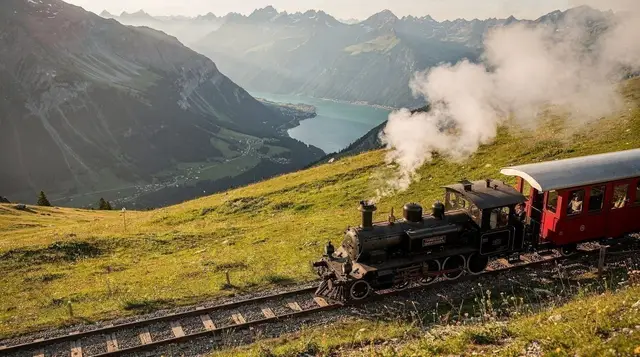
Alternatively, travel to Brienz by train or by lake boat across Lake Brienz, then take a local bus on to the East entrance. This route suits a day that also includes time in Brienz itself, whether for the woodcarving workshops, the lakeside promenade, or the base station for the Brienz Rothorn steam railway.
Driving is straightforward too, with parking available at both entrances, though this is one of the few Bernese Oberland excursions where the train genuinely is the simpler option, since it removes any need to double back for a car left at the opposite end of the site.
Combining Ballenberg with the rest of the day
Ballenberg on its own is a full day; bolting it onto a mountain excursion the same day usually means shortchanging one or the other. It combines more comfortably with a Brienz-based day: museum in the morning at the East entrance, then Brienz village, its woodcarving workshops, and either the lake promenade or the Rothorn railway in the afternoon. For a broader look at how Ballenberg fits against other options nearby, see day trips from Interlaken, or, on a wet forecast, rainy-day options around Interlaken, since a fair share of Ballenberg’s buildings offer indoor shelter along an outdoor route in a way that few other single-site excursions here do.
Families weighing it up against other options should see the dedicated notes on visiting Ballenberg with children, including which regional groups tend to hold younger visitors’ attention longest and which sections are more of a slog with a pushchair. For the wider question of when to schedule an outdoor day like this one, the best time to visit Interlaken covers how the shoulder-season weather and crowd levels compare against a fully booked July weekend, and things to do in the museums and art category rounds up how Ballenberg sits alongside the region’s other indoor and covered attractions.
If a museum-heavy day out matters more than the specific setting, two guided alternatives worth weighing are a guided day trip from Bern taking in Biel and the Omega watchmaking museum, which covers Swiss industrial heritage rather than rural architecture, or a self-guided food tour around Fribourg for a day built around eating rather than walking a large open-air site.
Ballenberg visit: frequently asked questions
Is Ballenberg worth a full day or can it be done in a few hours?
A few hours only covers one end of the site. With 66 hectares and around 110 buildings spread across roughly 13 regional groups, most visitors who walk rather than skip sections need five to seven hours, including the internal bus rides and a lunch stop.
Which Ballenberg entrance should I use, East or West?
Arrive at the West entrance near Hofstetten if you are coming by train, since the Ballenberg request stop on the Brunig line is right outside it. Use the East entrance near Brienz if you are coming by boat or bus from Brienz village, or if you want to start with the Bernese buildings closest to the lake.
Do I need to use the internal bus at Ballenberg?
Not strictly, but most visitors do at least once. The site is long and hilly, and the internal shuttle bus running between the two entrances saves a return walk of well over an hour if you enter at one end and want to leave from the other.
When are the craft demonstrations at Ballenberg?
Demonstrations run through the day, typically from around 11am to 4pm, but the exact list changes daily and by season. Check the demonstration board at either entrance on arrival rather than planning around a specific craft in advance.
Is Ballenberg open in winter?
No. Ballenberg is a seasonal museum, open from mid-April to the end of October. Outside that window the buildings are closed and unheated, and there is no winter programme.
How do you get to Ballenberg from Interlaken?
Take a train from Interlaken Ost towards Lucerne on the Brunig line and get off at the Ballenberg request stop, right by the West entrance, in around 25 to 30 minutes. Alternatively take the train or a boat to Brienz and continue by local bus to the East entrance.
Can you eat at Ballenberg, or should you bring food?
There are several restaurants and simpler food stands inside the grounds, including ones serving dishes cooked using the museum’s own historic ovens and hearths, so you do not need to bring a packed lunch. Prices are typical Swiss museum-catering level, not cheap, but there is no obligation to leave the site to eat.
Mountain excursions on GetYourGuide
Verified deep-linked GetYourGuide tours. Book through these links and we earn a small commission at no cost to you.
GetYourGuide does not provide a product photo for this activity — the image shows the meeting point, photographed by us.