The last steam rack railway in Switzerland
Most of the Bernese Oberland’s mountain railways were electrified decades ago. The Brienzer Rothorn Bahn was not, and that is the entire reason to ride it. Opened in 1892 to carry Victorian tourists up from the shore of Lake Brienz, it still runs original and replica steam locomotives up a rack-and-pinion track to 2,350m, making it the last steam-hauled cog railway operating in Switzerland. The Furka Cog Railway further east also runs steam, but only as a heritage line over a few kilometres; the Rothorn Bahn is a full working mountain railway with a daily public timetable.
The journey starts at Brienz station, on the same platform as the CFF mainline, at 566m above sea level. From there the line climbs 1,678m over 7.6km to the Rothorn Kulm at 2,350m, with an average gradient of around 25% and short stretches touching 28%. The trip takes roughly 65 minutes, slower than almost any train most visitors will have ridden, and that slowness is the point: it gives the locomotive time to be heard, smelled and watched working, and gives passengers time to watch the terrain change from lakeside meadow to pine forest to open alpine pasture above the treeline.
Not every departure is steam-hauled. In high summer the railway typically runs two or three steam services a day, with diesel locomotives covering the remaining timetable slots on the same schedule. Diesel trains are faster to prepare and cheaper to operate, so the railway uses them for most trips and reserves steam for a handful of showpiece departures, usually mid-morning. If riding behind steam specifically matters, check the day’s assignment board at Brienz station before buying a ticket, since it changes with maintenance schedules and occasionally with staffing.
a guided ascent of the Brienzer Rothorn with a Swiss triathlete, run for hikers who want route advice along with the ride combines the railway with route planning for the descent on foot, which is useful if you have not walked in the region before and want a sense of pacing on Swiss trail gradings.
What the ride is actually like
Brienz station’s platform for the Rothorn Bahn sits apart from the CFF platforms, with its own ticket window and a small workshop where locomotives are serviced in view of waiting passengers. Carriages are open-sided in fine weather and seat around 30, arranged so the gradient does not tip drinks or bags: seats and the floor are stepped to stay level while the locomotive pushes from below, in the traditional rack-railway arrangement.
The first third of the climb runs through mixed forest, with only occasional views back to the lake. Around the halfway point, near Planalp (1,341m), the line breaks into open pasture and the views open properly: Lake Brienz spreads out below, backed by the Faulhorn ridge, and on a clear day the higher peaks around the Aletsch region and the Bernese Alps appear to the south. Planalp is also a request stop, and a mountain inn there serves as a starting or finishing point for walkers doing only the upper half of the route.
The final stretch above Planalp climbs through switchbacks cut into open rock and alpine meadow, with cog and rail visibly working hard on the steeper sections. The train terminates at Rothorn Kulm, a short walk below the actual summit of the Brienzer Rothorn (2,350m), where a hotel-restaurant with a terrace serves food and drink to arriving passengers.
| Stage | Distance | Altitude gained | Approx. time |
|---|---|---|---|
| Brienz to Planalp | ~4.2km | ~775m | ~35 min |
| Planalp to Rothorn Kulm | ~3.4km | ~903m | ~30 min |
| Full journey (one way) | 7.6km | 1,678m | ~65 min |
Fares and the timetable
Fares vary by season and by whether the train is steam or diesel hauled, with steam departures usually costing a supplement. As a guide for planning, expect these ranges; confirm the exact figure for your travel date at the station or with the operator, since Swiss rack railways revise pricing each year.
| Ticket | Approx. price (CHF) | Notes |
|---|---|---|
| Return, diesel service | 88–96 | Standard fare, most departures |
| Return, steam service | 96–104 | Supplement for the two or three daily steam departures |
| One way (either direction) | 56–62 | Useful if walking one leg |
| Half Fare Card holders | roughly 50% off | Swiss Half Fare Card and Swiss Travel Pass discounts apply |
| Children (6–15) | roughly half adult fare | Under-6s generally free with a paying adult |
The Swiss Travel Pass does not give a free ride on the Rothorn Bahn — it is one of the private mountain railways that offer a discount rather than free travel, typically around 50%, the same as Half Fare Card holders. The Berner Oberland Pass and Jungfrau Travel Pass cover it differently depending on the pass tier, so check the small print before assuming a mountain excursion is included.
Trains run roughly hourly through the middle of the day in peak season (June to September), with fewer departures in the shoulder months of May and October. The full published timetable, including which specific departures are steam-hauled on a given date, is posted at Brienz station and on the railway’s own site; it is worth checking the night before if the steam train is the reason for the trip.
The view: three lakes, weather permitting
The advertised draw of the Rothorn Kulm is a simultaneous view of Lake Brienz, Lake Thun and Lake Lucerne from one viewpoint, with the Bernese Alps as a backdrop. On a genuinely clear day this delivers: the two Bernese Oberland lakes sit close together and are easy to pick out, while Lake Lucerne appears further off to the north-east, a paler sliver rather than a dramatic panorama.
The honest caveat is that this is a lower, more exposed summit than the Jungfraujoch or Schilthorn, and haze builds over the lakes by early-to-mid afternoon on warm days even when the morning was clear. Visitors on a midday or afternoon train frequently get one lake clearly and the others as a grey smear. If the three-lake view specifically is the goal, take one of the first two departures of the day and be prepared for it not to happen at all if cloud has settled on the ridge — check the webcam feed on the railway’s site before travelling from Interlaken, since a wasted round trip costs both time and the fare.
Compared with Harder Kulm, which is faster and cheaper to reach from Interlaken but lower and closer to town, or Schynige Platte, which has a similar rack railway but faces the Jungfrau massif rather than the lakes, the Rothorn’s specific appeal is the combination of the steam train and the lake panorama rather than either alone.
The faster way up: the aerial tram
For visitors who want the summit view without the hour-long climb, a cable car and gondola combination also runs from Brienz to the Rothorn, taking around 35 minutes in total against the train’s 65. It follows a different line up the mountain, does not call at Planalp, and costs somewhat less than the steam railway.
the return aerial tram to the Rothorn, for a faster ascent when time is short or the steam timetable does not line up is the practical choice on a day when only a couple of hours are available for the whole excursion, or when travelling with children who will not sit still for an hour-long train ride each way.
The trade-off is honest: the cable car gets you the view without the railway, while the steam train gives you the railway as the main event and the view as a bonus. Neither is wrong; they simply answer different questions about why you are going up.
Walking down (or up)
A marked path, the Panoramaweg, follows roughly the same line as the railway from Rothorn Kulm down to Planalp and on to Brienz, graded for hikers rather than mountaineers, and typically taking 3–4 hours for the full descent. Many visitors ride the train up and walk down, buying a one-way ticket, which is both cheaper and lets the descent set its own pace rather than being dictated by a timetable.
The path is unshaded in its upper section and can be exposed to sun and wind on the open ridge above Planalp; carrying water and a layer is sensible even on a warm-looking morning, since the temperature at 2,350m is routinely 15–20°C cooler than at lake level. Sturdy shoes matter — the surface below Planalp is a mix of gravel track and root-covered forest path, not pavement.
Brienz village: wood carving and violin making
Brienz itself, at lake level, is easy to treat as a mere railway terminus, which undersells it. The village is home to the Swiss School of Wood Carving (Schweizerische Schnitzlerschule), a state-recognised trade school that has trained carvers since 1884, and carving workshops and shopfronts line the main street selling everything from cuckoo clocks to detailed animal figures, some of it mass-produced for the tourist trade and some genuinely made on site. It is worth distinguishing the two before buying: ask whether a piece was carved in Brienz, since imported reproductions are sold alongside local work at similar prices.
Less well known is the village’s second craft school: Brienz is also home to one of Europe’s few dedicated violin-making schools, training luthiers in an unbroken local tradition that runs alongside the wood-carving trade. Workshop visits are not generally open to casual walk-ins, but the connection between mountain timber, carving skill and instrument-making is part of what makes Brienz a genuine craft town rather than a manufactured “Swiss village” stop.
a guided walk from Hofstetten near Brienz to the local wildlife park, a gentler option for a day that mixes some activity with the village visit suits a day when the railway itself is skipped in favour of exploring the shoreline and foothills around the village at a slower pace.
The lakefront promenade in Brienz is quieter and less commercial than Interlaken’s Höheweg, with benches facing the water and a public bathing area in summer. It makes a reasonable lunch stop before or after the railway, and restaurant prices are generally a little lower than in Interlaken itself.
Getting to Brienz from Interlaken
Trains from Interlaken Ost to Brienz run roughly twice an hour and take about 20 minutes, either on the direct lakeside line or via the Brünig line towards Lucerne, which also calls at Brienz. The two lines share the same platform pattern at Interlaken Ost, so check the departure board rather than assuming a train’s final destination tells you it stops at Brienz.
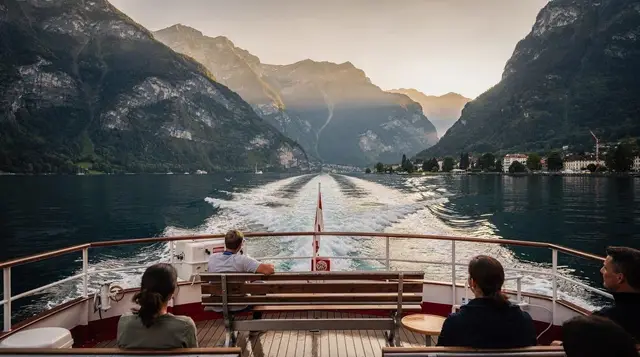
By boat, Lake Brienz boat trips run from Interlaken Ost to Brienz in around an hour, slower than the train but scenic, and a reasonable way to arrive if the railway timetable allows a later start. Combining the boat out and train back (or vice versa) avoids retracing the same route twice in one day.
For visitors staying in Brienz overnight rather than day-tripping, the village sits close to Iseltwald and the Giessbach falls and to Meiringen and the Aare Gorge, both reasonable half-day additions if building a longer stay around the eastern end of the lake rather than basing in Interlaken itself.
On the water: options that pair with the railway
Because Brienz sits directly on the lake, several water-based activities depart from the same village as the railway station, making it straightforward to combine a morning on the mountain with an afternoon on the water, or the reverse.
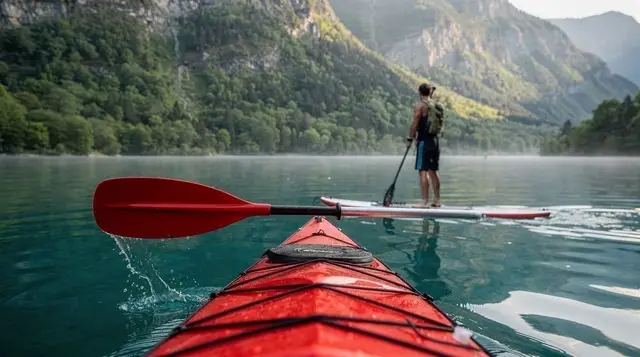
a guided kayak session on Lake Brienz’s turquoise water runs from the Brienz shoreline and suits visitors who have already done the railway on a previous visit or an earlier day. For something faster and shorter, a scenic jetboat ride across Lake Brienz departs from the Interlaken side of the lake and gives a different, low-level view of the same shoreline the railway looks down on from above.
When it is not worth going
The Rothorn Bahn closes completely for winter, typically from late October to mid-June, with no substitute rail service to the summit during that period. Outside the operating season the only way up is on foot or ski touring, both requiring proper winter mountaineering judgement rather than a tourist excursion.
Even within season, days with low cloud over the ridge are a genuine reason to skip the trip or postpone it: the fare is not refundable for weather after the train has run, and a summit in cloud offers essentially none of the view that justifies the price. The railway’s own webcam, checked from Interlaken before setting out, is a better guide than the forecast for Brienz village at lake level, since cloud frequently sits on the ridge while the valley below stays clear.
Compare this against Harder Kulm, a much cheaper and faster funicular from Interlaken Ost itself, if the goal is simply “a mountain view on a morning with uncertain weather” rather than “the specific experience of the steam railway.” For a longer day that treats the Rothorn as one stop among several around the eastern end of the lake, see day trips from Interlaken and the two lakes and villages itinerary, both of which place Brienz alongside Ballenberg and the Giessbach falls rather than as a standalone excursion.
For background on the railway’s engineering and full operating history, see the dedicated Brienz Rothorn steam railway guide. For the craft schools and workshops in the village itself, see wood carving and violin making in Brienz.
Walkers planning the Planalp descent should also check best mountain excursions from Interlaken for how the Rothorn compares on difficulty and cost with Schynige Platte and other rack-railway summits in the region, and travellers deciding when to schedule any of these trips should check the best time to visit for the season’s rough weather patterns before committing a whole day to one mountain.
Brienz and the Rothorn Railway: common questions
Is the Brienz Rothorn steam train worth the price?
Yes, if you go for the railway itself rather than just the view. It is the last steam-hauled rack railway in Switzerland, built in 1892, and the hour-long climb through forest and alpine meadow to 2,350m is the experience, not just a means of getting up. The return fare is roughly CHF 96–104 depending on season, which is expensive for a single mountain, but the Brienzer Rothorn Bahn is genuinely unusual, not a marketing exercise.
How long does the Brienzer Rothorn Bahn take?
About 65 minutes each way, covering 7.6km and climbing 1,678m from Brienz station (566m) to the Rothorn Kulm (2,350m). The average gradient is around 25%, with sections up to 28%.
Do the trains run on steam every day?
No. Steam locomotives usually work two or three departures a day in high summer, and diesel locomotives cover the rest of the timetable. Check the day’s schedule at Brienz station or on the operator’s site before you plan your day around a specific steam departure.
Can I go up by steam train and down another way?
Yes. Many visitors ride up and walk down, following the Panoramaweg or the steeper direct path back to Planalp and Brienz, which takes 3–4 hours. A one-way ticket costs less than the return fare.
What is the alternative to the steam train?
A gondola-and-cable-car combination also reaches the Rothorn from Brienz in around 35 minutes, at a lower price than the steam railway, though it runs a different route and does not stop at Planalp.
What can I see from the summit?
On a clear day the Rothorn Kulm looks down on Lake Brienz, Lake Thun and Lake Lucerne simultaneously, along with the peaks of the Bernese Alps to the south. Haze or low cloud, common by early afternoon in summer, can cut this to one lake or none.
Is Brienz worth visiting beyond the railway?
Yes. The village has Switzerland’s national school of wood carving, a violin-making school that is one of only a handful in Europe, and a lakefront promenade that is quieter and cheaper than Interlaken’s. It works well as a half-day stop even without going up the mountain.
Does the Brienzer Rothorn Bahn close for winter?
It closes completely from around late October to mid-June. There is no winter service and no way to reach the summit by rail outside that window.