Giessbach Falls and the shore path to Iseltwald
Is Giessbach Falls worth visiting and can you walk from there to Iseltwald?
Yes. The falls drop in fourteen tiers on the south shore of Lake Brienz, reached by boat and a funicular from 1879, with a path that runs directly behind the water. From the falls a flat lakeshore path continues about 5 km to Iseltwald and on to Bönigen, roughly two to two and a half hours of easy walking.
Fourteen steps of falling water
Giessbach Falls drops down the wooded slope on the south shore of Lake Brienz in fourteen distinct tiers, losing about 500 metres between its source below the Faulhorn ridge and the point where it meets the lake. No single viewpoint shows all fourteen at once; the water disappears behind rock and forest between steps, which is part of why the site works as a walk rather than a single photograph. It has been a fixture of Bernese Oberland tourism since the 1870s, when the falls were first illuminated by torchlight for hotel guests, and it remains one of the more understated highlights of the region precisely because it takes a bit more effort to reach than a roadside cascade.
The falls sit directly below the Grandhotel Giessbach, a restored Belle Époque hotel that has watched over the site since 1875, and the whole complex — funicular, hotel, path network — feels more like a single 19th-century tourism project than a natural attraction that tourism grew up around later. That history is worth keeping in mind: this is not a wild, undiscovered spot, but it has aged into something quieter and more interesting than most engineered viewpoints from the same era.
Getting there: boat, funicular, or on foot
There is no direct road to the Giessbach boat landing, which keeps the immediate area free of cars and coach traffic. The standard approach is the BLS boat on Lake Brienz, stopping at the Giessbach pier roughly midway between Brienz and Iseltwald. From Interlaken Ost the crossing takes around 40 to 50 minutes depending on the route and number of stops; see the Brienz and Iseltwald boat excursion to Giessbach Falls if you would rather have the timings and stops arranged for you.
From the pier, the 1879 funicular climbs about 100 vertical metres in a couple of minutes to the hotel terrace and the start of the falls path. Walking up instead takes 15 to 20 minutes on a steep zigzag path and is a reasonable option if the funicular queue is long or you want the exercise; walking down after seeing the falls is the more common compromise.
Drivers can park above the falls near Axalp on the Brienz side and walk down, though this reverses the usual approach and adds route-finding. It is generally simpler to park in Brienz or Iseltwald and use the boat for the water crossing. Cyclists and e-bikers often combine the falls with the lakeshore route from Interlaken; the e-bike tour to Giessbach Falls and Iseltwald covers that combination without the logistics of arranging bike hire and a boat ticket separately.
The funicular and the path behind the water
The funicular dates from 1879, which makes it one of the oldest still operating in Switzerland, alongside the rack railway up to Schynige Platte. Note that Giessbach’s funicular is a different, older mechanism to the cable cars on the higher peaks around Interlaken — it uses a counterbalance system between two cars rather than a single haul cable, and the ride itself, slow and slightly creaking, is part of the appeal rather than an inconvenience. It typically runs from around April to late October; check the current timetable before planning a visit outside high summer, since it closes for the winter along with the hotel.
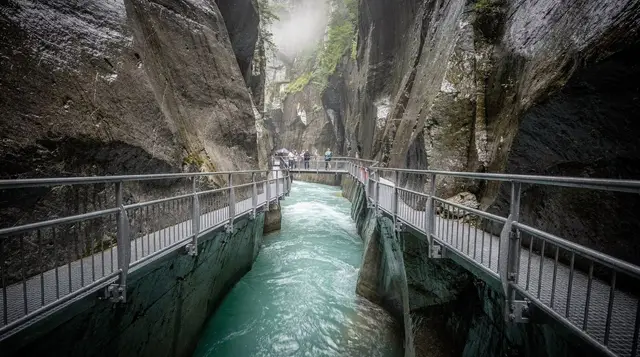
At the top, a signed path loops through the falls area, criss-crossing the cascade on wooden bridges and stone steps. The best-known section takes you onto a ledge directly behind one of the middle tiers, with the rock overhanging above and the water falling a few metres in front of you. It is genuinely wet here — spray carries further than it looks from below — and the rock underfoot is often slick, so this is a place for proper shoes rather than sandals. The full loop past the main viewpoints takes 30 to 45 minutes at an unhurried pace; add another 20 minutes if you want to see the upper tiers as well, which fewer visitors bother with and which are correspondingly quieter.
The path network connects to longer routes into the hills above, including onward links toward Brienz Rothorn for anyone extending the day into a proper hike rather than a falls visit, and to the broader network described in our guide to the best day hikes from Interlaken.
The Grandhotel Giessbach
The hotel above the falls opened in 1875, fell into disrepair through the mid-20th century, and was restored from the 1980s onward after a public campaign kept it from being demolished. It now operates as a working hotel with a restaurant terrace that looks straight down the lake, and it is a legitimate reason to linger rather than treat Giessbach as a 40-minute stop. Even for non-guests, the terrace is open for coffee or a meal, and in high summer the falls are still occasionally lit in the evening as a nod to the original 19th-century spectacle — check locally, since this is not run to a fixed schedule.
The building and its grounds are worth ten minutes on their own: the lobby retains much of its period furniture, and the short walk around the formal garden gives a different angle on the falls than the marked cascade path.
The shore path to Iseltwald and Bönigen
From the Giessbach boat landing, a lakeside path — part of the wider Uferweg network around Lake Brienz — runs roughly 5 km west to Iseltwald, mostly through mixed forest a few metres above the waterline, flat enough that it barely counts as a hike. Allow 1.5 to 2 hours at a gentle pace, more if you stop often for the lake views, which change colour through the day as the light shifts on the glacial silt that gives Brienz its turquoise cast. The path is well marked with the standard yellow Swiss hiking signs and needs no special equipment beyond ordinary walking shoes; it is a reasonable option even for visitors who otherwise avoid marked trails.
Iseltwald itself is a small harbour village with a 12th-century church tower, a handful of restaurants, and a wooden jetty that became disproportionately famous after appearing in a Korean television series. That single pier now draws a queue of its own in peak season, particularly midday in July and August, which is worth knowing before you build your schedule around a photo there — arrive early or late, or simply treat the rest of the village, which is quiet and unremarkable in the best sense, as the actual destination. For a longer look at what the village and its Netflix-driven fame have done to daily life there, our background piece on the Iseltwald effect covers it in more detail.
Walkers who want the full traverse can continue from Iseltwald toward Bönigen and on into Interlaken, adding roughly 4 km and 1 to 1.25 hours to reach Bönigen, from where local buses and boats run back to Interlaken Ost. The complete Giessbach–Iseltwald–Bönigen shore walk totals around 9 km and is comfortably done in half a day including stops, making it one of the easier full days out from Interlaken that does not involve a mountain railway or a steep ascent. See our guide to easy flat walks around Interlaken for other routes in the same register.
Those who would rather cover the same ground without walking can take the boat directly from Giessbach to Iseltwald, or book the boat trip to Giessbach Falls with a guided hike on to Iseltwald, which handles the timetable coordination between boat and funicular for you.
Getting home from Iseltwald or Bönigen
Iseltwald has its own boat landing with services back toward Interlaken Ost and onward to Brienz, and a bus connection toward Interlaken via Bönigen for anyone who prefers road transport or has missed a boat. Bönigen, at the western tip of Lake Brienz, sits close enough to Interlaken Ost to reach on foot in about 20 minutes along the lakeside, or by the frequent local bus. For a wider look at how boats fit into a day around both lakes, see the Lake Brienz boat trips guide and, for the historic paddle steamers that still work the route in summer, our guide to the paddle steamers of the Bernese Oberland.
Practical details
| Item | Detail |
|---|---|
| Boat from Interlaken Ost to Giessbach | ~40–50 min, BLS Lake Brienz service |
| Funicular ride | ~2 min, ~100 m ascent, opened 1879 |
| Funicular season | roughly April to late October |
| Falls loop path | 30–45 min for the main viewpoints |
| Giessbach to Iseltwald on foot | ~5 km, 1.5–2 hours, flat |
| Iseltwald to Bönigen on foot | ~4 km, 1–1.25 hours, flat |
| Full shore walk, Giessbach to Bönigen | ~9 km, 2.5–3.25 hours |
| Passes accepted | Swiss Travel Pass, Berner Oberland Pass cover the funicular |
Prices for boats and the funicular are set by BLS and revised annually; a standalone funicular return runs to roughly CHF 10 for adults without a pass, and the boat fare from Interlaken to Giessbach is in the CHF 30–40 range one-way depending on class and route, considerably less or free with a Swiss Travel Pass or regional pass. Check current fares before travelling, since Swiss transport pricing changes each timetable year.
When to visit and what to avoid
Giessbach Falls carries the most water, and looks most dramatic, in late spring and early summer when snowmelt is still feeding it from higher up; by late August in a dry year the lower tiers can look noticeably thinner. The funicular’s spring and autumn closures for maintenance are worth checking directly if you are visiting in April or late October, since a wasted trip to a closed boat landing is a bigger loss of time here than at destinations reachable by road. Midday in July and August brings the heaviest boat and funicular traffic, mostly day-trippers doing the falls as a standalone excursion; arriving on one of the first or last boats of the day thins the queue considerably and improves the light for photographs.
The Iseltwald pier deserves a specific warning: treat it as one stop on a lakeshore walk, not as the reason for the trip, and you will not be disappointed by the inevitable queue of people taking the same photograph you had planned to take.
For visitors who want the falls, the lake and Iseltwald combined without working out the boat and funicular timetables themselves, guided options such as the quad tour to Iseltwald and Lake Brienz package the whole area into a single half-day out from Interlaken.
Giessbach Falls and Iseltwald: your questions answered
How many tiers does Giessbach Falls have?
Fourteen, dropping around 500 metres in total. The marked path passes the lower and middle steps directly and includes a short detour onto a ledge behind one of the cascades; the uppermost tiers are visible only from a longer path that most day visitors skip.
How do you get to Giessbach Falls?
By BLS boat on Lake Brienz to the Giessbach landing, then the 1879 funicular up to the falls and the Grandhotel Giessbach terrace. There is no through road to the boat landing, so a car only gets you as far as Brienz or Iseltwald.
How old is the Giessbach funicular?
It opened in 1879 and is one of the oldest funiculars still running in Switzerland, climbing roughly 100 metres from the lake to the hotel in about two minutes.
Can you walk behind Giessbach Falls?
Yes, on a short, marked section of the path where the rock overhangs one of the middle tiers. Expect spray and slippery stone, and wear shoes with grip rather than open sandals.
How long is the walk from Giessbach to Iseltwald?
About 5 km on flat lakeside and forest track, taking roughly 1.5 to 2 hours. Continuing to Bönigen adds a further 4 km and about an hour, for a full shore walk of around 9 km.
Is the Giessbach funicular included in the Swiss Travel Pass?
Yes, along with the Berner Oberland Pass. Without either, expect to pay separately for the ride; a one-way ticket up, followed by the walk down to Iseltwald, is a sensible way to see both the falls and the shore path in one trip.
Is Iseltwald worth visiting or just a photo stop?
It is a small working harbour village with a 12th-century church tower and a lakeside restaurant, not only the pier made famous by a Korean drama. Visit outside the middle of the day in July and August and the crowd at the pier thins to almost nothing.
When does Giessbach Falls close for the season?
The funicular and the Grandhotel Giessbach typically operate from around April to late October, closing over winter. The lower falls remain visible year-round from near the boat landing, but the path behind the water and the upper viewpoints depend on the funicular being open.
Hiking & nature tours on GetYourGuide
Verified deep-linked GetYourGuide tours. Book through these links and we earn a small commission at no cost to you.
GetYourGuide does not provide a product photo for this activity — the image shows the meeting point, photographed by us.