Paddle steamers of the Bernese Oberland
Can you still ride a historic paddle steamer on Lake Thun and Lake Brienz?
Yes. The BLS fleet includes two working coal-turned-oil paddle steamers: DS Blümlisalp (built 1906) on Lake Thun and DS Lötschberg (built 1914) on Lake Brienz. Both sail a full seasonal timetable roughly from May to September, with a reduced schedule either side, and passengers can watch the steam engine turning through glass panels below deck while under way.
Two lakes, two working steamships
BLS Schifffahrt runs a mixed fleet on Lake Thun and Lake Brienz: modern motor vessels for the bulk of the timetable, and two genuine paddle steamers kept running as working boats rather than museum pieces. DS Blümlisalp, launched in 1906, covers Lake Thun. DS Lötschberg, launched in 1914, covers Lake Brienz. Neither is a replica built to look old; both still turn the same reciprocating steam engines they were built with, converted from coal to oil firing decades ago but mechanically the same machines.
That matters for anyone planning a trip around them rather than stumbling onto one by luck. The steamers do not replace the regular boats — they run a published subset of sailings, often once or twice a day in season, and BLS lists the “Dampfschiff” (steamship) departures separately from the general timetable. Book the wrong sailing time and you get a comfortable modern catamaran instead, which is a fine boat but not what most people are travelling to see.
DS Blümlisalp: the Lake Thun veteran
Built in 1906 by the Sulzer Brothers works in Winterthur, Blümlisalp is named after the Blüemlisalp massif visible from parts of the lake near Spiez. It is the older and more frequently sailing of the two steamers, and the one most visitors to Interlaken will actually manage to board, since Lake Thun sailings run from the town’s own jetty a short walk from Interlaken West station.
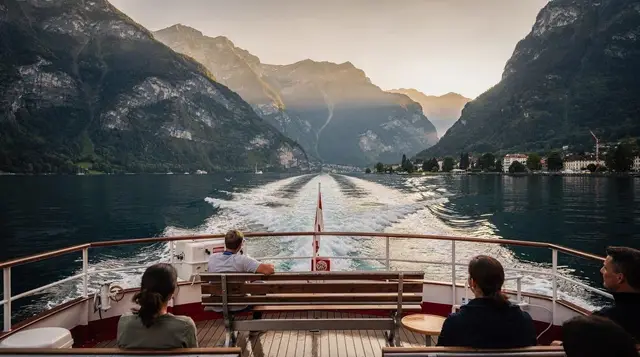
The boat underwent a major restoration completed in 2008, which returned the saloons closer to their original Belle Epoque appearance: dark wood panelling, brass fittings and upholstered bench seating in the covered first-class saloon, with a separate dining saloon used for lunch service on longer round trips. The open promenade deck above gives an unobstructed view down the lake towards the Niesen pyramid and, on a clear day, back towards the peaks above Beatenberg.
Blümlisalp’s route covers the full length of Lake Thun, calling at Thun, Spiez, Oberhofen and the Interlaken jetty, with some sailings extending to Merligen. A full end-to-end crossing takes a little over two hours; shorter round trips of 45 minutes to an hour are also timetabled on some days, aimed at people who want the steamer experience without committing a whole afternoon.
DS Lötschberg: Lake Brienz’s own paddle steamer
Lötschberg is younger by eight years, built in 1914, and sails the shorter, steeper-sided Lake Brienz. It is the rarer of the two boats to catch: BLS schedules it for a limited number of dedicated steamer days each summer rather than a daily slot, concentrated in the peak season when demand and staffing allow it. Anyone building a trip specifically around riding it should check the current year’s steamer calendar before fixing dates, since the days shift from year to year and are not simply “every weekend.”
The boat itself follows the same general layout as Blümlisalp — a covered saloon, an open promenade deck and the below-deck engine viewing area — on a slightly smaller hull suited to Lake Brienz’s more compact size. The route runs the length of the lake between Interlaken Ost and Brienz, passing close to Iseltwald and the Giessbach falls, with the striking turquoise-green water of Lake Brienz looking noticeably different in colour from Lake Thun on the same afternoon.
Sailing days and timetables
| Steamer | Lake | Built | Season | Typical frequency |
|---|---|---|---|---|
| DS Blümlisalp | Lake Thun | 1906 | Late April to late October, main season May–September | Most days in high season, several sailings daily |
| DS Lötschberg | Lake Brienz | 1914 | Selected dates, mainly July–August | A handful of dedicated steamer days per season |
Both timetables are published on the BLS website ahead of the season and printed at the Interlaken jetties. The steamer sailings carry a small “DS” marker on the printed timetable to distinguish them from the regular motor vessels — easy to miss if you are skimming for departure times rather than boat type. It is worth checking the current schedule shortly before travelling, since steamer days are more exposed to cancellation for maintenance or weather than the diesel-powered boats, which run in most conditions that keep the steamers docked.
Neither boat sails through winter. Outside the main season, both lakes are served entirely by the modern motor vessel fleet, and the steamers are laid up for maintenance — a genuine 1906 or 1914 machine needs more off-season attention than a modern hull.
The first-class saloon and what it adds
Standard tickets on both steamers give access to the open deck and the standard covered saloon, which is where most passengers sit regardless of ticket class — the view is the same from either. The first-class saloon supplement buys a seat in the panelled, carpeted saloon with table service available on longer Blümlisalp crossings, and on some sailings a set lunch menu built around the two-hour timing of the full Lake Thun route.
Holders of a first-class Swiss Travel Pass, Half Fare Card upgrade or first-class regional pass get saloon access included; second-class pass holders pay a supplement on board, typically a modest amount rather than a separate full fare. For a short round trip the saloon adds little beyond the panelling itself, since the whole point of a paddle steamer crossing is being on deck watching the shoreline and the paddle wheels. For a full lake crossing with lunch on board, it is a more reasonable way to spend two hours than standing at the rail the whole time.
Watching the engine room in motion
The most distinctive part of either boat, and the reason to choose a steamer over a modern motor vessel at all, is the engine room. Both Blümlisalp and Lötschberg have a viewing point — a glazed opening or a rail around a well in the deck — where passengers can watch the original steam engine turning: the crosshead sliding, the connecting rod driving the crank, and the crankshaft turning the paddle wheels on either side of the hull. It runs the whole time the boat is under way, included in the standard ticket, with no separate booking or extra charge.
It is a genuinely mechanical thing to watch rather than a static display — oil, brass, painted steel, moving at walking pace, loud enough at close range that conversation there means raising your voice. Crew are generally happy to answer questions about the engine’s history if asked directly, though there is no fixed guided tour of the engine room itself; it is a public viewing point rather than a supervised visit.
Getting to the jetties
Blümlisalp departs from the Interlaken West lake jetty, a five-minute walk from Interlaken West station and close to the Höhematte end of the Höheweg. Lötschberg departs from the Interlaken Ost jetty, next to Interlaken Ost station, on the Lake Brienz side of town. Confusing the two stations is one of the more common planning mistakes in Interlaken generally, and it applies directly here: turning up at the wrong jetty with a steamer departure in twenty minutes means missing it, since the walk between the two takes the better part of twenty-five minutes on foot.
Both jetties sell tickets on-site, and both accept Swiss Travel Pass, Berner Oberland Pass and Jungfrau Travel Pass without a separate boat ticket. Buying online in advance is rarely necessary outside a specific festival weekend, though it does guarantee a seat on a fully booked steamer sailing rather than standing room only.
Booking a crossing with the steamer included
The regular Lake Thun timetable mixes steamer and motor vessel sailings on the same route, so a standard round-trip boat ticket does not guarantee a steamer unless the specific departure is checked against the “DS” sailings. A more reliable way to be sure of riding Blümlisalp specifically is a scheduled cruise built around a steamer departure, which typically also adds a stop most people would not organise on their own:
a Lake Thun cruise combined with a stop at the St Beatus Caves and a lakeside picnicThe St Beatus Caves sit above the lake near Beatenberg, reachable from the boat landing, and pairing the crossing with the caves and a picnic turns a one-hour steamer ride into a half-day out without doubling back through Interlaken. For visitors approaching from further afield rather than staying in Interlaken itself, a similar combination runs from Basel:
a day trip from Basel that includes Thun, the Beatus Caves and a lake cruiseAnyone stacking several boat and rail days together across the Bernese Oberland — Lake Thun one day, a mountain excursion the next — is usually better off on a multi-day pass than paying per sailing:
a Bernese Oberland travel pass covering three to eight days of trains, boats and cable carsNone of these bookings are required to ride the steamer on an ordinary point-to-point ticket; they exist for travellers who want the crossing bundled with something else rather than working out jetty times and connections independently.
Where the steamers fit against the rest of the lake
Both lakes have a full timetable of modern boats running far more often than the steamers, and for most point-to-point travel — Interlaken to Thun for shopping, Interlaken to Brienz to connect with the Rothorn steam railway — a motor vessel is simply what turns up next and does the job perfectly well. The steamers are worth deliberately choosing when the boat trip itself is the point of the afternoon rather than a means of getting somewhere.
For a broader look at what each lake’s boats cover more generally, see the Lake Thun boat trips guide and Lake Brienz boat trips guide; for a day that uses both lakes together, the two-lake cruise guide and the two lakes and villages itinerary both build a route around the connecting train between the two waterfronts through central Interlaken.
Swimming from the lakeside beaches near Thun and Spiez is a separate, cheaper way to spend time on the water in summer — covered in the swimming guide to both lakes — and the shore path past Iseltwald to the Giessbach falls, detailed in the Giessbach falls and shore path guide, gives a walker’s view of the same water the Lötschberg crosses by steam.
What it actually costs
A standard Lake Thun round trip on Blümlisalp between Interlaken and Thun runs to roughly CHF 45–55 in second class without a pass, more for the full lake circuit including Spiez and Oberhofen; the first-class saloon supplement adds a further modest amount rather than doubling the fare. Lake Brienz fares on Lötschberg run similarly for an equivalent distance.
Both are included at no extra charge under the Swiss Travel Pass, Berner Oberland Pass and Jungfrau Travel Pass, which is the more economical route for anyone already using trains and cable cars on the same trip rather than paying for a single boat ticket in isolation. Prices are set by BLS and revised periodically; treat any figure here as a planning guide rather than the exact fare on the day, and check current pricing at the jetty or on the BLS site before travelling. For the wider picture of what a day on the water adds to an Interlaken budget, see the Interlaken travel costs guide.
A boat trip, not a museum exhibit
The easiest mistake to make with either steamer is treating it as a static attraction that will always be there and always be running. It is a working boat with a maintenance schedule, a limited season, and — for Lötschberg especially — a short list of actual sailing dates rather than a daily departure. Check the current year’s steamer timetable before building a day around one, confirm which jetty (Interlaken West for Lake Thun, Interlaken Ost for Lake Brienz), and treat the engine room viewing point as the part worth arriving early for, since it is the one thing a modern motor vessel genuinely cannot offer.
Lake cruises & boat tours on GetYourGuide
Verified deep-linked GetYourGuide tours. Book through these links and we earn a small commission at no cost to you.
GetYourGuide does not provide a product photo for this activity — the image shows the meeting point, photographed by us.