Above the lake, not just beside it
Most visitors to the northern shore of Lake Thun stay at water level, hopping between Sigriswil and Merligen or riding the boat between Thun and Interlaken. Beatenberg does something different: it sits on a shelf above the lake, roughly 500 metres higher than the shoreline, with no road access from the water side steep enough to make driving worthwhile for most people. A funicular does the climbing instead, and from the village a second cable car keeps going up to the Niederhorn, a 1,950-metre summit with a genuinely wild ibex population and a ridge trail that most Interlaken day-trippers never walk.
The two halves of this destination — the Beatus Caves down at lake level and the Niederhorn up top — are physically close but functionally separate outings. The caves suit a rainy morning or a family with young children. The Niederhorn suits a clear day and proper boots. Doing both in one day is possible but long; most people pick one, or split them across two visits from Interlaken.
Getting up: boat, funicular, cable car
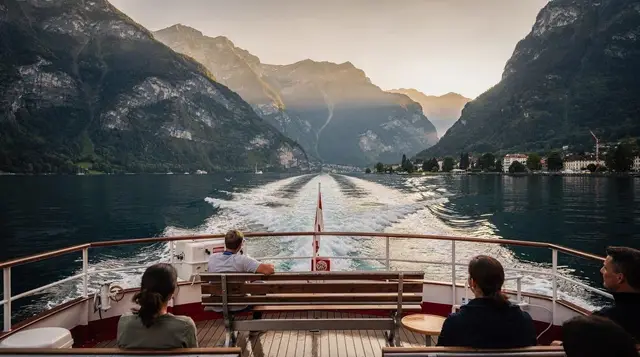
The gateway is Beatenbucht, a small landing stage on the northern shore of Lake Thun, reachable by the scheduled boats that run the Lake Thun cruise routes from Interlaken West or Thun, or by regional bus if you’d rather skip the water. From Beatenbucht, the Beatenbergbahn funicular hauls you up a steep, wooded slope to Beatenberg village in about seven minutes. It’s a proper funicular, not a tourist gimmick — locals use it as their everyday connection to the valley floor, and it runs year-round on a fixed schedule rather than only in high season.
Beatenberg itself is a long, thin village strung along the terrace, with the kind of unhurried, slightly old-fashioned holiday-village feel that a lot of the busier spots around Interlaken have lost. From the upper part of the village, the Niederhornbahn gondola takes over, climbing through pasture and forest to the Niederhorn summit station in around 15 minutes. The whole journey from the Beatenbucht landing to the top — funicular plus gondola, with a short walk or minibus between the two stations — takes about half an hour, on top of whichever boat or bus got you to Beatenbucht in the first place.
If you’re coming from central Interlaken, budget close to an hour door to door, and check the Niederhornbahn’s operating dates before you set out: like most of the region’s smaller lifts, it closes for scheduled maintenance in spring and autumn, and can run reduced hours outside July and August. The guide to cable cars and funiculars covers how these connections generally work if you want the mechanics explained once rather than route by route.
The St Beat Caves and their underground river
Lower down, near the hamlet of Sundlauenen on the same lakeshore, the Beatushöhlen — St Beat Caves — cut into the limestone behind a waterfall. Legend has it a hermit named Beatus lived here and drove out a dragon; what’s verifiable is that the cave system is genuinely extensive, with an underground river that has carved galleries deep into the mountain over thousands of years. Roughly a kilometre of walkway is open to visitors, following the stream past stalactites, small chambers and a couple of viewpoints back towards the entrance waterfall, before the accessible section ends and the rest of the surveyed system — several kilometres of it — continues unlit and unvisited beyond a barrier.
It’s a commercial attraction, not a wild cave: paths are paved, lit, and handrailed, and there’s a small museum near the entrance covering the site’s exploration history, plus a restaurant and gift shop that do brisk trade with coach groups in summer. Entry for an adult runs to around CHF 20, with family and combination tickets available; a skip-the-desk ticket covering the caves and museum avoids queueing at the counter on a busy afternoon, which is worth doing if you’re arriving by the midday boat when several tour groups tend to land at once.
If you’d rather see the caves as part of a lake outing rather than a standalone trip, a cruise that combines the boat crossing with cave entry and a lakeside picnic bundles the transport and the ticket into one booking.
Being honest about it: the caves are pleasant rather than spectacular by the standards of major European show caves, the walkway is short for the price, and the gift-shop-and-restaurant complex at the entrance feels more geared towards tour buses than independent travellers. It’s a solid rainy-day option and a good one for families — the guide to Interlaken in bad weather lists it alongside the region’s other indoor and semi-indoor fallbacks — but don’t expect an adventure caving experience.
Niederhorn: the summit at 1,950 metres
The Niederhorn is a different kind of attraction altogether: a proper alpine viewpoint, lower and less crowded than the Jungfraujoch or Schilthorn, but with a panorama that punches well above its modest altitude. From the summit station you get a clear line across Lake Thun to the Stockhorn range on the far shore, and a turn eastward brings the Eiger, Mönch and Jungfraujoch into view above the ridgelines around Interlaken — on a clear day it’s arguably a better single-frame photo of the Bernese Oberland’s big three peaks than you get from Harder Kulm, simply because the Niederhorn is far enough away to fit all three in without craning your neck.
There’s a restaurant at the summit station, Berggasthaus Niederhorn, doing the usual Alpine menu of rösti, soup and cake, with terrace seating that fills up fast on sunny weekends. Below the restaurant, a short network of paths loops around the immediate summit area — easy enough for most fitness levels and popular with families doing the guide to easy flat walks around Interlaken style of outing, since the cable car does all the climbing and the walking on top is close to level.
The ibex of Niederhorn
The detail that sets the Niederhorn apart from most of the other viewpoints around Interlaken is its ibex colony. Alpine ibex — Steinböcke, with their heavy backswept horns — were hunted to extinction in Switzerland by the early 19th century and reintroduced from Italian stock starting in the 1900s. A group has been resident on the slopes below the Niederhorn summit for decades, and unlike a lot of wildlife-watching promises in tourist literature, this one tends to deliver: rangers monitor the herd, and in the warmer months small groups of ibex are commonly seen grazing on the open slopes within a few hundred metres of the top station, sometimes close enough for a decent photograph without a long lens.
There’s no guarantee — they’re wild animals, not a zoo enclosure, and they move with the season, spending more time higher and further from the lifts in midsummer heat and coming down closer to the pastures in spring and autumn. Early morning and early evening give better odds than the middle of a hot afternoon. If wildlife is the main draw for your visit, the guide to wildlife and marmots has more on where else in the region to look, including the marmot colonies that are easier to find on some of the higher hiking routes.
Walking the ridge to Gemmenalphorn
For anyone with proper boots and a few hours to spare, the ridge trail west from the Niederhorn towards the Gemmenalphorn (2,064 metres) is the best hike in this part of the Lake Thun destinations that almost nobody from Interlaken bothers with. The path follows open, grassy ridgeline with drops on both sides — steep but not technical, and not exposed in the scrambling sense, though it’s not a walk for anyone uneasy on narrow ground with a view straight down to the lake on one side. Allow around two to two and a half hours return from the Niederhorn summit station at an unhurried pace, with a genuine payoff: from the Gemmenalphorn you look down simultaneously on Lake Thun and Lake Brienz, with Interlaken sitting in the gap between them.
This is high pastureland used for summer grazing, so expect gates, occasional cattle, and paths that can be genuinely wet or slippery after rain even in July. It’s a summer-only route in practice — snow can linger into June in a heavy year, and the cable car that gets you to the start of it doesn’t run through winter regardless. For hikers weighing this against the region’s other ridge routes, the best day hikes from Interlaken guide sets it alongside options like the Hardergrat ridge, which is longer, harder and considerably more exposed than this one.
If you’d rather have local knowledge on the ground than navigate the ridge alone, a guided hike up to the Rothorm ridge above Sigriswil with a local mountain guide covers similar terrain on the same side of the lake, with route-finding and pacing handled for you.
Prices and opening times
| What | Price (adult, CHF) | Typical hours |
|---|---|---|
| Beatenbergbahn funicular (Beatenbucht–Beatenberg), return | ~14 | Year-round, roughly 07:00–19:00, shorter in winter |
| Niederhornbahn cable car, return | ~48 | Late May–late Oct, closed for revision in spring/autumn |
| St Beat Caves entry with museum | ~20 | Late Mar–late Oct, roughly 10:30–17:00 |
| Lake Thun boat, Interlaken West–Beatenbucht | ~20 | Scheduled sailings, reduced outside summer |
Prices shift year to year and with exchange rates, so treat these as a planning guide rather than a quote. Anyone holding a Swiss Travel Pass or a regional Berner Oberland Pass gets meaningful discounts or free travel on the boat and funicular; the Swiss Travel Pass guide explains which passes cover which of these connections, since coverage on the smaller mountain lifts varies more than people expect.
When to go
June through September is the reliable window for the full combination — caves, cable car and ridge walk all running, ibex more visible on the lower slopes, and long daylight if you want to combine this with another stop on the lake, such as Thun’s old town or Spiez on the way back.
Shoulder season (May and October) can still work for the caves, which run on their own separate schedule, but check the Niederhornbahn’s exact dates before building a day around the summit — like most of the region’s smaller lifts it closes for a maintenance window that shifts slightly year to year, and turning up to a locked station after the funicular and boat connections is the kind of day-wrecking mistake worth avoiding. The guide to when mountain railways open and close — or, if that redirects, the general best time to visit Interlaken guide — is worth checking the week before you travel.
Winter closes the Niederhorn cable car entirely and reduces the funicular’s usefulness, since there’s little reason to be in Beatenberg once the summit is inaccessible; the caves also shorten their season. If a Beatenberg detour fits into a longer stay, it slots naturally into the two lakes and villages three-day itinerary, which pairs it with the Thun and Brienz shorelines on the days either side.
Beatenberg and Niederhorn: your questions answered
How do you get to the St Beat Caves from Interlaken?
Take the Lake Thun boat or a regional bus to the Beatushöhlen landing near Sundlauenen, on the northern shore between Interlaken and Beatenbucht. It’s a separate stop from the Beatenbergbahn funicular, which departs from Beatenbucht itself a short distance further along the shore.
Are the Beatus Caves worth visiting?
They’re a solid, if commercial, option — a lit walkway of around a kilometre past an underground river, with a museum and restaurant at the entrance. They suit a rainy day or a family outing more than anyone hoping for a dramatic caving experience, and the price feels a little high for the length of the visit.
How much does the Niederhorn cable car cost?
A return ticket runs to roughly CHF 48 for an adult, on top of the Beatenbergbahn funicular fare from Beatenbucht. Swiss Travel Pass and regional pass holders typically get a discount; check coverage before you travel since it varies by pass.
Can you really see ibex on the Niederhorn?
Yes, more reliably than most wildlife promises in the region. A resident herd grazes on the slopes near the summit station through the warmer months, most visibly early or late in the day. They’re wild, so nothing is guaranteed, but sightings are common enough that the colony is one of the Niederhorn’s main draws.
Is the Gemmenalphorn ridge trail difficult?
It’s steep in places with drops on both sides, but not technical or scrambly. Fit walkers in proper boots should manage the two-to-two-and-a-half-hour return trip comfortably; it’s not suitable for anyone uneasy with exposure or for young children.
Is Beatenberg open in winter?
The village and the Beatenbergbahn funicular run year-round, but the Niederhornbahn cable car and the ridge trail close for winter, and the St Beat Caves shorten their season considerably. Winter isn’t the season to plan this destination around.
Can you combine the caves and the Niederhorn in one day?
It’s possible if you start early — boat to the caves, then on to Beatenbucht for the funicular and cable car — but it’s a long day by the time you factor in queueing and connection waits. Most visitors are better served picking one focus and, if time allows, returning another day for the other.
Is the funicular from Beatenbucht worth taking just for itself?
It’s a genuine everyday transport link rather than a tourist ride, but the views over Lake Thun on the climb are good enough to justify the trip even without continuing to the Niederhorn, particularly for anyone who prefers funiculars to the more crowded gondolas elsewhere in the region.