Lake Thun does not get the postcard reputation of Lake Brienz’s turquoise water, and that is partly the point. It is the working lake of the Bernese Oberland — paddle steamers built when steam was still the modern way to travel, four castles you pass rather than queue for, and villages where people go to swim rather than to be photographed swimming. If you want a day away from Interlaken’s tour buses that still feels like Switzerland rather than a museum piece, this is it.
Getting on the water: the paddle steamers
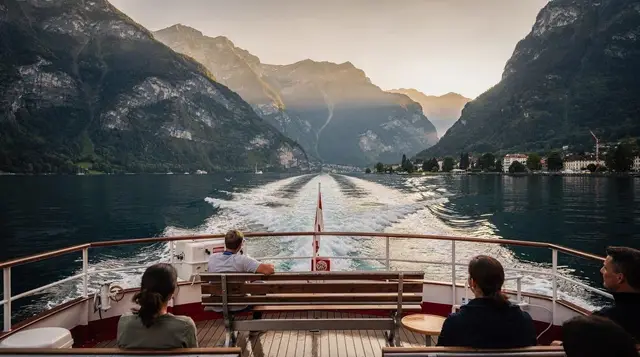
Lake Thun’s boats are run by BLS, the same company that operates the region’s trains, and the fleet still includes genuine paddle steamers — the DS Blüemlisalp, built in 1906, is the oldest working example on the lake and still runs regular services in summer. The paddle wheels are visible from the open rear deck, which is worth the walk back from the café seats even if you are not particularly interested in engineering.
Boats leave from Interlaken West, on the town side facing Lake Thun rather than Interlaken Ost, so check which station you need before you go — a mistake here means a 15-minute walk or a missed departure. The full run from Interlaken West to Thun takes around two hours to two hours and twenty minutes with roughly ten intermediate stops; a shorter Interlaken–Spiez or Thun–Oberhofen segment takes 30–60 minutes if you want the flavour without committing a whole afternoon.
Timetables thin out sharply outside the main season. From April to October there are several departures a day; from November to March, service drops to a handful of runs or stops altogether on some routes, so this is very much a summer-half activity. Second class one-way from Interlaken West to Thun runs around CHF 40, but the boats are fully covered by the Swiss Travel Pass, and Half Fare Card holders pay 50% — worth factoring in if you are already carrying either for the trains.
Full details on routes, boarding points and current fares are in the Lake Thun boat trips guide, and the fleet’s history — including the other surviving paddle steamers on Lake Brienz and Lake Lucerne — is covered in the guide to the region’s paddle steamers.
The castles along the shore
Four castles sit close enough to the water that you see them from the boat deck whether you stop or not, and each is a different kind of visit.
Schloss Thun sits on the hill above Thun’s old town, a genuine medieval keep with a museum inside and a rooftop terrace looking down the covered shopping street and out over the lake. It is the most substantial of the four and the easiest to combine with a wander through Thun itself.
Schloss Oberhofen, in the village of Oberhofen, is the most photogenic from the water — a turreted tower built almost into the lake, with an English-style garden open to the public even outside museum hours. The interior museum runs a shorter season, typically May to October.
Schloss Hünegg, a short walk from Oberhofen, is smaller and less visited, and better for it: the interior is furnished almost exactly as a wealthy family left it around 1900, Belle Époque wallpaper and all, rather than curated as a generic museum.
Schloss Spiez, on the opposite shore in Spiez, combines a Romanesque church, a stone keep on a small peninsula and a lakeside terrace that doubles as one of the better lunch spots on the lake — the view down the vineyard-backed shoreline is the reason people linger here longer than the castle alone would justify.
Entry to each runs roughly CHF 8–12, and none of them require advance booking outside a handful of summer weekends.
Swimming in July and August
This is the part visitors underestimate. Every town and village on Lake Thun has a public Strandbad — grass or gravel, changing rooms, a diving platform or two, and free or near-free entry — and locals use them all summer the way people elsewhere use a public pool. Thun’s Strandbad, right below the castle hill, is the largest and busiest. Spiez has a smaller lido near the harbour with the castle as a backdrop. Merligen and Oberhofen both have quieter lakeside grass areas that rarely feel crowded even in August.
Water temperature depends heavily on the year and on recent weather — the lake is fed by glacial meltwater from the Kander and other Alpine rivers, so a few days of heavy rain in the mountains can drop the temperature noticeably even in mid-summer. In a normal July or August, expect somewhere around 20–23°C by the surface; June and September are swimmable but noticeably cooler, and worth checking on a warm afternoon rather than assuming. The full picture, including how Lake Thun compares to Lake Brienz for temperature and clarity, is in the swimming guide for both lakes.
Boat-train connections and getting around
The practical appeal of Lake Thun is that boats and trains run to the same timetable family, so you can go out one way and back the other without much waiting. A common day plan: train from Interlaken West to Thun (about 20–25 minutes), explore the old town and castle, then the boat back to Interlaken with a stop at Oberhofen or Spiez along the way. Reverse it if you would rather do the slow leg first while you are fresh.
Regional trains along the north shore stop at Interlaken, Unterseen, Spiez and Thun with a journey time of well under half an hour end to end, and buses fill the gaps to villages the trains do not reach directly, such as Merligen and Sigriswil. None of this requires a car — in fact a car is a liability on the narrow lakeside roads near Sigriswil and Beatenberg, where the switchbacks are built for buses that know the road, not visitors testing it for the first time. The full network of trains, buses and boats around both lakes is mapped out in the transport guide for the region, and pass options are compared properly in the Swiss Travel Pass guide.
Day tickets and passes worth knowing
If you are staying in Interlaken or Unterseen, your hotel almost certainly issues a guest card (Gästekarte) covering local buses around the Bödeli at no extra cost — useful for reaching the Interlaken West boat pier or nearby stops, though it does not cover the lake boats themselves. For the boats and regional trains together, a Berner Oberland Regional Pass or a Swiss Travel Pass covers Lake Thun outright; a single-day Saver Day Pass on SBB is the better option if you only need the train legs and plan to pay for the boat separately.
Worth noting for planning: unlike Lake Brienz, where the boat network is smaller and more purely scenic, Lake Thun’s boats double as genuine public transport for people commuting between lakeside villages and Thun, so timetables run reliably even outside peak tourist hours in the summer months — though they thin out fast once October ends.
Left bank vs right bank: two different lakes
Locals talk about Lake Thun’s two shores as if they were different places, and functionally they are.
The north shore — running from Interlaken’s edge through Sundlauenen, Merligen, Gunten, Sigriswil, Hilterfingen and Oberhofen to Thun — is where most of the sightseeing sits. The St. Beatus Caves, reached from Sundlauenen, are a short walk up from the boat landing and worth the detour for the waterfall at the entrance alone, even without going into the show caves. This shore also has better public transport density, most of the castles, and the villages that feel most postcard-ready, which means it also carries more day-trip traffic on a sunny Saturday.
The south shore — Spiez, Faulensee, Krattigen, Leissigen — sits under the Niesen pyramid and feels distinctly quieter. Spiez itself, with its castle, harbour and vineyard terraces, is the one genuine town-sized stop; beyond it, the villages are small, residential and mostly used by people who live there rather than visit for an afternoon. If your goal is a lunch with a view and no crowd, this side delivers it more reliably than the north shore in high season.
Neither shore is objectively “better” — the north shore rewards a day of stopping and looking, the south shore rewards slowing down and staying in one place. A three-day plan that uses both lakes properly, rather than rushing one in an afternoon, is laid out in the two lakes and villages itinerary; if you are trying to decide which of the two lakes deserves more of your time in the first place, that comparison is handled directly in the Lake Thun vs Lake Brienz guide.
Two ways to see the lake beyond the boat
The paddle steamer is the classic way to see Lake Thun, but it is not the only one. A guided cruise that bundles the boat with a stop at the St. Beatus Caves and a picnic removes the timetable-juggling entirely — useful if you would rather not work out connections yourself: the Thun and Beatus Caves lake cruise from Basel covers the same ground as a self-planned day but as a single booked block, cheese tasting included, which suits visitors based further afield who want Lake Thun as a one-day add-on rather than a base to return to.
For a different pace entirely, e-bike routes follow parts of the lakeside cycle path through orchards and past smaller villages the boat does not reach — the Interlaken lakes and ruins e-bike tour and the valley e-bike route through rivers, lakes and forests both work the terrain around Lake Thun’s shoreline into a half-day ride, which is a reasonable way to combine two or three villages without depending on boat or bus timetables at all.
Full cycling routes, distances and where to rent are set out in the cycling and e-bike routes guide.
Lake Thun frequently asked questions
Can you actually swim in Lake Thun?
Yes, and locals do it every summer evening. Public lidos (Strandbad) at Thun, Spiez, Merligen and Oberhofen have grass, changing rooms and lake access, most free or a few francs to enter. Water reaches around 20–23°C in late July and August; it is noticeably colder in June and after heavy rain, since the lake is fed by Alpine meltwater.
Is the Lake Thun boat covered by the Swiss Travel Pass?
Yes. The Swiss Travel Pass covers the BLS lake boats free of charge, the same as the trains. Half Fare Card holders pay 50%. Without either, a one-way full-lake trip from Interlaken West to Thun costs around CHF 40 in second class, so the pass pays for itself quickly if you are also using regional trains.
How long does the full boat trip from Interlaken to Thun take?
About two hours to two hours and twenty minutes one way, depending on how many of the roughly ten intermediate stops the boat makes. It is a scenic transfer, not a fast one — treat it as the activity itself, not just a way to get to Thun.
Which castles can you visit on Lake Thun?
Schloss Thun (the medieval keep above Thun’s old town), Schloss Oberhofen (lakeside, with gardens open to the public), Schloss Hünegg (Belle Époque interiors, furnished as left in 1900) and Schloss Spiez (Romanesque church and lakeside terrace) are all open to visitors in season, roughly April to October.
Is the north shore or south shore of Lake Thun better to visit?
The north shore — Merligen, Sigriswil, Gunten, Hilterfingen, Oberhofen — has most of the castles, the St. Beatus Caves and better boat and rail connections. The south shore around Spiez and Faulensee is quieter, backed by the Niesen pyramid, and better for a slow lunch with a view rather than sightseeing stops.
Do the Lake Thun boats run in winter?
Mostly no. The full seasonal timetable runs roughly April to October; from November to March, services are reduced to a handful of routes or suspended entirely depending on the year. Check the BLS timetable before planning a winter visit around the boats.
Can you cycle around Lake Thun?
Yes, a signed lakeside route runs most of the way around, mixing quiet lanes with short sections on busier roads near Thun and Spiez. E-bikes are the practical choice given the distance (around 45 km for a full loop) and some short climbs on the north shore.