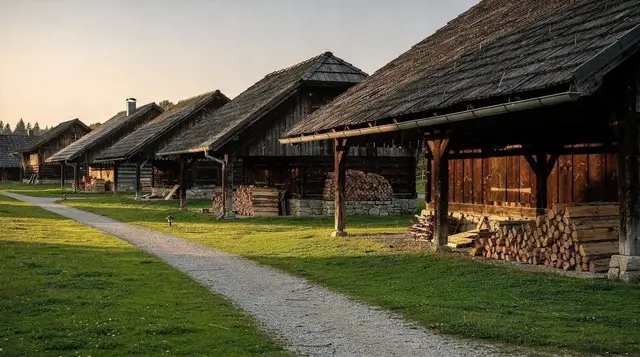
Thun old town and castle: a walking guide
How much time do you need for Thun old town and castle?
Budget three to four hours: about 45 minutes for the castle's five museum rooms, an hour drifting along the Obere Hauptgasse and down to the Aare locks, and 45 minutes in Schadau Park for the Wocher Panorama. Add an hour if you come on a Saturday morning for the market.
Why Thun is more than a station on the way to Interlaken
Most people see Thun from a train window on the way between Bern and Interlaken, or as a name on a boat timetable on Lake Thun. That is a mistake worth five minutes of correcting, because the old town sits close enough to the station that you can walk the castle hill, the market street and the lake outflow in half a day and still catch an afternoon train onward.
Thun’s centre is compact: castle on the hill, one long shopping street running below it with a genuinely odd rooftop-pavement system, and the Aare River rushing out of the lake through a set of locks right in the middle of town. Add Schadau Park on the lakeshore, ten minutes’ walk away, and you have a full but unhurried half-day loop that does not require a car, a cable car ticket or a boat reservation.
Getting to Thun and finding your way from the station
Trains from Interlaken run from both Interlaken West and Interlaken Ost, take about 25 minutes, and arrive at Thun station on the edge of the old town. From the station, it is a five-minute walk along the river to reach the foot of the castle hill; signs point the way to “Schloss Thun” throughout.
If you are coming from further afield, Thun sits on the main line toward Bern (about 20 minutes further) and on the route many trains use en route to Spiez and the Lötschberg. A Swiss Travel Pass covers the train journey itself; the castle museum entry is a separate ticket bought on site.
| From | Journey time | Typical frequency |
|---|---|---|
| Interlaken West/Ost | ~25 min | every 15–30 min |
| Bern | ~20 min | every 15–30 min |
| Spiez | ~10 min | every 15–30 min |
| Bönigen/Interlaken via boat | ~2 hr | seasonal, several daily |
The boat option from Interlaken is slow but scenic if you want to see Oberhofen and Hilterfingen en route; see the Lake Thun boat trips guide for timetables and fares. Most visitors take the train there and, if they fancy it, the boat back.
Schloss Thun: five rooms, one very good view
The castle above the old town was begun around 1190 by Berchtold V of Zähringen, the same family that founded Bern, and its four corner towers are the single most photographed silhouette in the region after the Eiger. Inside, the Thun Museum occupies five rooms across the upper floors, and the visit is short enough to fit into 45 minutes without rushing.
The sequence runs roughly: a weapons and armour room on the lower level, a Bernese domestic-history room with furniture and costume from the canton, a section on local archaeology and early Thun, and then the Knights’ Hall (Rittersaal) at the very top, a genuinely impressive timber-roofed space that was the counts’ banqueting hall and now doubles as the best viewpoint in town. From the Rittersaal’s corner towers you get a clean panorama over the old town roofs, the lake, and on a clear day the peaks toward Interlaken and beyond.
Entry is a modest adult fee at the door, with reduced rates for students, seniors and children, and a family ticket for two adults plus children. It is not included on the Swiss Travel Pass or regional passes, so budget for it separately; check current prices at the ticket desk since they are revised periodically. The castle is open daily in the main season with shorter hours and some closed days in winter, so confirm before a January or February visit.
For a guided version that pairs the castle with the lake, the Lake Thun castles tour with entry tickets included bundles Schloss Thun with a stop at Oberhofen castle and takes the ticket logistics off your hands.
Obere Hauptgasse: walking on the shop roofs
The street below the castle, the Obere Hauptgasse, is Thun’s real curiosity. After fires forced rebuilding in the 15th and 16th centuries, the town raised the pavement level above the line of shops, so pedestrians now walk along a “first floor” pavement directly over the shopfronts’ roofs, linked to the ordinary street below by short flights of stone steps at intervals. The effect is a street with two walking levels running in parallel: browse the upper pavement for the view down into the lower street and the covered arcades, or stay below for the shop windows at eye level.
It is one of the more photographed quirks of the Bernese Oberland and, unlike a lot of “old town charm,” it is functional rather than reconstructed — locals use both levels for actual shopping. The street is short enough to walk end to end in ten minutes, but budget half an hour if you want to duck into any of the independent shops, bakeries or the Rathausplatz at its lower end, which hosts the town hall and, on Saturdays, the weekly market.
The rooftop pavements are not step-free: wheelchairs and pushchairs are better off on the lower street, which runs the same distance without the stairs.
The Aare locks and the town’s open-water swimming spot
Where Lake Thun narrows and drains into the Aare River, right at the foot of the old town, the water picks up speed and runs turquoise-clear over a series of locks and weirs (Schleusen) that regulate the lake’s level. It is worth the five-minute detour from the Obere Hauptgasse to stand on one of the footbridges and watch the current; on a hot day you will also see locals doing what people do in Bern on the Bern old town walking guide route — floating downstream in the fast current from a spot upstream of the locks, climbing out well before the weir itself.
The water is glacier-fed and cold even in high summer, and the current is stronger than the postcard shots suggest, so this is not somewhere to let children swim unsupervised, and it is not a spot for anyone who is not a confident swimmer. If you want a calmer alternative, the lake itself has managed bathing areas along both shores; see swimming in Lake Thun and Lake Brienz for options.
Schadau Park and the Wocher Panorama
Ten minutes’ walk from the old town along the lakeshore, past the station, Schadau Park is an English-style landscape garden built around Schloss Schadau, a 19th-century neo-Gothic villa now used as a restaurant rather than a museum. The park itself is free to walk, with mature trees, lawns running down to the water, and views back across the lake toward the mountains — a pleasant place to sit after the castle and old town, and popular with locals for exactly that reason.
The park’s specific reason to visit is the Wocher Panorama, a rotunda holding a large 360-degree painting completed by Marquard Wocher in 1814, showing Thun as it looked around 1810, before the railway, the grand hotels or most of what you have just walked through existed. It is one of the oldest surviving panoramic paintings in the world still displayed in its purpose-built rotunda, and it takes 15 to 20 minutes to see properly. Admission is separate and modest; the building keeps shorter hours than the castle, so check before planning your route around it.
The Saturday market
Thun’s weekly market sets up in the old town, centred on the Rathausplatz at the foot of the Obere Hauptgasse, on Saturday mornings. Expect the usual Bernese Oberland mix: regional cheeses, bread, cut flowers, seasonal produce and the odd craft stall, largely wound down by early afternoon. It is smaller and less touristy than Bern’s market days, which makes it a reasonable stop if you want a working town market rather than a display for visitors — see markets of the Bernese Oberland for how it compares to others in the region.
If Saturday does not suit your itinerary, the shops along the Obere Hauptgasse and the covered arcades operate normal hours through the week, so you are not missing the town’s character, just the stalls.
A practical half-day route
- Arrive by train, walk from the station along the river toward the castle hill (5–10 min).
- Climb to Schloss Thun and see the five museum rooms, finishing at the Rittersaal view (45 min).
- Descend to the Obere Hauptgasse, walking one level and returning on the other (30 min).
- Detour to the footbridges over the Aare locks (15 min).
- Walk the lakeshore to Schadau Park and the Wocher Panorama (45 min, plus transit).
- Return to the station, or continue by boat toward Interlaken.
| Stop | Time needed | Cost |
|---|---|---|
| Schloss Thun museum | 45 min | modest adult fee, reductions available |
| Obere Hauptgasse | 30 min | free |
| Aare locks viewpoint | 15 min | free |
| Schadau Park | 20 min | free |
| Wocher Panorama | 20 min | modest separate fee |
| Saturday market (if timed) | 30–60 min | free to browse |
Combining Thun with the rest of a day trip
Thun works well as a standalone half-day, but it also slots neatly into a longer loop. Many visitors pair it with Bern, 20 minutes further by train, for a full-day version — see day trips from Interlaken for how the timings stack up. Travellers coming from further out sometimes fold it into a longer private itinerary; the Basel, Bern and Thun private day trip covers all three in one outing if you are based further north.
If your interest in Thun is really the lake rather than the town, the Lake Thun cruise with St. Beatus Caves and a picnic stop uses Thun as one end of a boat itinerary rather than a walking destination, and the day pass covering Lake Thun and Lake Brienz boat cruises is worth comparing against single-ticket fares if you plan to get on and off at several lakeside stops in one day.
For budgeting the day as a whole, alongside your other Bernese Oberland stops, Interlaken travel costs breaks down what a realistic daily spend looks like once trains, entry fees and food are added up. And if Thun is a wet-weather fallback rather than the main plan, the castle’s indoor rooms and the covered Obere Hauptgasse arcades make it one of the better rainy-day options within easy reach — worth cross-checking against Interlaken in bad weather before you commit to an outdoor itinerary elsewhere.
Thun old town and castle: frequently asked questions
How do I get from Interlaken to Thun?
Direct trains run from both Interlaken West and Interlaken Ost to Thun roughly every 15 to 30 minutes, taking about 25 minutes. It is covered by the Swiss Travel Pass and by regional passes that include the Thunersee zone; without a pass, expect to pay full point-to-point fare each way.
What does it cost to visit Schloss Thun?
The castle museum charges a modest adult entry fee, with reductions for students, seniors and a separate, cheaper children’s rate; a family ticket is available. It is not covered by the Swiss Travel Pass, though Half Fare Card holders sometimes get a small discount, so check at the ticket desk rather than assume.
Is the Wocher Panorama worth the extra stop?
Yes, if you have any interest in how Thun looked before the railway and the grand hotels arrived. It is a small, separate admission inside Schadau Park, quick to see in 15 to 20 minutes, and one of the oldest surviving panoramic paintings in the world rather than a modern reconstruction.
Can you swim in the Aare at Thun like in Bern?
Yes. Locals float and swim in the fast, cold current where the lake drains into the river near the old town, usually from a public spot upstream of the locks and out before the weirs. Water is glacier-fed and cold even in August, and the current is stronger than it looks, so it is not a place for weak swimmers or small children unsupervised.
Which day is the Thun market?
The main weekly market runs on Saturday mornings in the old town, with stalls for cheese, bread, flowers and local produce. It winds down by early afternoon, so arrive before midday if the market is the reason for your visit.
Are the rooftop pavements on Obere Hauptgasse wheelchair or pushchair friendly?
Not really. The raised pavements above the shopfronts are reached by stone steps at intervals along the street, with no ramps built into the historic structure. Pushchairs and wheelchairs are better off on the ordinary street level below, which runs parallel and covers the same distance.
Is Thun worth a stop if I am short on time in the Bernese Oberland?
If you have to choose one lakeside old town beyond Interlaken itself, Thun beats a lot of the alternatives because the castle, the market street and the lake outflow all sit within five minutes’ walk of the station. Half a day covers it properly without feeling rushed.
Museum & art tours on GetYourGuide
Verified deep-linked GetYourGuide tours. Book through these links and we earn a small commission at no cost to you.
GetYourGuide does not provide a product photo for this activity — the image shows the meeting point, photographed by us.