Bern old town walking guide
How long does it take to walk Bern's old town?
Budget two and a half to three hours for the full loop covering the Zytglogge, the fountains, the cathedral tower and the bear pit, without rushing. Add 30 to 45 minutes if you climb the 344 steps of the Münster tower and walk up to the Rosengarten for the view.
Bern’s old town is a UNESCO World Heritage site not because of one monument but because the whole medieval layout survived: sandstone arcades running for about six kilometres, a river loop that still defines the street plan, and fountains that have stood on the same corners since the 1540s. Almost everyone who visits from Interlaken does the same five things in some order — the clock, the fountains, the cathedral tower, the bears, the view from across the river — and this route strings them together in a way that avoids backtracking.
Getting your bearings before you start walking
The old town sits on a peninsula formed by a hairpin bend in the Aare, so the street grid is a straight run from the railway station down to the Nydeggbrücke, with the river wrapping around three sides. The main street changes name six times along its length — Spitalgasse, Marktgasse, Kramgasse, Gerechtigkeitsgasse — but it is the same continuous arcade the whole way, known locally as the Lauben. You will walk most of it twice: once going down toward the bear pits, once coming back up on the return leg, or via the parallel Aarstrasse if you want variety.
| Stage | Distance from station | Typical time |
|---|---|---|
| Zytglogge | 550m | 10 min walk |
| Bern Münster | 250m further | 5 min walk |
| Nydeggbrücke / bear pits | 700m further | 12 min walk |
| Rosengarten (uphill) | 500m further, +40m elevation | 12–15 min walk |
| Back to station via the Lauben | 1.9km | 25–30 min walk |
That adds up to roughly 4km of forward walking plus the return, close enough to the six kilometres usually quoted once you factor in the fountains detour and the loop around the cathedral terrace.
The Zytglogge: Bern’s medieval clock tower
The Zytglogge is the obvious starting point, both because it sits at the point where the old town’s main street bends and because it is the easiest of the city’s monuments to misjudge if you don’t know when to look. The clock tower dates to the early 13th century as a city gate, but the astronomical mechanism that makes it famous was installed in 1530 by Caspar Brunner, and it still runs on the original gearing today, wound by hand.
The show that draws the crowds happens on the western face, about four minutes before each hour: a rooster crows, a procession of bears circles a seated figure representing Kronos, and on the stroke of the hour the rooster crows a second time as Kronos turns his hourglass. It lasts under a minute and is easy to miss if you arrive expecting a longer performance, or if you turn up right on the hour rather than a few minutes early. The astronomical dial below shows the position of the sun and moon and the zodiac sign of the month — it is worth a slower look than most people give it, since almost everyone’s attention is on the bears above.
Interior tours of the mechanism room run on a fixed schedule and are limited to small groups, in German with translated notes; tickets are sold at Bern Welcome at the station and sell out on busy afternoons in summer. If you’d rather not manage timings and tickets yourself, a private guided walking tour of the medieval downtown typically times its route to catch the jacquemart show and explains what the astronomical dial is actually showing, which is not obvious from the street.
Eleven fountains, and which ones to actually stop for
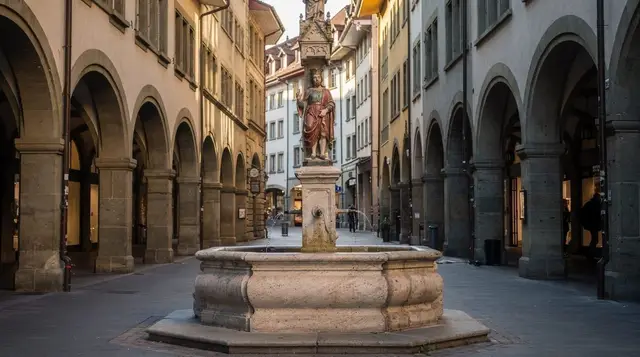
Bern has eleven Renaissance fountains scattered along the old town’s main streets, almost all carved and painted between 1540 and 1546, commissioned as part of a civic beautification drive after a fire had destroyed much of the town a few years earlier. They are working fountains, not static monuments — Bernese children still cool off in them in summer — and the water is drinkable unless a sign says otherwise.
The one everyone stops for is the Kindlifresserbrunnen, the Ogre Fountain, on Kornhausplatz just off the main axis: a seated figure eating a child, with more children in the sack on his back and one more clutched in his pocket. What it is meant to represent has never been settled — a Greek myth, a carnival character, an anti-Jewish stereotype from the period, a warning about child abduction — and the city has not tried to resolve the ambiguity with an explanatory plaque, which makes it more unsettling to look at, not less.
Further down Kramgasse, the Zähringerbrunnen shows an armoured bear, a reference to the founding legend that Duke Berchtold V named the city after the first animal he killed hunting nearby. Near it, the Samson fountain depicts the biblical strongman prising open a lion’s jaws, and the Vennerbrunnen shows a standard-bearer in sixteenth-century armour. The Gerechtigkeitsbrunnen, the Justice fountain, stands blindfolded with her sword and scales over four toppled figures representing a pope, an emperor, a sultan and a mayor — a piece of civic self-flattery, since the mayor is the only one of the four still standing upright.
Two are easy to walk past without noticing their significance: the Anna-Seiler-Brunnen, the only one of the eleven named after a real, historical woman — a 15th-century hospital founder — rather than an allegorical or mythical figure, and the Pfeiferbrunnen, the Piper fountain, whose bagpiper figure is one of the oldest in the group, predating the main wave of 1540s fountains. None of the eleven takes more than a minute to look at properly, but doing that for all eleven, rather than only the Ogre Fountain everyone photographs, is what separates a considered walk from a rushed one.
Bern Münster: 344 steps for the best view in the old town
Bern Münster is the tallest cathedral in Switzerland, a Late Gothic sandstone building begun in 1421 and not actually finished — the spire — until 1893, four and a half centuries later. The main west portal is worth stopping at before going in: a tympanum showing the Last Judgment carved around 1490, with over 200 figures split between the saved on Christ’s right and the damned, in some detail, on his left.
The tower climb is what most people come for. It is 254 steps up a narrow spiral stair to the first platform, with a further stretch to the bell chamber that brings the total closer to 344 depending on where you start counting from inside the nave. The stair is genuinely narrow — passing another visitor coming down requires one of you to step into a recess — and it is not a good climb for anyone with claustrophobia or significant mobility limitations. At the top, the platform gives an open view over the Aare’s loop, the arcaded rooftops of the old town, and on a clear day a line of Bernese Alps including the Stockhorn range to the south. Admission to the tower is a separate, modest fee from entering the church itself, which is free.
The bear pits and the BearPark
Bears have been kept in Bern in some form since at least 1513, and the city’s name is popularly (if not reliably) traced to a bear killed on the founding hunt. The original stone bear pits, the Bärengraben, sat right at the end of the Nydeggbrücke from 1857 and are still there, though the bears themselves moved in 2009 to the larger BearPark on the slope down to the river, a mix of open enclosure and riverbank access that is a considerable improvement on the old concrete pit.
Viewing the bears from the public paths above the park is free, and the animals are visible from several angles without needing to enter anything. They are most active in the cooler parts of the day; at midday in summer, especially on hot afternoons, they frequently retreat out of sight to shaded corners, so a late-morning or early-evening pass by the enclosure gives better odds of seeing them moving around. The old, empty stone pits next to the new park are kept as a historical marker and are free to look into as well.
Rosengarten: the view everyone ends up photographing
From the bear pits, a signposted path climbs the far bank of the Aare to the Rosengarten, a rose garden and restaurant terrace about 40 metres above the river. The climb takes 12 to 15 minutes on foot, mostly on a paved switchback path with occasional stone steps; bus line 10 also stops nearby if you would rather skip the uphill walk, particularly relevant on a hot day or with limited mobility.
The payoff is the single best panorama of the old town: the full curve of the Lauben rooftops, the cathedral spire rising above them, and the Aare wrapped around three sides, with the Bernese Alps behind on a clear day. It is at its best in the hour before sunset, when the sandstone buildings pick up warm light and the crowds thin out compared to midday. The roses themselves flower from roughly May to September; outside that window it is still worth the climb for the view, just without the foreground colour.
How long to allow, and where to start and finish
A comfortable pace covering the Zytglogge, all eleven fountains, the cathedral exterior and tower, the bear pits and the Rosengarten runs to two and a half to three hours, not counting a meal stop. Starting at the railway station and finishing back there works well, since the loop naturally returns you to the same point via the parallel stretch of arcades on the way back. If you are short on time, the version that keeps the essentials — Zytglogge, a handful of fountains, the cathedral exterior, and the bear pits without the Rosengarten climb — can be done in about 90 minutes.
Anyone who wants the history explained rather than pieced together from plaques (many of which are in German only) is better served by a guide than by this page alone. A private walking tour with a local guide covers the same ground at whatever pace suits your group and fills in the founding legend, the fountains’ iconography and the cathedral’s construction history in a way that reading signage on the move does not.
Getting to Bern from Interlaken
Trains from Interlaken Ost to Bern run roughly twice an hour and take about 52 minutes, arriving directly into Bern’s main station, a five-minute walk from the Zytglogge. There is no need for a car — the old town is entirely walkable and largely pedestrianised, and on-street parking near the centre is both scarce and expensive. A Swiss Travel Pass covers the journey along with most other regional trains, which is worth checking against a point-to-point ticket if you are combining this with other day trips from Interlaken.
Combining the walk with something else
If a bear-and-fountain walk is not enough city for one day, the Zentrum Paul Klee sits a short bus ride from the centre and is worth the detour for anyone with an interest in modern art; see the Bern museums guide for opening hours and how to combine the two. For a different kind of viewpoint over the city, the funicular up the Gurten hill on the southern edge of town gives a wider, greener outlook than the Rosengarten, and a Gurten Park visit with the 360-degree viewpoint and a cheese picnic makes a relaxed second half to the day once the old town walk is done.
Travellers with more time, or based in Bern for a night rather than doing it as a single day trip, sometimes extend outward to Biel/Bienne, a short train ride away and home to the Omega watch museum; a guided day tour to Biel with entry to the Omega museum covers that combination without needing to plan the connections yourself. Anyone weighing Bern against Switzerland’s other main old towns on a longer Interlaken itinerary should also look at the Thun old town and castle guide — smaller in scale, right on the way back toward Interlaken, and doable in half the time.
Eating along the route
The arcades themselves are lined with a mix of chain shops and independent cafés, and prices climb noticeably the closer you are to the Zytglogge. A cheaper, better option is to walk one street back from the main axis, where bakeries and lunch counters serve the same rösti and sandwiches for several francs less.
For something more filling than a quick lunch, the restaurant guide for the region and the fondue and raclette guide both cover what a proper Swiss meal costs and where it is worth paying more, patterns that hold in Bern as much as around Interlaken. Chocolate shops cluster near the Zytglogge as well; the Swiss chocolate experiences guide covers which ones are worth a stop rather than a tourist markup.
Practical notes and timing
Bern’s old town does not close for winter the way some alpine attractions do — the arcades, fountains and bear enclosure are outdoor and open year-round, though the cathedral tower keeps shorter hours from November to March and closes in poor weather when the stair becomes a safety concern.
If a wet day interrupts your plans, most of the walk is still doable under the arcades, which is exactly what they were built for; see the Interlaken bad weather guide for a broader list of covered options in the region. Markets set up on Tuesday and Saturday mornings along the Bundesplatz and add produce, flower and craft stalls to the route without disrupting it — the regional markets guide has the schedule if you want to time your visit around one.
For anyone flying in rather than arriving from Interlaken, Bern is also a realistic stop on the way from Zurich airport, and pairs naturally with a broader look at day trips from Interlaken or with Lucerne if you are stringing several old towns together over more than one day.
Frequently asked questions about walking Bern’s old town
How long does it take to walk Bern’s old town?
Budget two and a half to three hours for the full loop covering the Zytglogge, the fountains, the cathedral tower and the bear pit, without rushing. Add 30 to 45 minutes if you climb the 344 steps of the Münster tower and walk up to the Rosengarten for the view.
Is the Zytglogge worth seeing, and when does the mechanism move?
Yes, but only if you time it. The jacquemart figures start moving about four minutes before the hour, with the rooster crowing twice and Chronos turning his hourglass on the stroke. Turning up exactly on the hour means you miss the build-up.
How many steps are in Bern Cathedral’s tower, and is it worth the climb?
The platform is 254 steps up a spiral stair, and a further short flight brings the total closer to 344 including the approach inside the nave. It is worth it on a clear day: the view takes in the Aare loop, the old town roofs and, weather permitting, a line of Bernese Alps on the horizon.
Are the bears at the Bärengraben real, and is entry free?
Yes, Bern still keeps bears at the BearPark on the banks of the Aare, and viewing the outdoor enclosure from the public paths is free. The bears are most active in the morning and early evening; at midday, especially in summer, they often nap out of sight.
What is the Kindlifresserbrunnen and why does it look disturbing?
It is the Ogre Fountain, a 1546 sandstone figure eating a child while more children wait in his sack and pocket. Nobody has settled what it actually depicts — theories range from a carnival figure to a warning about the plague — and Bern has left the ambiguity alone rather than sanitise it.
Do I need tickets or a guide for this walk?
No ticket is needed for the arcades, the fountains or the outside of the Zytglogge and the cathedral; only the cathedral tower and the Zytglogge’s interior mechanism tour are paid. A private guide adds context on the fountains and the clock’s history that is easy to miss walking alone.
Can I do this walk as a day trip from Interlaken?
Yes. Trains from Interlaken Ost to Bern run roughly every half hour and take about 52 minutes, so a morning train and an early-evening return leave a full day in the old town with time to spare for the Rosengarten and a meal.
City sightseeing tours on GetYourGuide
Verified deep-linked GetYourGuide tours. Book through these links and we earn a small commission at no cost to you.
GetYourGuide does not provide a product photo for this activity — the image shows the meeting point, photographed by us.