Bern is the one big city that fits naturally into an Interlaken trip without derailing it. Direct trains from Interlaken Ost run roughly every hour and take about 50 minutes, so it is genuinely a half-day-to-full-day proposition rather than an expedition. What you get for the trip is a working national capital with roughly 135,000 people, a UNESCO World Heritage old town still used as an actual city centre, and — for a few months of the year — locals swimming to work down the Aare in their lunch break.
This guide covers the old town’s arcades and the Zytglogge, the bear enclosure on the river, Zentrum Paul Klee out on the eastern edge of town, the Aare swim and its real rules, the Gurten hill above the station, and the Tuesday and Saturday markets that decide, more than anything else, which day of the week you should pick.
Getting there from Interlaken
Both Interlaken stations serve Bern, though Interlaken Ost is where most of the direct services start. Trains run about once an hour, take 50 to 55 minutes, and arrive at Bern’s main station (Bern Bahnhof), which sits directly beneath the old town — you walk out of the station concourse and the arcades of the Spitalgasse begin within a couple of minutes.
| Fare type | One-way price (approx.) | Notes |
|---|---|---|
| Full-price second class | CHF 29 | Buy at the machine or via the SBB app |
| With Half Fare Card | CHF 15 | Card pays for itself after two or three trips |
| Swiss Travel Pass | Included | No separate ticket needed |
| Berner Oberland Pass | Included | Covers most regional trains, including Bern |
If you already hold a regional pass, check what it covers before buying a separate ticket.
the Berner Oberland Pass bundles many of the region’s trains, cable cars and boats, and Bern is one of the destinations it reaches, which can make sense if you are also using it for Thun or the mountain lines above Grindelwald.
The last practical return trains to Interlaken run into the evening, but check the timetable for the specific date — Sunday and holiday schedules thin out earlier than weekdays.
If you are weighing the train against other ways of moving around, the Swiss Travel Pass guide explains when a pass pays off, and trains, buses and boats around Interlaken shows how the Bern line fits with the rest of the local network.
The old town: six kilometres of arcades
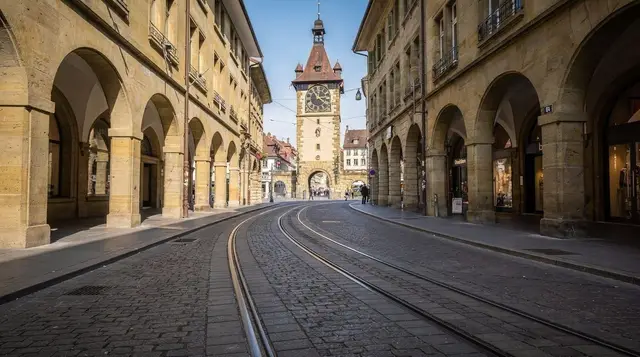
Bern’s old town (Altstadt) sits on a tight loop of the Aare and has changed remarkably little since a fire in 1405 forced it to be rebuilt in sandstone. UNESCO listed the whole peninsula in 1983, and the headline feature for a first-time visitor is the arcades: around six kilometres of covered, vaulted walkways (Lauben) running along both sides of the main streets — Spitalgasse, Marktgasse, Kramgasse and Gerechtigkeitsgasse — lined with shops and cellars.
Walking the full length from the station to the Nydeggbrücke takes about 25 minutes without stopping, but stopping is the point: cellar shops selling everything from vinyl records to Alpine cheese sit below street level, reached by narrow stairs, a layout that dates back centuries and still works as ordinary retail space rather than a museum piece.
If you would rather follow a set route than wander, the Bern old town walking guide lays out the streets in order, and the wider Bern day trip from Interlaken guide shows how to pace the whole day around them.
Along the way you pass a run of ornate fountains (Brunnen) — the Zähringerbrunnen, the Kindlifresserbrunnen (the “child-eater fountain,” which is exactly as unsettling as it sounds), and several more — most from the 16th century and still working.
The Zytglogge
The Zytglogge is Bern’s medieval clock tower, originally a 13th-century city gate that had its astronomical clock mechanism added in 1530. The clock mechanism still runs on its original gears, and four minutes before every hour a small parade of figures — a rooster, dancing bears, a jester, Father Time turning an hourglass — goes through its motions above the astronomical dial. It is a minor spectacle rather than a major one, worth timing your walk to catch on the way past rather than building a special stop around, since the crowd it draws is small and the show lasts under a minute.
Guided tours inside the tower’s clockwork (in German and English, booked through Bern Welcome) run a few times daily and are the only way to see the mechanism itself; without one you see the tower and dial from the street, which is enough for most visitors.
The Bundesplatz, home to the Swiss Federal Parliament building (Bundeshaus), is a five-minute walk further and free to view from outside; the fountains on the square are switched to a choreographed water display on summer evenings, and the square itself becomes the market ground on Tuesday and Saturday mornings.
The bear pit on the river
Bears are Bern’s civic emblem — the city’s own name is traditionally linked to the German word for bear (Bär) — and it has kept live bears on display, in one form or another, since the 1850s. The old stone Bärengraben (bear pit) opposite the Nydeggbrücke has been retired as a bear enclosure; the animals now live in the BärenPark, a larger, terraced park opened in 2009 that gives them direct access to the Aare itself, where they are visibly fond of swimming.
Viewing is free and the park is open year-round, dawn to dusk. The bears are most active and visible in the cooler parts of the day in summer; in deep winter they spend long stretches out of sight in their den, which is worth knowing before building a visit around them. The nearby Nydeggbrücke bridge gives a good overview shot down into the park and across to the old town spires beyond.
Zentrum Paul Klee
Zentrum Paul Klee sits about four kilometres east of the old town, on a hillside beside the motorway, and is easy to miss if you only walk the centre. The building itself — three rolling steel-and-glass waves designed by the architect Renzo Piano — is worth the trip on its own; inside, it holds the largest collection of the painter Paul Klee’s work anywhere, around 4,000 pieces, shown in rotation since the full collection can’t be displayed at once.
Tram 12 runs directly from the old town area to the museum stop in about 15 to 20 minutes; a taxi takes less time but costs considerably more. Standard adult admission runs around CHF 20, with reductions for students and under-16s free; special exhibitions sometimes carry a supplement. Advance booking isn’t essential outside peak weekends but a timed online ticket avoids a queue in summer.
If the museum appeals, Zentrum Paul Klee and Bern’s other museums are covered in more detail, which helps you decide how much of the day to give to indoor sightseeing.
The museum’s grounds include a children’s museum (Creaviva) and a sculpture park that is free to walk even without a ticket to the main galleries, which makes the site workable even for a family member who isn’t interested in the paintings themselves.
Swimming the Aare — and the rules that matter
From roughly June to September, once the spring snowmelt has passed its peak and the water has warmed, swimming the Aare through the city becomes an everyday activity for Bern residents, not a tourist novelty. The classic route runs from the Marzili area near parliament downstream to the Lorraine or Schönausteg area, drifting with the current for 20 to 30 minutes while doing very little actual swimming — the river does the work.
Three things matter before getting in. First, the water is glacier-fed and colder than a summer afternoon suggests — even at the height of August it typically sits in the mid-teens Celsius, which is a shock rather than a pleasure for anyone unprepared. Second, the current is genuinely strong; this is a real river carrying real flow, not a lazy canal, and it is not the place for a first open-water swim of the year. Third, check the published flow rate before entering — Bern’s own hydrological service posts current conditions, and swimming is not advised when the flow is high, typically after rain or during peak snowmelt, when the current becomes fast and the water turns brown.
Locals use a dry bag (Wickelfisch) to float their belongings alongside them, sold in shops throughout the city, and exit points are marked with steps along the riverbank; know your exit point before entering, since missing it in a fast current means a long walk back upstream in a wet costume.
The Gurten
The Gurten is Bern’s local hill, reached by a short funicular from Wabern, itself a few minutes by tram from the old town. At 858 metres it isn’t dramatic by Bernese Oberland standards, but on a clear day the view stretches to the Alpine skyline south of the city — a useful, low-effort preview of the mountains you are headed back towards.
The summit has a restaurant, a miniature railway that runs in summer, walking paths, and open grass that fills with locals picnicking and sunbathing on warm weekends. It works well as a wind-down after a day in the old town, before the train back to Interlaken.
a Gurten funicular ticket bundled with a hilltop picnic and a ride on the summit slide covers the practical side of a Gurten visit in one booking, which is convenient if you’d rather not queue separately for the funicular and a picnic spot.
On clear evenings outside the city, the hills of the Gantrisch nature park south of Bern are one of Switzerland’s designated dark-sky reserves; a guided stargazing night hike into the Gantrisch dark-sky reserve is only practical as an overnight add-on rather than part of a day trip from Interlaken, but worth knowing about if a longer Bern stay is on the table.
If swimming in a river sounds too bold, the guide to swimming in Lake Thun and Lake Brienz describes calmer water back near Interlaken, and Solothurn is another riverside town on the same side of Bern.
The Tuesday and Saturday markets
Bern’s produce and flower market sets up on the Bundesplatz and spills along the Marktgasse and Waisenhausplatz every Tuesday and Saturday morning, roughly 8am to noon (the Saturday market is larger). Farmers from the surrounding Emmental region sell vegetables, cheese, cut flowers and bread directly from stalls, and it is worth timing a Bern day trip around one of these two days if the market experience matters to you — on other weekdays, the same squares are simply open pavement.
A separate monthly crafts and antiques market (Bernentrödel) fills the Münsterplatz, beside the cathedral, on the third Saturday of the month between April and October, mixing secondhand goods with local artisan stalls.
If a market day doesn’t line up with your schedule, the covered Markthalle near the station operates as a food hall on other days, with stalls selling everything from Thai food to Alpine cheese under one roof, rain or shine.
Extending the day: Solothurn
Solothurn, a smaller baroque old town about 30 to 40 minutes beyond Bern by train, pairs naturally with a Bern day if you start early and are willing to keep Bern itself to a half-day. Its old town is compact enough to see properly in two to three hours.
a guided walking tour of Solothurn’s old town covers the baroque cathedral and the town’s eleven-of-everything numerology (eleven churches, eleven fountains, eleven museums, by local tradition) in about 90 minutes, which fits a combined Bern-and-Solothurn day without feeling rushed.
Bern also makes a good counterpoint to the mountains: if you are choosing between a city day and an alpine one, the day trips from Interlaken overview puts the options side by side, and Lucerne is the other city most visitors compare it with.
What a day in Bern actually costs
| Item | Typical cost (CHF) |
|---|---|
| Return train, Interlaken–Bern (no discount) | 58 |
| Return train with Half Fare Card | 30 |
| Zentrum Paul Klee admission | 20 |
| Lunch at a mid-range restaurant | 25–35 |
| Coffee and pastry | 8–10 |
| BärenPark, Gurten funicular ride, market browsing | Free / ~10 for the funicular |
A frugal day built around the free old town, the free bear park and a packed lunch can be done for under CHF 40 on top of the train fare; a fuller day with the museum and a sit-down lunch runs closer to CHF 90–120.
Practical notes
Bern’s old town is largely pedestrianised and flat by Swiss standards, making it one of the more accessible town centres in the region for anyone with limited mobility, though the arcade floors are uneven cobble and stone in places. Public toilets are signposted from the main squares; several cafés along the Marktgasse allow use for the price of a coffee.
Tram and bus tickets within the city (Bern’s Libero network) are separate from the train ticket that got you there; single tickets and day passes are sold from machines at every stop, and most museums and the Zentrum Paul Klee tram are easily reached on foot or with a single short ride.
For onward planning, see how many days to allow around Interlaken if Bern is one of several day trips you are weighing, and the Interlaken travel costs guide for how a Bern day fits into an overall trip budget. If you are building out a longer loop, the seven-day itinerary with day trips slots Bern in alongside Thun and Lucerne.
Bern day trip: frequently asked questions
How do I get from Interlaken to Bern?
Direct trains leave Interlaken Ost (and call at Interlaken West a few minutes later) roughly every hour and take 50 to 55 minutes to Bern. A second-class single costs around CHF 29 without a discount card; the Half Fare Card cuts that to about CHF 15, and the Swiss Travel Pass covers it entirely.
Is Bern worth a full day, or just a half-day?
The old town and Zytglogge can be seen in two to three hours. To also do the bear pit, Zentrum Paul Klee and a proper lunch, budget a full day. Add the Aare swim or the Gurten funicular and you are looking at a long day, best started on the first or second train out of Interlaken.
Can I really swim in the Aare in Bern?
Yes, from around June to September when the water has warmed and the snowmelt current has eased. The water is glacier-fed and always colder than it looks; check the flow rate before getting in, since Bern’s own river authority publishes daily conditions, and never swim after heavy rain when the current runs fast and brown.
Is the Bärengraben still home to real bears?
Yes. The modern bear park (BärenPark) on the bank of the Aare replaced the old stone pit in 2009 and gives the bears access to the river itself. Viewing is free and the enclosure is open year-round, though the bears are less visible in the coldest weeks of winter.
Do I need to book Zentrum Paul Klee in advance?
Advance booking isn’t required outside major temporary exhibitions, but buying a timed ticket online saves a queue on weekends and in summer. The building itself, by architect Renzo Piano, is worth the tram ride out even if the current show doesn’t interest you.
When is the Bern market on?
The main produce and flower market runs on the Bundesplatz and along the Marktgasse on Tuesday and Saturday mornings, roughly 8am to noon (larger on Saturday). A separate crafts and antiques market fills the Münsterplatz on the third Saturday of the month between April and October.
Can I combine Bern with another town in one day from Interlaken?
Solothurn is 30 to 40 minutes beyond Bern by train and pairs well if you start early and keep Bern to a half-day. Trying to add both Bern and Thun properly in one day from Interlaken is tighter and usually means rushing one of the three.