One week in Interlaken with four rail day trips
Why one hotel works better than three
Interlaken sits on the strip of flat land between Lake Thun and Lake Brienz, with a station at each end of town: Interlaken Ost for the Jungfrau trains, the Brienzersee boats and the Brünig line, Interlaken West for the Thunersee boats and the Hoheweg hotels. That geography is what makes a fixed base work for a week: almost everywhere worth seeing from here is a there-and-back train or boat ride, not a one-way relocation. You unpack once, leave the heavy bag at the hotel, and treat each excursion as a day out rather than a move.
This plan uses four longer rail excursions — Jungfraujoch, Bern, Lucerne, and a choice between Zermatt and Montreux — and three local days built around Harder Kulm and the two lakes. It assumes you are not renting a car; nothing here needs one, and several of the villages further up the valleys do not allow one anyway.
The week at a glance
| Day | Focus | One-way travel from Interlaken Ost | Type |
|---|---|---|---|
| 1 | Interlaken and Harder Kulm | 8 minutes (funicular) | Local |
| 2 | Jungfraujoch | About 2h20 | Rail excursion |
| 3 | Bern | 52 minutes | Rail excursion |
| 4 | Lake Brienz and Lake Thun | 15–25 minutes by boat or train | Local |
| 5 | Lucerne via the Brünig line | About 1h50 | Rail excursion |
| 6 | Zermatt or Montreux (pick one) | About 2h15 / about 3h | Rail excursion |
| 7 | Slow morning, departure | — | Local |
Day 1: Arrive, unpack once, climb Harder Kulm
Whichever station you arrive at, get your bearings before doing anything else: Interlaken Ost and Interlaken West are about twenty minutes apart on foot along the Höheweg, past the Hohematte, the fourteen-hectare protected meadow where paragliders land through the afternoon. Check into the hotel and leave the main luggage there for the rest of the week.
Once settled, take the eight-minute funicular from Interlaken Ost up to Harder Kulm at 1,322 metres. It is the fastest view in town — no booking, no long transit — with a viewing platform over both lakes and a restaurant if you time it for early evening. It also works as a low-effort reset day after travelling, which is exactly what a first day in a seven-day trip should be.
Day 2: Jungfraujoch, the one everybody has heard of
This is the longest single day of the week regardless of how you slice it, so plan for it, don’t fight it. There are two ways up to the 3,454-metre station, Europe’s highest, and they cost different amounts of time and money.
The route via Grindelwald and the Eiger Express gondola reaches the Eigergletscher station in about fifteen minutes from the Grindelwald Terminal, then continues by rail through the tunnel bored into the Eiger to the summit. The older route via Lauterbrunnen and Kleine Scheidegg is slower but keeps you on trains the whole way and gives better views on the climb. Either way, budget the better part of a day: door to door from Interlaken Ost runs to roughly two hours twenty minutes each way, and the summit itself — ice palace, observation deck, restaurant — takes a few more hours if the weather cooperates.
That’s the catch worth stating plainly: the lifts up here close for scheduled maintenance in spring and autumn, and the summit terrace closes in high wind even in season. Check conditions the morning you go, not the week before. If the logistics feel like more than you want to manage on your own, a guided day trip that handles the timed tickets and connections for you removes that risk. Full route detail, including the tunnel stops and where to sit for the view, is in the Jungfraujoch guide and the Eiger Express writeup.
Day 3: Bern, the capital, comfortably in a day
After a full day on the mountain, Bern is a relief: 52 minutes each way, direct, no altitude and no lift dependency. The old town is a UNESCO site you can walk in a few hours — the Zytglogge clock tower, the arcaded shopping streets, the bear enclosures along the Aare, the terrace views from the Rose Garden. Aim for the earlier trains out and back so you have five or six hours in the city rather than three.
Because the transit cost is so low, this is also the day to run errands if you need them: SIM cards, pharmacy items, anything harder to find in a resort town. The Bern old town walking guide lays out a route that covers the highlights without doubling back.
Day 4: A local day on the lakes
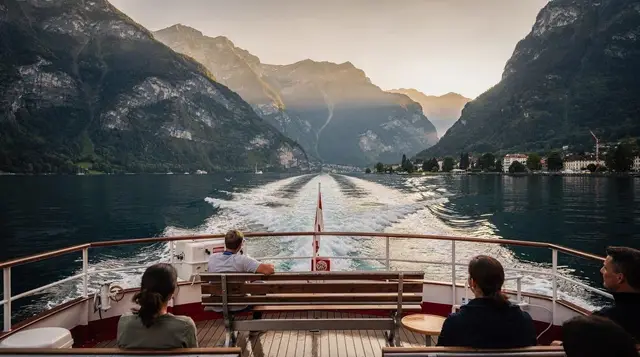
Give the trains a rest and take a boat instead. The BLS lake boats run on both Lake Thun and Lake Brienz, and a Swiss Travel Pass covers both. Lake Brienz is the better half-day: the water’s turquoise colour comes from glacial rock flour, and the short crossing to Iseltwald drops you at the wooden pier that became briefly famous after a Korean drama filmed there — worth seeing once, best avoided at midday when the queue for photos gets long. From Brienz you can also ride the funicular up to the Giessbach falls, a fourteen-tier cascade with a grand hotel at the top.
If you’d rather stay on the Thun side, the boats there call at Spiez castle and Oberhofen, both easy walk-off stops. Either lake works; don’t try to do both in one day, since the connections between them run back through Interlaken and eat the time you’re trying to save by not taking a train excursion. Details and timetables are in the Lake Brienz boat guide.
Day 5: Lucerne over the Brünig line
The Brünig line to Lucerne is a panoramic train in its own right — a rack section, then lake views for the last stretch — and at about 1h50 each way it’s the longest of the “comfortable” excursions in this itinerary rather than a stretch. Lucerne’s old town sits either side of the Reuss river, with the covered Chapel Bridge as the obvious landmark and Lake Lucerne opening out beyond it.
If you have the stamina for an add-on, two mountains are within reach from the city itself. A return trip up the Rigi with the boat and cogwheel train bundled together works well for a half-day extension, and for a longer, pricier day a private itinerary combining the Bürgenstock funicular and Mount Titlis covers both in one go, at the cost of getting back to Interlaken later than usual.
Either turns Lucerne from a half-day into a full one, so decide before you leave the hotel which version of the day you’re doing. Background on the line itself is in the Lucerne day trip guide.
Day 6: Zermatt or Montreux — the honest trade-off
This is the day to be realistic about. Both destinations are worth seeing; neither is a light add-on to a week already built around three other excursions.
Zermatt, reached via Spiez, Visp and a shuttle train from Täsch since private cars stop there, takes about two hours fifteen minutes each way — call it four and a half hours on trains for a day that also needs time to actually see the Matterhorn, which is not guaranteed to be cloud-free. It rewards hikers and cable-car enthusiasts more than sightseers on a tight clock.
Montreux, on the GoldenPass line, runs closer to three hours each way, but the journey is part of the point: vineyard terraces above Lake Geneva for the final stretch, and Château de Chillon sitting almost on the platform at the end. If you’d rather not navigate it solo, a private guided walk along the Montreux lakefront covers the town’s highlights in a fixed block of time, which helps when you’re also watching the clock for the return train.
Pick one. Trying both in the same week turns two of your seven days into almost pure transit, which defeats the point of keeping a fixed base in the first place.
Day 7: Slow morning, departure
Keep the last day light. Pack the night before, have a proper breakfast, and if your train or flight isn’t until the afternoon, a flat walk along the Aare or around the Höhematte is enough without risking a missed connection. If you’re heading onward by air, build in the full journey time: Zürich Airport runs about two hours five minutes from Interlaken Ost, Geneva a little under three. The Zürich airport transfer guide has the exact connections.
Which pass actually pays for itself
Add up the point-to-point second-class fares for this week — Bern return, Lucerne return, Zermatt or Montreux return, the lake boats, plus the Jungfraujoch leg from Interlaken — and a multi-day Swiss Travel Pass covering the consecutive travel days will usually come out ahead, on top of the convenience of not queueing for individual tickets. The pass doesn’t make Jungfraujoch free — it discounts the Jungfrau Railways section rather than covering it outright — but it does cover the regular trains, city transport in Bern and Lucerne, and the lake boats in full.
Compare it against the regional Berner Oberland Pass, which is cheaper but stops covering you the moment you leave the Jungfrau region for Bern, Lucerne, Zermatt or Montreux. Fare details change often enough that it’s worth pricing both against your actual itinerary before you buy; the Swiss Travel Pass guide walks through how to do that.
Questions about a week based in Interlaken
Do I need a car for this itinerary?
No. Every destination in this plan is reachable by train or boat from Interlaken, and several of the mountain villages further up the valley, such as Wengen and Mürren, ban private cars entirely.
Which pass should I buy for a week like this?
A Swiss Travel Pass covering the consecutive days you travel is the simplest fit, because it reaches Bern, Lucerne, Zermatt and Montreux on the regular network as well as the local boats. The cheaper Berner Oberland Pass or Jungfrau Travel Pass only covers the region around Interlaken, so it will not get you to Bern, Lucerne, Zermatt or Montreux without extra tickets.
Can I really do Zermatt as a day trip from Interlaken?
Yes, but it is long. The journey via Spiez and Visp to Täsch, then the shuttle train into car-free Zermatt, takes about two hours fifteen minutes each way, so you are looking at roughly four and a half hours on trains for one day above the resort.
Is Montreux worth six hours of round-trip travel for one day?
It depends what you are there for. The GoldenPass route itself is part of the appeal, and Château de Chillon sits right on the platform, but if scenery-for-its-own-sake does not interest you, a second local day around Lake Brienz or up Grindelwald First gives a better return on the same hours.
Do I need to book Jungfraujoch tickets in advance?
Booking a timed slot in high season is worth doing, since the platforms and the summit terrace both get crowded by mid-morning. Check the live webcam before you leave Interlaken, because the top station closes to visitors in poor visibility and the ticket is not refunded for weather.
Should I stay near Interlaken Ost or Interlaken West?
Ost suits this itinerary better, since the Jungfraujoch trains, the Lake Brienz boats and the Brünig line to Lucerne all start there. West sits closer to the Hoheweg and suits a trip weighted toward Lake Thun instead.
What’s the cheapest way to run the same loop for less money?
Swap the Zermatt-or-Montreux day for a second local day around the lakes, use the regional Berner Oberland Pass instead of a Swiss Travel Pass, and buy lunch from a Coop or Migros rather than a mountain restaurant. That alone removes the two most expensive line items in the week.
Lake cruises & boat tours on GetYourGuide
Verified deep-linked GetYourGuide tours. Book through these links and we earn a small commission at no cost to you.
GetYourGuide does not provide a product photo for this activity — the image shows the meeting point, photographed by us.