Lucerne and Mount Pilatus in a day from Interlaken
Can you do Lucerne and Mount Pilatus as a day trip from Interlaken?
Yes, using the Luzern-Interlaken Express (around 1 hour 50 minutes each way) combined with the Pilatus Golden Round Trip by boat, cogwheel railway and cable car. Plan for a long day, roughly 7am to 8pm, and check that the Vitznau cogwheel railway is running before you set off, since it closes for winter and for spring or autumn maintenance.
Two towns, one line, and a loop that makes the day work
Lucerne and Mount Pilatus sit close enough together, and far enough from Interlaken, that trying to do them as separate trips wastes a travel day you don’t have. The fix is the Luzern-Interlaken Express, a direct train that gets you from Interlaken Ost to Lucerne station in one seat, followed by the Pilatus Golden Round Trip, which uses a lake steamer, a cogwheel railway and a cable car to get up and down the mountain by two different routes. Done back to back, the two make a full but genuinely workable day. Done separately, you pay for the train twice and still don’t see much of either place.
This guide covers the timings that actually hold up, what the day costs in practice, the two ways up the mountain and when each makes more sense, and what to do instead if the summit is closed or socked in cloud when you wake up.
The Luzern-Interlaken Express, in practice
The Luzern-Interlaken Express runs over the Brünig line, the metre-gauge route through Meiringen, Giswil and the Brünig Pass that also connects Lucerne to the rest of the Bernese Oberland. From Interlaken Ost, journey time is around 1 hour 50 minutes, with departures roughly every hour through the day. Some trains carry panoramic carriages with larger windows on the Meiringen-Lucerne stretch, which is the scenic half of the ride past Sarnersee and Lake Lucerne’s western arm, but it is a standard SBB service rather than a premium product, so there is no supplement and reservations are optional rather than required.
Full-fare second class one-way is typically in the CHF 30-35 range; it drops with a Half Fare Card and is fully covered by a Swiss Travel Pass, which is worth checking against your other planned trips using our Swiss Travel Pass guide. The line is one of the more reliable options covered in our overview of trains, buses and boats around Interlaken, but it is still a single-track mountain line: a delay upstream at Meiringen or Giswil can cost you 15-20 minutes, which matters when you are chasing a boat connection in Lucerne.
The Golden Round Trip: boat, cogwheel railway, cable car
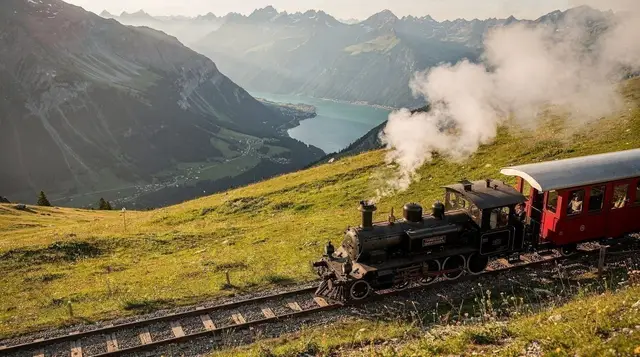
The Pilatus Golden Round Trip is the classic way to do the mountain, and it is a loop rather than a there-and-back. From Lucerne, a lake steamer crosses to Vitznau, a small lakeside village about 45 minutes away by boat. From Vitznau, the Pilatus cogwheel railway climbs to the 2,132m summit station, a 30-minute ride with a maximum gradient of 48 percent, which makes it the steepest rack railway in the world; it has run this line, largely unchanged in principle, since 1889. At the top, the summit ridge has a short network of tunnels and viewing platforms looking out over Lake Lucerne, the Alpine chain to the south, and on a clear day as far as the Bernese Oberland peaks around Interlaken itself.
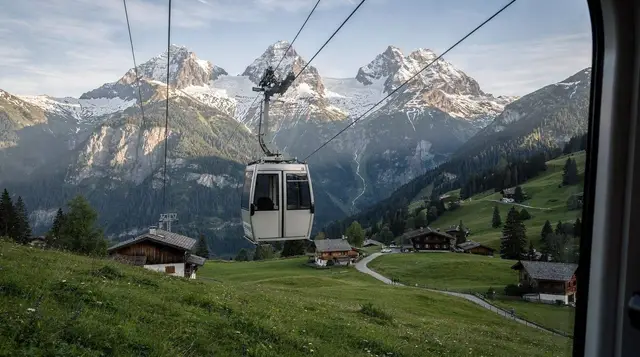
Down the other side, the descent to Kriens uses two linked systems: a large aerial cable car followed by the “Dragon Ride” gondola, dropping you at the valley station just outside Lucerne, from where a city bus takes about 15-20 minutes back to the station. You can run the loop in either direction; going up via Vitznau and down via Kriens is the more common order, since it keeps the steeper, slower cogwheel section for the ascent when you have more patience for it.
If you’d rather not manage the boat and rail connections yourself, a private guided day trip that covers both Pilatus and Lucerne handles the routing and timing for you, which is worth the premium if you are travelling with people who get anxious about tight connections.
What it costs
Prices below are approximate 2026 second-class figures per adult; children and Half Fare Card holders pay less, and the Swiss Travel Pass reduces but does not eliminate the mountain fares.
| Leg | Approximate cost | Covered by Swiss Travel Pass |
|---|---|---|
| Interlaken Ost to Lucerne, one way | CHF 30-35 | Yes, fully |
| Lucerne to Vitznau, boat | CHF 30-35 one way | Yes, fully |
| Vitznau-Pilatus-Kriens Golden Round Trip (rail + cable car) | CHF 100-120 | No, discounted rate only |
| Kriens-Pilatus-Kriens, cable car and gondola only, no boat | CHF 65-75 | No, discounted rate only |
| Lucerne bus, Kriens to station | CHF 4-5 | Included in city transport passes |
A realistic all-in budget for the return train plus the full Golden Round Trip lands somewhere around CHF 180-220 per adult before food, which is enough to make some travellers ask whether it’s worth it. It is one of the pricier days out from Interlaken, and it earns a mention in our piece on overpriced things and genuine tourist traps for that reason, but the mountain does deliver a view that Rigi and Titlis don’t quite match for drama, largely because of the rack railway’s gradient and the two-sided descent.
A timetable that actually works
This is a workable outline for a Golden Round Trip day, not a fixed schedule; check current SBB and Pilatus Bahnen timetables the week before, since departure times shift slightly by season.
| Time | What |
|---|---|
| 07:05 | Depart Interlaken Ost on the Luzern-Interlaken Express |
| 08:55 | Arrive Lucerne station |
| 09:10-10:00 | Short walk through the old town and Chapel Bridge before the boat |
| 10:15 | Boat departs Lucerne for Vitznau |
| 11:00 | Boat arrives Vitznau, connect to cogwheel railway |
| 11:30 | Arrive Pilatus summit; lunch and viewpoints |
| 13:30 | Cable car and gondola down to Kriens |
| 14:15 | Bus from Kriens back to Lucerne station |
| 14:45-17:30 | Free time in Lucerne: old town, Lion Monument, museums |
| 17:56 or 18:56 | Return Luzern-Interlaken Express |
| ~19:45 or ~20:45 | Arrive Interlaken Ost |
That leaves a genuine window in Lucerne on both ends of the day, which is enough for the Chapel Bridge and old town but not much more. If you want a slower, dedicated look at Lucerne itself rather than bookending it around a mountain, our Lucerne day trip from Interlaken guide and the standalone day trips from Interlaken overview cover that alternative pacing.
Two ways up the mountain
The Golden Round Trip via Vitznau is the scenic, and more expensive, option, and it only runs while the cogwheel railway is in season, typically from around May to November; it closes over winter and for scheduled maintenance in spring and autumn, so confirm operating dates before you build a day around it.
The alternative is the Kriens side alone: a straightforward round trip on a round-trip cable car and gondola ticket to the summit from Kriens, which runs year-round and skips the boat and cogwheel railway entirely. It’s cheaper, faster door to door, and the only option in winter, but you miss the lake crossing and the steepest-rack-railway novelty that makes the full loop memorable.
If Pilatus is fully booked, closed for a technical stop, or simply crowded on the day you’re there, Mount Rigi across the lake is the standard substitute, reached from Lucerne by a different boat and rack railway combination, or consider the open-top Cabrio cable car to Stanserhorn, a quieter, less crowded peak near Stans with a similar view over the lake for a shorter half-day commitment. Our rundown of cable cars and funiculars around the region explains how the different systems compare if you’re deciding between them.
When the weather turns: the rain-day version
Check the Pilatus summit webcam, not the forecast for Lucerne itself, before you commit to the mountain leg. Lucerne sits at lake level and can be perfectly clear while the summit at 2,132m is sitting inside cloud, which turns the view that justifies the ticket price into grey fog and a cold platform. If that’s the case, or if wind has closed the Kriens cable car, skip the mountain and spend the whole day in Lucerne instead: the covered Chapel Bridge and Water Tower, the old town’s painted facades, the Lion Monument, and the Rosengart Collection or Swiss Museum of Transport if you want an indoor option with substance.
It’s a smaller day than the full round trip, but it isn’t a wasted one, and it avoids paying full price for a mountain you can’t actually see. Our general guide to Interlaken in bad weather covers the same logic for closures nearer to base, and the reasoning holds for Pilatus too: a closed or fogged-in cable car is common enough at altitude that having a plan B costs nothing and saves the day.
Practical notes before you go
Leave main luggage at your accommodation or in a locker at Interlaken Ost rather than hauling it around Lucerne and up the mountain; neither the boat nor the cogwheel railway is set up for large cases, and Pilatus summit has minimal storage. Wear proper shoes rather than sandals for the summit paths, since 2,132m can be 10-15 degrees colder and windier than lake level even in summer, and bring a layer regardless of the season.
If you’re combining this with other excursions during your stay, see how many days in Interlaken makes sense before deciding whether a Lucerne-Pilatus day fits your itinerary or crowds it out. Buy the boat and mountain tickets on arrival in Lucerne rather than in advance online where possible, since same-day changes for weather are far easier to make with an unstamped ticket in hand.
Lucerne and Mount Pilatus day trip: frequently asked questions
How long does the Luzern-Interlaken Express take?
About 1 hour 50 minutes each way between Interlaken Ost and Lucerne, running roughly hourly over the Brünig line via Meiringen and Giswil. It is a normal SBB service with panoramic carriages on some departures, not a separate premium train, so no reservation is required though one is sensible in July and August.
What is the Pilatus Golden Round Trip?
A one-way-each-way loop that takes in Mount Pilatus from both sides: a lake steamer from Lucerne to Vitznau, the world’s steepest cogwheel railway up to the 2,132m summit, then the aerial cable car and gondola down to Kriens for a bus back into Lucerne, or the same route reversed.
Is Mount Pilatus worth it if Lucerne is under cloud?
Check the summit webcam before committing, since Lucerne’s weather at lake level tells you almost nothing about conditions 2,132m up. If the summit is in cloud, the panorama that makes the trip worthwhile disappears and you are paying for a walk in fog.
Can I use the Swiss Travel Pass for this trip?
The train between Interlaken and Lucerne is fully covered. The boat to Vitznau is also covered, but the Pilatus cogwheel railway and the Kriens cable car both charge a discounted rate to pass holders rather than being free, so budget for that leg regardless.
What happens if the Pilatus cable car is closed for wind?
The Kriens side runs two cable cars and a gondola, all of which can suspend service in strong wind. The Vitznau cogwheel railway, being fixed to a rack rail rather than hanging in the air, is far less likely to close for wind, though it can still stop for ice on the track in early or late season.
Is one day really enough for both Lucerne and Pilatus?
It is enough to see the highlights of both, but only just. Expect roughly 2 hours in Lucerne’s old town split between the outbound and return legs, and most of the middle of the day on the mountain, with little slack for delays.
What’s cheaper: the Kriens cable car alone or the full Golden Round Trip?
The Kriens-only round trip, without the boat and cogwheel railway, is the cheaper option and also the one that runs year-round. The full Golden Round Trip costs more and only operates while the Vitznau line is in season, but it is the more scenic route and the one most first-time visitors picture when they think of Pilatus.
Mountain excursions on GetYourGuide
Verified deep-linked GetYourGuide tours. Book through these links and we earn a small commission at no cost to you.
GetYourGuide does not provide a product photo for this activity — the image shows the meeting point, photographed by us.