Most Swiss mountains sell you a view. The Stanserhorn, above the small town of Stans in central Switzerland, sells you the ride itself. Its cable car, the CabriO, is the only one in the world with a fully open-air upper deck: you ride the last stretch to the summit standing outside, wind in your face, holding a rail rather than a window frame. Getting there also means riding a 1893 funicular that predates the car, the aeroplane, and Interlaken’s own tourist boom. It is a longer day than most of the excursions covered in this roundup of mountain trips from Interlaken, and it is not a detour you make on a whim, but it rewards the trip.
Why the Stanserhorn is different from every other Swiss summit
Switzerland has no shortage of cable cars and cog railways, and this guide covers most of the ones within reach of Interlaken elsewhere on the site, from the Pilatus and Rigi to Titlis above Engelberg. What sets the Stanserhorn apart is not the elevation, which at just under 1,900 metres is modest by regional standards, but the two-stage journey and the design of the upper cabin.
Stage one is a funicular built in 1893, one of the oldest still running in Switzerland, climbing from the valley station in Stans to the mid-station at Kälti. Stage two is the CabriO, a double-deck cable car whose upper level has no roof. Up to six passengers can stand on that open deck for the final climb to the summit, while the enclosed lower deck carries the rest. It is a genuinely unusual piece of engineering, not a marketing gimmick: the doors and safety rail were purpose-built for it, and nothing else in the country works the same way.
Getting there from Interlaken
There is no direct train. From Interlaken Ost, the standard route runs via Lucerne on the Brunig line, a scenic journey in its own right, taking roughly 1 h 50. At Lucerne, change to a local S-Bahn service (direction Engelberg) for the short hop to Stans, about 15 to 20 minutes. Add walking and connection time and the door-to-door journey from Interlaken to the Stans valley station runs close to 2 h 15.
From Stans railway station, the CabriO valley station is a walk of about 15 to 20 minutes, or a short local bus ride if you would rather save your legs for the summit. Because of the length of the journey, this is not a half-day add-on the way Harder Kulm or Niederhorn are; it works best as a full day trip, ideally paired with a couple of hours in Lucerne itself, either on the way out or the way back.
Anyone holding a Swiss Travel Pass already has the rail leg covered and gets the mountain transport included as well, which changes the maths on a day like this considerably.
Stage one: the 1893 funicular to Kälti
The lower section is easy to overlook once you have heard about the roofless cable car above it, which is a shame, because it is the more historic of the two. The funicular from Stans to Kälti has been running since 1893, making it one of the oldest mountain railways in the country still in commercial operation. The cars have been modernised over the decades, with larger windows than the original stock, but the alignment and the character of the ride are unchanged: a steady, quiet climb through forest and pasture rather than the swoop of a cable car.
It is worth treating this stage as part of the day rather than a formality to get through. The gradient and the older-style cabins give a sense of what mountain tourism looked like in the Jungfrau region around the same period, when lines like the Jungfrau Railway and the Schynige Platte rack railway were also being built. Kälti itself is a modest mid-station with connecting paths, not a destination in its own right, but it is where the CabriO takes over.
The CabriO: riding with the roof off
The CabriO opened in its current form in 2012, replacing an older gondola on the upper section, and it was built specifically to let passengers stand in the open air on the top deck during the ascent. The cabin runs on two levels: an enclosed lower deck that works like any standard gondola, and an open-topped upper deck reached by an internal stair, with room for a handful of standing passengers behind a solid rail.
Riding the upper deck is the reason most visitors make the journey. There is no glass between you and the view, no reflection to fight with a camera, and a genuine sense of exposure as the car climbs the final rock face to the summit station. It is not vertigo-inducing in the way a via ferrata is, and it is entirely safe, but it does feel different from any enclosed cable car, including the ones up Schilthorn or Grindelwald First. Wind and temperature matter more here than on a normal cabin: bring a layer even on a warm valley day, since a few minutes at speed on an open deck at altitude is colder than it looks in photographs.
The most efficient way to book the return ride, particularly if you are travelling from Lucerne rather than doing the full rail journey from Interlaken independently, is a combined package that bundles the transport and the cable car: a half-day CabriO trip to the Stanserhorn from Lucerne covers exactly this loop and removes the need to work out connections and ticket counters on the day.
The summit: ten lakes, weather permitting
The summit station sits just under 1,900 metres, low enough that the panorama is about breadth rather than glacier scenery. Stanserhorn’s own marketing describes the view as taking in ten lakes on a clear day, with Lake Lucerne spread out directly below and Lake Zug, Lake Sarnen, and several smaller bodies of water visible further out depending on haze and cloud. It is a wide, layered view of the pre-Alps and the lowlands rather than the high-glacier drama of the Jungfraujoch, and it is worth setting that expectation before you go: this is a summit for lake-and-valley panoramas, not for standing among 4,000-metre peaks.
At the top, Rondorama is a revolving restaurant that completes a full turn roughly every hour, letting you eat lunch while the view slowly rotates past the window; it is priced like a mountain-summit restaurant, so treat it as scenery with a meal attached rather than a destination in its own right.
Outside, a short network of easy paths circles the ridge, and a marmot enclosure near the summit station is a reliable draw for families, with a good chance of seeing the animals in the morning and early evening. None of the walking here demands hiking boots or fitness beyond a gentle stroll, which makes the Stanserhorn one of the more accessible summit experiences on this coast of the Alps, closer in effort to Harder Kulm than to a full mountain hike.
Stans: old town, main square, and the Winkelried museum
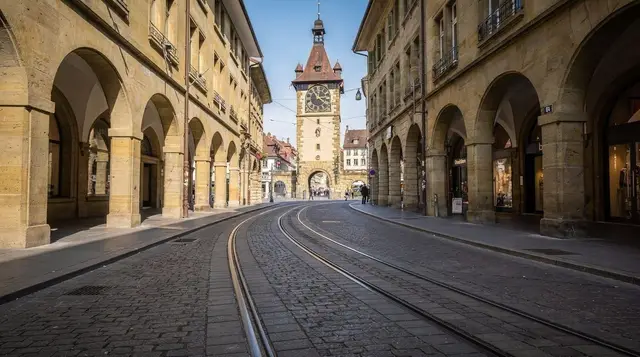
It is easy to treat Stans purely as the base station for the cable car, but the town itself deserves the hour it takes to see properly, either before the ascent or on the way back to the station. The centre is small and walkable, built around the Dorfplatz, the main square, overlooked by the parish church of St Peter and St Paul and shaded by an old plane tree that has stood on the square for generations and is treated locally as something close to a landmark in its own right.
The other reason to linger is the Winkelried-Museum, a small history museum housed in a historic building on the square and named for Arnold von Winkelried, the semi-legendary local figure credited with a decisive, self-sacrificing charge at the Battle of Sempach in 1386 that turned the battle in favour of the Swiss Confederacy. The museum covers Winkelried’s story alongside the wider history of Stans and the canton of Nidwalden, including period armour and household objects; it is a modest, low-key stop rather than a major attraction, and pairs naturally with a coffee on the square rather than a dedicated half-day.
For a broader sense of how this region’s museums compare, the same canton borders Lucerne, whose own old town and lake are covered in the Lucerne day trip guide, and Zug, a smaller lakeside town with its own distinct character reachable on the same rail network.
Prices, hours, and season at a glance
| Item | Detail |
|---|---|
| Base station | Stans, 15–20 min walk or short bus ride from Stans railway station |
| First stage | Funicular built in 1893, Stans to Kälti |
| Second stage | CabriO open-top cable car, Kälti to the summit |
| Summit elevation | Just under 1,900 metres |
| Return fare, full adult | Around CHF 72–76 from Stans; check current prices before you go |
| Half Fare Card | Roughly 50% off the standard fare |
| Swiss Travel Pass | Travel included at no extra cost |
| Season | Late April to mid-November; closed for winter and maintenance outside this window |
| Journey time, valley to summit | About 30 minutes total across both stages |
| Restaurant | Rondorama, a revolving restaurant at the summit station |
Prices on Swiss mountain railways move most years, so treat the fare above as a planning figure rather than a guarantee. The bigger cost on this particular day trip is usually the rail journey to get there in the first place, not the mountain ticket itself.
Paragliding and other add-ons from Stans
Stans has its own small but active paragliding scene, launching from slopes near the Stanserhorn with views down over Lake Lucerne on the descent. It is a shorter, less crowded alternative to tandem flights over the Hohematte in Interlaken, and worth considering if you would rather fly somewhere quieter: a tandem paragliding flight above Stans runs subject to wind and weather, so build flexibility into the day if you are counting on it.
Anyone who wants Lucerne’s lake and cliffs at ground level rather than in the air might prefer a private guided walk along Lucerne’s cliff path as a lower-key way to fill the hours around the Stanserhorn trip, particularly on a day when cloud rules out the summit panorama. If you are staying in Lucerne overnight rather than doing this as a single long day, a private mountain tour that includes the Stanserhorn alongside other stops, such as a private guided Stanserhorn mountain tour can bundle the logistics for you. For a change of pace on the lake itself,
an e-bike and boat tour combining four lakes with a Lake Lucerne cruise
is worth comparing against the standard Lake Lucerne boat routes if you want to see more of the water than a single crossing allows.
Where the Stanserhorn fits in an Interlaken trip
Given the travel time involved, the Stanserhorn is not a first-choice excursion for a short stay. If you have one or two days for day trips from Interlaken, the shorter options covered in the main day trips from Interlaken guide, such as Harder Kulm or the Lauterbrunnen valley, will use your time better.
The Stanserhorn earns its place on a longer stay, particularly one built around the seven-day Interlaken itinerary with day trips, or on a trip where you are already planning to spend a night in Lucerne and can treat Stans as a half-day extension rather than a return journey from Interlaken in a single day.
It also makes sense as an alternative to, rather than an addition to, other central Switzerland peaks on the same rail network. Travellers deciding between this and Pilatus or Rigi are effectively choosing between three different characters of mountain: Pilatus for its dramatic ridge and the steepest cog railway in the world, Rigi for its long summit ridge and sunrise trains, and the Stanserhorn for the open-air cable car and the quieter, less-visited approach through Stans. Doing all three on one trip is possible but turns the day trip into a multi-day central Switzerland loop rather than an outing from Interlaken.
Common mistakes
The most frequent misstep is treating this as a half-day trip and running out of time, either missing the last connection back to Interlaken or arriving at the valley station with barely enough time for a single ride up and down. Build in the full round-trip travel time before committing to the day. The second is assuming the upper deck is guaranteed: on a windy day, or in poor visibility, the operator may restrict passengers to the enclosed lower deck for safety, which removes the main reason most visitors make the trip.
Check the day’s conditions and, where possible, aim for a stable morning rather than an afternoon when cloud tends to build over the lakes. The third is skipping Stans itself: because the valley station is a walk from the railway station, some visitors go straight to the cable car and back without seeing the Dorfplatz or the Winkelried-Museum, missing the one part of the day that does not depend on the weather.
Stanserhorn and Stans: frequently asked questions
What makes the CabriO different from other Swiss cable cars?
Its upper deck has no roof: passengers can stand in the open air for the final climb from Kälti to the summit. No other cable car in the world is built this way, which is why it draws visitors who would otherwise skip a modest, sub-1,900-metre summit.
How long does the trip from Interlaken to the Stanserhorn take?
Around 2 h 15 each way, travelling by train from Interlaken Ost via Lucerne, then a local S-Bahn to Stans, plus a walk or short bus ride to the valley station. Combined with time on the mountain, this is realistically a full day rather than a half-day excursion.
Is the Stanserhorn open all year?
No. The funicular and CabriO typically run from late April to mid-November, closing over winter. There is no ski infrastructure at the summit, unlike some of the higher peaks in the Jungfrau region.
How much does the CabriO cost?
A full adult return from Stans runs around CHF 72–76, though fares are revised most years and should be checked before travelling. Half Fare Card holders get roughly 50% off, and the Swiss Travel Pass covers the journey at no extra cost.
Is the open-air upper deck always available?
No. In high wind or poor visibility, the operator can restrict the upper deck for safety and carry passengers on the enclosed lower level only. There is no way to guarantee the open-air ride in advance.
What is there to see in Stans besides the cable car?
The Dorfplatz, the town’s main square, with its parish church and old plane tree, and the Winkelried-Museum, a small local history museum named for Arnold von Winkelried, a figure from the Battle of Sempach in 1386. Both are within a short walk of the railway station.
Can I combine the Stanserhorn with Lucerne in one day from Interlaken?
Yes, and most visitors do, since the rail route to Stans already passes through Lucerne. A common pattern is a couple of hours in Lucerne’s old town on the way out or back, with the Stanserhorn and Stans filling the middle of the day.
Is the Stanserhorn worth it compared with Pilatus or Rigi?
It depends on what you want. Pilatus and Rigi offer higher elevations and longer ridge or summit walks; the Stanserhorn’s draw is specifically the open-top CabriO and the 1893 funicular, plus a quieter, less crowded approach through Stans. Visitors mainly interested in the ride itself tend to rate it highly; those chasing the highest possible view may prefer the alternatives.