Mount Rigi: the Queen of the Mountains, done properly
What makes Mount Rigi different from Pilatus or the Jungfrau peaks?
Rigi is a standalone massif between Lake Lucerne and Lake Zug, reached by two rack railways dating to 1871 and 1875 rather than a single modern lift. Its summit plateau is flat and walkable, which is why it became Europe's original sunrise-viewing mountain in the 19th century, and it has a mineral-water bathing complex at Rigi Kaltbad partway up.
Why Rigi earned the nickname Queen of the Mountains
Mount Rigi sits on its own, a 1,797-metre massif rising between Lake Lucerne and Lake Zug, with no higher neighbour close enough to block the view. That isolation is the whole point. From the summit plateau you look out over lower Switzerland in one direction and the high Alps in the other, without a ridge in the way. Locals have called it Königin der Berge, Queen of the Mountains, since the 19th century, and unlike most Swiss superlatives this one has held up: Rigi was drawing paying tourists to a mountaintop decades before the Jungfraujoch railway existed.
This guide is written from an Interlaken base, and it is honest about the trade-off up front: Rigi is not a quick trip from here. It belongs to the Lucerne region geographically and logistically, and if your Interlaken stay is short, Mount Pilatus or the mountains directly above the Bernese Oberland will eat less of your day. But Rigi has three things nothing near Interlaken has: the oldest mountain rack railway in Europe, a proper bathing complex partway up the mountain, and a summit plateau flat enough to stroll rather than scramble.
Two railways, two companies, one mountain
Rigi’s railway history is unusual because two separate companies climbed the same mountain from opposite sides within four years of each other, and both are still running.
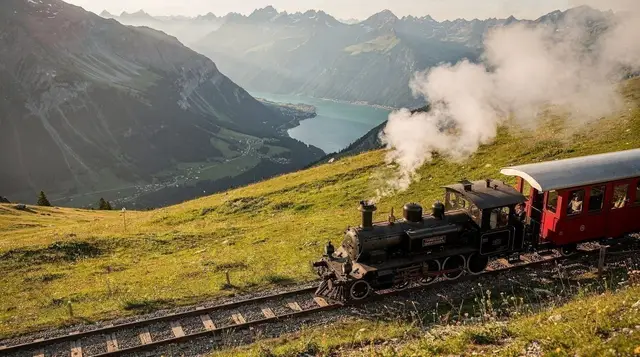
The Vitznau-Rigi-Bahn (VRB) opened in 1871, climbing from the lakeside village of Vitznau on Lake Lucerne. It was the first rack railway built in Europe, using the Riggenbach cog system, and it proved that steep alpine gradients could be climbed reliably by train rather than left to mule tracks and hotel porters. The Arth-Rigi-Bahn (ARB) followed in 1875, climbing from Arth-Goldau on the opposite side, where it connects directly to the Gotthard mainline. The two companies competed for over a century before merging into Rigi Bahnen in 1992, and both lines are still in daily operation, now with modern rolling stock rather than steam.
For a visitor based in Interlaken, this gives you a genuine choice rather than a single fixed route:
| Approach | Starting point | Character | Best for |
|---|---|---|---|
| Vitznau-Rigi-Bahn | Vitznau, on Lake Lucerne | Boat trip first, then a steady 30-minute climb through forest and meadow | A scenic, unhurried day combining the lake and the mountain |
| Arth-Rigi-Bahn | Arth-Goldau, on the Gotthard mainline | Direct rail connection, faster overall journey | Travellers pushed for time, or coming via Zurich rather than Lucerne |
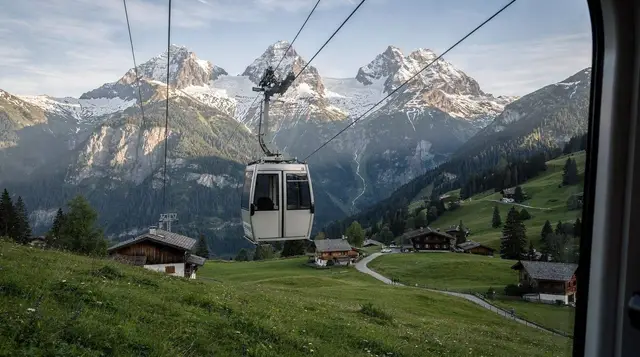
| Cable car from Weggis | Weggis, on Lake Lucerne | Modern gondola to Rigi Kaltbad, no cogwheel | Visitors heading straight for the baths rather than the summit |
Both rack railways converge at Rigi Kulm, the summit station, and both stop at Rigi Kaltbad on the way up, so you can genuinely mix and match: go up one side, walk the ridge, and come down the other.
a summer day card covering both Rigi railways and the connecting boat is the simplest way to book the whole climb in one ticket rather than working out fares for each leg separately.
Rigi Kaltbad and its baths
Rigi Kaltbad sits at 1,453 metres, roughly two-thirds of the way up, and it is a destination in its own right rather than just a railway stop. The name means “cold bath,” referring to a spring that has drawn visitors here since at least the 17th century, long before the railway existed.
The current Mineralbad & Spa, designed by Ticino architect Mario Botta and opened in 2010, replaced an older bathing pavilion. It draws mineral water from 1,200 metres below the mountain and offers indoor and outdoor pools, several saunas, and a panorama that most spa towns would charge double for. It is a paid, separate admission from the railway ticket, and it gets busy on weekends, so a weekday visit is noticeably more relaxed. Rigi Kaltbad is also where the Weggis cable car arrives, so it works as a standalone half-day trip if you have no interest in reaching the summit at all.
From Kaltbad, several short trails fan out across the mountainside, none of them technical, which makes this a sensible stop if you are travelling with people who do not want the full walk to the top.
The sunrise that founded alpine tourism
Before funicular railways existed anywhere else in the Alps, wealthy travellers on the Grand Tour were already climbing Rigi on foot or by mule, specifically to watch the sun rise over the peaks from the summit. This started in the early 19th century and by mid-century had become one of the defining rituals of early Swiss tourism: Queen Victoria made the ascent in 1868, and Mark Twain devoted a comic chapter of A Tramp Abroad (1880) to climbing Rigi and then, through a mix-up over timing, sleeping through the sunrise he had gone up specifically to see.
That story is worth telling honestly, because the mountain has not changed. Rigi’s summit plateau catches weather from both Lake Lucerne and the Alps, and cloud can sit on it while the valley below stays clear, or the reverse. A sunrise trip is one of the best things Rigi offers on a good morning and one of the most frustrating on a bad one. If you want to try it, check the mountain forecast specifically rather than the Lucerne city forecast, and be aware that the earliest trains in July and August can sell out. Staying overnight at one of the hotels near Rigi Kulm removes the risk of missing the first train, at the cost of a night’s accommodation on the mountain.
Walking the summit plateau
This is where Rigi separates itself from the steeper peaks around Interlaken. The ridge between Rigi Kulm (1,797 m) and Rigi Kaltbad (1,453 m) is walkable by almost anyone in reasonable shape, with a height difference of around 340 metres covered gently over roughly 1.5 to 2 hours, mostly downhill if you start from the top. There is no exposure and no scrambling, just an open path with Lake Lucerne on one side and Lake Zug on the other.
Longer options exist for those who want more: the trail continuing to Rigi Scheidegg extends the walk by another two hours or so along a quieter, less-visited stretch of ridge with fewer day-trippers. On a clear day, the claim that you can see across more than a dozen lakes from the Rigi summit area is roughly true, depending on haze, and the Alpine panorama runs from the peaks above central Switzerland round toward the Bernese Oberland skyline that dominates the view from Interlaken itself.
None of this requires hiking boots strictly, though they help; trainers with good grip are adequate on a dry day. There is no need to book a guide for the plateau walk itself, though a guided option exists if you would rather have local commentary along the way.
a guided walk up from the Arth-Goldau side that finishes with a barbecue lunch turns the ascent into more of a social day out than a solo ramble, which suits travellers who would rather not plan the route themselves.
Getting there from Interlaken, realistically
There is no way around this: Rigi belongs to the Lucerne region, not the Bernese Oberland, and getting there from Interlaken means committing to Lucerne as an intermediate stop. From Interlaken Ost, the train to Lucerne takes around 1 hour 50 minutes via the Brünig line, one of the more scenic rail routes in the country in its own right. From Lucerne, it is a further 20 to 30 minutes by train or boat to Vitznau, or a direct connection to Arth-Goldau on the mainline.
Realistically, that puts total one-way travel time from Interlaken at somewhere around 2.5 to 3 hours before you have even started climbing the mountain. A Rigi day trip from Interlaken is a full day, not a half-day add-on, and it makes more sense as part of a wider Lucerne visit than as a bolt-on to an Interlaken-based itinerary.
If Lucerne itself is on your list anyway, combining the two is the efficient option: spend the morning in the old town, then head up Rigi from Vitznau or Weggis in the afternoon and come back down by cable car or the other railway. a self-guided combination covering Lucerne, Rigi and the Kaltbad spa is built around exactly this pairing, and it works equally well starting from Interlaken as from Zurich if you adjust the first leg of the journey yourself.
For getting between Interlaken and Lucerne in the first place, see our Lucerne day trip from Interlaken guide, which covers the Brünig route and the alternative via Bern in more detail.
Rigi versus Pilatus: the honest comparison
Both mountains sit in the Lucerne area rather than close to Interlaken, both involve a similar amount of travel time, and both get pitched to Interlaken visitors as if they were nearby. Neither is.
| Mount Rigi | Mount Pilatus | |
|---|---|---|
| Summit height | 1,797 m | 2,132 m |
| Ascent style | Two rack railways, both from lake level | World’s steepest cogwheel railway, plus cable car options |
| Summit terrain | Flat, walkable plateau | Steeper, more dramatic, less strolling |
| Standout feature | Historic railways, Kaltbad baths, sunrise tradition | Steepest cogwheel railway in the world, Golden Round Trip |
| Travel time from Interlaken | Around 2.5–3 hours one way | Around 2.5–3 hours one way |
If flat walking, a bathing stop, and railway history appeal more than a dramatic steep ascent, choose Rigi. Full details on the alternative are in our Mount Pilatus guide.
Prices and passes
Rigi Bahnen fares change seasonally, so treat the figures below as a planning guide rather than a fixed quote, and check current pricing before you travel. As a rough order of magnitude, a return trip from Vitznau or Arth-Goldau to Rigi Kulm for an adult sits in the CHF 70–80 range at standard fares, with the Weggis cable car to Kaltbad priced somewhat lower for the shorter climb.
Holders of a flexible Swiss train, bus and boat pass typically get a worthwhile discount on the Rigi railways rather than free travel, since Rigi Bahnen sits outside the core national network. Half Fare Card holders also get a reduction. Always check whether your pass gives a percentage discount or full inclusion before assuming Rigi is covered.
The Mineralbad & Spa at Kaltbad charges separately from the railway, typically in the CHF 30–40 range for a few hours, more for a full day with sauna access.
Practical notes
- Weather matters more than altitude here. Rigi is lower than the the Jungfrau Region peaks, but its exposed, isolated position means it catches cloud and wind that the higher, more sheltered summits sometimes avoid. Check the live webcam or forecast for Rigi Kulm specifically before travelling.
- Wind can suspend the Weggis cable car even when the railways keep running, since a cabin lift is more wind-sensitive than a rack railway. Have a backup plan if you are relying on the cable car for one leg of the trip.
- Spring and late-autumn maintenance windows affect Rigi Bahnen as they do most Swiss mountain railways. If you are planning a visit in April, November, or early December, confirm both railway lines are running before booking transport to Vitznau or Arth-Goldau.
- Footwear: normal trainers are fine for the Kulm-to-Kaltbad ridge walk in dry conditions; anything muddy or icy calls for proper hiking boots.
- Combine with a Lucerne stop. Given the travel time involved, treat Rigi as part of a Lucerne day rather than a standalone trip from Interlaken. See our best mountain excursions from Interlaken for how Rigi compares to closer options, and our day trips from Interlaken overview for the full list.
- For the transport logistics of any Swiss mountain excursion, our cable cars and funiculars explained guide and Swiss Travel Pass guide cover ticketing in more depth, and when mountain railways open and close covers the seasonal shutdown pattern that catches out a lot of first-time visitors.
- If Rigi’s baths appeal, our thermal baths near Interlaken guide covers closer alternatives that do not require the trip to Lucerne.
- Arriving via Zurich rather than through Interlaken directly, our getting to Interlaken from Zurich Airport guide covers routes that pass close to the Arth-Goldau side of the mountain, making a Rigi stop en route a realistic option before you even reach Interlaken.
Frequently asked questions about visiting Mount Rigi
How do I get to Mount Rigi from Interlaken?
There is no direct line. Take the train to Lucerne, around 1 hour 50 minutes via the Brünig route, then continue to either Vitznau, for the Vitznau-Rigi-Bahn, or Arth-Goldau, for the Arth-Rigi-Bahn. Allow a full day for the round trip from Interlaken with time on the mountain.
Which railway should I take up Rigi, Vitznau or Arth-Goldau?
The Vitznau side gives you a boat trip on Lake Lucerne first and is the more scenic approach for most Interlaken-based visitors. The Arth-Goldau side connects directly to the mainline railway and is faster if you are short on time or coming from Zurich.
Is the Rigi Kaltbad sunrise trip worth doing?
It is genuinely worthwhile on a clear, calm morning, but the mountain does not deliver a guaranteed view. Cloud sits on Rigi as often as it clears, and the early trains sell out in midsummer. Check the weather forecast for the plateau specifically, not for Lucerne down in the valley, before committing to an overnight stay for sunrise.
What is there to do at Rigi Kaltbad besides the railway station?
The Mineralbad & Spa, an indoor and outdoor thermal bathing complex designed by Mario Botta, opened in 2010 and uses mineral water pumped from 1,200 metres below the mountain. There are also several marked walking trails starting right at the station, and a cable car down to Weggis on Lake Lucerne.
How long does it take to walk from Rigi Kulm to Rigi Kaltbad?
Around 1.5 to 2 hours at an easy pace, mostly downhill or level, following the ridge with lake views on both sides. It is one of the gentlest high-altitude walks in central Switzerland and needs no technical gear beyond sturdy shoes.
Is Rigi or Pilatus the better day trip from Interlaken?
Both require a similar amount of travel time from Interlaken and both are more naturally reached from Lucerne. Rigi has the gentler summit walking and the historic railway angle; Pilatus has the steeper cable car and cogwheel approach and slightly better name recognition. Neither is a quick half-day trip from Interlaken itself.
Does Mount Rigi close in bad weather or for maintenance?
The railways run in fog and light snow, but strong wind can suspend the Weggis cable car specifically, and both rack railways schedule maintenance windows in spring and late autumn. Always check the Rigi Bahnen operating status for your exact travel date before buying tickets.
Mountain excursions on GetYourGuide
Verified deep-linked GetYourGuide tours. Book through these links and we earn a small commission at no cost to you.
GetYourGuide does not provide a product photo for this activity — the image shows the meeting point, photographed by us.