Lake Lucerne boat trips: steamers, the Rütli and the Golden Round Trip
What is the best boat trip on Lake Lucerne?
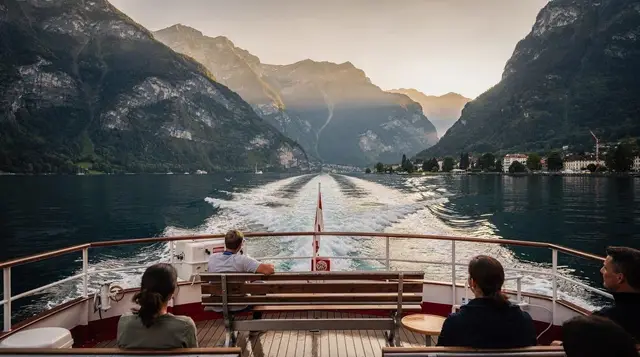
The Golden Round Trip is the standout: a paddle steamer from Lucerne to Vitznau, the cogwheel railway up Mount Pilatus, and the cable car down to Kriens. It takes most of a day and costs around CHF 116 second class, though a Swiss Travel Pass or Half Fare Card cuts that substantially.
Why Lake Lucerne is worth the day trip from Interlaken
Lake Lucerne (Vierwaldstättersee, the “lake of the four forest cantons”) is not on the Interlaken doorstep the way Lake Thun and Lake Brienz are. It takes a train ride to reach it. What you get in return is a working passenger fleet that includes five genuine paddle steamers, a shoreline that carries the founding story of the Swiss Confederation, and a boat-to-cogwheel-railway combination up Mount Pilatus that has no real equivalent in the Bernese Oberland. This guide covers the fleet, the Rütli meadow, the Swiss Path along the shore, fares and passes, and how to string it all together as the Golden Round Trip.
If you only have one day and are weighing this against other options, see day trips from Interlaken and the dedicated Lucerne day trip from Interlaken guide, which covers the town itself in more depth than this page does.
Getting there: the Luzern-Interlaken Express
The Luzern-Interlaken Express runs about once an hour from Interlaken Ost, taking roughly 1 hour 50 minutes via the Brünig-Hasliberg line and Meiringen. It is a scenic ride in its own right, with a rack section over the Brünig Pass, and it terminates at Lucerne station, a two-minute walk from the main boat piers on the Bahnhofquai. Buy a Saver Day Pass, a Swiss Travel Pass, or a Half Fare Card in advance if you plan to combine the train with the boat and the Pilatus railway on the same day; paying full fare for all three separately adds up fast in a country that is not cheap to begin with.
The fleet: five paddle steamers and the motor vessels
Lake Lucerne Navigation (Schifffahrtsgesellschaft des Vierwaldstättersees, SGV) runs the largest fleet of historic paddle steamers left in Europe. Five are original coal or oil-fired steamers, still driven by their nineteenth or early twentieth century engines rather than replicas:
| Steamer | Built | Notes |
|---|---|---|
| Uri | 1901 | Oldest in service, oil-fired |
| Unterwalden | 1902 | Restored saloon interiors |
| Schiller | 1906 | Named after the playwright of William Tell |
| Gallia | 1913 | Belle Époque first-class saloon |
| Stadt Luzern | 1928 | Largest, often used for evening cruises |
The rest of the timetabled network runs on modern diesel motor vessels, which are faster and less romantic but cover most of the practical routes, including the Golden Round Trip leg to Vitznau. You cannot guarantee a steamer on a given sailing; the SGV rotates the fleet and publishes which vessel is assigned to each departure on its own timetable, not always the boat you pictured when you booked.
The Rütli meadow and the founding of Switzerland
The Rütli is a sloped meadow on the lake’s southern shore, reachable only by boat or on foot; there is no road. Tradition places the 1291 oath of the Rütli here, the alliance between the cantons of Uri, Schwyz and Unterwalden that Swiss national history treats as the founding act of the Confederation. There is no medieval documentation proving the meeting happened on this exact spot, and historians treat the story as founding myth layered onto a real early alliance, but the site itself is genuine nineteenth and twentieth century national ground: it hosts the official Swiss National Day ceremony on 1 August most years, with the president in attendance.
The meadow itself is modest: a flagpole, an information hut, a spring, and view across the water to Seelisberg. Most visitors spend twenty to thirty minutes here before catching the next boat onward. Sailings between Lucerne and Flüelen or Brunnen call at the Rütli landing stage on a seasonal timetable, mainly from spring to autumn; check the current SGV schedule before planning a same-day return, since gaps between calls can run two hours or more outside peak season.
The Swiss Path (Weg der Schweiz)
Running along the shore roughly from the Rütli to Brunnen, the Swiss Path (Weg der Schweiz) is a 35-kilometre walking route built for the 700th anniversary of the Confederation in 1991. It is divided into sections proportional to each canton’s population at the time, each canton responsible for building and maintaining its own stretch. Few visitors walk the whole thing; the popular option is a short section near the Rütli or Seelisberg combined with a boat back, or the flatter stretch closer to Brunnen. It is a walking route, not a cycling one, and some sections involve real gradient rather than flat lakeside promenade.
Fares, timetables and passes
Fares on Lake Lucerne Navigation boats are distance-based, similar to Swiss rail. A short hop, Lucerne to Weggis for example, runs around CHF 20 second class one-way at full fare; the longer Lucerne-Flüelen run costs closer to CHF 40. Half Fare Card holders pay half, and the Swiss Travel Pass covers Lake Lucerne Navigation sailings at no extra charge, which is one of the pass’s better-value inclusions if you are already carrying it for the rest of a Swiss trip. Interlaken’s own transport passes and the Bernese Oberland’s regional passes do not extend to Lake Lucerne; this is a different navigation company entirely.
a Swiss Travel Pass covering trains, buses and Lake Lucerne boats is worth comparing against buying tickets separately if your Interlaken trip already includes multiple long train legs; for a single Lucerne day out on its own, point-to-point tickets are usually cheaper.
For travellers who would rather not work out the timetable and connections themselves, a private option removes the guesswork: a private luxury boat cruise on Lake Lucerne runs on your own schedule rather than the public timetable, at a proportionally higher price.
The Golden Round Trip: boat, cogwheel railway, cable car
The best-known combination on Lake Lucerne is the Golden Round Trip up Mount Pilatus, and it is worth planning as a full day rather than squeezing it in. The standard direction:
- Board a boat from Lucerne’s Bahnhofquai to Vitznau, about 1 hour 15 minutes.
- Ride the Pilatus cogwheel railway from Vitznau, the steepest rack railway in the world at up to 48 percent gradient, reaching the summit at 2,132 metres in about 30 minutes.
- Spend an hour or more at the top: the ridge path between Esel and Tomlishorn, the hotel terraces, and views over central Switzerland and, on a clear day, into the Bernese Alps.
- Descend by aerial cableway and gondola to Kriens, near Lucerne, in around 40 minutes.
- Take a bus or tram back into central Lucerne to close the loop.
A combined Golden Round Trip ticket covering all three legs runs around CHF 116 second class from Lucerne; Swiss Travel Pass and Half Fare Card holders pay less. The cogwheel railway operates seasonally, roughly late May to mid-November, closing for the winter and for spring maintenance; outside that window the loop only works in reverse, cable car up and down, without the boat or the steepest-rack-railway novelty. Full details, current fares and the reverse-direction option are in the Mount Pilatus guide.
Alternative routes: Brunnen, Flüelen and Lake Uri
The southern arm of Lake Lucerne, between Brunnen and Flüelen, is often called Lake Uri (Urnersee) and has a different character from the broader northern basin: steeper shores, the Rütli and the Axenstrasse cliff road cut into the rock face above the water. It is the section that carries the most historical weight and, on a clear day, the most dramatic scenery, with the Uri Rotstock and Bristenstock peaks closing in on the water. A round trip from Brunnen to Flüelen and back is a shorter, cheaper alternative to the full Lucerne-based itinerary if you approach from the Gotthard side rather than from Interlaken.
a scenic cruise between Brunnen and Flüelen on Lake Uri covers this southern arm specifically, without the longer transit time from Lucerne itself.
For a different pace on the water, cycling along sections of the shore between boat legs is a way to see villages the timetabled sailings skip: a private e-bike and boat tour covering four lakes around Lucerne combines a shore ride with a cruise rather than staying on the water the whole time.
Comparing Lake Lucerne with the Bernese Oberland lakes
If you are deciding whether a Lake Lucerne day is worth the travel time from Interlaken, it helps to see it against what is already on the doorstep.
| Lake Lucerne | Lake Thun | Lake Brienz | |
|---|---|---|---|
| Travel time from Interlaken | ~1h50 by train | On foot from town, or ~10 min by boat/train | ~20 min by train to Brienz |
| Historic steamers | 5 original paddle steamers | 1 (DS Blüemlisalp, 1906) | None in regular service |
| Signature combination | Boat + Pilatus cogwheel + cable car | Castle and abbey stops, Beatus Caves | Giessbach Falls funicular, turquoise water |
| Full loop time | 6-7 hours | Half day | Half day |
| Historical draw | Rütli, Swiss Path | Thun and Spiez castles | Ballenberg nearby |
Neither Bernese Oberland lake has anything like the Golden Round Trip, and neither carries the national-founding weight of the Rütli. What they have instead is convenience: no long train ride first, and boats that leave from a pier a few minutes from most Interlaken hotels. Details for both are in the Lake Thun boat trips guide and the Lake Brienz boat trips guide, and a wider comparison of the historic wooden-hulled steamers across the region is in paddle steamers of the Bernese Oberland.
Practical notes
Lake Lucerne sits lower and is generally milder than the high alpine excursions around Interlaken, but weather still matters: low cloud over the lake hides both the Rütli’s mountain backdrop and the summit views from Pilatus, and the cogwheel railway can suspend running in high wind, same as the lifts around Grindelwald and Lauterbrunnen. Check the Pilatus webcam and the SGV’s own status page on the morning of travel rather than assuming a scheduled sailing or railway departure will run as planned.
Deck seating on the steamers is uncovered and exposed to wind even on a warm day; bring a layer regardless of season. Lake Lucerne’s water is cold year-round, similar to Lake Thun and Lake Brienz, so this is a boat trip rather than a swimming stop, unlike some sheltered bays elsewhere on the lake in high summer.
If you are combining Lake Lucerne with more of central Switzerland rather than a single day loop, Mount Rigi and Engelberg-Titlis are both reachable from the same lakeside towns and make a second day out of the region rather than a rushed add-on to the Pilatus trip. For itinerary planning across a longer Interlaken stay, see Interlaken with day trips, 7 days, and for the general category of scenic water excursions from Interlaken, lake cruises rounds up the other lakes covered on this site.
Questions about boat trips on Lake Lucerne
How do I get from Interlaken to Lake Lucerne?
The Luzern-Interlaken Express runs roughly hourly and takes about 1 hour 50 minutes from Interlaken Ost, following the Brünig line via Meiringen. There is no faster direct route; changing via Bern adds time rather than saving it.
Are the paddle steamers on Lake Lucerne real steam ships?
Five of them are genuine coal or oil-fired paddle steamers built between 1901 and 1928, still running on their original engines. The rest of the fleet is modern diesel motor vessels, which cover most timetabled routes.
Is the Swiss Travel Pass worth it for a Lake Lucerne boat trip?
If you are already using it for trains elsewhere in Switzerland, yes: it covers Lake Lucerne Navigation boats at no extra cost. Buying it purely for one boat ride is not worth it; a single Lucerne-Vitznau return is far cheaper on its own.
Can I visit the Rütli meadow by boat?
Yes, most Lucerne-Flüelen and Lucerne-Brunnen sailings call at the Rütli landing stage on request or by scheduled stop, seasonally. There is no road access; the boat is the only practical way in, alongside a demanding hike from Seelisberg or Bauen.
How long does the Golden Round Trip take?
Budget six to seven hours door to door from Lucerne: about 1 hour 15 minutes by boat to Vitznau, 30 minutes on the Pilatus cogwheel railway, an hour or more at the summit, and a 40-minute cable car and gondola descent to Kriens, plus a bus or tram back into town.
Does the Pilatus cogwheel railway run all year?
No. It typically operates from around late May to mid-November, weather permitting, and closes for winter and for spring maintenance. In the closed months the aerial cableway from Kriens is the only way up, so the Golden Round Trip as a boat-and-cogwheel loop is a summer and autumn plan.
Do I need to book the Lake Lucerne steamers in advance?
Regular timetabled sailings do not require booking; you buy a ticket at the pier or on board. Private charters and evening dinner cruises do need advance reservation, especially in July and August when boats sell out.
Lake cruises & boat tours on GetYourGuide
Verified deep-linked GetYourGuide tours. Book through these links and we earn a small commission at no cost to you.
GetYourGuide does not provide a product photo for this activity — the image shows the meeting point, photographed by us.