The best day trips from Interlaken, ranked by travel time
What are the best day trips from Interlaken, ranked by travel time?
Harder Kulm, Lauterbrunnen and Thun are back-before-dinner half-day trips of an hour or less each way. Grindelwald, the Jungfrau region peaks, Bern, Kandersteg and Lucerne need a full day. Zurich, Zermatt, Montreux, Gruyères and Rhine Falls involve four to six hours of travel round trip and rarely justify giving up a whole day in the Jungfrau region.
Interlaken sits at the centre of a rail and cable car network that reaches most of the Bernese Oberland and a fair chunk of the rest of Switzerland within a few hours. That is both the appeal and the trap. Because everything looks reachable “in a day” on a map, it is easy to lose six hours of a short trip to trains and connections and arrive somewhere with barely enough daylight to look around before heading back.
This guide sorts twenty realistic excursions from Interlaken by door-to-door travel time rather than by how photogenic they are, because travel time is what actually determines whether a destination fits into your itinerary. It also names the five that, honestly, are better done as an overnight stop or skipped than squeezed into a single day.
Twenty excursions, sorted by how much of your day they eat
Times below are one-way, from Interlaken Ost or Interlaken West as noted, and assume no missed connections — Swiss trains generally run on time, but mountain routes with several changes leave less margin for error than the low-lying ones.
| Destination | One-way travel time | Verdict |
|---|---|---|
| Harder Kulm | 8 minutes (funicular) | Half-day |
| Thun | About 25 minutes | Half-day |
| Lake Brienz shore towns | About 20 minutes | Half-day |
| Lauterbrunnen | About 20 minutes | Half-day |
| Schynige Platte | About 50 minutes | Half to full day |
| Wengen | About 40 minutes | Full day |
| Grindelwald | About 35 minutes | Full day |
| Grindelwald First | About 50 minutes | Full day |
| Kandersteg / Oeschinensee | About 1 hour | Full day |
| Mürren | About 1 hour | Full day |
| Bern | About 52 minutes | Full day |
| Schilthorn | About 1 hour 20 minutes | Full day |
| Jungfraujoch | About 2 hours | Full day |
| Ballenberg, via Brienz | About 25 minutes | Full day |
| Lucerne | About 1 hour 50 minutes | Full day |
| Gstaad | About 1 hour 40 minutes | Full day, weather-dependent |
| Zürich | About 2 hours 5 minutes | Skip as a day trip |
| Zermatt | About 2 hours 15 minutes | Skip as a day trip |
| Montreux | About 3 hours | Skip as a day trip |
| Gruyères | About 2 hours 15 minutes | Skip as a day trip |
Half-day trips: back before lunch or dinner
These are the excursions that leave most of the day intact for something else, or for resting after a hiking day.
Harder Kulm is the obvious first choice: an eight-minute funicular ride from Interlaken Ost puts you at 1,322 metres, looking straight down onto the two lakes and the Bödeli, the flat strip of land between Lake Thun and Lake Brienz where Interlaken itself sits. Round trip with an hour at the top and a coffee on the viewing platform is comfortably under three hours. Full detail, including current ticket prices and the walking alternative, is in the Harder Kulm guide.
Thun, twenty-five minutes by train, has a genuinely nice old town: a covered arcade shopping street with raised pavements over the shop cellars, a hilltop castle museum, and a riverside promenade along the Aare as it leaves Lake Thun. It also happens to be the one half-day trip on this list that works in the rain, covered in the Thun old town and castle guide.
Lauterbrunnen is twenty minutes away and worth doing even if you are also going up to Wengen or Mürren the same day. The valley floor has the Staubbachfall dropping 297 metres almost from the village itself, and the Trümmelbach Falls, ten glacial cascades inside the mountain, a short walk further up the valley. The Lauterbrunnen valley waterfall walk covers both in a loop of two to three hours.
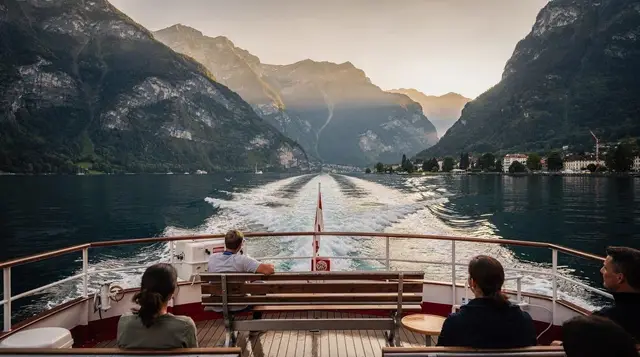
Brienz, twenty minutes the other direction, is a lakeside village known for woodcarving and violin-making workshops that are still open to visitors, plus the departure point for the Brienz Rothorn steam railway if you have longer. A short boat ride or train hop covers it comfortably in half a day.
Full-day trips: worth giving up the whole day
Grindelwald and Grindelwald First. The village itself is thirty-five minutes away and pleasant enough, but the reason to go is First, the cable car station at 2,168 metres with the First Cliff Walk and, for a fee, the First Flyer zipline. A booked entry saves queueing at the base station in high season — the Grindelwald First cable car ticket from Interlaken bundles transport and the ride up. The Grindelwald First guide has current cable car prices and the best months to avoid crowds.
Wengen and Mürren, the two car-free villages on either side of the Lauterbrunnen valley, both take around forty minutes to an hour to reach by train and cable car or gondola. Neither has a car park because neither allows cars — everything, including hotel luggage, moves by rail or cable car. Both make sense as a full day if you are also hiking, and the practicalities of getting there without a car are in the car-free villages explainer.
Schilthorn (Piz Gloria), reached via Mürren, sits at 2,970 metres with the revolving restaurant made famous by the 1969 Bond film. Round trip travel is over an hour each way before the cable car itself, so this is a committed full day rather than an add-on. The Schilthorn guide breaks down the route options from Lauterbrunnen versus Stechelberg.
Jungfraujoch, at 3,454 metres, is Europe’s highest railway station and the single most expensive excursion on this list — a return ticket runs into several hundred francs depending on season and discount card, though the early “Good Morning” ticket and the Swiss Travel Pass both cut the price meaningfully. Two routes get you there: via Lauterbrunnen and the Wengernalp Railway, or via Grindelwald Terminal and the Eiger Express gondola to Eigergletscher, both converging at Kleine Scheidegg. Either way it is roughly two hours each way before you reach the summit tunnel through the Eiger, so leave on an early train. Full pricing and route comparison in the Jungfraujoch guide.
Kandersteg and Oeschinensee. About an hour by train via Spiez, then a gondola or a 45-minute walk up to the turquoise lake at 1,578 metres, ringed by cliffs and glaciers. This is one of the better-value full-day trips on the list, and a guided version exists if you would rather not plan the connections yourself: the guided Oeschinensee scenic hiking day trip from Interlaken handles transport and the lakeside walk. Details in the Oeschinensee hiking guide.
Bern. Fifty-two minutes by train puts you in Switzerland’s capital, with its UNESCO-listed old town, the Zytglogge clock tower, and the bear park along the Aare. It is compact enough to see the highlights in four to five hours including the train time, which is why it is one of the better full-day options rather than a marginal one — details in the Bern day trip guide.
Ballenberg, the open-air museum near Brienz, gathers over a hundred historic buildings relocated from across Switzerland, with craftspeople demonstrating period trades. It rewards a full day rather than a rushed visit, and is covered in the Ballenberg open-air museum guide.
Lucerne, via the Brünig line from Interlaken Ost, takes about an hour fifty and is one of the more scenic train rides in this list in its own right, running along Lake Brienz and over the Brünig pass. Lucerne’s old town, covered bridges and lakefront make it worth the travel time, and the connection also runs in reverse for visitors based there — the private day tour combining Interlaken sightseeing with local chocolate and cheese tastings is a different kind of day out worth knowing about if Lucerne feels like one trip too many. Full route and timing in the Lucerne day trip guide.
Gstaad and Glacier 3000. About an hour forty by train through the Simmental valley, with the option to continue up to the Glacier 3000 cable car and its suspension bridge. Weather-dependent at altitude, and best checked against the when mountain railways open and close guide before committing, since lifts here close for revision in spring and autumn like the rest of the region’s cable cars.
The five that honestly aren’t worth it as a day trip
These are all real, worthwhile destinations. The problem is arithmetic: each one costs four to six hours of round-trip travel from Interlaken, which is most of a day spent in transit rather than at the destination.
Zürich is about two hours five minutes each way — over four hours round trip for an old town and lakefront walk that takes half that long to see properly. It only makes sense with a rail pass already paid for and a specific reason to go, such as a flight connection.
Zermatt, home to the Matterhorn, is about two hours fifteen minutes each way via Spiez and Visp. It deserves an overnight stay, not a few rushed hours after a four-and-a-half-hour round trip.
Montreux and Chillon Castle, reached by the scenic GoldenPass line, run to about three hours each way — six hours round trip. The GoldenPass route itself is the main draw for rail enthusiasts; as a day trip purely to see Montreux, the numbers don’t work.
Gruyères, the medieval hill town behind the famous cheese and the Callier chocolate factory, is a similar story: around two hours fifteen minutes each way via Zweisimmen, more if connections are loose.
Rhine Falls, near Schaffhausen, is Europe’s largest waterfall by volume but sits close to Zürich, meaning a round trip from Interlaken runs to five or six hours including the change. It fits far better into a Zürich-based itinerary than an Interlaken one.
If any of these five genuinely matter to your trip, build in an overnight stay rather than a day trip — or accept that seeing them means giving up an entire day of the Jungfrau region highlights covered elsewhere on this site.
Getting each one right: passes, tickets and timing
Most of the destinations above are covered by the Swiss Travel Pass, the Half Fare Card, or the region’s own Berner Oberland Pass and Jungfrau Travel Pass, all of which are worth comparing against the price of individual tickets before you commit to a plan — see the Swiss Travel Pass guide for the breakdown.
A couple of practical points apply across the board: mountain railways and cable cars close for scheduled revision in spring and autumn, and some also close on high-wind days regardless of season, so check operating status the evening before rather than assuming a lift will be running. Leaving on one of the first trains out of Interlaken Ost or Interlaken West also buys back time at the far end, which matters most for the longer full-day trips like Jungfraujoch, Lucerne and Bern.
If you would rather not plan train connections at all for one of the adventure-oriented options, guided day trips exist for some of the destinations above — for a change of pace from rail travel, the e-bike day trip through the Rosenlaui valley from Interlaken covers ground near Meiringen that isn’t well served by public transport at all.
For planning how many of these to fit into a longer stay, see how many days in Interlaken and the seven-day itinerary built around day trips.
Common questions about day trips from Interlaken
What is the closest day trip to Interlaken?
Harder Kulm, reached by an eight-minute funicular from Interlaken Ost. The full round trip, including half an hour at the summit, fits into two hours.
Can you do the Jungfraujoch as a day trip from Interlaken?
Yes, but budget the whole day. The round trip via Lauterbrunnen or Grindelwald and Kleine Scheidegg takes around four hours of train travel alone, before time at the summit, so leave on one of the first trains out of Interlaken Ost.
Is Zürich worth a day trip from Interlaken?
Marginal. The train is about two hours and five minutes each way, so a return trip eats over four hours in transit. It works if you have a rail pass and want to see the old town and Lake Zürich, but it leaves little time on the ground.
Which day trips from Interlaken are not worth it?
Zürich, Zermatt, Montreux and Chillon, Gruyères, and Rhine Falls all involve four to six hours of round-trip travel from Interlaken. Each is a legitimate destination, but as a single day out from Interlaken the travel time outweighs the time spent there.
Do I need a car for day trips from Interlaken?
No. Every destination in this guide is reachable by train, boat or cable car, and several villages, including Wengen and Mürren, do not allow cars at all. A Swiss Travel Pass or Berner Oberland Pass covers most of the network.
What is the best half-day trip from Interlaken if the weather turns bad?
Thun, twenty-five minutes away, has an old town, arcaded shopping streets and a castle that are enjoyable regardless of cloud cover, unlike the mountain excursions.
How many day trips can you realistically fit into a week in Interlaken?
Four to five, if you mix half-day and full-day trips and keep one day free for weather delays, since mountain railways sometimes close for wind or maintenance.
Lake cruises & boat tours on GetYourGuide
Verified deep-linked GetYourGuide tours. Book through these links and we earn a small commission at no cost to you.
GetYourGuide does not provide a product photo for this activity — the image shows the meeting point, photographed by us.