Gstaad’s Promenade is one street, roughly 400 metres of it, and it carries the reputation for the whole valley. Prada, Ralph Lauren and half a dozen watch and jewellery houses sit behind timber-clad facades that look, from a distance, like any other Bernese Oberland village. That contradiction is the point: this is a working alpine valley that happened to become fashionable, not a resort built from nothing to look like one.
The Promenade: an expensive street in an ordinary-looking village
Gstaad’s car-free main street runs from the railway station past the Gstaad Palace hotel’s approach road down to the church, lined with wood-shingled buildings built in the regional chalet style rather than anything imported. Look past the shopfronts and the architecture is the same you would find in Adelboden or the Lenk valley next door: deep eaves, carved balconies, and window boxes kept up whether or not a tourist walks past.
What changed the street is money, not design. Rents on the Promenade are among the highest in rural Switzerland, and it shows in prices: a coffee runs CHF 6–8, a simple lunch CHF 30–45 per person, noticeably above what the same meal costs in Thun or Spiez.
Walking the Promenade end to end takes twenty minutes without stopping. Most visitors spend longer, partly for the window shopping and partly because the village is genuinely pleasant to sit in: benches face south towards the Videmanette ridge, and the Saane river runs shallow and clear along one edge of the centre. There is no obligation to buy anything, and the tourist office at the station end hands out a free village map that covers the short walking loop past the church and the wood-carved chalets on the hillside above.
A good way to read the village is to treat the Promenade as the shop window and the lanes behind it as the real thing. Turn off the main street and you reach quiet corners where children cycle home from school and neighbours stop to talk, with no sign that a few steps away the shop fronts carry some of the most famous names in retail. If you are used to the busier streets of Interlaken, the pace here feels slower and more private, and a late-afternoon stroll once the day visitors have left is often the best moment.
Getting to Gstaad from Interlaken
There is no direct train. From Interlaken Ost or Interlaken West, take a train to Spiez, change onto the BLS line to Zweisimmen, then change again onto the MOB (Montreux Oberland Bernois) GoldenPass line for the final stretch to Gstaad. Total journey time is usually 1h50 to 2h05 depending on the connection, with two changes each way. The GoldenPass Line guide covers the panoramic carriages used on the Zweisimmen–Montreux stretch, which continues past Gstaad towards Château-d’Œx and Montreux on Lake Geneva, should you want to continue rather than double back.
| From | Change at | Approx. journey time |
|---|---|---|
| Interlaken Ost | Spiez, Zweisimmen | 1h50–2h05 |
| Bern | Zweisimmen | 1h35–1h50 |
| Montreux | — (direct GoldenPass) | 1h35 |
| Zurich | Bern, Spiez, Zweisimmen | 3h10–3h30 |
Driving is more direct but slower in winter: the road from Interlaken runs via Spiez and over the Saanenmöser pass, which is kept open year-round but can be affected by snowfall. Parking on the Promenade itself is limited and metered; most day visitors use the pay car parks near the railway station instead. A Swiss Travel Pass covers the whole route, including the GoldenPass panoramic seating, without a supplement.
Glacier 3000 and the Peak Walk by Tissot
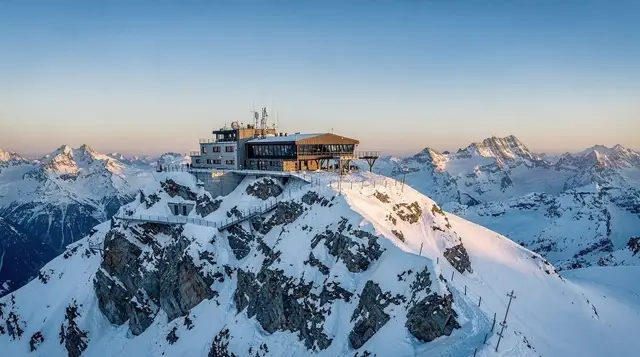
Gstaad’s real mountain excursion is not above the village itself but a twenty-minute drive or bus ride away, at Col du Pillon on the road towards Les Diablerets. From there, a cable car climbs in two stages to Glacier 3000 at just over 3,000 metres, on the edge of the Diablerets glacier. A return ticket costs around CHF 64 for an adult at standard rates, with discounts for Swiss Travel Pass and half-fare card holders; check current prices before travelling, since glacier-station tickets are revised most seasons.
The main draw at the top is the Peak Walk by Tissot, a 107-metre suspension bridge opened in 2014 that connects two rocky summits and is, its operator says, the only bridge of its kind linking two peaks anywhere in the world. Crossing it takes two or three minutes; the appeal is the drop either side and the view towards Mont Blanc on a clear day, not the walk itself. There is also a short glacier chairlift, a viewing platform, and a restaurant at the upper station.
Like most high-altitude installations in the region, Glacier 3000 closes for scheduled maintenance in spring and again for a shorter window in autumn, and the summit sections can close on high-wind days even in season — worth checking the operator’s site the morning of a visit rather than assuming the cable car is running. A guided version of this route, combined with a look at Montreux and Vevey on Lake Geneva, is bookable as a private day trip: a full-day Gstaad, Glacier 3000, Montreux and Vevey excursion by private vehicle, which removes the need to coordinate buses and cable car timings yourself.
Planning your day around the mountain
Because the journey from Interlaken is long, the order of your day matters. Many visitors head for Glacier 3000 first, while the morning air is clearer and the cable car is quieter, and keep the village for the afternoon, when a slow lunch and a walk along the Promenade make a gentle ending. Reversing the plan is possible, but cloud tends to gather around the high summits as the day goes on, so the view you travelled for is less certain. Our Gstaad and Glacier 3000 day trip guide lays out the timings in more detail, and the broader Glacier 3000 guide explains what to expect at the top, including what to wear. Mountain weather changes fast, so the advice in altitude, weather and what to pack applies here as much as it does on the Jungfrau side.
The Menuhin Festival Gstaad
For seven weeks each summer, usually mid-July into early September, Gstaad’s other identity takes over: not shopping street but concert venue. The Menuhin Festival Gstaad was founded in 1956 by violinist Yehudi Menuhin, who lived in the valley, and most performances still take place in the wooden Saanen church a few minutes from Gstaad by train or bus, a building that seats a few hundred and has become known for its acoustics rather than its size.
A larger festival tent near Gstaad hosts bigger orchestral and gala evenings. Ticket prices vary enormously by programme, from budget-priced recitals to premium orchestral evenings; the festival’s own site publishes the full calendar each spring. Outside festival weeks, Saanen church can usually be visited for free during the day. The wider calendar of valley events, including the festival, is covered in the Bernese Oberland events and festivals guide.
Saanenland: the working valley behind the label
Step off the Promenade and the contrast is immediate. Gstaad sits inside the Saanenland, an agricultural valley of hay meadows and dairy farms that has been grazed for cattle long before any hotel opened. Saanen cows, the pale-coated breed that gives the valley and its cheese their name, still graze the slopes visible from the village centre, and the surrounding communes — Saanen itself, Schönried, Gsteig and Turbach — are working villages with none of the retail density of the Promenade. A short walk or bus ride out to any of them shows the same chalets built for hay storage and livestock that define the whole Kandertal, Simmental and Gstaad region, not resort architecture at all.
This is also cheese country. Saanen and l’Etivaz, a village on the Pays-d’Enhaut side of the pass, both give their names to alpine cheeses still made in mountain dairies during the summer grazing season, and several dairies around the valley open to visitors for tastings; the cheese dairies of the Bernese Oberland guide and the separate Gruyères cheese and chocolate day cover the practicalities, and Gruyères itself is close enough for a combined day from Gstaad if you have a car.
For a straightforward Bernese Oberland meal without festival-week prices, the fondue and raclette guide applies just as well to restaurants in Saanen as it does closer to Interlaken.
For visitors who want the Alpine luxury experience without Gstaad’s specific price point, a private guided day from Zurich taking in Bern and Gstaad together is also bookable: a private Bern and Gstaad day tour from Zurich, useful for visitors based near Zurich rather than Interlaken who want both in one outing.
Skiing and hiking around Gstaad
The Gstaad ski area links several sectors — Wispile, Eggli, Saanerslochgrat and the Wasserngrat above the village, plus the higher Glacier 3000 slopes reached from Col du Pillon — under one regional lift pass with Adelboden and Lenk. Terrain runs gentler than the high-alpine skiing around Kandersteg, which suits families and intermediate skiers better than experts hunting steep off-piste. The full breakdown of lifts, passes and which sector suits which ability is in the Adelboden and Lenk ski guide.
In summer, the same lower slopes open to hikers, and the valley floor between Gstaad, Saanen and Gsteig offers flat, easy walking beside the Saane river for anyone who has already done a harder mountain day elsewhere in the region. Longer hikes head up towards the Wasserngrat ridge or across towards Kandersteg’s Oeschinensee, covered together with transport options in the Kandersteg and Oeschinensee day trip guide.
A private tour that pairs Oeschinensee with the Gstaad side of the valley is also bookable directly: a private van tour combining Oeschinen Lake and Kandersteg, run from Montreux and useful for visitors approaching the region from the Lake Geneva side rather than Interlaken.
If you are comparing Gstaad with other ways to spend a long day out of Interlaken, the day trips from Interlaken guide sets the options side by side. Gstaad suits travellers who prefer atmosphere and pastoral scenery over headline-grabbing peaks. A neighbouring valley option is the aerial tramway up to the Engstligenalp plateau above Adelboden, which pairs naturally with a night in the region if you want a second mountain day without returning to the Jungfrau side.
A day’s budget in Gstaad
| Item | Typical cost (CHF) |
|---|---|
| Coffee on the Promenade | 6–8 |
| Simple restaurant lunch | 30–45 |
| Glacier 3000 return cable car (adult) | ~64 |
| Regional day ski pass | 65–75 |
| Train, Interlaken–Gstaad return | 70–90 (less with a travel pass) |
None of these are outliers by Swiss standards, but they sit above what the same items cost in Interlaken, Thun or Frutigen. The Interlaken travel costs guide sets out regional baselines if you want a point of comparison before budgeting a Gstaad day. Visitors on a tighter budget can still see the Promenade and church for free, buy lunch from the Coop or Migros supermarket in Saanen rather than on the main street, and treat Glacier 3000 as the one paid activity of the day.
Gstaad and Saanenland: frequently asked questions
Is Gstaad worth visiting as a day trip from Interlaken?
Yes, though it takes most of a day: the train via Spiez and Zweisimmen runs close to two hours each way. The village can be seen in a few hours, but Glacier 3000 needs a half-day on its own, so plan for a full day out or one night.
How do you get from Interlaken to Gstaad by train?
Take a regional or InterRegio train from Interlaken Ost or Interlaken West to Spiez, change for Zweisimmen, then change again onto the MOB GoldenPass line to Gstaad. There is no single direct train; allow two changes and roughly 1h50 to 2h in total, depending on connections.
Is Gstaad expensive compared to the rest of the Bernese Oberland?
Yes. A coffee or a simple lunch on the Promenade typically costs more than in Interlaken or Thun, and hotel prices on the main street run well above regional averages. Budget travellers can still visit for a day and eat in Saanen or Gstaad’s supermarket bakery rather than on the Promenade itself.
What is the Peak Walk by Tissot at Glacier 3000?
It is a 107-metre suspension bridge connecting two rocky summits above the Glacier 3000 cable car station, opened in 2014. It is free once you have paid for the cable car ride up from Col du Pillon, and the walk across takes only a few minutes, though queues can build on clear days.
When is the Menuhin Festival Gstaad held?
It runs for around seven weeks each summer, from mid-July into early September, with most concerts held in the wooden Saanen church and a large festival tent near Gstaad. Violinist Yehudi Menuhin founded it in 1956, and it remains one of the country’s better-known classical music festivals.
Can you ski at Gstaad without staying in an expensive hotel?
Yes. Day lift passes cover the same slopes whether you stay in a chalet on the Promenade or a budget room in Saanen, Schönried or Zweisimmen, all a short train or bus ride from the lifts. Ski school and equipment rental prices are broadly in line with other Bernese Oberland resorts.
Is Gstaad a car-free village like Wengen or Mürren?
No. Gstaad has road access and parking, unlike the car-free villages of the Jungfrau region. Traffic is restricted only on the pedestrianised Promenade itself, where deliveries and residents’ vehicles are limited to certain hours.