A different Switzerland, three hours west
Montreux sits on Lake Geneva, and it looks and feels like a different country from the Bernese Oberland. The lake is warmer, the shoreline is planted with palm trees and magnolias, and French is the local language rather than Swiss German. What it shares with Interlaken is the same national rail punctuality and the same appetite for building railways up impossible-looking mountains. Coming here from Interlaken is a proper excursion, not a quick add-on, so it is worth knowing exactly what the day costs in time before deciding whether to do it as a day trip or an overnight stop.
The town itself is compact. Chillon Castle sits at one end of the lakeside promenade, the Freddie Mercury statue and the casino sit roughly in the middle, and the funicular up to the Rochers-de-Naye starts from Montreux station at the top of the old town. Nearly everything a first-time visitor wants is walkable along the flat quai, which is unusual for this part of Switzerland and one of the reasons Montreux suits people who do not want another day of climbing.
Getting there: the GoldenPass Line from Interlaken
The direct route from Interlaken is the GoldenPass Line, one of the country’s named panoramic routes. From Interlaken Ost, a train runs to Zweisimmen, where you change onto the MOB (Montreux–Oberland Bernois) line down to Montreux. The whole journey takes around three hours, and reservations for the panoramic carriages cost extra and are worth booking ahead in July and August, when they sell out. Regular second-class seats on the same trains need no reservation.
There is also a version of the journey with a change at Zweisimmen onto the newer GoldenPass Express, which uses adjustable-gauge trains to run through without a further change in some configurations; timetables vary by season, so check connections on the day rather than assuming the fastest option automatically applies. Either way, this is a scenic ride in its own right, climbing over the Sanetsch and Saanenland countryside before dropping down through vineyards to the lake. Full details on timings, seasonal variations and ticket types are in our dedicated GoldenPass Line guide.
A Swiss Travel Pass covers the entire route, including the second-class seat, though not the seat reservation supplement. Without a pass, a standard second-class one-way fare from Interlaken to Montreux runs to roughly CHF 75–85, so anyone doing this trip without a pass should compare it against a day pass or Half Fare Card before buying single tickets. The Swiss Travel Pass guide covers where the maths works in your favour and where it does not.
Chillon Castle: it earns the photographs
Chillon Castle stands on a rock at the edge of the lake a couple of kilometres south of central Montreux, connected to the shore by a short causeway. It is the most visited historic monument in Switzerland, and unlike some over-photographed sites, the inside holds up to the outside. The castle has 25 buildings from different centuries built onto the same rock, with vaulted dungeons at water level, a great hall, a chapel with medieval frescoes, and a walk across the roof with views back towards Montreux.
Adult entry is CHF 15.50, with a reduced rate for students and young people and free entry for children under six; it is included on the Swiss Travel Pass. An audio guide is included in the ticket price and covers the visit in a self-guided loop that takes 60 to 90 minutes depending on how thoroughly you read the information panels. The castle gets busy with coach tour groups from around 10:00 to 14:00 in summer, so arriving at opening (typically 09:00 in high season) or after 15:00 gives a noticeably calmer visit.
Getting there from central Montreux is a 30 to 40 minute walk along the lakeside path, or a short ride on bus line 201, or the seasonal lake boat that stops directly below the castle. Walking is the better option if the weather is good, since the path itself, past private gardens and small beaches, is part of the appeal.
The quai, the flowers and the Freddie Mercury statue
The Montreux lakeside promenade is planted with flowerbeds year-round and takes its name, the Montreux Riviera, seriously. It runs for several kilometres from the Casino de Montreux towards Territet and Chillon in one direction and towards Vevey in the other, and it is flat, paved and easy for anyone, including pushchairs and wheelchairs. Free public benches face the water and the French Alps across the lake, which is why this stretch is genuinely popular with people who are not chasing a specific sight, just a slow walk.
The Freddie Mercury statue stands on the quai near the Casino de Montreux, arms raised, facing the lake. Mercury and Queen recorded at Mountain Studios in Montreux from the mid-1970s onwards, and Mercury kept an apartment here until his death in 1991; the statue, unveiled in 1996, has become one of the most photographed spots in French-speaking Switzerland, with a queue for photographs most of the day in summer. Early morning avoids the crowd. A short walking route linking the statue, the studios’ small free exhibition inside the casino building, and the promenade is covered step by step in our Montreux and Chillon day trip guide, which is worth reading before you go if you only have a few hours.
For a walking loop through this part of town with someone explaining what you are looking at, rather than working it out from a map, a local guide runs a route covering the statue, the old town lanes above the lake and the market square:
a private guided walk through Montreux’s lakeside landmarks and old town.
Rochers-de-Naye: marmots and a view over the lake
Above Montreux, a cogwheel railway that has run since 1892 climbs to the Rochers-de-Naye, a 2,042-metre summit with views over Lake Geneva to the French Alps and, on a clear day, towards Mont Blanc. The journey takes about an hour from Montreux station, climbing through forest and then open alpine pasture. A return ticket costs around CHF 82 for adults, with a 50% reduction for Swiss Travel Pass and Half Fare Card holders.
At the top, an alpine garden (open roughly June to October) holds several thousand mountain plant species, and a marmot enclosure lets visitors get closer to the animals than most wild sightings would allow, generally with a good chance of seeing them out and active in the morning or early evening in summer. There is also a short circular walking trail around the summit plateau and a restaurant with the same panoramic view. In winter, the railway continues to run and the summit becomes a modest snow-play and toboggan area rather than a serious ski destination.
This is a different mountain experience from the high peaks around Interlaken: no glacier, no via ferrata, and a much gentler, family-friendly pace. If you are choosing between an alpine excursion here and the higher, more dramatic Glacier 3000 further along the GoldenPass corridor, a tour that takes in Glacier 3000 directly from Montreux covers the bigger, more alpine version of the same day out:
a guided day trip from Montreux up to the glacier and viewing platform at Glacier 3000.
The Montreux Jazz Festival, and when the town gets difficult
For around two weeks from late June into early July, Montreux hosts the Montreux Jazz Festival, one of the best-known music festivals in Europe and, despite the name, no longer limited to jazz. Many of the lakeside stages and fan zones are free to enter, while ticketed evening concerts at the Auditorium Stravinski and the more intimate Montreux Jazz Club require tickets bought well in advance, often months ahead for headline acts.
The practical effect for a visitor not attending the festival is straightforward: hotel prices in Montreux roughly double during the festival fortnight, restaurants and the lakeside promenade are far busier than usual, and Chillon Castle sees its heaviest crowds of the year on festival weekends. If your priority is the castle and a quiet walk rather than live music, avoid this window; if the festival itself is the draw, book accommodation as early as possible. Our events and festivals guide for the region lists the exact dates as they are confirmed each year, since they shift by a week or so annually.
Where to eat, and what a day in Montreux actually costs
Montreux is not a cheap town, and it sits at Lake Geneva prices rather than Bernese Oberland prices, which in practice means slightly higher than Interlaken for equivalent food. A coffee and croissant on the lakeside runs to CHF 8–10. A sit-down lunch of perch fillets (filets de perche, the regional speciality, caught in the lake and served meunière-style with fries) costs CHF 28–38 at a mid-range lakeside restaurant, and considerably more at places directly facing the Mercury statue, where you are paying for the view as much as the food. A simple bakery sandwich or a kebab from one of the streets behind the promenade runs CHF 9–14, and is a reasonable way to keep costs down without leaving the centre.
A realistic day budget without accommodation:
| Item | Cost (CHF) |
|---|---|
| Return second-class rail fare, Interlaken–Montreux (without pass) | 150–170 |
| Chillon Castle entry | 15.50 |
| Lunch, mid-range restaurant | 30–40 |
| Coffee, snacks, water | 15–20 |
| Rochers-de-Naye return (optional) | 82 |
| Total, without Rochers-de-Naye | ~210–245 |
| Total, with Rochers-de-Naye | ~290–330 |
Anyone holding a Swiss Travel Pass strips out the rail fare and the castle entry, and halves the Rochers-de-Naye ticket, which changes the arithmetic considerably and is usually the better option if you are combining Montreux with any other rail-heavy day from Interlaken. Perch and lake fish are seasonal and sometimes imported when local catches are low; menus are required to state the origin, so it is worth asking if it matters to you.
Vevey, Lausanne and Gruyères: turning it into a loop
Montreux rarely stands entirely alone on an itinerary, because two other worthwhile stops sit close by on the same lakeside rail line. Vevey, ten minutes north by train, is smaller and less polished than Montreux, with a Wednesday and Saturday market, the Nestlé headquarters and the Alimentarium food museum, and a giant fork sculpture planted in the lake as its own minor landmark. A guided walk through Vevey covers the old town and market streets in around two hours:
a local guided walking tour through Vevey’s old town and lakeside.
Lausanne, roughly 20 minutes further by train, is the larger city on the lake, with a Gothic cathedral, the Olympic Museum and a genuinely different, steeper urban layout. It suits a half-day on its own rather than being squeezed into a Montreux day trip; our Lausanne destination page covers what a half-day there looks like.
Between Vevey and Lausanne, the terraced vineyards of Lavaux climb the hillside above the lake and are a UNESCO World Heritage site; the villages along this stretch, covered on our Lavaux and Vevey destination page, are walkable in an afternoon and produce the Chasselas wine that dominates lake-view restaurant lists. Our wine guide covering Lavaux and the Bernese Oberland explains what to expect from a tasting if you want to build one in.
Inland from Montreux, Gruyères is the medieval walled town behind the cheese, reachable by train with a change at Montbovon or Bulle, or more comfortably by an organised tour that also stops at a cheese dairy and, often, a chocolate factory. This combination from Montreux is popular enough to run as a set day trip:
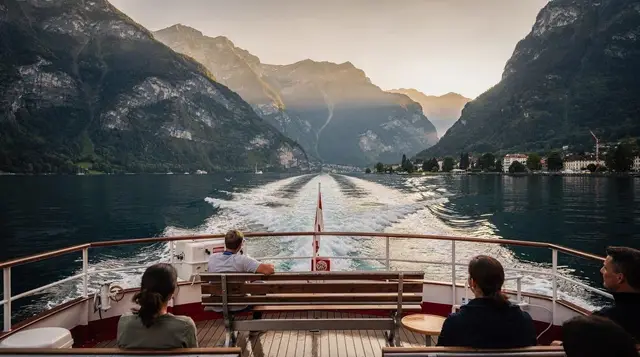
If a boat rather than a train appeals more for at least part of the day, short lake cruises run from Vevey along the Riviera shoreline, giving a different angle on Chillon Castle from the water:
a two-hour boat cruise along the Riviera shoreline from Vevey.
For a broader look at how Montreux fits into a longer circuit that also takes in Gstaad and the glacier country to the east, see our Gruyères and Broc day trip guide and the wider Grand Tour of Switzerland itinerary from Interlaken, which threads Montreux in as one stop among several over a week.
Practical notes before you go
The GoldenPass panoramic carriages have limited capacity and a compulsory seat reservation in the premium car; standard second-class seats on the same trains do not require one, so if reservations are sold out, you can usually still travel, just without the front-facing panoramic windows. Book reservations through SBB or the MOB website rather than assuming you can buy them on the day in July or August.
Chillon Castle and the Rochers-de-Naye railway both operate reduced winter timetables, and the alpine garden at the summit closes outside roughly June to October; check current opening times before planning a winter visit, since a same-day return from Interlaken with a closed garden and a shortened castle visit is a wasted train fare.
Montreux’s climate is noticeably milder than Interlaken’s, largely thanks to the lake’s moderating effect, so it is common to find Montreux pleasant in a light jacket while Interlaken is still cold in early spring or late autumn; this microclimate is also why palm trees and magnolias survive here at all. Wildlife around the Rochers-de-Naye, including the marmots, is easiest to see at dawn or dusk in warmer months; our wildlife and marmots guide has more on realistic expectations for sightings elsewhere in the region too.
Finally, if the return journey after a long day feels like too much, Montreux has hotels across a wide price range along and just behind the lakeside, and staying one night removes the pressure to fit the castle, the promenade and the mountain into a single day squeezed between two three-hour train rides.
Frequently asked questions about visiting Montreux from Interlaken
Is Montreux worth a day trip from Interlaken?
Yes, but budget the whole day for it. The GoldenPass Line takes around three hours each way with a change at Zweisimmen, so a return trip plus Chillon Castle and the lakeside promenade fills a full day. Staying one night lets you also ride up to the Rochers-de-Naye without rushing.
How do you get from Interlaken to Montreux?
The classic route is the GoldenPass Line: a panoramic train from Interlaken Ost to Zweisimmen, then a change onto the MOB train down to Montreux. Total journey time is around 3 hours, with reservations recommended for the panoramic carriages in summer.
How much does Chillon Castle cost to enter?
Adult entry is CHF 15.50, with reductions for students and children, and it is included on the Swiss Travel Pass. Audio guides are free with the ticket and available in several languages including English.
What is the Rochers-de-Naye known for?
It is a 2,042-metre summit above Montreux reached by a cogwheel railway, known for its alpine garden, a marmot enclosure where the animals can usually be seen close up in summer, and views across Lake Geneva to the French Alps.
When is the Montreux Jazz Festival?
It runs for around two weeks from late June into early July. Many concerts around the lakeside stages are free, while ticketed shows at the Auditorium Stravinski and the Montreux Jazz Club sell out well in advance.
Where is the Freddie Mercury statue in Montreux?
It stands on the lakeside promenade near the Montreux Casino, facing the water. Mercury lived in Montreux and recorded at the town’s Mountain Studios, which is one reason the jazz festival and the town’s music heritage are closely linked.
Can you visit Montreux and Gruyères in the same day?
It is possible but tight by public transport, since Gruyères is roughly an hour from Montreux by train with a change. Most visitors doing both from Interlaken in a single day use an organised tour that handles the connections and drop-offs.