Kandersteg and Oeschinensee: a full day out from Interlaken
Can you do Kandersteg and Oeschinensee as a day trip from Interlaken?
Yes. The train from Interlaken Ost to Kandersteg takes about an hour, changing at Spiez, and the gondola up to Oeschinensee runs in around six minutes. A full loop of the lake takes 1.5 to 2 hours on foot, which leaves time for lunch, the summer toboggan run near the valley station, and a train back to Interlaken by early evening.
A lake, a village and one change of train
Kandersteg sits in a quiet side valley off the main Interlaken–Spiez–Bern line, which is exactly why it gets overlooked in favour of the Jungfrau region’s bigger names. It has one obvious draw: Oeschinensee, a glacial lake at 1,578 m below the Blüemlisalp massif, reached by a short gondola ride and a level walk. Unlike Jungfraujoch or Schilthorn, there’s no queue for a train through a mountain and no risk of paying full price to stand in cloud. The trade-off is that Kandersteg is further round: budget a full day, not a half-day add-on to Thun or Spiez.
This guide covers the practical version of the day: the train, the gondola, the lake loop, the summer toboggan run that sits at the valley station, and the timing that gets you back to Interlaken before the evening trains thin out.
Getting there: the train via Spiez
From Interlaken Ost, trains run roughly hourly towards Spiez on the BLS network, and Kandersteg trains connect there. The change at Spiez is a same-station platform change, not a walk between buildings, and connections are built with a reasonable margin — you’re rarely sprinting for it. Total journey time from Interlaken Ost to Kandersteg is around an hour.
| Leg | Approx. time | Notes |
|---|---|---|
| Interlaken Ost → Spiez | ~20 min | Direct, several trains per hour |
| Spiez → Kandersteg | ~35–40 min | Change platforms at Spiez, BLS line towards the Lötschberg |
| Total, Interlaken Ost → Kandersteg | ~1 hour | Half-hourly to hourly service depending on time of day |
Full-fare second class one-way from Interlaken Ost is in the region of CHF 30; a Half Fare Card roughly halves that, and the Swiss Travel Pass and the regional Berner Oberland Pass both cover the route outright. If you’re weighing up which pass makes sense for a longer stay, the Swiss Travel Pass guide and the wider transport guide for getting around by train, bus and boat both cover the maths in more detail than is worth repeating here.
Kandersteg village itself is a scattered collection of chalets, hotels and outdoor-sports operators strung along the valley floor, with the gondola’s valley station a short, flat walk — about 10 minutes — from the railway station. There’s no need for a taxi or bus for that stretch unless you’re carrying a lot of gear.
The gondola up to Oeschinensee
The Kandersteg–Oeschinensee gondola climbs from the valley station to a mountain station in around six minutes, gaining most of the day’s altitude without any effort. From the top, it’s a further 15 to 20 minutes on a gently descending path down to the lake shore itself — the gondola doesn’t drop you at the water’s edge, which surprises people expecting a lift straight to a lakeside terrace.
Return fares are typically in the region of CHF 46 for an adult, with reductions for Half Fare Card holders and children travelling free or at a steep discount depending on age. Tickets are sold at the valley station and there’s rarely a meaningful queue outside peak summer weekends and the middle of the day in August.
| Option | Approx. fare | Time |
|---|---|---|
| Adult return | ~CHF 46 | 6 min each way |
| Half Fare Card holder | ~CHF 30–35 | 6 min each way |
| Walking up instead | Free | 1.5–2 hours, ~400 m ascent |
Walking up is a real option if you’d rather spend the money elsewhere or want the exercise: a signed path climbs steadily through forest and takes most people 1.5 to 2 hours. Most visitors ride up and either ride back down or walk down, since the knees generally prefer descending on foot over a longer, gentler gradient than the ascent.
Walking the Oeschinensee loop
The lake itself is the reason to come. Oeschinensee is a turquoise-green glacial lake ringed by cliffs and the glaciers of the Blüemlisalp above, and the water’s colour genuinely does shift through the day with the light — it isn’t just a filtered photograph. A full loop of the shore takes 1.5 to 2 hours at an easy pace, mostly flat, with one uneven stretch across an old rockfall and alluvial fan on the far side from the restaurant.
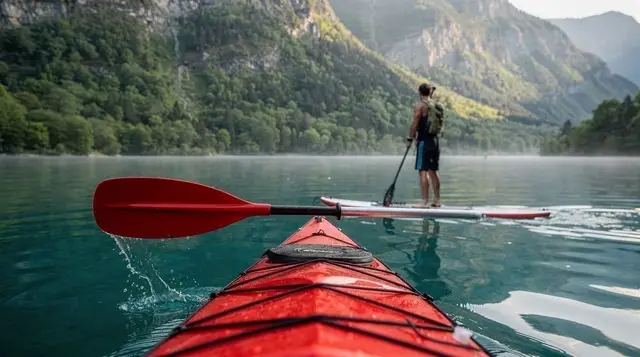
Rowing boats and pedalos can be hired at the lake in summer for anyone who’d rather be on the water than beside it. The path is wide and level enough near the mountain station for pushchairs and less confident walkers; the far side, past the boulder field, needs sturdier footwear. If you want a longer day, several proper hiking routes fan out from the lake into the surrounding valleys — worth checking the dedicated Oeschinensee hiking guide before you commit to a route beyond the basic loop, and the broader roundup of the best day hikes from Interlaken if Oeschinensee is one stop on a hiking-focused trip.
a guided hike around Kandersteg led by a Swiss triathlete is worth considering if you’d rather have route-finding and local knowledge handled for you, particularly if you’re tempted by one of the longer routes beyond the basic lake loop.
The summer toboggan run
Near the gondola’s valley station in Kandersteg, a summer toboggan run (a fixed rail track you ride down on a wheeled sledge, braking yourself) operates through the warmer months, roughly late spring to early autumn. It closes in wet weather since the track needs to be dry for grip, so it’s worth treating as a bonus rather than the centrepiece of the day. Rides are typically bought individually or as multi-ride cards, at somewhere around CHF 8 to 10 a go, cheaper per ride if you buy several at once.
It suits older children and adults comfortable controlling their own speed; small children usually ride tandem with an adult. If it’s shut when you arrive — check first, since a closure isn’t always obvious from a distance — the lake loop and the gondola alone are enough to fill the day without feeling short-changed.
Kandersteg beyond the day trip
Kandersteg is also the starting point for the car-carrying train through the Lötschberg base tunnel to Goppenstein in Valais, and for hikers, the trailhead for routes towards the Gemmi Pass and beyond — neither of which fits into a single day trip from Interlaken alongside Oeschinensee, but both are reasons some visitors choose to base themselves here for a night or two rather than treating it as a day trip at all. Nearby, Blausee, a small, startlingly clear private lake in a forest a short drive or bus ride from Kandersteg, is sometimes combined with Oeschinensee on longer private itineraries.
a private day trip from Zurich covering both Blausee and Oeschinensee exists for visitors based further afield who want both lakes without arranging trains themselves, and a private guided hike to Oeschinensee from Zurich covers similar ground with more walking and less driving.
If you’re staying in the Kander valley area rather than passing through, Adelboden is a further 30 to 40 minutes on from Kandersteg by bus and makes a reasonable extension for anyone with two days rather than one to spend in this corner of the Bernese Oberland.
Eating at the lake and in the village
The Berghaus at Oeschinensee serves the usual Bernese Oberland lineup — rösti, soup, sausage, cake — at prices that reflect the fact that everything arrives by gondola or on foot; expect CHF 25 to 35 for a main course. It’s the only proper restaurant directly at the lake, so on a busy August weekend the terrace fills up around midday. Packing your own food is entirely normal and plenty of people picnic on the grass near the shore instead.
Kandersteg village has a handful of hotel restaurants and a couple of independent options along the main street, generally calmer and marginally cheaper than the lake. For a broader sense of what a mountain restaurant should and shouldn’t cost across the region, the mountain huts and berghaus dining guide is useful context, as is the Interlaken on a budget guide if you’re tracking spend across a longer trip.
What to bring, when to go, when it doesn’t work
Sturdy shoes matter more here than at most Interlaken-area viewpoints, because of the rockfall section on the lake’s far shore. A layer for the gondola ride and the lake itself is worth having even in summer, since Oeschinensee sits in a bowl of high peaks and the air off the water and glaciers is noticeably cooler than the valley floor. Sun protection matters at altitude even on a mild day.
Go in the morning if you can. The lake’s colour and the light on the surrounding cliffs are generally better before midday cloud builds, which happens often enough in the Bernese Oberland in summer to plan around. The gondola, like most lifts in the region, closes for scheduled maintenance in spring and again in autumn, and can also stop running in high wind — check the operator’s status page the morning you travel rather than assuming it will be running because it was open yesterday.
Rain changes the calculation completely: the toboggan run shuts, the lake loses its colour and the far-shore path gets slick over loose stone. On a genuinely wet forecast, this is a day trip to postpone rather than push through, and one of the rainy day activities closer to Interlaken is the better call instead.
Getting back: last trains and timing your day
Trains back from Kandersteg to Interlaken Ost run on broadly the same hourly-to-half-hourly pattern as the outbound journey, with the same change at Spiez, until the evening. Build your day backwards from a target arrival in Interlaken: allow the hour of travel, plus buffer for the change, and you’ll generally want to be leaving the lake by mid-to-late afternoon if you also want a relaxed dinner back in Interlaken rather than a rushed one.
For visitors weighing Kandersteg against the region’s other day trips, the day trips from Interlaken overview sets it alongside the alternatives, and anyone building a longer stay should look at the seven-day itinerary that folds in day trips or the general question of how many days to spend in Interlaken before deciding whether Kandersteg earns a full day on a shorter trip.
If canyoning or another adventure activity is more your speed than a lake walk, it’s worth knowing the Bernese Oberland’s canyoning trips run from the Lütschine valley near Interlaken rather than from Kandersteg itself — a canyoning trip departing directly from Interlaken is the more practical option if that’s the day you’re after, saved for a separate outing rather than combined with Kandersteg.
Kandersteg and Oeschinensee day trip FAQ
How long does it take to get from Interlaken to Kandersteg?
Around an hour from Interlaken Ost, with one change at Spiez onto the BLS line towards the Lötschberg. There is no need to change stations in Spiez, just platforms, and connections are usually built with 10 to 15 minutes of margin.
Do I need to book the gondola to Oeschinensee in advance?
No booking is needed outside the busiest summer weekends. Tickets are sold at the valley station in Kandersteg, and queues are rare before mid-morning or after 4pm.
Is the walk around Oeschinensee suitable for children?
The lakeside path from the gondola’s mountain station to the shore and partway around is flat and pushchair-friendly in dry weather. The far side of the loop, past the alluvial fan and rockfall debris, has uneven sections better suited to children who are confident walking on loose stone.
Is the summer toboggan run at Kandersteg open all year?
No, it runs roughly from late spring to early autumn and closes in wet weather, since the track relies on dry rails for grip. Check conditions at the valley station before counting on it as the day’s highlight.
Can I do Kandersteg and Oeschinensee without the gondola?
Yes, a signed path climbs from the village to the lake in around 1.5 to 2 hours, gaining roughly 400 metres. Most visitors ride the gondola up and either ride back down or walk down, since the descent path is easier on the knees than the ascent.
Is Kandersteg covered by the Swiss Travel Pass?
The train journey from Interlaken Ost to Kandersteg is included, since it runs on the BLS network covered by the pass. The Oeschinensee gondola is a separate, privately operated lift and is not included, though pass holders sometimes get a percentage discount on the fare.
Lake cruises & boat tours on GetYourGuide
Verified deep-linked GetYourGuide tours. Book through these links and we earn a small commission at no cost to you.
GetYourGuide does not provide a product photo for this activity — the image shows the meeting point, photographed by us.