Interlaken on a budget: cheaper beds, cheaper meals, cheaper mountains
Can you visit Interlaken cheaply?
Yes, if you sleep in a hostel dorm, cook in a shared kitchen, buy a Half Fare Card or regional pass instead of paying full rail and cable car fares, and choose one paid mountain excursion rather than several. Skipping the Jungfraujoch alone can cut a day's spending by more than 200 CHF.
Switzerland is expensive, but Interlaken has an unusual number of ways round it
Interlaken has one advantage most Swiss destinations don’t: it built its economy on backpackers long before it built it on Instagram. Balmer’s Herberge has been putting up budget travellers since 1945, and the town still has more hostel beds per head than almost anywhere else in the Bernese Oberland. That history matters, because it means the cheap infrastructure — dorms, shared kitchens, communal laundry, bike rental desks — never went away even as day-trip prices for the Jungfraujoch and Schilthorn climbed into the hundreds of francs.
The gap between a budget trip and an expensive one here is enormous, and almost all of it comes down to three decisions: where you sleep, whether you cook, and which mountains you actually pay to go up. See What Interlaken really costs: three daily budgets for a full breakdown of what things cost before you start cutting.
Sleeping cheap: hostels, not hotels
A hostel dorm bed in central Interlaken runs 35 to 45 CHF a night in season, breakfast sometimes included, sometimes a 6 to 10 CHF add-on. A private room at the same hostels costs 90 to 130 CHF for two, which is still noticeably cheaper than a comparable hotel double, which starts around 150 CHF and climbs fast near the lake or Höheweg.
Balmer’s, Backpackers Villa Sonnenhof, and Funny Farm all sit within 10 to 15 minutes’ walk of Interlaken West, and all have kitchens guests can actually use rather than a kettle in the corner. Book directly with the hostel where possible; third-party booking fees add up over a multi-night stay. Full options, including which hostels have decent kitchens versus a single hotplate, are in Where to stay in Interlaken: centre, Unterseen, Matten, Bönigen or up the mountain.
Camping is the next tier down. Camping Jungfrau in Lauterbrunnen and Camping Sackgut in Interlaken charge 12 to 18 CHF per person plus a small pitch fee, and both rent basic huts for those without a tent. It is genuinely the cheapest bed in the region, but you lose the social kitchen and the ease of walking distance to the two stations.
Cooking instead of eating out
This is the second lever, and it is bigger than most visitors expect. A restaurant main course in Interlaken typically costs 25 to 38 CHF; add a drink and you are past 40 CHF a head before dessert. A Coop or Migros supermarket dinner for two — pasta, sauce, a salad, bread — comes in well under 20 CHF combined, and both chains have branches within a few minutes of Interlaken West station. Migros is marginally cheaper than Coop on staples; Denner, where you can find one, is cheaper still.
If your hostel has a kitchen, use it for at least dinner. Breakfast is the easiest meal to self-cater regardless of accommodation: bread, cheese, and fruit from a supermarket cost a fraction of a hotel breakfast buffet. For days on the move, a picnic assembled the evening before beats buying lunch at a mountain restaurant, where a bowl of soup can run 12 to 15 CHF and a full meal 25 CHF or more at altitude. Eating cheap in Interlaken has specific bakeries, the weekly market days, and which restaurants do a genuinely reasonable lunch menu.
Half-price mountains: the rail and lift cards that actually help
The Swiss Travel Pass is the pass most visitors hear about first, and for a short Interlaken-focused stay it is usually the wrong one. It is priced for people covering long distances across the whole country over several days, with unlimited travel on trains, buses, and boats plus discounts on mountain lifts. If your trip is mostly Interlaken and the Jungfrau region, you will not use enough of that included travel to justify the price.
A better fit for most budget itineraries is the Half Fare Card: about 120 CHF for one month, giving 50% off nearly all trains, buses, boats, and most mountain lifts, the Jungfraujoch and Schilthorn included. It needs roughly two to three return journeys to break even, so it makes sense for a stay of four days or longer with a few excursions planned, and makes less sense for a flying weekend where you might only take one return trip. For that shorter case, a Saver Day Pass bought for a specific day and route can undercut even the half-fare rate if booked early through SBB.
Regionally, the Berner Oberland Pass and the Jungfrau Travel Pass bundle multi-day travel and lift discounts specifically for this area, and are worth pricing against your actual itinerary rather than assumed to be better — for a visitor doing one or two big excursions, buying single half-fare tickets is often still cheaper than any pass. Compare the options properly in The Swiss Travel Pass: what it actually covers in the Interlaken region and Jungfrau Travel Pass vs Berner Oberland Pass: which to buy before committing to either.
The one mountain you should probably skip
The Jungfraujoch is the excursion most likely to blow a budget trip apart. The return fare from Interlaken Ost is well over 200 CHF even with a half-fare discount, before food at altitude, and the trip eats most of a day. For a budget visit, this is the line item to cut first, or to save for a single splurge day rather than a routine outing.
The substitute that actually works: Grindelwald First or the Kleine Scheidegg–Männlichen circuit give comparable Eiger north face views and genuine high-alpine scenery for roughly a third to a half of the Jungfraujoch fare, and both connect easily by train and cable car from Interlaken Ost. See how the two compare directly in Jungfraujoch vs Schilthorn: which summit is worth it? and First, Männlichen and Kleine Scheidegg: the three balconies compared before booking anything.
Hike it instead of riding it
Several of the region’s best viewpoints have a paid lift and a free (or nearly free) walking alternative to the same summit.
| Viewpoint | Lift fare (return) | Walking alternative | Time on foot |
|---|---|---|---|
| Harder Kulm | ~36 CHF full, ~18 CHF half-fare | Marked trail from Interlaken Ost | 1.5–2 hours up |
| Schynige Platte | ~72 CHF full, ~36 CHF half-fare | Trail from Wilderswil | 3–4 hours up |
| Niederhorn | ~54 CHF full, ~27 CHF half-fare | Trail from Beatenberg | 2–3 hours up |
None of these are trivial climbs, and none should be attempted in poor weather or without proper footwear, but for a fit visitor with time and no interest in paying full lift fare, they cut the day’s cost to essentially nothing beyond food. Full trail notes and timings are in Harder Kulm: the funicular, the platform and the walk down, Schynige Platte: the 1893 railway and Interlaken’s best view for the money, and the Niederhorn guide.
More generally, The best day hikes from Interlaken, ranked by difficulty and Easy flat walks around Interlaken cover routes that need no lift at all, from valley floor loops to the lower stretches of the Lauterbrunnen valley waterfall walk.
If you would rather cover ground on wheels than on foot, an e-bike rental in Interlaken costs a fraction of a guided coach excursion and lets you set your own route and pace along the lakes and villages, stopping only where you choose.
Free and near-free days in Interlaken itself
You do not need to leave town to have a full day that costs nothing beyond a meal. The Höhematte, the 14-hectare protected meadow in the middle of Interlaken, is free to walk across at any time, and on a clear afternoon you can watch paragliders land there having launched from the hills above — free entertainment that would cost you 150 to 200 CHF to do yourself. The Höheweg promenade running alongside it is equally free, lined by the grand hotels without any obligation to enter them.
Walking the flat lakeside paths from Interlaken towards Bönigen on the Lake Brienz side, or towards Neuhaus on the Lake Thun side, costs nothing and takes under an hour each way, with genuine mountain and lake views the whole distance. Unterseen’s old town, a five-minute walk from Interlaken West, has a free viewpoint over the river and a wooden bridge worth the short detour. None of this needs a ticket, a pass, or a booking. Free things to do in Interlaken and Interlaken’s viewpoints list the rest, and Interlaken covers the town layout if you are working out routes on foot.
Lauterbrunnen deserves a mention here too: the Staubbachfall, a 297-metre waterfall, is visible for free from the village itself. You only pay if you go into the Trümmelbach Falls inside the mountain (around 14 CHF), which is a different and genuinely worthwhile sight, but not a required one on a tight day.
Seeing the lakes without paying for a cruise
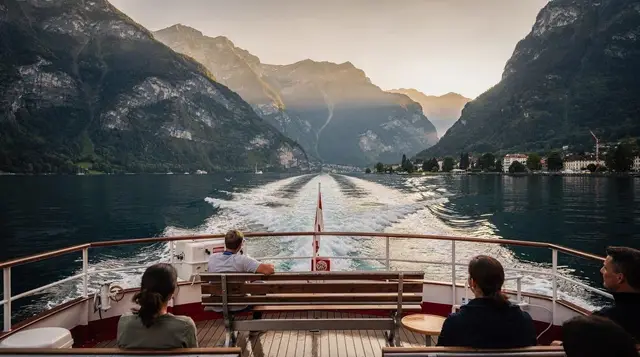
A full boat tour on Lake Thun or Lake Brienz is a pleasant way to spend an afternoon, but it is not the only way to see either lake. Walking sections of the shore path, as above, costs nothing. If you want to cover more distance and reach spots like Iseltwald — the small harbour village that became disproportionately famous after appearing on screen — or the Giessbach Falls on Lake Brienz, an e-bike route out to Iseltwald and Giessbach covers the same ground as a guided boat and coach package at a lower cost, on your own schedule.
Full boat fares and timetables, for when a cruise genuinely is the better choice, are in Lake Thun boat trips: stops, the paddle steamer and day tickets and Lake Brienz boat trips: Interlaken to Giessbach and Iseltwald.
Arriving and moving around without overpaying
If you are flying into Geneva rather than Zurich, the train to Interlaken takes about 2 hours 45 minutes and is the standard, reliably punctual option. For groups splitting the cost, or travellers who would rather not manage a connection with luggage, a direct transfer from Geneva to Interlaken can work out comparably priced per person while saving the change at Bern — but for a solo budget traveller, a normal SBB ticket, ideally a Saver Day Pass booked in advance, is usually the cheaper route. Getting to Interlaken from Geneva airport has the full comparison.
Once you’re in the region, remember there are two stations — Interlaken Ost for the Jungfrau railway and Brienz-bound trains and boats, Interlaken West for the town centre and Lake Thun boats — and mixing them up wastes time and sometimes a missed connection, not money directly, but it can cost you a transport ticket you didn’t need to buy twice. Trains, buses and boats around Interlaken lays out how the network fits together.
One splurge, chosen deliberately
Cutting costs everywhere does not mean cutting them on everything. Most budget visitors do better picking one paid experience deliberately rather than denying themselves entirely and then caving on something overpriced and low-value instead — check Tourist traps and overpriced things in Interlaken for what to avoid when that urge hits. A bundled experience like rafting followed by a raclette dinner combines an activity and a meal into one paid outing rather than two separate expenses, which is a more efficient way to spend a splurge budget than a standalone restaurant dinner plus a standalone activity booked separately.
A realistic budget day, added up
For a single traveller keeping costs low: a 40 CHF hostel dorm bed, an 8 CHF self-catered or bakery breakfast, a 10 CHF picnic lunch, a 15 CHF self-cooked dinner, and a free walk or hike rather than a paid lift, comes to roughly 73 CHF for the day. Add a half-price Harder Kulm ticket at 18 CHF and you are still under 100 CHF. Compare that with a visitor staying in a hotel, eating three restaurant meals, and doing the full-price Jungfraujoch return, who can easily spend 350 to 400 CHF in a single day.
The gap is the entire point of this guide. Interlaken on a budget: cheaper beds, cheaper meals, cheaper mountains figures aside, How many days in Interlaken? is worth reading alongside this if you are still deciding how long to stay, since a longer stay at a lower daily rate often beats a short, expensive one.
Frequently asked questions about doing Interlaken cheaply
What is the single biggest way to save money in Interlaken?
Accommodation. A hostel dorm bed runs 35 to 45 CHF a night against 150 CHF or more for a mid-range hotel double, and most hostels have a shared kitchen that removes the cost of restaurant meals entirely.
Is the Jungfraujoch worth the money on a tight budget?
For most budget travellers, no. The return fare from Interlaken Ost is well over 200 CHF even with a discount card, and the Kleine Scheidegg to Grindelwald First area gives comparable Eiger and glacier views for a fraction of the price.
Is the Swiss Travel Pass worth buying for a budget trip?
Usually not for a short stay focused on Interlaken itself. It is priced for travellers covering long distances across Switzerland; a Half Fare Card plus single tickets, or a regional Berner Oberland Pass, is cheaper if you are staying mainly in the Jungfrau region.
Are there free things to do in Interlaken itself?
Yes. Walking the Höhematte and Höheweg, watching paragliders land, the free viewpoint over Lake Thun from Unterseen, and the flat lakeside paths to Bönigen or Neuhaus cost nothing.
Can you hike instead of taking a cable car?
For several viewpoints, yes. Harder Kulm and Schynige Platte both have marked walking trails that reach the same summit as the funicular or train, at the cost of two to three hours of climbing instead of a fare.
How much does a bare-minimum day in Interlaken cost?
Roughly 60 to 80 CHF per person: a hostel dorm bed, self-catered breakfast and dinner, a cheap lunch or picnic, and a free walk or hike rather than a paid excursion. Add 20 to 40 CHF if you want one modest paid activity that day.
Is self-catering actually cheaper than eating out in Interlaken?
Considerably. A restaurant main in Interlaken typically costs 25 to 38 CHF, while a Coop or Migros dinner for two comes in under 20 CHF combined, and hostel kitchens let you cook it yourself at no extra charge.
Do half-fare cards pay for themselves on a short trip?
A one-month Half Fare Card costs around 120 CHF and needs roughly two to three return train or cable car journeys to break even, so it suits a stay of four days or more with regular excursions rather than a flying weekend visit.
Lake cruises & boat tours on GetYourGuide
Verified deep-linked GetYourGuide tours. Book through these links and we earn a small commission at no cost to you.
GetYourGuide does not provide a product photo for this activity — the image shows the meeting point, photographed by us.