Eating cheap in Interlaken
How can you eat cheaply in Interlaken?
Shop at Migros or Coop for self-catering, order the lunchtime Tagesteller instead of an evening menu, use a hostel's communal kitchen, and refill bottles at public fountains rather than buying drinks. A frugal but proper day of eating costs roughly CHF 30 to CHF 40 per person; a restaurant-only day runs CHF 70 or more.
Switzerland is expensive; Interlaken does not have to break you
Restaurant prices in Interlaken are genuinely high: a standard dinner main runs CHF 32 to CHF 45, a large beer is CHF 7 to CHF 9, and a coffee after a meal adds another CHF 4.50. None of that is a rip-off by local standards — Swiss wages, rent and food safety rules are baked into the bill — but it does mean a week of eating out three times a day can cost more than the flights that got you here.
The good news is that Interlaken has the same infrastructure every Swiss town has for people who don’t want to pay restaurant prices at every meal: supermarkets with long opening hours near both stations, a lunchtime set-menu culture that undercuts dinner by a third, hostel kitchens you’re already paying for whether you use them or not, and free drinking water on nearly every corner. This guide covers all four, plus what a realistic day of budget eating actually costs.
Supermarkets: where they are and when they’re open
The two supermarket chains that matter here are Migros and Coop, Switzerland’s dominant grocers, both represented in central Interlaken. There’s a Coop on the Hoheweg within a few minutes of the Hohematte, and Migros has a branch close to Interlaken West as well as a smaller outlet inside Interlaken Ost station itself. Denner, the discount arm of Migros, has a shop in Unterseen, a fifteen-minute walk across the river; Lidl and Aldi both have branches on the outskirts of Matten, useful if you’re driving or don’t mind a bus, less useful if you’re relying on your feet.
Opening hours follow the standard Swiss pattern: Monday to Friday roughly 08:00 to 18:30 or 19:00, Saturday until around 17:00, and closed all day Sunday. That closure catches a lot of visitors out, because it’s easy to assume a resort town keeps tourist hours. It doesn’t, with one useful exception: the small Migros and Coop shops inside Interlaken Ost and Interlaken West stations are classed as station shops and open on Sundays, usually 07:00 or 08:00 through to 20:00 or later, seven days a week. If you land in town on a Sunday and need bread, cheese or a bottle of water, the station shop is where to go, not the high street branch.
Prices between Migros and Coop are close enough not to matter for a short trip. Own-brand pasta, rice, bread and cheese are the cheapest way to fill a bag; branded snacks and imported goods cost noticeably more, which is why Denner or Lidl are worth the walk if you’re staying more than a few days and self-catering seriously.
The lunchtime Tagesteller: the single best value meal in town
The most useful thing to understand about Swiss restaurant pricing is that lunch and dinner are not the same menu at the same prices. Nearly every restaurant, café and even some hotel dining rooms serve a Tagesteller (or Mittagsmenü) roughly between 11:30 and 14:00 — a fixed daily plate, usually with a small soup or salad included, changed daily. Where a dinner main course runs CHF 32 to CHF 45, the same kitchen’s lunch plate is typically CHF 19 to CHF 26. It’s not a smaller portion of worse food; it’s the kitchen’s way of filling tables during the slow midday hours, and the local workforce relies on it.
| Meal type | Typical price (CHF) | When served |
|---|---|---|
| Tagesteller / Mittagsmenü | 19–26 | ~11:30–14:00 |
| Standard dinner main | 32–45 | from ~18:00 |
| Fondue or raclette (evening) | 28–38 per person | from ~18:00 |
| Bakery breakfast (Gipfeli + coffee) | 5–7 | from ~06:30 |
| Hotel breakfast buffet, bought separately | 12–18 | ~07:00–10:00 |
The practical strategy this suggests is simple: make lunch your one restaurant meal of the day and self-cater breakfast and dinner. It flips the usual travel habit of a big dinner out, but it’s the difference between a week of eating well and a week of eating on a tight jaw. For a longer look at how restaurant pricing works across town, see the Interlaken restaurant guide; for the cheese-and-cured-meat side of things specifically, the fondue and raclette guide covers where a shared pot is worth the money and where it isn’t.
Hostel kitchens: cooking for yourself
If you’re staying in a hostel, you’re very likely already paying for kitchen access without using it. Backpackers Villa Sonnenhof, Balmers Hostel and Funny Farm all include a communal kitchen — hobs, a fridge, basic pans and often a shared spice shelf — as part of the room rate, no extra charge. A packet of pasta, a jar of sauce and a block of Migros cheese costs under CHF 8 total and feeds one person twice; a rösti pan and eggs from the same trip does the same. Even a simple bread-cheese-tomato assembly counts: Swiss bread from a bakery, a wedge of Gruyère or Emmental from the cheese counter, and you have a dinner that costs less than a single beer at a restaurant.
The trade-off is obvious — you’re on holiday, not meal-prepping at home — which is exactly why alternating is the sensible approach: cook two or three nights, eat out the rest, and put the lunch Tagesteller in between. If you haven’t picked accommodation yet and kitchen access matters to your budget, it’s worth checking for it specifically; the where to stay in Interlaken guide notes which properties have one and which don’t.
Free water: fountains, not bottled
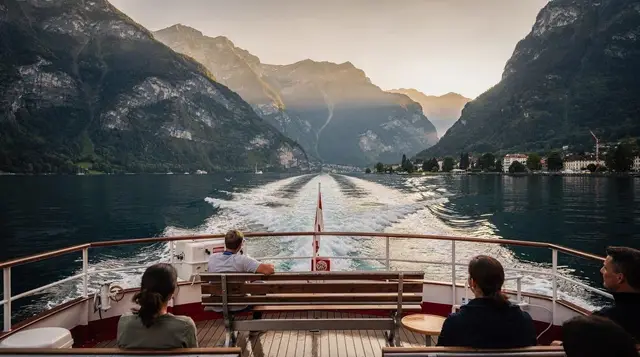
Interlaken and the villages around it are full of public fountains (Brunnen), fed by mountain springs and safe to drink from unless a sign explicitly says otherwise (kein Trinkwasser, rare but it exists near a few livestock troughs). This matters more than it sounds: a 500ml bottle of water at a kiosk or restaurant costs CHF 3.50 to CHF 5, and refilling a bottle from a fountain costs nothing. Fill up before a hike, before a train, before a boat trip on Lake Thun or Lake Brienz — tap water at any accommodation is exactly the same water, so there’s no need to buy bottled water for the room either.
Picnicking: the Hohematte and the lakeshores
Interlaken’s centrepiece is the Hohematte, the 14-hectare protected meadow between the Hoheweg’s grand hotels, and it’s open public land with no restriction on bringing your own food. Buy bread, cheese, cured meat and fruit from Migros or Coop, and you have a lunch or dinner with a view of the Jungfrau massif for the price of the groceries, not a service charge on top.
The same applies along both lakeshores: Lake Thun’s promenade near Unterseen and Matten and the quieter stretches of Lake Brienz both have benches and grass within a short walk of a fountain. It’s one of the better entries on the town’s free things to do list, and it works just as well as a pre-hike lunch as it does an evening meal watching paragliders land on the meadow.
Mountain restaurants: budget rules change up high
Everything above assumes you’re eating in the valley. Once you’re on a mountain — Harder Kulm, Schynige Platte, the Jungfraujoch, Grindelwald First — the calculation changes, because everything served up there has been transported by rail or cable car, and prices reflect that: a simple pasta dish that costs CHF 22 in Interlaken can be CHF 28 to CHF 34 at altitude, and a bottle of water can double in price.
The standard workaround is to bring your own food up rather than buying at the top, which is entirely permitted at the outdoor terraces even if some indoor restaurants would rather you didn’t. The mountain huts and berghaus dining guide has specifics for individual summits, including which ones have a genuinely good self-service option versus which only have a full-service restaurant.
What a realistic day of eating actually costs
Three scenarios, based on current prices, to plan against rather than guess:
| Approach | Breakfast | Lunch | Dinner | Total per person |
|---|---|---|---|---|
| Frugal (self-catering) | Bakery Gipfeli + coffee (CHF 6) | Supermarket picnic (CHF 8) | Hostel-cooked pasta (CHF 8) | ~CHF 22 |
| Mixed | Bakery (CHF 6) | Restaurant Tagesteller (CHF 22) | Hostel-cooked (CHF 8) | ~CHF 36 |
| Restaurant-only | Café breakfast (CHF 14) | Restaurant main + drink (CHF 30) | Restaurant dinner + drink (CHF 40) | ~CHF 84 |
Over a five-day stay, the gap between the frugal and restaurant-only columns is roughly CHF 300 per person — the price of a return train ticket to somewhere else, or two extra nights of accommodation. Neither approach is wrong, but knowing the real numbers means the choice is deliberate rather than accidental. For a broader breakdown covering accommodation and activities alongside food, see Interlaken travel costs and the dedicated Interlaken on a budget guide.
Cheese and chocolate without the tourist markup
Two Swiss staples get sold twice in Interlaken: once at a fair price in a supermarket, and once at a marked-up “experience” price aimed at visitors. A block of Gruyère, Emmental or local alpine cheese from Migros or Coop costs a fraction of the same cheese served as a plate at a themed restaurant, and it’s the identical product from the same regional dairies — the cheese dairies of the Bernese Oberland guide covers where that cheese is actually made if you want to see the process rather than just eat the result.
Chocolate follows the same pattern: supermarket-shelf Swiss chocolate is genuinely good and costs a few francs a bar, while a chocolate-making workshop or tasting experience costs considerably more for the added activity, covered separately in the Swiss chocolate experiences guide. Neither is a bad choice; the point is knowing which price you’re paying for the food and which price you’re paying for the show.
If a food-focused outing on the water is what you’re after rather than a self-guided picnic, the scenic wine and cheese tasting tour puts local producers’ actual product in front of you with someone explaining it, which is a fair trade for the higher price of an organised activity rather than a supermarket run.
For something sweeter and low-effort, the chocolate fondue float on the river is a novelty rather than a budget option, but it’s a one-off worth costing into a trip rather than an ongoing expense. And for a proper Swiss classic combined with an outdoor activity, the raclette rafting trip on the river bundles a hot meal into an afternoon on the water, which for some travellers is worth more than the cash saved by cooking at the hostel that night.
A day plan built around eating cheap
A concrete version of the frugal approach: start at a bakery near Unterseen and Matten or on the Hoheweg for a Gipfeli and coffee, then walk or cycle out along easy flat walks around Interlaken with a fountain-refilled water bottle. Stop at a Migros or Coop on the way back for picnic supplies — bread, cheese, fruit, maybe a cold drink — and eat it on the Hohematte or by the lakeshore rather than sitting down at a restaurant.
Save the one restaurant booking of the day for lunch rather than dinner, when the Tagesteller makes the same kitchen’s food a third cheaper, and cook something simple back at the hostel kitchen in the evening. None of this requires giving up eating well in Interlaken; it just moves the spending to where the value actually is.
Frequently asked questions about eating cheap in Interlaken
What time do supermarkets close in Interlaken?
Migros and Coop branches on the Hoheweg and near the two stations typically close at 18:30 or 19:00 on weekdays and around 17:00 on Saturdays. Nearly everything closes on Sundays, with the exception of the small Migros and Coop shops inside Interlaken Ost and Interlaken West stations, which open on Sundays and later into the evening.
Is tap water safe to drink in Interlaken?
Yes. Tap water is drawn from local springs and meets drinking water standards without treatment. Public fountains (Brunnen) around town and in the surrounding villages run the same water and are safe to refill from unless a sign specifically says kein Trinkwasser.
What is a Tagesteller and how much does it cost?
A Tagesteller, or Mittagsmenü, is a fixed lunch plate served roughly between 11:30 and 14:00, usually a main course with a small salad or soup included. In and around Interlaken it typically costs CHF 19 to CHF 26, compared with CHF 32 to CHF 45 for the same restaurant’s dinner mains.
Do hostels in Interlaken have kitchens guests can use?
Most of the larger hostels, including Backpackers Villa Sonnenhof, Balmers Hostel and Funny Farm, have communal kitchens with hobs, a fridge and basic pans included in the room rate. Bringing pasta, eggs or a supermarket rösti from Migros or Coop and cooking it yourself cuts a meal’s cost to under CHF 8.
Which supermarket is cheapest, Migros, Coop, Denner or Lidl?
Denner and Lidl generally undercut Migros and Coop on branded groceries, but neither has a branch in central Interlaken; the nearest Denner is in Unterseen and Lidl is on the edge of Matten. For anything bought within walking distance of the two stations, Migros and Coop are the realistic options and price differences between them are minor.
How much should a full day of eating in Interlaken cost?
A self-catering day with a bakery breakfast and a supermarket picnic lunch and dinner runs about CHF 25 to CHF 35. Mixing in one restaurant lunch pushes that to CHF 40 to CHF 55. A day of three restaurant meals, with drinks, typically lands between CHF 70 and CHF 100 per person.
Are bakeries a cheap breakfast option?
Yes. A Gipfeli (croissant) and coffee from a Bäckerei such as the ones near Interlaken West or on the Hoheweg costs around CHF 5 to CHF 7, against CHF 12 to CHF 18 for a hotel breakfast buffet bought separately from a room rate.
Can you picnic on the Hohematte or by the lakes?
Yes, and it is one of the better free things to do in the town. The Hohematte meadow in the centre of Interlaken and the shorelines of Lake Thun and Lake Brienz are open public space with no restriction on bringing your own food, and several spots have benches or grass close to a fountain.
Lake cruises & boat tours on GetYourGuide
Verified deep-linked GetYourGuide tours. Book through these links and we earn a small commission at no cost to you.
GetYourGuide does not provide a product photo for this activity — the image shows the meeting point, photographed by us.