Where to stay in Interlaken: centre, Unterseen, Matten, Bönigen or up the mountain
Where should I stay in Interlaken?
Interlaken centre is the easiest base for two train stations and a wide choice of hotels, but it is not the cheapest or the quietest. Unterseen and Matten are a 10 to 15 minute walk away and noticeably cheaper. Staying up in Wengen, Mürren or Grindelwald cuts your morning journey to the mountains but adds a train change for everything else.
Most people who ask where to stay in Interlaken actually mean something narrower: is it worth paying more to be near the Hoheweg, or is a cheaper room in Unterseen or Matten just as good. And a smaller group is asking a different question entirely — should they skip Interlaken altogether and sleep up at Wengen, Mürren or Grindelwald instead. Both questions have real answers, and they depend mostly on how many nights you have and how early you want your first mountain train.
Interlaken itself is smaller than it looks on a map
Interlaken proper has around 5,900 residents. Add Unterseen and Matten, and the built-up area people mean when they say “Interlaken” — locally the Bodeli — comes to roughly 15,000. None of it is large. From the Hoheweg to Unterseen’s old town is a 12-minute walk along the river; from the Hoheweg to Matten’s edge is less than that. This matters for the accommodation decision, because “staying outside the centre” in Interlaken rarely means a long commute — it usually means a 10 to 20 minute walk, or one stop on the local bus.
The town also has two railway stations, and which one you’re closer to changes your daily routine more than which neighbourhood you’re in. Interlaken Ost is the departure point for Jungfrau region trains (Lauterbrunnen, Grindelwald, and on to the Jungfraujoch), for Lake Brienz boats, and for the Brünig line to Lucerne. Interlaken West sits closer to the Hoheweg and the shopping streets, and is where Lake Thun boats depart. A hotel a five-minute walk from West can still be a 20-minute walk from Ost.
The options at a glance
| Base | Price level | Distance to Interlaken Ost | Best for |
|---|---|---|---|
| Interlaken centre (Hoheweg) | CHF 180–450+ / double | 5–15 min walk | First-timers, short stays, no car |
| Unterseen | CHF 120–220 / double | 15–20 min walk | Quieter old town, better value |
| Matten | CHF 100–200 / double | 10–15 min walk | Budget stays, families, self-catering |
| Bönigen | CHF 110–230 / double | 10 min walk or bus | Lake Brienz shoreline, calmer evenings |
| Wengen | CHF 150–350 / double | ~50 min (train + train) | Early Jungfraujoch starts, car-free village |
| Mürren | CHF 160–380 / double | ~1 h 10 (train + cable car) | Views of the Eiger, Mönch and Jungfrau |
| Grindelwald | CHF 160–400 / double | ~35 min by train | Eiger Express access, First and Männlichen |
Prices are indicative doubles in high season (July–August, December–February) and swing 20–30% lower in shoulder months. Switzerland is expensive everywhere on this list; the differences between these bases are smaller than the difference between Switzerland and almost anywhere else.
Interlaken centre: convenience, at a price
The stretch along the Hoheweg, facing the Hohematte — the 14-hectare protected meadow where paragliders land in front of the grand hotels — is the most recognisable part of town and the most expensive. You’re paying for being a level walk from both stations, from the Migros and Coop supermarkets, from restaurants that stay open past 9pm, and from the tourist office. For a stay of two or three nights built around one or two big mountain excursions, that convenience is worth something: you’re not managing luggage across town at 6am for an early Jungfraujoch train.
The trade-off is that many centre hotels are large, coach-tour-oriented properties, and rooms facing the Hoheweg can pick up traffic noise. Ask for a courtyard or park-facing room if that matters to you. It’s also worth reading where things get overpriced in this town before booking anything that looks like a “central location” premium rather than a genuine upgrade.
Unterseen: the same walk, a better old town
Cross the Aare from the Hoheweg and you’re in Unterseen, technically a separate municipality with its own 13th-century core, a proper town square, and noticeably fewer coach groups. Guesthouses here run cheaper than equivalent Hoheweg rooms for a similar or shorter walk to Interlaken West, though Interlaken Ost is a bit further. It suits people who want to feel like they’re staying in a Swiss town rather than a tourist strip, without adding real distance.
Matten: where locals actually live
Matten stretches south from the centre and mixes small hotels, B&Bs and self-catering apartments at some of the lowest rates on the Bodeli. It’s flat, walkable, and close enough to both stations that the saving isn’t offset by inconvenience. Families doing a week with day trips out tend to end up here for the extra space an apartment gives over a hotel room, and because groceries from the Matten Coop cost the same as they do anywhere — unlike a hotel breakfast buffet.
Bönigen: quieter evenings, Lake Brienz on your doorstep
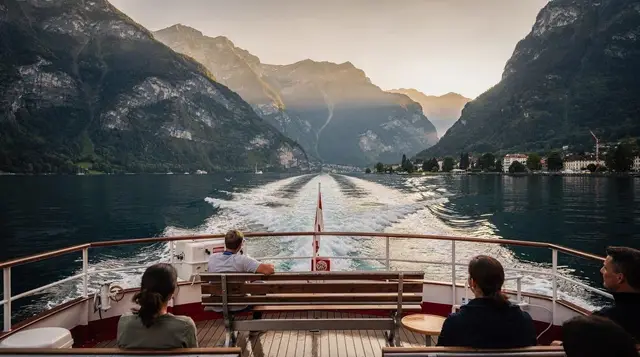
Bönigen sits at the near end of Lake Brienz, a short walk or one bus stop past Interlaken Ost. It has none of the restaurant density of the centre, but it does have a genuinely different evening atmosphere — the turquoise water, the working boat harbour, mountains rising straight from the shore. If your priority is swimming and quiet lakeside walks over nightlife, this is a better fit than the Hoheweg, and it’s still an easy ride into town for dinner.
Sleeping higher up: Wengen, Mürren and Grindelwald
This is the real fork in the decision, not a variation on it. Staying in Interlaken means every mountain excursion starts with a train ride; staying up at Wengen, Mürren or Grindelwald means you wake up already there, at the cost of a slower, costlier connection back down for anything else — dinner in town, a lake boat, the shops on the Hoheweg.
Wengen and Mürren are both car-free villages, reached only by train or cable car, with cars left behind in Lauterbrunnen or Stechelberg. Wengen sits directly on the railway toward the Jungfraujoch via Kleine Scheidegg, which makes it the more logical overnight base if that trip is your priority — you can be on the first train up without an early alarm for the journey from Interlaken.
Mürren looks straight across the valley at the Eiger, Mönch and Jungfrau and feels the more scenic of the two to simply sit in, but reaching it from Interlaken means a train to Lauterbrunnen and then a cable car change, and evenings there are genuinely quiet — there is very little to do after dinner beyond the view itself.
Grindelwald is the largest and most developed of the three, with the Eiger Express gondola giving a roughly 15-minute run up to the Eigergletscher and the Jungfraujoch beyond it, plus direct access to Grindelwald First and Männlichen. It has more restaurants and hotels across more price points than Wengen or Mürren, and the train down to Interlaken Ost takes about 35 minutes, so a night out in town is realistic if you want it.
None of these three is cheaper than Interlaken. What you’re buying is time in the morning and a different view from the window, not a lower bill — check seasonal closures for lifts and railways before committing to a mountain base, since spring and autumn maintenance windows can strand you above a station with nothing running.
Getting between your base and everything else
Wherever you stay, day trips beyond the immediate Jungfrau region usually route back through Interlaken first. A Swiss Travel Pass or the regional Jungfrau Travel Pass can flatten the cost difference between bases considerably, since a pass covering unlimited regional travel makes staying an extra 20 minutes out far less of a daily tax. If you’re arriving from Zurich Airport, factor the roughly two-hour transfer into your first night’s plans regardless of where you’ve booked — nobody arrives ready for an immediate mountain excursion.
Guests based in the centre or Matten can also cover ground independently: an e-bike hired for a day around the two lakes reaches Unterseen, Bönigen and beyond without waiting on bus timetables, and a guided e-bike route past castle ruins and lake viewpoints is a reasonable way to see both shorelines in one outing if you’d rather not plan the route yourself.
Which base for how many nights
For a single overnight stop between longer stays elsewhere, the centre or Matten make sense purely on convenience — you’re not there long enough for the walk to matter. For three to five nights built around several mountain excursions, Unterseen or Matten give the same access at a better rate, and the saving adds up across a week; see how many days to actually plan for Interlaken before booking a length of stay. For a trip where the Jungfraujoch or the view from Mürren is the entire point and everything else is secondary, one or two nights up at Wengen, Mürren or Grindelwald is worth the extra planning, ideally bookended by nights in Interlaken for the transport links.
Travellers doing more than a week, mixing lake time with mountain days and a couple of outings further afield, tend to do best splitting the stay — a base in town for the lakes, shopping and evenings, then a night or two up at altitude for the early trains. It costs more in packing and unpacking, not necessarily more in francs, since mountain hotel rates aren’t dramatically higher than the centre’s top end.
If your days already lean toward the water, add on activities that use it directly: a ride out to Iseltwald and the Giessbach falls suits a Bönigen or centre base equally well, and an early tour through the valleys and waterfalls around town is a manageable half-day whichever side of the Bodeli you’ve chosen to sleep on.
Where to stay in Interlaken: frequently asked questions
Is Interlaken centre worth the extra cost over Unterseen or Matten?
Only if the walk to both stations genuinely matters to your itinerary — for example, an early Jungfraujoch departure with heavy luggage. For a relaxed pace, the 10 to 15 minute walk from Unterseen or Matten is a minor cost for a meaningful saving.
Is it better to stay in Interlaken or Grindelwald?
Interlaken gives you two stations, boats on both lakes, and the widest range of hotel prices. Grindelwald puts you closer to the Eiger Express and First, at higher room rates, and you still travel by train for anything outside the Jungfrau region.
Should I stay in Wengen or Mürren?
Both are car-free and reached only by train or cable car. Wengen sits on the railway to the Jungfraujoch, so it is the more convenient overnight stop if that is your main goal. Mürren looks straight across at the Eiger, Mönch and Jungfrau and feels quieter, but adds a cable car change to reach it.
How far is Bönigen from the centre of Interlaken?
About a 15-minute walk from Interlaken Ost, or one stop on the local bus covered by the Interlaken guest card. It’s closer to Interlaken Ost than most of the Hoheweg hotels are.
Do I need a car if I stay in Wengen, Mürren or Grindelwald?
No — and for Wengen and Mürren you can’t drive in at all. Cars stay in Lauterbrunnen or Stechelberg and you continue by train or cable car. Grindelwald is reachable by road, but the train from Interlaken Ost is simpler and there’s no parking advantage to driving.
Is Matten a safe, sensible choice for families?
Yes. It’s flat, quiet in the evenings, close to a supermarket, and within easy walking distance of both stations. Self-catering apartments there are common and generally cheaper than an equivalent hotel room in the centre.
Does staying up the mountain save money overall, once you count the transport?
Rarely. Mountain-base hotel rates are comparable to or higher than Interlaken’s, and you still pay for the railway or cable car to reach anything outside the immediate village. The advantage is time and an early start, not cost.
What’s the single biggest mistake people make choosing where to stay?
Booking a mountain village for a short trip and then discovering the lifts are closed for spring or autumn maintenance, or grounded by wind, with nothing else to do in the village that evening. Check when the mountain railways open and close before booking anywhere above Interlaken.
Lake cruises & boat tours on GetYourGuide
Verified deep-linked GetYourGuide tours. Book through these links and we earn a small commission at no cost to you.
GetYourGuide does not provide a product photo for this activity — the image shows the meeting point, photographed by us.