Swimming in Lake Thun and Lake Brienz
Can you swim in Lake Thun and Lake Brienz, and which is warmer?
Yes, both lakes are swum in all summer and are clean enough that locals do it daily. Lake Thun is the warmer of the two, reaching roughly 22-23°C in August, while glacier-fed Lake Brienz rarely gets much past 18-19°C even at the height of summer.
Everyone photographs Lake Brienz for its colour and Lake Thun for its castles, but on a hot July afternoon the more useful question is simpler: where can you actually get in the water, is it free, and how cold is it going to be. The two lakes behave differently enough that the answer depends on which one you are standing next to.
Water temperature, month by month
Both lakes are monitored informally by the same swimmers who use them every year, and the pattern is consistent enough to plan around. Lake Thun is the warmer lake because its main inflow has already passed through Lake Brienz and the town of Interlaken, giving the water time to lose its glacial edge. Lake Brienz stays cold because it receives glacial meltwater more directly, via the Lütschine and the upper Aare.
| Month | Lake Thun (typical surface temp) | Lake Brienz (typical surface temp) | Realistic for swimming? |
|---|---|---|---|
| May | 13-15°C | 10-12°C | Short dips only, cold shock risk |
| June | 17-19°C | 13-15°C | Thun yes, Brienz brief |
| July | 20-22°C | 16-18°G | Both comfortable |
| August | 22-23°C | 17-19°C | Peak season, both good |
| September | 19-21°C | 15-17°C | Thun still pleasant, Brienz cooling fast |
| October | 14-16°C | 11-13°C | Cold-water swimmers only |
Treat these as typical ranges rather than a guarantee for any given day. A cold, rainy week in June can knock two or three degrees off either lake, and a hot spell with little wind can push Lake Thun a degree or two above the range shown. If you want a live read before setting out, the Bundesamt für Umwelt publishes daily gauge readings for both lakes, and most of the Strandbad kiosks chalk the day’s temperature on a board by the entrance.
The practical takeaway: if someone tells you Lake Brienz is “the same as Thun, just prettier,” they have not actually swum in it. The temperature difference is large enough to notice within the first ten seconds.
Free public beaches around Lake Thun
Lake Thun’s shoreline has more flat, accessible ground than Lake Brienz, so free spots are easier to find. None of the following charge for access; you bring your own towel and use whatever shade or grass is available.
- Merligen, on the lake’s less-visited northern shore, has a long shingle and grass shoreline with views across to the Niesen and Stockhorn ranges. It is the quietest of the free options and a reasonable stop if you are exploring Sigriswil and Merligen by car or postbus.
- Oberhofen has a small public lawn immediately below Oberhofen Castle, shaded by mature trees, with the boat landing a short walk away if you want to combine swimming with a Lake Thun cruise.
- Spiez offers free lake access along the public shoreline west of the castle bay, separate from the paid Seebad Spiez lido described below. It gets busy on weekends because it is one of the few spots with direct rail access from Spiez station.
- Interlaken itself has limited free lake swimming directly in town; the Aare canal that runs between the Höhematte and the lakes is used by some swimmers for a current-assisted float, but this is not an official swimming area and is best avoided by anyone unfamiliar with the current.
- Thun’s Schadaupark, at the point where the Aare leaves the lake, has open lawns with lake access next to the paid Strandbad, useful if you want free grass without paying the lido entrance.
Paid lidos: Strandbad Thun and the pool-and-lake combination
A Strandbad or Seebad adds infrastructure that the free spots do not have: changing cabins, lockers, a proper swimming pool alongside the lake, diving platforms, a snack kiosk, and, during the busiest weeks of summer, a lifeguard on duty.
Strandbad Thun, on the lake shore a ten-minute walk from Thun’s old town, is the largest of these facilities on either lake. It combines a heated outdoor pool with direct lake access, diving boards of varying heights, and grass terracing for sunbathing. Entry runs roughly CHF 7-9 for an adult day ticket, cheaper with a half-day rate after mid-afternoon. It gets crowded on the first hot weekend of the season and stays that way through August.
Seebad Spiez, on the Lake Thun shore near Spiez Castle, is smaller and quieter than the Thun facility, with a similar mix of pool and lake access. It suits a stopover if you are already visiting Spiez on the way to or from Kandersteg or the Simmental.
There is no equivalent large paid lido on the Interlaken side of Lake Brienz; the facilities there lean towards free public lawns rather than pool-and-lido complexes, partly because the colder water makes a heated pool alongside it more attractive to operators, and none has been built at that scale.
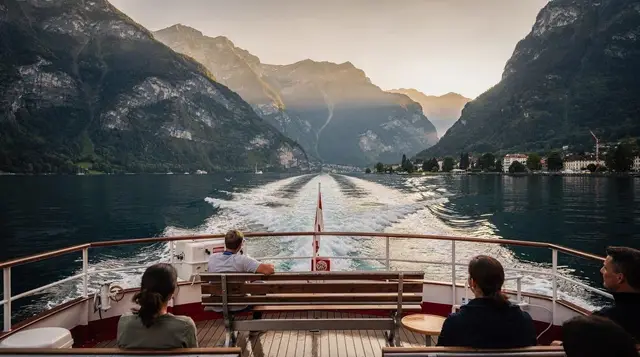
If you would rather see both lakes from the water than swim in them on a given day, the Interlaken boat day pass on Lake Thun covers unlimited hop-on hop-off travel between the shoreline villages, which is a reasonable way to scout beaches before committing a whole afternoon to one spot.
Lake Brienz: free spots and the cold-water reality
Lake Brienz’s free swimming spots are fewer and generally smaller than Thun’s, partly because the shoreline is steeper and backed by forest for long stretches between villages.
- Bönigen, a short walk or bus ride from Interlaken Ost, has a public lakeside lawn that is the closest easy swimming spot to central Interlaken and popular at sunset because of the view down the lake towards the Brienzer Rothorn.
- Iseltwald has a small public swimming area near the church point, the same peninsula that draws large day-trip crowds for photographs. Swimming here in July and August means sharing a fairly small patch of shoreline with a lot of visitors; arriving before 10am avoids the worst of it. If you are combining a swim with sightseeing further round the lake, the Interlaken quad tour to Iseltwald and Lake Brienz covers the same shoreline by a different route.
- Giessbach, reached by the funicular below the Giessbach Falls, has a small pebble beach at lake level that is quieter than Iseltwald simply because fewer people make the extra stop.
What all three share is the cold. Even in the warmest week of August, Lake Brienz rarely climbs much past 18-19°C at the surface, and a few metres down it drops further. Locals swim in it happily, but first-time visitors from warmer climates are often surprised by how much colder it feels than the postcard colour suggests. Budget for a shorter swim than you would plan at Lake Thun, and know that the initial minute is the hardest part; most people adjust after that, but a few do not and get out again, which is a sensible response rather than a failure of nerve.
For a longer look at why the water is that particular shade of turquoise-grey, see why Lake Brienz is that colour — it comes down to the same glacial silt that keeps the lake cold.
Where swimming is banned: jetties and boat lanes
Both lakes are worked by the Schifffahrtsgesellschaft Thunersee und Brienzersee passenger fleet, and every landing stage has a marked exclusion zone where swimming is prohibited. This is not a formality: propellers and docking manoeuvres near a jetty are genuinely dangerous, and the fines for swimming inside a marked zone are enforced.
The specific places to avoid:
- The approach and departure channels at every boat landing on both lakes, generally marked by yellow buoys or a sign on the jetty itself.
- The canal sections around Interlaken Ost and Interlaken West, where the Aare connects the two lakes and boat and rail traffic both operate close to the banks.
- Any stretch marked with a red-and-white “Baden verboten” sign, which appears near a small number of private jetties and steep drop-off points in addition to the commercial landings.
Outside these marked areas, swimming from a public shore or your own boat is normal and unrestricted. If you are unsure whether a stretch of shoreline is clear, the absence of a jetty or a sign is generally your answer.
Practical notes before you get in
A few things matter more here than at a typical lakeside destination:
- Depth changes quickly on both lakes close to shore in places, particularly near Brienz and along the steeper northern side of Lake Thun. Wade in rather than diving from an unfamiliar spot.
- Wind changes conditions fast. Both lakes sit in a valley that channels wind, and a calm morning can turn choppy by early afternoon, which matters more for open-water swimming than for a quick dip near shore.
- Water quality is genuinely good. Switzerland treats both lakes as drinking-water sources in parts of the catchment, and algae blooms are rare compared with many alpine lakes at lower altitude, so this is one thing you do not need to worry about.
- Sun exposure is stronger than it looks. At 560 m for Interlaken and higher around the shoreline villages, UV is more intense than the mild air temperature suggests, and reflection off the water adds to it.
- Facilities close outside summer. The paid lidos generally run from late May to early September; outside that window, free shoreline access remains but changing rooms and kiosks do not.
If your priority is seeing the lakes rather than swimming in them, the two-lakes cruise guide and the dedicated Lake Brienz boat trips guide cover the timetables and routes in detail, and the Interlaken: Lake Thun cruise with St. Beatus Caves and picnic pairs a cruise with one of the better-known stops on the northern shore.
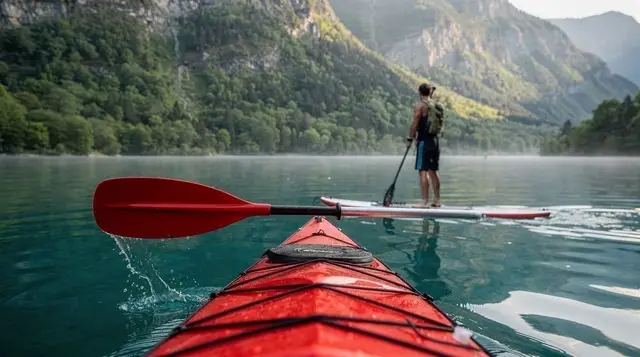
For anyone wanting to get closer to the water than a boat deck allows, kayaking and SUP on Lake Brienz is a reasonable middle ground between a full swim and a cruise ticket, and the attraction ticket day pass for Lake Thun and Brienz boat cruises covers both lakes if you want to compare the shoreline villages before deciding where to spend a swimming afternoon.
Which lake to choose, and when
If you only have one afternoon and want a comfortable swim without cold-water surprises, Lake Thun in July or August is the straightforward choice, and Spiez or Oberhofen give you free access plus a paid lido nearby as a backup. If you want the view that makes Lake Brienz famous and are prepared for a shorter, colder swim, Bönigen is the easiest option from Interlaken itself, with Iseltwald as the more scenic but more crowded alternative. Neither lake needs advance planning beyond checking the day’s temperature and avoiding the marked boat zones — bring a towel, pick your spot, and the rest takes care of itself.
Frequently asked questions about swimming in Lake Thun and Lake Brienz
Is it safe to swim in Lake Thun and Lake Brienz?
Yes, water quality in both lakes is high and swimming is a normal local activity. The main risks are cold shock from sudden depth changes, boat traffic near jetties and shipping lanes, and underestimating how quickly Lake Brienz cools you down.
Which lake is warmer for swimming, Thun or Brienz?
Lake Thun. It is shallower on average and not directly fed by a glacier, so it warms several degrees more than Lake Brienz, which draws meltwater from the Aare glacier via the Lütschine and Aare rivers.
Do you have to pay to swim in the lakes?
No. Public lawns and pebble shorelines around both lakes are free to use. You only pay to enter a Strandbad or Seebad lido, which adds changing rooms, lockers, diving platforms, and usually a proper swimming pool alongside the lake access.
What months can you actually swim without wetsuits?
Late June through early September for Lake Thun, and a slightly shorter window, roughly mid-July to late August, for Lake Brienz. Outside those windows the water is swimmable but genuinely cold, closer to 10-15°C.
Where are the free public beaches around Interlaken?
The best free spots are the lawns at Bönigen and Iseltwald on Lake Brienz, and Merligen, Oberhofen, and Spiez’s public shoreline on Lake Thun. None of these charge entry, though some have limited parking.
Why is Lake Brienz so much colder than Lake Thun?
Lake Brienz sits at the end of a valley fed directly by glacial meltwater carried down by the Lütschine and Aare rivers, which keeps the water cold and gives it its distinctive turquoise colour from suspended glacial silt. Lake Thun’s main inflow has already passed through Lake Brienz and Interlaken first, giving it more time to warm.
Can you swim near the boat landing stages?
No. Swimming is prohibited within the marked zones around every Schifffahrtsgesellschaft Thunersee und Brienzersee jetty, and near the Interlaken Ost and Interlaken West canal channels, because passenger boats and their propellers use these areas.
Are there lifeguards at the lake beaches?
Only at the larger paid Strandbad complexes during peak summer, and even then only at set hours. The free public lawns and pebble beaches have no lifeguard cover at all, so you swim at your own judgement.
Lake cruises & boat tours on GetYourGuide
Verified deep-linked GetYourGuide tours. Book through these links and we earn a small commission at no cost to you.
GetYourGuide does not provide a product photo for this activity — the image shows the meeting point, photographed by us.