Lake Thun vs Lake Brienz: which one for your day?
Which is better, Lake Thun or Lake Brienz?
Lake Brienz has cleaner, brighter turquoise water and steeper mountain walls, so it wins on scenery and swimming. Lake Thun has more towns, a castle you can walk into and more frequent boats close to Interlaken, so it wins on convenience and variety. If you only have time for one, pick Brienz for a short, dramatic trip and Thun for a fuller day.
Interlaken sits on a strip of land between two lakes that look nothing alike, and most visitors only work this out once they are standing on the shore of one wondering why it does not match the postcard. Lake Thun and Lake Brienz are ten minutes apart by train and share a station town, but the water, the villages and the way you spend a day on each are genuinely different. This guide sets out the differences that matter for planning: colour, temperature, what is around the shore, and which one deserves your limited time.
Two lakes, one town in between
Interlaken means “between the lakes”, and the name is literal. Interlaken West station faces Lake Thun; Interlaken Ost, roughly two kilometres east, faces Lake Brienz and also serves as the departure point for the Jungfrau railway network. This geography is the first practical point: whichever lake you head for, you are starting from a different station, and the two are not within easy walking distance of each other with luggage.
| Lake Thun | Lake Brienz | |
|---|---|---|
| Length | 17.5 km | 14 km |
| Max depth | 217 m | 261 m |
| Water colour | Deep blue-green | Turquoise, milky |
| Typical August surface temp | Low 20s°C | High teens°C |
| Main town on shore | Thun, with its castle and old town | Brienz, known for woodcarving |
| Boat departures from Interlaken | Frequent, multiple daily | Frequent, multiple daily |
| Best known for | Castles, Beatus Caves, Spiez | Colour, Giessbach Falls, Iseltwald |
Colour: why Brienz looks turquoise and Thun looks green-blue
Lake Brienz’s colour is the single most photographed thing about the Bernese Oberland, and it is not an accident of light. The lake is fed largely by the Aare river as it drains the glaciers around the Grimsel and Susten passes, carrying with it extremely fine rock particles known as glacial flour. Suspended in the water, these particles scatter sunlight in a way that produces the milky turquoise seen from Iseltwald, Giessbach and the boats. The effect is strongest from June to September when glacial melt peaks, and it is genuinely visible to the naked eye, not a trick of photo editing.
Lake Thun’s water comes from broadly similar glacial sources but has had longer to settle by the time it reaches the lake, and the lake itself is shallower near its edges, so it reads as a clearer, deeper blue-green rather than the opaque turquoise of Brienz. Neither colour is better exactly, but if the postcard shot is the priority, Brienz is the lake in the photograph.
Water temperature and swimming
Both lakes are swimmable in summer, and both have proper public bathing areas rather than just a patch of grass. Lake Thun tends to be a degree or two warmer at the surface, helped by its shallower shoreline shelves at spots like Spiez and Hilterfingen. Lake Brienz, being more directly glacier-fed, keeps a slight chill even in August, particularly a few metres from shore where the depth drops away quickly. Neither lake is unpleasantly cold for a summer swim, but if you are choosing based on comfort rather than scenery, Thun edges it.
For a longer look at temperatures month by month and the best official bathing spots on each shore, see swimming in Lake Thun and Lake Brienz.
Villages and towns around each lake
Around Lake Thun
The Lake Thun shore is more built up and more varied. Thun itself, at the lake’s outflow, has a proper old town with a hilltop castle you can walk around inside, unlike most Swiss lake towns which only offer a view of theirs. Spiez, a stop for the GoldenPass line as well as the boats, has its own waterside castle and vineyard terraces. Oberhofen and Hilterfingen sit almost opposite each other with their own castles visible from the water, and Sigriswil and Merligen on the north shore are quieter, with the Beatus Caves a short walk from the Merligen boat stop.
Around Lake Brienz
Lake Brienz’s shore is steeper and less developed. Brienz town at the far end is known for woodcarving workshops and violin making, and is also the terminus for the Brienz Rothorn steam rack railway, the last of its kind in Switzerland. Closer to Interlaken, Iseltwald and Giessbach are the two names that come up most: Iseltwald is a small fishing village whose jetty became disproportionately famous after appearing in a Korean television drama, and Giessbach is a waterfall dropping directly into the lake beside a restored funicular and a grand nineteenth-century hotel.
Boat trips compared
Both lakes are served by the same operator, BLS Schifffahrt, and both run frequent scheduled boats through the summer timetable, dropping to a reduced winter service. Where they differ is in what you are sailing past.
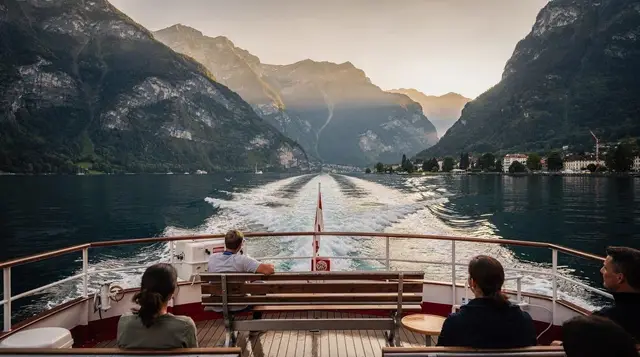
A full round trip on Lake Thun, calling at Spiez, Thun, Oberhofen and Hilterfingen, takes around two hours and works well as a sightseeing loop with a castle stop built in. A one-way crossing of Lake Brienz to Brienz town takes around an hour and is more about the water itself and the Giessbach stop than a string of towns to get off at.
For a flexible day of hopping on and off along the Thun shore, the day pass covering unlimited boat travel on Lake Thun works out cheaper than buying single tickets if you plan more than two legs. If you would rather not choose in advance which lake you will end up sailing, an attraction ticket covering a day of boats on both Lake Thun and Lake Brienz removes that decision, at a price that beats separate tickets on each lake.
Fares are broadly similar per kilometre on both lakes: a short hop of one or two stops runs to around CHF 15 to 20, and a full round trip is typically CHF 45 to 60 depending on the route, before any pass discount. The Swiss Travel Pass covers both lakes’ boats in full, so if you already hold one there is nothing extra to book.
For a fuller breakdown of routes, timetables and which class of boat runs where, see Lake Thun boat trips and Lake Brienz boat trips, or the combined two-lake cruise guide if you want to attempt both in a single day.
A guided way to see the highlights
If working out stops and connections yourself is not appealing, a couple of set-route options cover the main sights without you having to plan the boat timetable. The Lake Thun cruise that includes the Beatus Caves and a picnic stop bundles the castle-and-cave side of Lake Thun into a single half-day. On the Brienz side, the quad bike tour out to Iseltwald and the Lake Brienz shoreline is a faster, land-based way to reach the same viewpoints the boats serve, useful if the boat timetable does not fit your day.
Activities on and around the water
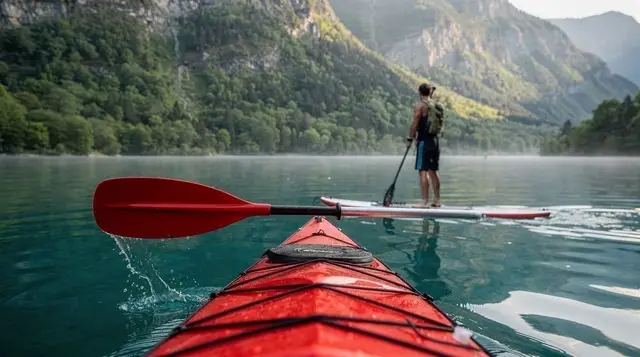
Lake Thun’s flatter, more sheltered water and its longer stretch of accessible shoreline make it the more established base for stand-up paddleboarding and casual kayaking near town, and its warmer temperature makes swimming more comfortable for longer. Lake Brienz’s colder, clearer water and steeper drop-offs suit kayaking and paddleboarding for those who want scenery over comfort; see kayaking and SUP on Lake Brienz for put-in points. Both lakes are used for classic paddle-steamer cruises on restored vessels; the history and current routes of these boats are covered in paddle steamers of the Bernese Oberland.
Shoreline walking differs too. The path from Giessbach along Lake Brienz is short, well signed and ends at a genuine waterfall, described in Giessbach Falls and the shore path. Lake Thun’s shoreline paths are longer and flatter, better suited to a gentle stroll between villages than a single dramatic destination.
Castles and set-piece sights from the water
Lake Thun wins clearly here. Thun Castle, Spiez Castle and Oberhofen Castle are all visible from the boat and all three can be visited, giving Lake Thun a string of built attractions that Lake Brienz simply does not have. Lake Brienz’s equivalent draw is natural rather than built: Giessbach Falls, the Rothorn steam railway, and the water itself. If castles and built history matter to your day, Thun is the stronger choice; if you want scenery with fewer stops, Brienz is.
Weather, light and the time of day
The same lake can look quite different depending on the hour and the sky. Brienz’s colour reads best in clear, bright light, so a grey morning is a poor moment to judge it; if the cloud is low, it is often better to spend that stretch on Lake Thun, where the castles and villages still hold your interest without a big sky behind them. Thun’s blue-green looks richer under soft light than in harsh midday sun. If the forecast is unsettled, Interlaken in bad weather and things to do when it rains help you decide which indoor stops to line up around a boat, and altitude, weather and what to pack covers the layers worth carrying on deck, where it can feel cooler than on the pier.
The seasons matter as well. Summer is when both lakes are at their busiest and the boats run their fullest timetable. Spring and autumn are calmer on the water, and Interlaken in autumn describes how the shoreline looks once the crowds thin. For the broader picture of when to come, see the best time to visit Interlaken.
Getting between the lakes and onward
Because the two lakes start from different stations, it pays to settle which one you are doing before you leave your hotel. Trains, buses and boats around Interlaken explains how the local connections fit together, and the Swiss Travel Pass guide is worth reading if you are weighing whether a pass makes both lakes effectively free. If you are carrying bags between stations, luggage and lockers saves you dragging them onto a boat.
Think of the lakes as the gateway to other days as well. From the Thun side, the shoreline leads naturally towards Thun old town and castle and further on to Bern. From the Brienz side, the same journey continues to the woodcarving workshops described in Brienz woodcarving and violin making or up the line to the Brienzer Rothorn. If you are building a wider plan, day trips from Interlaken puts both lakes alongside the other options.
Travelling with others
Who is in your group changes the answer. Families with younger children usually find Thun easier: more places to stop, more to look at between stops, and gentler shoreline for a paddle. Brienz suits a shorter outing where the boat itself is the entertainment. Interlaken with kids covers the wider picture for families. Travellers on a tight budget can lean on Interlaken on a budget and free things to do in Interlaken, since a walk along either shore costs nothing and a swim costs very little. If you are travelling alone and want an easy, low-pressure day, solo travel in Interlaken suggests how a lake day fits in with other plans.
A few practical habits that help on either lake
- Decide the lake the night before, then look at the morning sky, rather than trying to plan every stop in advance.
- Bring a layer even on a warm day; the deck and the water’s edge are cooler than the town.
- Keep one stop in reserve. Whichever lake you pick, an unhurried lunch by the water usually turns out to be the part people remember.
- If you want to stay on land for part of the day, pair the boat with a short shoreline walk from easy flat walks around Interlaken, which suits either lake.
- If you are undecided about where to sleep to be near the water, where to stay in Interlaken compares the areas.
Which lake for your day trip
If you have a full day and want variety, spend it on Lake Thun: a boat to Spiez or Thun, a castle visit, lunch by the water, and a swim if the weather holds. If you have half a day and want the scenery that makes the Bernese Oberland famous in photographs, take the short crossing to Iseltwald or Giessbach on Lake Brienz instead. If you genuinely cannot choose, the town in between makes it easy to see a slice of both: a morning swim or short boat hop on one lake, and an afternoon at a village or castle on the other, without needing a car or more than one change of station.
For a fixed plan that does exactly this, see the two lakes and villages itinerary, or read why Lake Brienz is that colour and the Iseltwald effect for more on why one small village on Lake Brienz now gets busier than towns many times its size.
Lake Thun and Lake Brienz: your questions answered
Which is warmer for swimming?
Lake Thun, generally by a degree or two, thanks to its shallower shoreline shelves and greater direct sun exposure near Interlaken and Spiez.
Can you swim in both lakes?
Yes, both have official public bathing areas with changing rooms, though Lake Brienz stays noticeably colder even in August.
Which has better boat trips?
Lake Thun has more stops and more built attractions to visit along the way; Lake Brienz has fewer stops but more dramatic scenery from the deck.
Is Lake Brienz’s colour real?
Yes, it comes from fine glacial sediment in the water and is strongest from June to September.
Which lake is closer to Interlaken?
Both touch the town directly: Interlaken West faces Lake Thun and Interlaken Ost faces Lake Brienz.
Can you do both lakes in one day?
Yes, most visitors combine a short trip on each rather than a full round trip on both, which would take most of a day on boats alone.
Which is quieter?
Lake Thun’s north shore villages such as Sigriswil and Merligen are generally quieter than Lake Brienz’s Iseltwald, which has become a busy stop despite its size.
Are the boats covered by the Swiss Travel Pass?
Yes, on both lakes. The Interlaken hotel guest card does not cover the lake boats.
Lake cruises & boat tours on GetYourGuide
Verified deep-linked GetYourGuide tours. Book through these links and we earn a small commission at no cost to you.
GetYourGuide does not provide a product photo for this activity — the image shows the meeting point, photographed by us.