The village beneath a mountain everyone recognises
Grindelwald doesn’t need a viewpoint ticket to make its case. Walk out of the main train station, cross the Hauptstrasse, and the Eiger’s north face is already there — 1,800 metres of dark limestone and ice rising straight out of the meadows, close enough that you don’t need a zoom lens. It’s the same wall that killed climbers for decades before the first successful ascent in 1938, and the village has been selling the view, respectfully or otherwise, since the 1850s.
What Grindelwald offers that the high stations don’t is a place to actually stay: hotels, guesthouses, a Coop and a Migros, restaurants that don’t close at 4pm, and a station on the Jungfrau railway network that connects onward to almost everywhere. It sits at roughly 1,034 m, low enough to be snow-free for longer than Wengen or Mürren, high enough to feel properly alpine.
Grindelwald village and Grindelwald Grund are not the same place
This trips up a fair number of first-time visitors, and it matters for where you book a bed. Grindelwald village is the terrace above the valley floor — Hauptstrasse, the main railway station, most hotels, the church with its view of the north face over the cemetery. Grindelwald Grund, about ten minutes on foot downhill or one stop on the train, is flatter and less scenic: it holds a second, smaller station, the large car park serving the Grindelwald Terminal, and a scatter of guesthouses that run a little cheaper precisely because they’ve lost the view.
If you’re driving, Grund is often where you’ll actually park, since the terminal’s multi-storey garage is the main option for day visitors heading up the Eiger Express. If you’re staying the night, the village itself is worth the short uphill walk with your bags — the difference in outlook, from a room facing the Eiger versus a room facing a car park, is real.
Grindelwald Terminal and the Eiger Express
The Grindelwald Terminal, opened in December 2020, is a large glass-and-timber building down near Grund that replaced the old train-and-cable-car shuffle through Grindelwald Grund station. From here, the Eiger Express tricable gondola covers the climb to Eigergletscher — the junction for the Jungfraujoch — in about 15 minutes, a journey that used to take closer to 45 by train via Kleine Scheidegg.
That speed comes at the cost of the older route’s scenery — you’re in a cabin over pasture and forest rather than rattling along the open Wengernalp line — so travellers who’d rather see the classic rack-railway view than save half an hour should route via Lauterbrunnen and Kleine Scheidegg instead. Full details on both routings, including which one to pick with young kids or heavy bags, are in the Eiger Express and Grindelwald Terminal guide.
| Route to Eigergletscher | Approx. time | Character |
|---|---|---|
| Eiger Express (Grindelwald Terminal) | ~15 min | Fast, glass cabins, valley and forest views |
| Train via Lauterbrunnen–Kleine Scheidegg | ~1 h 10–1 h 30 | Slower, classic rack railway, open mountain views |
The terminal itself has a restaurant, ski rental and lockers, and it’s the departure point for buses back towards Interlaken and Lauterbrunnen if you’re not returning to Grindelwald village directly.
Bort and Pfingstegg: the viewpoints locals actually use
Everyone’s heard of Grindelwald First and the cliff walk. Fewer visitors bother with Bort, the mid-station on the First gondola line at around 1,570 m, which is a mistake if you’re short on time or budget — it has some of the same Eiger and Wetterhorn outlook as First itself, without the extra fare or the crowds at the top. In winter Bort is where Grindelwald’s toboggan run starts, a genuinely fun and cheap alternative to the ski lift pass.
Pfingstegg, reached by its own cable car from the eastern edge of the village in about four minutes, sits at roughly 1,391 m facing the Wetterhorn and Fiescherhorn rather than the Eiger directly. It’s a shorter, cheaper trip than First — a return ticket runs around CHF 32 against roughly CHF 70–75 for the full Grindelwald–First return — and it has a summer toboggan run and a rope park that keep families occupied for an afternoon. If your time in Grindelwald is a single free morning, Bort or Pfingstegg will get you a mountain view for a fraction of the cost of the bigger lifts.
| Lift | Approx. return fare | Altitude | What it’s for |
|---|---|---|---|
| Grindelwald–First (to top) | CHF 70–75 | 2,168 m | Cliff walk, Bachalpsee, paragliding launch |
| Grindelwald–Bort (mid-station) | included in First fare, or shorter fare alone | ~1,570 m | Eiger view, winter tobogganing |
| Pfingstegg cable car | ~CHF 32 | ~1,391 m | Wetterhorn view, summer toboggan, rope park |
| Eiger Express to Eigergletscher | ~CHF 32 one-way alone | 2,320 m | Jungfraujoch connection |
Prices move year to year and with online discounts, so treat these as a starting estimate rather than the current tariff — check the Jungfrau Railways site or your lift pass before you go.
The glacier gorge: a walk into the mountain, not up it
The Gletscherschlucht — Grindelwald’s glacier gorge — is the one Grindelwald attraction that doesn’t involve a lift at all. A network of galleries and walkways, partly bolted straight into the rock, follows a stream carved by the Lower Grindelwald Glacier over thousands of years, with the walls closing in overhead in places to almost a tunnel. Admission is around CHF 19 for adults, and the walk itself takes 45–60 minutes there and back at an easy pace.
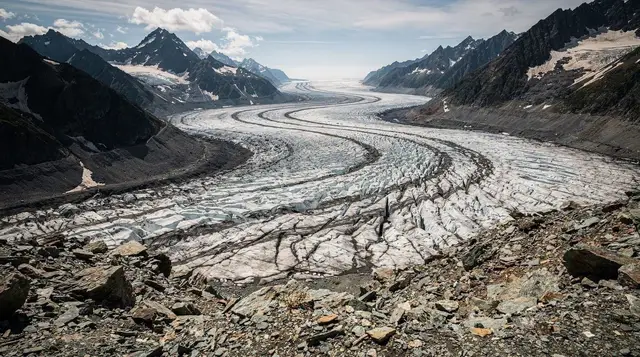
It’s a good option specifically because it doesn’t depend on clear weather at altitude: on a day when cloud sits over First and the Eiger’s summit disappears, the gorge stays sheltered and scenic regardless. A free shuttle bus usually runs from the village centre to the gorge entrance in high season; outside that window it’s roughly a 20–25 minute walk. The glacier that carved it has retreated well up the valley, so don’t expect to see ice at the gorge itself — this is about the rock, not the glacier that’s now out of sight.
Life in Grindelwald when the crowds thin out
Grindelwald in late spring (roughly late April into May) and again in November is a genuinely different place. Several lifts close for scheduled maintenance during these windows — Bort and First have historically shut for stretches in spring and autumn — and a number of restaurants take their own annual break at the same time, so check opening dates before building a trip around a specific lift. What you get in exchange is a working alpine village rather than a staged one: quieter streets, hotel rates well below summer or ski-season peaks, and locals rather than day-trippers filling the few cafés that stay open.
It’s not a shoulder season to build a first visit around if seeing the Jungfraujoch or riding First is the point of the trip — check when the mountain railways open and close before committing to dates. But if you already know Grindelwald, or you’re passing through the region on a wider Switzerland trip and just want the view and a walk, the quiet months are honestly the more pleasant time to be there. Winter itself (December to March) is its own busy season again, built around skiing at Grindelwald–Wengen and the toboggan runs off Bort and First.
Getting to Grindelwald from Interlaken
Trains run from Interlaken Ost roughly every half hour, taking about 35 minutes with one change at Zweilütschinen, and continuing on to serve both the village station and Grindelwald Grund. There is no meaningful reason to route via Interlaken West — the trains for Grindelwald depart from Ost, alongside the boats for Lake Brienz and the Brünig line towards Lucerne, so it’s worth confirming which of Interlaken’s two stations your onward ticket actually uses.
Drivers reach Grindelwald via Zweilütschinen and up the valley road; the Grindelwald Terminal car park is the main option for a day visit, and it fills up on clear midsummer days by mid-morning. If you’re combining Grindelwald with a wider loop rather than a single return trip, both a glass-roofed bus tour through Interlaken, Grindelwald and Lauterbrunnen and an Interlaken-based version of the same three-village circuit cover the valley without you needing to work out train connections yourself.
Where to stay, and what to pair it with
For a first visit, one night in the village itself — not Grund — gives you an evening and a morning with the Eiger lit up by low sun, plus enough time to ride First or Pfingstegg without rushing. Two nights suit anyone planning to hike, ski, or add the Eiger Trail or a loop towards Kleine Scheidegg and Männlichen.
For the First side of the village, an adventure package combining the Grindelwald gondola with the First cliff walk and its zipline bundles the lift with the extras rather than paying for each separately; travellers coming up from Interlaken for a single day can also book an attraction ticket to Grindelwald First that includes the return journey from Interlaken. Neither substitutes for checking current lift status if wind or maintenance closures are a risk on your dates.
If Grindelwald is one stop on a longer Bernese Oberland trip, the Jungfrau region highlights itinerary sequences it against Lauterbrunnen and the Jungfraujoch over three days, and the Grindelwald versus Lauterbrunnen comparison is worth reading before you decide which village gets the overnight and which gets a half-day visit.
For a fuller regional context beyond Grindelwald itself, the best mountain excursions from Interlaken and general day trips from Interlaken guides set it against First, Harder Kulm and Schynige Platte.
Grindelwald: frequently asked questions
Is Grindelwald village or Grindelwald Grund where I should book a hotel?
The village terrace, around the main station and Hauptstrasse, has the shops, restaurants and the best direct view of the Eiger. Grindelwald Grund, ten minutes down the valley by foot or one stop by train, is flatter, has the Grindelwald Terminal car park and tends to be a little cheaper, but it loses the north-face outlook and the evening stroll.
Do I need the Eiger Express to visit Grindelwald, or can I skip it?
You can skip it entirely and still have a full visit. The Eiger Express only matters if you’re continuing up to Eigergletscher and the Jungfraujoch, or want the fifteen-minute cable car ride for its own sake. Bort, Pfingstegg and the glacier gorge are reached by other lifts or on foot.
What is the difference between Grindelwald First and the Eiger Express?
They go in opposite directions from the same village. The Grindelwald–First gondola climbs east to First at 2,168 m, for the cliff walk and Bachalpsee. The Eiger Express climbs west from the separate Grindelwald Terminal towards Eigergletscher and the Jungfraujoch. They do not connect to each other.
Can I see the Eiger north face without paying for any lift?
Yes. The face is visible free from most of the village, from the church terrace, and from the meadows below Grindelwald Grund. Bort and Pfingstegg give a higher, closer angle for the price of a return gondola or cable car ticket.
Is Grindelwald open and worth visiting outside summer and ski season?
Late April to early June and November are the quiet shoulder periods: some lifts close for annual maintenance, snow lingers on higher trails, and several restaurants shut for a few weeks. The village itself stays open, hotel prices drop, and it’s a legitimate option if you don’t need the summit lifts running.
How long does the Grindelwald glacier gorge walk take?
The main walkway through the Gletscherschlucht takes 45–60 minutes at an easy pace, more if you stop often. It’s a there-and-back route rather than a loop, so add return time on the same path.
Is Grindelwald cheaper than Wengen or Mürren?
Marginally. Grindelwald has road access and more competition among hotels and restaurants, which keeps prices slightly below the car-free villages of Wengen and Mürren, though nothing in the Jungfrau region is genuinely inexpensive.